A team implements an AI agent expecting to save ten hours a week. Three months later, the agent is running — but nobody would say it saved time. There are outputs to review, corrections to make, and edge cases to handle that the original process never generated. The work didn't disappear. It changed shape. A poorly implemented AI agent doesn't fail by doing nothing. It fails by creating a new category of work.
The work didn't disappear. It changed shape.
What is the difference between a broken agent and a time-creating one?
A broken agent fails visibly: it produces no output, throws an error, or stops running. Teams fix it or shut it off.
A time-creating agent is harder to diagnose. The agent produces output consistently. The output is plausible. But reviewing, correcting, and forwarding that output takes longer than the original task did. The team keeps the agent running because it feels like progress — and because switching it off feels like admitting the project failed.
The agent isn't broken. The implementation is. The distinction matters because the fix is different.
What is the review overhead trap?
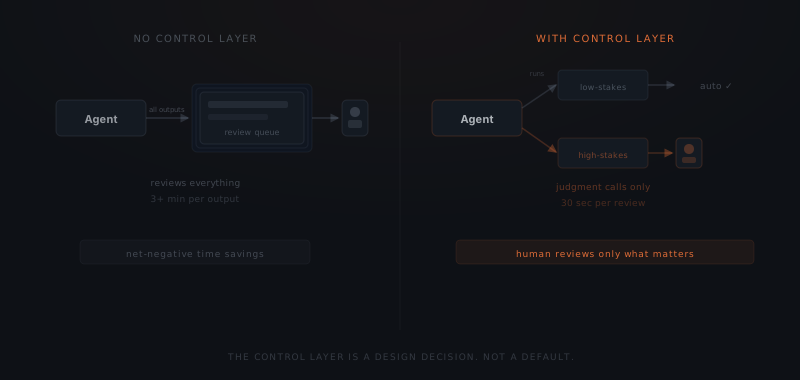
An agent without a designed control layer forces humans to review everything — because there is no systematic way to decide what needs review. That is not control. It is overhead with extra steps.
Every agent output either goes directly to the next step or waits for a human. The decision about which outputs require human review — and which the agent handles autonomously — is a design decision. It has to be made explicitly before the system is built.
Implementations that skip this decision produce a system where humans review everything. The alternative — letting an untested agent act without oversight — feels irresponsible. But reviewing everything is not a control layer. It takes more time than the original task, with the added friction of reading someone else's draft before acting on it.
A designed control layer specifies, for each output type, exactly what the agent can do without approval and what requires a human decision. A well-designed control layer means a human only sees the outputs that genuinely require judgment.
How does output quality function as a time variable?
If reviewing the output takes longer than doing the task, the implementation is net-negative.
Agent output quality has a direct relationship to time saved. An output a human approves in thirty seconds is a win. An output that needs editing before it can be used takes three minutes — which is often longer than writing from scratch.
Low-confidence outputs — those that are mostly right but require judgment to complete — are the most expensive kind. They take longer to evaluate than good outputs (because the human has to read carefully) and longer to fix than bad ones (because editing is slower than rewriting).
Time-saving implementations set explicit quality thresholds during scoping. Any output below the threshold gets flagged for human handling rather than forwarded as a draft. Outputs that clear the threshold get approved in seconds, not minutes.
What do time-creating implementations look like in practice?
The failure pattern is recognizable. It appears in three common forms, each driven by a missing design decision. McKinsey's 2024 State of AI survey found that the organizations least likely to generate value from AI deployments were the ones that launched without clearly defined approval workflows — the team reviewed everything because nobody had decided what could run automatically, making the agent a draft-generation step rather than a time-saving system.[¹]
The agency that reviews every output. The agent drafts client update emails. The account team reviews every draft before sending. In the first week, this feels reasonable — the agent is new, the team is learning its outputs. By week four, reviewing each draft takes three to four minutes: reading it, comparing it against the client file, deciding whether the context is right, editing where it is not. Writing the update from scratch took two minutes. The agent has doubled the time per update.
The consulting firm with the plausible-but-wrong exception. The agent categorizes inbound inquiries. Most are categorized correctly and routed automatically. But one category — inquiries from existing clients about scope changes — gets categorized as new business, because the brief did not account for it. Those inquiries receive a new business response instead of an account management response. Nobody notices for six weeks, because the agent's output looks correct on the surface. The cost is client relationships, not time.
The founder who added exception handling. The agent handles lead follow-up. After two months, the founder has added a growing list of contacts to a manual exception list — VIPs who should receive personal follow-ups, contacts from specific industries with different messaging, leads from specific campaigns that should not receive this sequence. Managing the exception list and updating it after each edge case takes forty-five minutes per week. The original follow-up process took thirty minutes.
In each case, the agent is running. In each case, the implementation is net-negative. The agent did not fail — the design decisions that should have been made before the build were never made.
What do the design decisions look like in practice?
Three decisions made before building separate time-saving implementations from time-creating ones.
Approval scope — Which outputs go directly to the next step, which wait for approval, and what the approval interface looks like. The AI does not make this decision. The implementation team makes it, documents it, and the system enforces it.
Quality threshold — What the minimum acceptable output looks like for this workflow. Outputs below the threshold are flagged, not queued for a human to edit. The human handles the exception, not the revision.
Exception routing — What happens when the agent encounters an input it was not designed for. A well-designed system routes exceptions to a defined inbox with context. An underdefined system drops them, or produces output that looks correct but is not.
None of these decisions are made by the AI. All of them determine whether the implementation saves time or creates it.
The table below shows the time impact of each decision when it is defined versus when it is left undefined.
| Design decision | When defined before the build | When left undefined |
|---|---|---|
| Approval scope | Human sees only outputs that require judgment; autonomous actions run without touch | Human reviews all outputs; each review takes 2–5 minutes regardless of quality |
| Quality threshold | Below-threshold outputs are flagged and handled as exceptions, not edited | Human edits low-confidence drafts; editing takes longer than writing from scratch |
| Exception routing | Unhandled inputs go to a defined exception inbox with context | Unhandled inputs either drop silently or produce plausible-but-wrong outputs |
How do you measure whether your implementation is net-positive?
A time-saving implementation should be measurable. The measurement is simple: compare the time the team spends on the workflow now against the time it spent before the agent was introduced.
Three metrics make that comparison meaningful. First, time per output: how long does it take from the agent producing an output to that output being sent or acted on? For a time-saving implementation, this should be under thirty seconds for outputs that clear the quality threshold. Second, correction rate: what percentage of outputs require editing before use? A rate above 20% usually indicates the quality threshold was not defined or is set too low. Third, exception handling time: how many minutes per week does the team spend managing inputs the agent could not handle? This should be stable or declining — an exception volume that grows week over week indicates the brief needs updating.
These three metrics can be calculated from a week of manual observation. If the implementation is net-positive, the numbers will confirm it without interpretation. If it is net-negative, the numbers will show where the time is being created — and which design decision was responsible.
Frequently asked questions
What makes an AI agent create more work instead of saving it? Three missing design decisions before the build: no defined approval scope (so humans review everything, which takes longer than the original task), no output quality threshold (so low-confidence outputs get forwarded as drafts instead of flagged), and no exception routing (so inputs the agent was not designed for produce plausible-but-wrong outputs).
How do you know if an AI agent implementation is net-negative? If reviewing and correcting the agent's output takes longer than doing the original task yourself, the implementation is net-negative. Low-confidence outputs — mostly right but requiring judgment to complete — are the most expensive: they take longer to evaluate than good outputs and longer to fix than bad ones.
What is a control layer in the context of AI agent outputs? A control layer defines, for each output type, what the agent handles autonomously and what requires a human decision. Without one, humans review everything — which is overhead with extra steps, not control. A well-designed control layer means a human only sees outputs that genuinely require judgment.
What three decisions separate time-saving from time-creating AI agent implementations? Approval scope (which outputs go directly to the next step versus wait for approval), output quality threshold (what the minimum acceptable output looks like for this workflow), and exception routing (what happens when the agent encounters an input it was not designed for). None of these are made by the AI — all determine whether the implementation saves time or creates it.
What should the correction rate be for a time-saving agent implementation? Under 20% — meaning at most one in five outputs requires meaningful editing before use. Above 20%, the editing time consistently exceeds the time saved by having the agent produce the draft. For implementations targeting time savings of five or more hours per week, the target correction rate is typically under 10%.
What is the fastest way to diagnose a time-creating implementation? Track three numbers for one week: time per output from agent draft to sent (anything above 90 seconds per output is a signal), correction rate on outputs that were sent (above 20% indicates a quality threshold problem), and exception handling time (minutes per week spent on inputs the agent flagged or could not process). These three numbers show where the time is being created and which of the three design decisions is responsible.
Can a time-creating implementation be fixed without rebuilding the agent? Usually yes. Most time-creating implementations are not built on a flawed agent — they are built on missing design decisions. Retrofitting those decisions is less work than the initial build: define which outputs go straight through versus require approval, set the quality threshold, and build the exception routing. The agent logic often does not need to change. The control layer and output routing do.
Notes
- McKinsey & Company. "The State of AI in 2024." McKinsey Global Survey, May 2024. https://www.mckinsey.com/capabilities/quantumblack/our-insights/the-state-of-ai