Implementing an AI agent system is not a technical setup step. It is a sequence of decisions — about which workflow to start with, how the agent connects to real systems, what controls govern its actions, and how it behaves under real conditions. Most of the time goes into scoping and control design, not the technical build.
Before talking to anyone who builds agent systems, it helps to know what implementation actually involves. Not the sales version — the real sequence of work that turns a capable AI into something running reliably inside your business.
Most of that work is not technical setup. It is a series of decisions about how the agent should behave, what it can do without you, and what happens when things do not go as expected. Understanding that sequence is the difference between a realistic expectation and a six-month delay.
What do most businesses expect?
Most businesses expect implementation to be mostly setup. You point the agent at a workflow, connect a few tools, configure some settings, and watch it run. The AI handles the rest.
That expectation is understandable — it is what most demos suggest. It is also why most AI agent projects stall. The team ships the prototype, discovers it does not work under real conditions, and spends months trying to close the gap with patches rather than proper implementation.
How is implementation time actually distributed?
The table below shows how time breaks down across a typical single-workflow implementation and where each phase is most commonly mishandled.
| Phase | Typical timeframe | Where the time goes | Common mistake |
|---|---|---|---|
| Scoping | 1–2 weeks | Workflow boundary decisions, exception mapping, control layer rules | Treating scoping as a short call rather than a structured decision process |
| Integration | 1–3 weeks | Tool connections, permission setup, field mapping, edge case discovery | Assuming connections that worked in a demo will work with live business data |
| Build + controls | 1–2 weeks | Agent logic, approval routing, exception handling paths | Rushing the control layer design to hit a launch date |
| Real-conditions testing | 1–2 weeks | Running against live data, catching gaps, iterating | Testing only against curated sample data and declaring it done |
| Maintenance (ongoing) | 2–4 hrs/month | Log review, prompt updates, integration health checks | Treating maintenance as "watch for errors" rather than active quality review |
The typical implementation timeline for a single-workflow agent is six to ten weeks from scoping through launch. Projects that run shorter than that have usually skipped something. Projects that stretch past ten weeks have usually been through a scoping process that was not structured, which caused rework in the build and testing phases.
What does scoping the workflow involve?
The first phase of implementation is scoping. It is also where most of the time goes — not because it is technically hard, but because it requires decisions that only the business can make.
Which workflow? That question sounds simple. It is not. A workflow like "handle client follow-up" contains dozens of sub-decisions: which clients, after how long, in what tone, under what circumstances, and what happens when the situation falls outside the expected pattern.
Before any technical work begins, those decisions need answers. The answers define what the agent is built to do — and, just as importantly, what it is not built to do. Getting scoping wrong means rebuilding later. Getting it right means the build phase is mostly execution.
How do you connect systems and define controls?
Connecting systems means giving the agent access to whatever the workflow touches — the inbox, the CRM, the project tracker — once the workflow is scoped.
Integration is not pointing at a tool. It involves configuring data access, defining what the agent can read and write, handling authentication, and mapping data between systems that do not share a format. Each connection introduces its own edge cases.
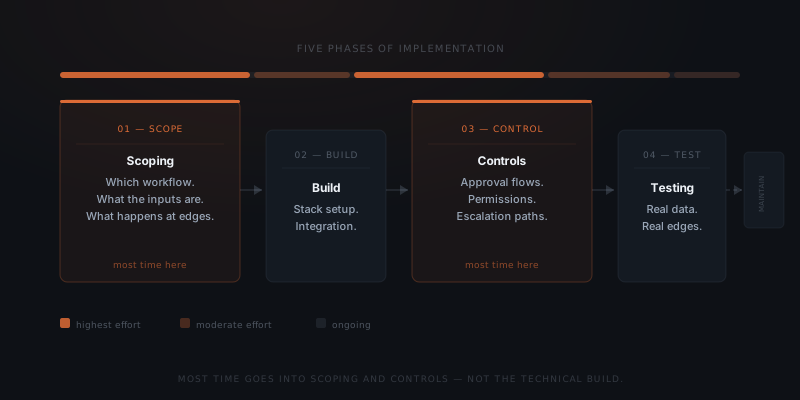
Alongside integration, the control layer gets designed. Which actions run automatically? Which queue for a human review? What happens at the edge cases — inputs that fall outside the expected pattern? These are not technical questions. They are operational decisions, and they require careful thought about where the business trusts the agent and where it does not.
The technical setup is the fast part. Deciding what the agent should do when things don't go as expected takes most of the time.
How do you test under real conditions?
Real-conditions testing differs from how most prototypes are evaluated. Most prototypes are tested against sample data — a curated set of inputs chosen to demonstrate the workflow. That testing passes because the inputs are designed to pass.
Real-conditions testing is different. The agent runs against actual data flowing through the business — real contacts, real records, real edge cases. Some inputs will not match what the scoping phase anticipated. Some will expose gaps in the control layer. Some will reveal integration issues that only appear with live data.
Implementation is complete when the agent runs reliably under real conditions — not when it passes a test. Those are different milestones, and in most implementations they are weeks apart.
This phase is where most of the iteration happens. It is also where the implementation earns its value — because a system that has been through real-conditions testing is one you can trust to handle what the business actually throws at it.
What separates a reliable implementation from a failed one?
Most failed implementations share a recognizable shape: they move from demo to build without a real scoping phase, skip the control layer design, test against sample data, and launch expecting the problems to surface later. They do surface later — usually within the first sixty days, in the form of outputs the team cannot trust and edge cases nobody planned for.
The difference between implementations that hold and ones that break is almost always in the scoping and control design phases. A team that spends a week defining exactly what the agent does in each situation — including the situations that are rare, inconvenient, or hard to predict — builds an agent that handles real conditions reliably. A team that treats scoping as a preliminary call and moves straight to build will discover the missed decisions during testing, or after launch, or when the first unusual input arrives.
Three questions identify whether a scoping process was serious: Can you describe exactly what happens when an input does not match the expected pattern? Can you name which actions require a human decision before the agent proceeds? Can you state what output the agent is supposed to produce in the ten most common scenarios it will face? If the answer to any of those questions is uncertain after the scoping phase, the build phase starts with unresolved decisions — which will be resolved under pressure, usually incorrectly.
For the three specific mistakes that produce this outcome most often, see what most businesses get wrong when implementing AI agents.
What does maintenance after launch involve?
Maintenance after launch means treating the agent as an ongoing responsibility, not a deployment you finish and move on from. The business changes. Workflows evolve. New edge cases appear. The agent's behaviour needs adjusting as the conditions it operates in shift.
Ongoing maintenance means monitoring what the agent does, catching the cases it handles poorly, and tuning its behaviour over time. It means introducing new workflows as the team grows more confident in the system. It means having someone responsible for keeping the system reliable — not just at launch, but six months and a year later.
The businesses that get the most from agent systems are the ones that treat launch as the beginning of operation, not the end of implementation. The maintenance work for a single-workflow agent is modest — two to four hours per month — but it requires a named owner and a defined review cadence. Undefined maintenance responsibility produces the same outcome as no maintenance: invisible drift until the problem is large enough to be unavoidable. For the specific mechanics of what monthly maintenance involves, see what AI agent maintenance actually involves.
Frequently asked questions
What does a real AI agent implementation involve?
A real implementation involves four phases: scoping (deciding what the agent is built to do and not do), integration (connecting the agent to live systems), control layer design (defining which actions run automatically and which require human approval), and real-conditions testing (running the agent against actual business data before launch). Ongoing maintenance is a fifth, indefinite phase.
Why does AI agent scoping take so long?
Scoping is where the business decisions live — which workflow, which clients, under what conditions, what the agent does when inputs fall outside the expected pattern. Those decisions cannot be made by a developer. They require the business owner's time and judgment, and they have to be made before any technical work begins.
What is the control layer in an AI agent?
The control layer is the set of rules that defines which actions the agent can take without human approval and which require a human decision first. It is designed before the build begins, not added afterward. Getting it right is what separates an agent system you can trust from one you supervise.
What is real-conditions testing for an AI agent?
Real-conditions testing runs the agent against actual business data — real contacts, real records, real edge cases — rather than a curated test set. It reveals inputs that the scoping phase did not anticipate, gaps in the control layer, and integration issues that only appear with live data. A system that has been through real-conditions testing behaves predictably in production.
How long does a single-workflow AI agent implementation take?
A single-workflow implementation typically runs six to ten weeks from scoping through launch: one to two weeks for scoping, one to three weeks for integration, one to two weeks for build and control layer design, and one to two weeks of real-conditions testing. Projects that compress below six weeks usually skip something that creates problems later. Projects that stretch past ten weeks usually had an unstructured scoping process that caused rework downstream.
What makes an AI agent implementation fail?
Most failed implementations share three characteristics: scoping was treated as a short kickoff call rather than a structured decision process; the control layer was not designed before the build started; and the agent was tested only against sample data before launch. The result is an agent that passes a demo, fails under real conditions, and requires months of remediation work — which costs more than doing the phases properly would have.
What should a business own in an implementation, and what should the implementation partner own?
The business owns the decisions: which workflow to start with, what the agent does in edge cases, which actions require human approval, and what success looks like in measurable terms. The implementation partner owns the execution: scoping the decisions into a brief, building and connecting the agent, designing the control layer, and running real-conditions testing. A partner who makes the business decisions on behalf of the client produces an agent built on assumptions — which is the primary reason agent systems do not work as expected in production.