Most AI agent implementation quotes cover only the build. Integration work typically adds 20–40% on top, and ongoing maintenance runs 15–30% of the build cost every year after launch. A $20,000 build costs $3,000–$6,000 annually just to keep running. The businesses that budget correctly know all three numbers before they sign.
Search "AI agent implementation cost" today and two of the pages that rank advertise "$2K–$65K" and "$8K–$400K" for what sounds like the same work — a roughly 50x spread, with neither page disclosing a method or sample.[2] That range is not a lie. It is an answer to an unstated question, because almost no published figure says what scope it prices.
Most quotes name the build. Few include integration work. Almost none include ongoing maintenance. Those three things are different costs with different timelines, and confusing them is how implementation projects end up over budget and under-supported.
Why do implementation quotes vary so widely?
The dollar ranges in this post are a modelled illustration — built from the hours a workflow of this kind typically needs, not from a survey of client invoices or a formal study. If you want the published labour-cost floor a European quote should sit above, see what an AI agent implementation costs in Europe, which works from Eurostat's hourly cost data by country instead of an assumed blended rate.
Three variables drive the range from $5,000 to $80,000-plus for what can sound like the same project.
Workflow complexity determines how much logic has to be designed before any code is written. A workflow with two or three consistent inputs and one output is straightforward. A workflow with conditional branching, multiple escalation paths, and edge cases that each need separate handling multiplies the design time before the build begins.
Number of integrations matters because each connected system — a CRM, an inbox, a project tracker, a billing tool — adds setup, permissioning, data mapping, and error handling. Connecting to one system is a task. Connecting to four is a project.
Whether ongoing support is included creates the largest gaps between quotes. A quote that covers only the build will look cheaper than a quote that includes maintenance and support. These quotes are not comparable. One ends at launch. The other covers what happens next.
What does the build cost actually cover?
The build is the part most quotes name explicitly. The build covers designing the workflow logic: what the agent does, in what order, under what conditions. The build includes writing and testing the prompts, configuring approval flows, and connecting the agent to a staging environment.
For a well-scoped single workflow, a build typically runs $5,000–$20,000 as a modelled illustration (see the disclosure above). For a multi-integration system with conditional logic and a control layer, $30,000–$80,000 is realistic on the same basis. The build is the only cost with a defined endpoint.
The build is a one-time cost. The running is not.
Which integration costs do most quotes skip?
Connecting an agent to live business systems is where many quotes fall short. API access, data mapping, error handling, and permission scoping each require time that headline build quotes often exclude.
Most business software was not built with agent access in mind. Giving an agent access to the right records — and only those records — requires permissioning work that vendors rarely document cleanly. When an API changes (and they change), someone needs to catch the break and fix it before the agent starts producing bad outputs.
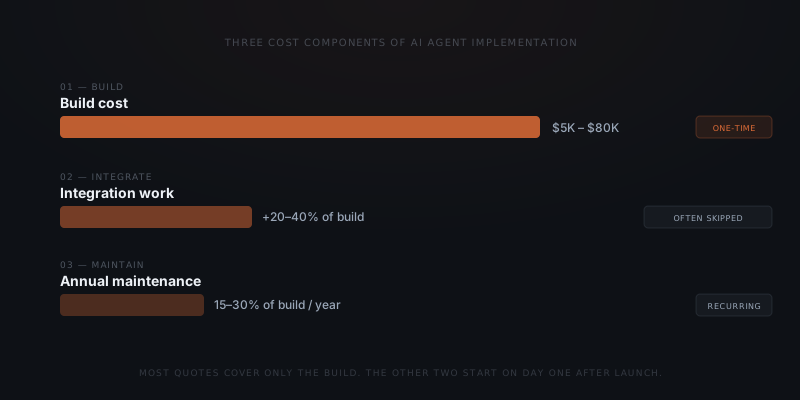
Budget an additional 20–40% above the build cost for integration work that many quotes leave unspecified — again a modelled range, not a measured average. That number is not padding — it is the work of connecting the agent to how the business actually runs.
What does maintaining a running agent actually cost?
Most implementation quotes cover the build. None of them cover what happens when a process changes, a connected tool updates its API, or the agent starts misfiring on edge cases. That cost starts on day one after launch.
After the build and integration, the agent needs ongoing attention. Prompts need updating when business language shifts or processes change. Integrations need maintenance when connected tools update their APIs. Edge cases accumulate — inputs the agent was not designed for that pile up unhandled until someone reviews the logs.
Plan for 15–30% of the initial build cost per year in ongoing maintenance — a modelled range, on the same basis as the build and integration figures above. A $20,000 build costs $3,000–$6,000 annually just to keep running correctly on that model. An agent left without maintenance does not hold its performance level — the agent degrades, slowly and invisibly, until someone notices a pattern of bad outputs that have been going out for weeks.
Year two typically costs more than year one, and the reason is worth budgeting for explicitly. Year-one maintenance is mostly prompt updates and integration fixes — the expected cost of keeping the agent aligned with a business that is still changing. Year one runs 15–25% of build cost. Year two adds a second cost on top: edge cases the agent was not built to handle in year one, which surface only after enough real-world volume has passed through it. That pushes year-two maintenance to 20–30% of build cost. An agent that looked fully paid for at the twelve-month mark typically needs a larger maintenance line in month thirteen, not a smaller one.
What does the full three-year cost look like?
The table below shows total cost of ownership over 36 months for three implementation scenarios that represent the range most small businesses fall into, on the same modelled basis as above. All figures are estimates — the actual costs depend on specific workflow complexity and the number of integrations.
| Scenario | Build cost | Integration (one-time) | Maintenance (year 1) | Maintenance (year 2) | Maintenance (year 3) | 36-month total |
|---|---|---|---|---|---|---|
| Single workflow, 1 integration, stable process | $8,000 | $2,000 | $1,500 | $2,000 | $2,000 | $15,500 |
| Single workflow, 2–3 integrations, moderate complexity | $18,000 | $5,000 | $4,000 | $5,000 | $5,000 | $37,000 |
| Two workflows, 4+ integrations, conditional logic | $40,000 | $12,000 | $9,000 | $10,000 | $10,000 | $81,000 |
Year three tends to hold near the year-two level rather than keep climbing. By then most of the edge cases in a stable workflow have already surfaced and been handled — the cost stops compounding once the backlog of unhandled inputs is cleared. A business whose processes keep changing will see maintenance stay closer to the year-two number; a business that leaves a workflow alone will often see it settle lower.
Every scenario that delivers time savings of four or more hours per week, valued at an assumed $50/hour, recovers its build-year cost within 24 months on this model. The first scenario recovers cost in seven months at that valuation. The economics are sound — as long as the full three-year cost was in the budget, not just the build.
The scenario that does not recover cost is the one where the build cost was budgeted but the integration and maintenance were not. A $40,000 build without $12,000 in integration work is an agent that does not connect to the business correctly. A $40,000 build without $9,000–$10,000 per year in maintenance is an agent that degrades quietly until it is switched off.
How do scope decisions change the total cost?
The most effective way to lower the three-year number in the table above is to narrow scope before the build starts — not to negotiate the build quote down. A narrow, well-documented workflow costs less to build, less to integrate, and less to maintain, because there is less logic to design, fewer connected systems to break, and a smaller domain of inputs for edge cases to hide in.
Scope is decided at the brief stage, not the build stage. A three-year total that is 40–60% lower comes from narrowing what the agent is asked to do — not from a builder cutting corners on the same scope.
A useful test at the scoping stage: can the workflow be described in one sentence that names a trigger, an input, and a specific output? "When a lead has not replied within five days and their status is Proposal Sent, draft a follow-up email referencing their specific proposal and surface it in Slack for review" is a narrow scope — one trigger, one input source, one defined output. "Handle prospect communication" is not. If describing the workflow takes several clauses and conditional branches, the scope needs narrowing before anyone prices the build.
This is why the single-workflow, one-integration row in the table above costs $15,500 over three years while the two-workflow, four-integration row costs $81,000. The gap is not markup — it is the compounding effect of more logic, more integration dependencies, and a larger surface for edge cases across build, integration, and all three years of maintenance. Narrowing scope at the brief is the highest-leverage cost decision in the entire engagement, because every other number in this post scales off it.
How do you evaluate an implementation quote?
Three questions expose whether a quote covers the real cost of implementation.
Does the quote include integration work — specifically, which systems will be connected, what access each requires, and who handles breaks after launch? Is there a maintenance plan, and what does the plan cover: prompt updates, integration maintenance, edge-case handling? What happens when something breaks after go-live — is there a defined support process with a response timeline?
A quote that cannot answer these questions is pricing the easy part of the project. The rest shows up later, unbundled, on a separate invoice — or does not show up at all, and the team discovers why after the first missed client email.
How should you budget before the first call?
Arriving at a scoping call without a budget range forces the implementation partner to guess what the business can afford — which produces a proposal designed around a number that was never stated. The correct order is to define the budget first, then scope the implementation to fit it.
For a single-workflow implementation at a small business, a realistic starting budget is $15,000–$25,000 total for year one: build, integration, and first-year maintenance. That budget delivers a reliable agent on a workflow with up to two integrations. It does not deliver a platform of five interconnected workflows with a custom approval dashboard.
A business with a tighter budget can start smaller: a well-scoped single workflow with one integration, built to run with monthly maintenance included, is achievable for $8,000–$12,000 year one. The expansion to additional workflows follows after the first one runs reliably.
The worst budget position is knowing the build cost but not the integration or maintenance cost. That position produces an agent that reaches launch underfunded, receives no maintenance after launch, and stalls within ninety days — which the business then attributes to the technology rather than the budget.
Frequently asked questions
How much does AI agent implementation cost for a small business?
As a modelled illustration, not a survey figure: for a single well-scoped workflow, expect $5,000–$20,000 to build it. Integration adds 20–40% on top. Then plan 15–30% of the build cost per year for maintenance — on a $20,000 build, that runs $3,000–$6,000 a year, ongoing. Know all three figures before you sign anything.
Why do AI agent implementation quotes vary so widely?
Three factors drive the range: workflow complexity (how much logic design precedes the build), number of integrations (each connected system adds setup, data mapping, and error handling), and whether ongoing support is included. A quote covering only the build is not comparable to one that includes maintenance.
What does AI agent maintenance cost?
Plan for 15–30% of the initial build cost per year. That covers prompt updates as business processes change, integration maintenance when connected tools update their APIs, and edge-case handling as new input patterns emerge. An agent left without maintenance degrades slowly and invisibly until someone notices a pattern of bad outputs.
What questions should I ask before signing an AI agent implementation quote?
Three questions: Does the quote include integration work — which systems, what access, who handles breaks after launch? Is there a maintenance plan covering prompt updates, integration maintenance, and edge-case handling? What is the defined support process when something breaks after go-live?
What is a reasonable year-one budget for a small business AI agent implementation?
A realistic year-one budget for a single-workflow implementation with one to two integrations is $15,000–$25,000, covering build, integration, and first-year maintenance. For tighter budgets, a well-scoped single workflow with one integration and monthly maintenance included is achievable for $8,000–$12,000. The important thing is that all three cost components — build, integration, maintenance — are in the budget before the engagement starts.
Why do agents fail within ninety days if the cost wasn't a problem at launch?
The ninety-day cliff is usually a maintenance funding problem, not a technical problem. An agent launched with a build budget but no maintenance budget has no funded path for prompt updates when the business changes, no funded response when a connected tool updates its API, and no funded review when edge cases accumulate. The agent degrades without anyone whose job is to prevent the degradation. The fix is to include maintenance costs in the original budget — not as an optional add-on, but as a non-negotiable line item.
Can you get a cheaper implementation by doing the maintenance yourself?
Yes, but the economics are only favorable if someone on your team has the time and skill to run the monthly review, update prompts when business language shifts, and diagnose integration failures when they occur. Two to three hours per month of undefined responsibility produces the same outcome as zero hours of defined responsibility: invisible drift. If maintenance is included in the engagement cost rather than carried internally, the agent's performance is the implementation partner's problem to sustain — which is the correct alignment of incentives.
How can I reduce the total cost of an AI agent implementation?
Narrow the scope at the brief stage, before anyone prices the build. A well-documented, single-process workflow with one integration costs less to build, integrate, and maintain than a broad scope covering multiple sub-processes and systems. A narrow scope's three-year total is typically 40–60% lower than a broad scope handling the same underlying domain, because the reduction compounds across build, integration, and all three years of maintenance.
Notes
- Anthropic, Building effective agents, 2024. anthropic.com/research/building-effective-agents. Cited for the workflow-complexity and design-effort factors described under "Why implementation quotes vary so widely" — it does not report cost or pricing data, and no figure in this post is drawn from it.
- The "$2K–$65K" and "$8K–$400K" figures are taken from titles in the live search result set for AI agent implementation cost, retrieved 2026-08-27 — the same retrieval documented in what an AI agent implementation costs in Europe. They are cited as evidence that the published record disagrees by roughly 50x, not as cost estimates. Neither discloses a method or sample.
- Eurostat, Hourly labour cost levels, dataset
lc_lci_lev, information and communication sector (NACE Rev. 2 section J), 2025. EU-27 average €48.20/hour, ranging €24.00–€71.70 by country. The full country table and method are in what an AI agent implementation costs in Europe. It is the closest published floor to what a European implementation's labour actually costs; it is not a substitute for the modelled dollar ranges in this post, which describe US-style small-business budgeting rather than the European labour-cost base.
Cost ranges in this post are a modelled illustration, not a report from a formal study or dataset, and not a first-party Yardwork pricing survey. They're built from an assumed hours-per-category structure typical of the workflow complexity, integration count, and maintenance requirements described above, and are meant to help set a realistic budget range going into a scoping conversation — not to predict the exact price of any specific implementation. A reader who wants a published, country-specific labour-cost floor rather than a modelled range should start from the Eurostat data in note 3.