Building AI agents in-house costs more than most estimates show — not because the build is expensive, but because of what comes after. Hiring takes three to six months before any code is written. Ongoing maintenance falls to internal staff indefinitely. When the engineer who built the agent leaves, the knowledge of how it works goes with them.
The job posting went up last week. Requirement: someone who can build AI agents for internal workflows. Expected timeline: three months to a working system. That expectation is wrong by a factor of four for almost every small business that tries it — and the ongoing cost after launch rarely appears in the budget at all.
In-house AI agent development is not a build project with a finish line. In-house development is a staffing commitment with obligations that do not end at launch.
What does building in-house actually require?
Building an AI agent in-house means hiring someone who can design workflow logic, connect the agent to live business systems, write and tune prompts, configure an approval layer, and maintain all of it as the business evolves. That is not a generic developer role.
Most candidates for "AI developer" roles have either model experience — training, fine-tuning — or automation experience with no-code tools. The person who can design a complete agent system with real system integrations, a control layer, and the judgment to decide when to escalate and when to act is a rarer hire, and a more expensive one. Most small businesses do not find that person on the first attempt.
How much time does it take before anything is built?
The first cost of building in-house is not money. The first cost is time. Finding the right candidate typically takes three to six months: job posting, screening, interviews, offer, notice period, onboarding. After joining, the new hire needs time to understand the business systems, the workflows, and the logic behind existing processes before any agent can be scoped or built.
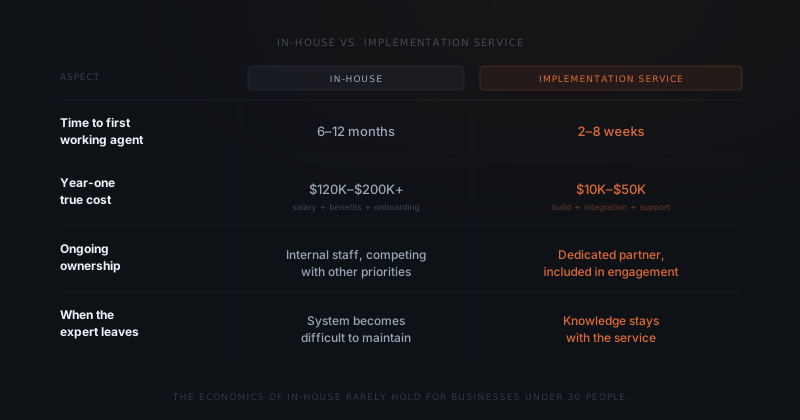
An implementation service can deliver a working agent system in two to eight weeks from the first scoping call. In-house, the equivalent timeline is six to twelve months — and that assumes the hire works out on the first attempt.
In-house isn't a build decision. It's a staffing commitment.
What is the ongoing cost nobody budgets for?
A working agent requires ongoing engineering attention. Prompts need updating as the business evolves. Integrations need maintenance when connected tools update their APIs. Edge cases that were not in the original design accumulate and need to be handled. Logs need reviewing to catch misfires before clients notice them.
Most in-house estimates cover the build. None cover this. The engineer who built the agent becomes the person responsible for running it, fixing it, and updating it — indefinitely — while also contributing to other technical work the business needs done.
What happens when the person who built it leaves?
The engineer who built the agent is the only person who understands why it works the way it does. When that engineer leaves — and engineers leave — the system becomes difficult to maintain. The team that inherits the agent can keep it running as long as nothing changes. When something changes, the team is working from incomplete knowledge.
This is the risk that in-house estimates rarely name. Agent logic is documented in code, but the reasoning behind each decision — why this prompt phrasing, why this escalation path, why this permission scope — lives in the builder's head. When the builder leaves, each subsequent fix is slower and riskier than it would have been for the original engineer.
The system does not break immediately. The system becomes progressively harder to adapt. A new integration takes twice as long. A prompt update requires reverse-engineering choices nobody documented. The agent that was meant to reduce workload becomes a liability nobody wants to touch.
What does the 24-month cost model look like?
The comparison between in-house and implementation service looks different depending on which costs are included. The table below models both paths for a small business adding a single-workflow AI agent system.
| Cost component | In-house | Implementation service |
|---|---|---|
| Time to first working agent | 6–12 months | 2–8 weeks |
| Year-one total cost | $134,000–$193,250 salary,[1] plus benefits, onboarding, and hiring overhead | $15,000–$30,000 — a modelled illustration, not a survey figure[2] |
| Year-two total cost | $134,000–$193,250 (ongoing salary)[1] | $3,000–$9,000 (maintenance only, same modelled basis) |
| Maintenance risk | Tied to one person's continued employment | Distributed across implementation team |
| Knowledge transfer risk | High — leaves with the engineer | Low — documented and maintainable by the service |
| Time to second workflow | Depends on engineer's availability | 2–4 weeks after first is stable |
The in-house year-one cost is built on a $134,000–$193,250 annual salary for a specialized AI/ML engineer — Robert Half's 2026 salary guide and Indeed's aggregate of over 5,000 recent US salary data points, the same figure documented in what it costs to hire an AI developer.[1] Add benefits, onboarding, and the overhead of the six-month search process before any build work begins, and the gap against a single-workflow implementation service only widens. For a business adding one AI workflow to save founder time, these economics rarely close.
The calculation changes if the business is building AI capability as a product — if the agents being built are what the company sells, not just how it operates. In that case, in-house is the right call: the business needs proprietary expertise that accumulates over time, not a workflow that runs reliably without management.
When does in-house actually make sense?
In-house wins under specific conditions. If AI is core to the product — if the agents being built are part of what the business sells, not just how the business operates — then internal ownership is the right call. The business needs engineers who accumulate deep, proprietary knowledge of the system over time.
In-house also makes sense when a dedicated technical team already exists with relevant experience and enough focused work to justify full-time attention on agent systems. Building in-house alongside other responsibilities is not building in-house — it is building slowly, intermittently, and at high risk of losing priority to something more urgent.
Most small businesses do not meet either condition. Their agents are operational tools, not products. Their technical staff have other responsibilities. For those businesses, the economics of in-house consistently favour an implementation service — not on the build cost, but on everything that comes after it.
Frequently asked questions
What does building AI agents in-house actually require?
In-house development requires hiring someone who can design workflow logic, connect agents to live systems, write and tune prompts, configure an approval layer, and maintain the system as the business evolves. That is not a generic developer role — it is a specialized hire that takes three to six months to find.
How long does in-house AI agent development take?
Finding the right hire typically takes three to six months. After joining, the new engineer needs time to understand the business systems and workflows before any agent can be scoped or built. Most small businesses see six to twelve months from decision to working system — compared to two to eight weeks with an implementation service.
What are the ongoing costs of running an in-house AI agent?
The engineer who built the agent becomes responsible for maintaining it indefinitely: prompt updates as the business evolves, integration maintenance when connected tools update their APIs, edge-case handling as new input patterns emerge, and log reviews to catch misfires before clients notice them. Most in-house estimates cover the build only.
When does building AI agents in-house make sense?
In-house makes sense when AI is core to what the business sells — not just how it operates — and when a dedicated technical team already exists with relevant experience and enough focused work to justify full-time attention on agent systems. For most small businesses, the economics consistently favour an implementation service.
What happens if the engineer who built the agent goes on leave or leaves the company?
The team that inherits the agent can maintain it as long as nothing changes. When something changes — a connected tool updates its API, a process evolves, a new edge case appears — the team is working from incomplete documentation. The reasoning behind each implementation decision was in the original engineer's head, not in the code or any handover document. This is the structural risk of in-house builds that most estimates do not price. An implementation service addresses this by maintaining the agent as part of the engagement — the knowledge is in the service, not a single person.
Is it possible to start in-house and transition to an implementation service later?
Yes, though the transition has friction. An agent built in-house typically has undocumented design decisions, integration configurations that exist only in one engineer's memory, and a brief that was never formalized as a written document. Transitioning to a service means the service has to audit the existing system before maintaining it — which is discovery work that adds cost. Starting with a service and building on top of documented, maintained foundations is almost always less expensive than transitioning an in-house build that has grown organically.
What is the best way to evaluate whether in-house or a service is right for your business?
Ask one question: is building AI agents the core capability you are trying to develop, or is using AI agents to run your business more efficiently the goal? If the former, in-house makes sense — you need proprietary expertise that builds over time. If the latter, a service is the right model — you need reliable agents running without management, not an internal engineering capacity for AI development. Most small businesses are in the latter category.
Notes
- Robert Half, "AI/ML Engineer Salary (Updated for 2026)." roberthalf.com/us/en/job-details/aiml-engineer; Indeed, "Machine learning engineer salary in United States, 2026." indeed.com/career/machine-learning-engineer/salaries — same figure documented in what it costs to hire an AI developer.
- The implementation-service figures in this post are a modelled illustration, not a survey of client invoices — see the disclosure in what an AI agent implementation actually costs for a small business, which sets out the same year-one range in more detail.