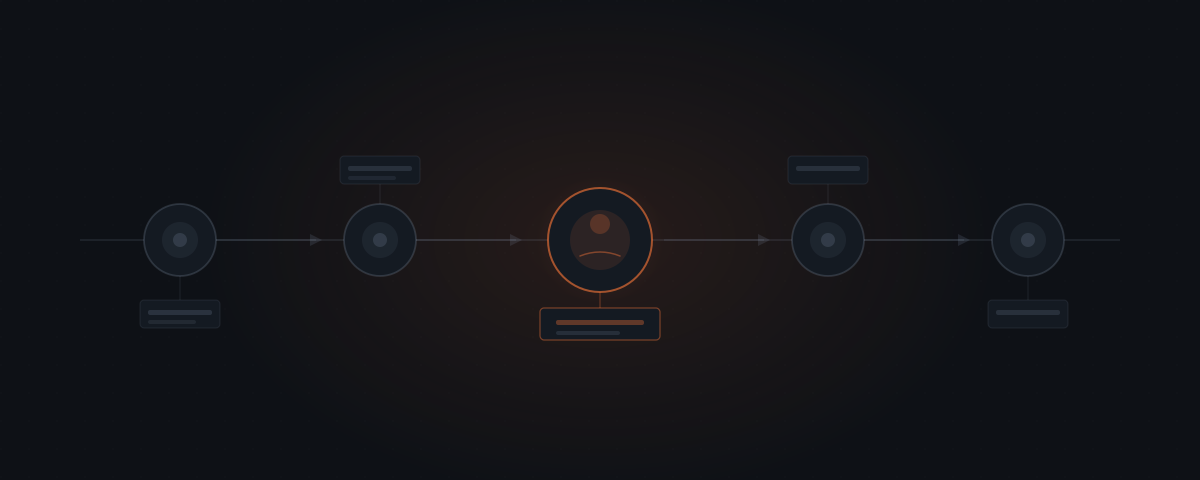
Human-in-the-loop is not a safety feature you turn on after an agent is built. It is a structural decision about which actions require a human decision before the agent proceeds. Most implementations that use the term place the human at the wrong checkpoint — after irreversible actions instead of before them. That placement gap is the difference between control and accountability after the fact.
The vendor confirmed it was human-in-the-loop. The demo showed a review queue, approvals at every decision point, a human in the flow. Six months after launch, an agent sent a client a message with incorrect pricing. The log showed it had sent four hours before anyone noticed.
The system had a human in the loop. The human was in the wrong place.
Human-in-the-loop does not mean a human is available to intervene when something goes wrong. Human-in-the-loop means the agent cannot take a defined action until a human has made a decision. Pre-action and post-action review are different mechanisms — and only one gives you control.
What does human-in-the-loop actually mean?
Human-in-the-loop is an architectural decision, not a vendor feature.
The decision is: at which specific points in a workflow does the agent stop and wait for a human before proceeding? Every other design choice follows from that answer — which actions run automatically, which require review, what the agent does if no response arrives.
A system where the human appears after an action has already executed is not human-in-the-loop. That design is post-action review. Pre-action checkpoints and post-action review protect against different things. Pre-action checkpoints prevent irreversible mistakes. Post-action review documents them.
What are the three places a human can sit in a workflow?
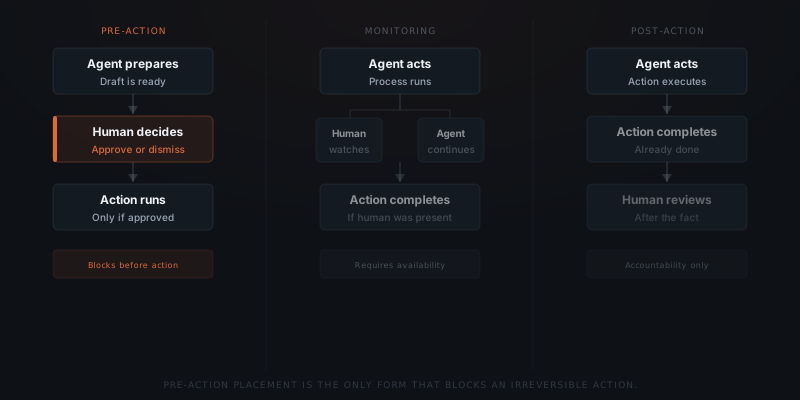
A human can sit at three points in any automated workflow: before an action runs, alongside the process as a monitor, or after the output is produced.
Pre-action placement is the only form that blocks the agent. The agent reaches a defined checkpoint, prepares the output — a draft, an update, a scheduled send — and stops. Nothing executes until a human decides. Pre-action placement is the only form that gives you control over actions that cannot be undone.
Monitoring places a human in parallel with the running process. The agent acts; the human watches. Monitoring can catch errors in progress, but monitoring depends on the human being present and attentive at the moment an error occurs. Monitoring cannot guarantee intervention before an irreversible action completes.
Post-action review is the most common form and the least protective. The agent acts. A log or notification informs a human afterward. By the time review happens, the message has sent, the record has changed, the deal has moved. Post-action review creates accountability. Post-action review does not create control.
The three forms compared:
| Review type | When the human acts | What it prevents | What it misses | Response window |
|---|---|---|---|---|
| Pre-action | Before the agent executes | Irreversible mistakes — agent waits for the decision | Nothing irreversible runs without approval | Defined per action type — minutes to hours |
| Monitoring | During execution | Errors caught while still in progress | Any error that completes before the human notices | Requires continuous attention — not reliable for unattended workflows |
| Post-action | After the agent has already acted | Nothing — action has already executed | All irreversible actions | N/A — review happens after the fact |
| Hybrid | Mixed — pre-action on high-stakes, post-action on low-stakes | Irreversible errors on actions classified as high-stakes | Errors in low-stakes actions not routed to pre-action review | Defined for the pre-action layer only |
Most implementations labelled human-in-the-loop are using post-action review. That labelling is not wrong — post-action review is a form of human oversight. The issue is scope: if the workflow contains irreversible actions, post-action review does not protect against the failure mode that matters most.
Why do most HITL setups add work instead of control?
The most common failure is not missing checkpoints — it is checkpoints placed after irreversible actions. An approval gate on a sent email does not prevent a wrong email from sending. An approval gate placed after sending creates a record of what went wrong.
The second failure is scope creep in the review queue. A business starts with approval gates on consequential actions: outbound client messages, deal status changes, financial updates. After a few weeks, someone adds approvals to internal tags and automated routing decisions. The queue fills with low-stakes reviews. The reviewer stops checking promptly. Consequential approvals start waiting hours instead of minutes.
Every item in the review queue has a cost: someone must read it, decide, and respond. A queue filled with low-stakes reviews trains the reviewer to move fast and skim. A queue in that state is where a genuinely important decision gets approved without being read.
The third failure is no defined consequence for non-response. The agent prepares a draft and requests approval. Nobody responds within the review window. A poorly designed system either executes the action on timeout or leaves it queued indefinitely — both worse than a clear default. A well-designed system expires the action, logs it as unactioned, and moves on.
What does a well-designed HITL workflow look like?
Where you place the human determines whether the loop protects you.
A well-designed human-in-the-loop system makes three things explicit before the agent runs.
First, every action the agent can take is classified as automatic or reviewed. Automatic actions are reversible, internal, and low-stakes — logging, tagging, scheduling drafts, routing within a system. Reviewed actions are external, high-visibility, or irreversible. The classification is written down, not implied.
Second, every review request carries enough context to decide in under thirty seconds. The notification includes the draft output, the trigger that caused it, and two options: approve or dismiss. No navigation required, no research required. A review request that takes more than thirty seconds to decide was not designed for a real queue.
Third, every outcome is logged regardless of the decision. Approved, dismissed, expired — all three produce a record. The system does not rely on human memory for accountability.
What does escalation actually look like in four common scenarios?
Abstract descriptions of human-in-the-loop design are easier to assess with concrete examples. The four scenarios below show what a well-structured escalation looks like: what triggers it, what the reviewer receives, what the response window is, and what happens if nobody responds.
Outbound client message. The agent drafts a follow-up based on a pipeline trigger — deal inactive for seven days. The reviewer receives: the draft text, the trigger label, the client name, and two buttons: Approve and Dismiss. Response window: 2 hours. If no response within the window: the draft expires, the event is logged as unactioned, no message is sent. The agent re-evaluates the trigger on the next scheduled run.
Deal status change. The agent detects conditions matching the "ready to close" criteria defined in the brief. The reviewer receives: a deal summary, the proposed status change, and Approve / Dismiss options. Response window: 4 hours. If no response: the status remains unchanged, the event is logged, and the trigger re-fires on the next day's run.
Document delivery. A client requests a certificate of insurance or a proposal copy. The agent matches the request to a template and routes it for delivery. The reviewer receives: the document type, the client name, and Approve / Review first options. Response window: one business day. If no response: the request is logged as pending and the agent sends a holding message acknowledging receipt.
Unrecognised input. An inbound message does not match any defined template. The agent cannot classify it. The reviewer receives: the full message text, a "No matching template" label, and two options: Handle manually or Add to templates. Response window: same business day. If no response: the message is logged as unhandled and no automated response is sent.
Each of these examples shares the same design logic: the reviewer gets enough context to decide in under thirty seconds, the window is defined, and non-response has a clear default that is not "execute anyway."
What operational cost do businesses not plan for?
An agent system moves at the speed of the slowest checkpoint in its approval chain.
Most businesses calculate how much time an agent saves per workflow. Most businesses do not calculate how much time the review queue requires per day. For a well-scoped human-in-the-loop workflow, that review time is small — focused minutes, not hours. But someone must be available for those minutes, reliably, on every day the system runs.
For time-sensitive workflows — lead follow-up, client communication, support escalation — the approval checkpoint has a response window. A draft that waits four hours for review does not deliver the response time the automation was built for. The person responsible for the queue must be reachable within the window the workflow actually requires.
Build the human side of the system with the same care as the agent side.
How do you configure a human-in-the-loop system before the agent runs?
The configuration decisions below must be made before go-live. Setting them up after a failure is possible but introduces a period of uncontrolled operation that cannot be undone.
Classify every agent action as automatic or reviewed
Write down every action the agent can take — send a message, update a field, create a record, route a request — and classify each as automatic or reviewed. Automatic: reversible, internal, low-stakes. Reviewed: external, high-visibility, or irreversible. If you cannot classify an action clearly, treat it as reviewed until its risk is understood.
Place every reviewed action at a pre-action checkpoint
For each reviewed action, define where in the workflow the agent stops and waits. The checkpoint must sit before the action executes — not after. This is the only placement that prevents irreversible outputs.
Design the review request to decide in under 30 seconds
Each review request should contain three things: the draft output or proposed action, the trigger context that caused it, and two decision options (approve / dismiss). Nothing else. A review request requiring research or navigation was not designed for a real queue.
Set a response window and define the non-response default
Every action type needs a defined window — 2 hours for time-sensitive, 4 hours for standard, one business day for low-urgency. When no response arrives within the window, the default must be: the action expires, the event is logged, no action is taken. Never configure auto-execute on timeout.
Assign a named reviewer with a backup
Name one person responsible for each review queue. Name one backup. Document when the backup is reachable. A queue with no named owner is a queue that fills silently.
Review queue size monthly
Once a month, review what is in the queue. If low-stakes reviews have accumulated, remove them. A queue that contains everything eventually means nothing gets read.
Frequently asked questions
What does human-in-the-loop mean in an AI agent system?
Human-in-the-loop means the agent cannot take a defined action until a human has made a decision. It is not a safety feature you turn on after the build — it is a structural decision about which checkpoints exist and where they sit in the workflow. Pre-action placement is the only form that gives you control over actions that cannot be undone.
What is the difference between pre-action review and post-action review?
Pre-action review blocks the agent at a checkpoint before it executes an action. Post-action review informs a human after the action has already run. Pre-action review prevents irreversible mistakes. Post-action review creates a record of them. Most implementations described as human-in-the-loop use post-action review and call it something else.
Why do HITL setups add work instead of reducing it?
Two common failures: checkpoints placed after irreversible actions (so they document mistakes rather than prevent them), and scope creep in the review queue (low-stakes items fill the queue, reviewers start skimming, and consequential decisions get approved without being read). A well-designed review queue contains only actions where the cost of getting it wrong justifies the review step.
What should be automatic versus reviewed in an AI agent?
Automatic actions are reversible, internal, and low-stakes: logging, tagging, scheduling drafts, routing within a system. Reviewed actions are external, high-visibility, or irreversible: outbound client messages, payment record updates, deal status changes. The classification should be written down explicitly — not implied by the build.