Agent mistakes are not a sign of bad implementation — they are an expected outcome at any meaningful scale. A prototype fails rarely because inputs are controlled. A production system fails because production environments contain conditions no design review fully anticipated. The quality of an implementation is not measured by whether it fails. It is measured by whether the system catches failures, contains them, and makes them fixable.
The agent sent an introduction email to a lead who had already replied three weeks earlier. The lead wrote back asking why they were receiving an introduction again. Nobody on the team had seen the original reply. The agent did not know it existed.
That error is not a dramatic failure. Normal ones look exactly like it — quiet, plausible, and unnoticed until a human stumbles across the consequence.
Every agent system running in production will produce mistakes. Not because the AI is unreliable, but because real traffic surfaces situations nobody planned for at design time. The question is not whether your agent makes mistakes. The question is whether your system is built to catch them.
Why mistakes are not a sign of bad implementation
A prototype proves the agent is capable of a task. A production system proves the implementation is sound. Part of what makes an implementation sound is how it handles failures — not just how it avoids them.
Agent mistakes occur at a predictable rate. Narrow decision spaces and well-scoped workflows keep that rate low. Strong logging and approval design keep each mistake isolated. But the expectation that a running system will eventually produce an error is not pessimism — it is the correct baseline.
Businesses that expect perfection from their agent systems do not build adequate response infrastructure. When the first error occurs, it registers as a system failure rather than an expected event. The reactive decisions that follow — excessive approval gates, unnecessary scope reductions, or switching the agent off entirely — are often worse than the original mistake.
Businesses with a realistic baseline build the response infrastructure before the first error occurs. When a mistake happens, they contain it, diagnose it, and use it to make the system more reliable.
The three failure modes and how each spreads
Agent mistakes follow three patterns. Each spreads differently and requires a different response. Anthropic's 2024 "Building Effective Agents" guide notes that well-designed agent systems build in explicit error detection and containment — logging each action, confirming success before proceeding to the next step, and halting on unexpected outputs — specifically because production error rates in live systems consistently exceed what testing environments produce.[¹]
Silent errors are the most dangerous. The agent completes an action incorrectly — sends the wrong draft, updates the wrong record, closes the wrong ticket — and no alert fires. The mistake enters the system undetected and produces downstream effects before anyone notices. By the time a silent error surfaces, secondary problems often already exist.
Cascading errors start with one wrong decision and compound. An agent misclassifies an inbound request. The misclassified request triggers a follow-up workflow. The follow-up workflow sends a message based on the wrong classification. Each step moves further from the original mistake and makes the root cause harder to trace. Cascading errors are most common in systems where multiple workflows share inputs without clear handoff logic.
Irreversible errors are single-action mistakes with consequences that cannot be undone unilaterally. A client email sent with wrong pricing. A record deleted without a backup. A contract sent before it was ready. The action is complete and external parties are already affected.
The three failure types compared:
| Failure type | How it spreads | Detection difficulty | Primary first response |
|---|---|---|---|
| Silent error | Enters the system undetected; downstream effects accumulate before anyone notices | High — no alert fires; discovered when someone encounters the consequence | Stop the workflow; audit all actions in the same time window |
| Cascading error | One wrong decision triggers subsequent workflows; compounds with each step | Medium — visible when downstream output looks wrong; root cause requires backward tracing | Stop all connected workflows; trace backward from the wrong output to find the original misclassification |
| Irreversible error | Single action with external consequences; affected party already knows or will notice | Low — visible immediately when external boundary is crossed | Assess what correction is available; notify affected party if they are likely to encounter the error before you reach them |
A well-implemented agent system does not just avoid mistakes — it makes mistakes visible. Logs, approval trails, and automatic halts on unexpected inputs are not optional features. They are the mechanism that keeps an isolated error from becoming a cascading one.
Wrong answers and wrong actions are different failures
The failure modes above are all actions the agent took — a draft sent, a record updated, a ticket closed. A wrong answer is a different class of problem, and conflating the two leads to the wrong control.
A wrong answer is a content error. The agent produces something inaccurate, incomplete, or fabricated, and it sits there waiting to be read. Nothing has happened in the outside world yet. The cost is bounded by whether a person catches it before acting on it.
A wrong action has already executed. The email left. The field changed. No review catches it after the fact, because there is nothing left to review — only consequences to unwind.
The controls differ accordingly:
| Wrong answer | Wrong action | |
|---|---|---|
| When it becomes costly | When someone acts on it | Immediately |
| Primary control | Review before the output is used | Scope limits and approval gates before execution |
| Detection | A human reading the output | Logs, alerts, and reconciliation |
| Recovery | Correct and re-issue | Often partial; sometimes impossible |
In practice this means an agent that only drafts needs a review habit, while an agent that sends, updates, or closes needs approval gates and a deliberate decision about when it may act on its own. Most agents do both, which is why the two controls are designed together rather than chosen between.
First response: contain before you diagnose
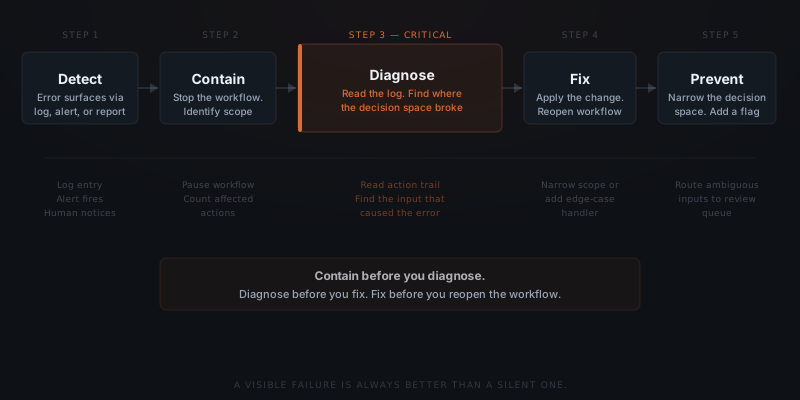
When an error surfaces, the first priority is containment — not diagnosis, not communication. The seven steps below apply in sequence. Moving to a later step before completing an earlier one extends the scope of the problem.
Stop the workflow immediately
Suspend the specific workflow that produced the error before anything else runs. If the agent is running parallel instances of the same workflow, pause all of them. A single missed pause can extend the error's scope while the cause is still unknown.
Identify the scope
How many actions were affected? Did the error produce one wrong output, or did it trigger downstream workflows? Is the problem confined to internal state, or did it cross an external boundary — a client, a partner, a third-party system? This assessment drives every decision that follows.
Preserve the evidence before touching anything
Do not edit the input, output, or action log before completing the diagnosis. Modified logs make root cause analysis significantly harder. If the affected record needs to be corrected, make a copy of its current state first.
Diagnose the root cause
Pull the action log for the relevant time window. Identify the specific input that triggered the error and trace what the agent did with it. The root cause is almost always in one of four places: an input outside the workflow's defined scope, a stale or missing data source, a brief that did not cover this case, or an integration that returned unexpected data.
Decide on external notification
If the error crossed an external boundary and the affected party is likely to notice before you reach them, notify proactively. Premature internal notifications create unnecessary alarm without reducing the problem. If the error is fully internal, contain before communicating.
Apply the fix before reopening
Narrow the decision space, add a classification step, or update the workflow brief. Do not reopen the workflow until the fix is applied and documented.
Verify with the scenario that caused the error
Run the input that produced the error through the updated workflow in a test environment. Confirm the fix produces the correct output before the workflow handles live inputs again.
The mistake isn't the problem. Not knowing about it is.
What a well-implemented system makes visible
A well-implemented agent system makes four things visible at every point in its operation.
Action logs. Every action the agent attempted, the input that triggered it, the output produced, and the outcome — executed, queued, dismissed, expired. The log is the source of truth for what happened and when. An agent system without complete action logs cannot be diagnosed.
Approval history. Every item that entered the review queue, what the reviewer decided, whether the original draft was edited before approval, and how long the review took. Approval history shows patterns: action types where the agent is consistently overridden are candidates for redesign before they produce an error.
Error flags. When the agent encounters an input it cannot handle with confidence, a well-implemented system flags the input and routes it to human review rather than producing a low-confidence output. These flags are diagnostic data — a cluster of flags on similar inputs points to a gap in the workflow design.
Integration state. The status of every connected system — which connections are active, which are producing errors, and when data was last successfully read or written. Integration failures are a common source of silent errors: the agent proceeds with stale or missing data and produces an output that looks correct but is based on wrong inputs.
If the current system does not surface these four things clearly, that is the implementation gap to close before the next error.
| Visibility requirement | What it records | Why it matters for diagnosis |
|---|---|---|
| Action logs | Every action the agent attempted, the input that triggered it, the output produced, and the outcome (executed / queued / dismissed / expired) | The source of truth for what happened and when — without it, failure tracing is guesswork |
| Approval history | Every item that entered the review queue, the reviewer's decision, whether the draft was edited, and how long review took | Reveals patterns of human override — consistent overrides on the same action type indicate a workflow design problem waiting to become an error |
| Error flags | Inputs the agent encountered that it could not handle with confidence, and how each was routed | A cluster of flags on similar inputs points directly to a gap in the workflow's input specification |
| Integration state | Which connected systems are active, which are producing connection errors, and when data was last successfully synced | Integration failures are a leading cause of silent errors — the agent proceeds with stale or missing data and produces an output that looks correct but is built on wrong inputs |
A system that logs all four has complete diagnostic coverage when an error occurs. A system that is missing any one of them requires reconstruction — using memory, calendar history, or context from other systems — to diagnose the failure. Reconstruction is slower, less accurate, and more likely to miss the root cause.
Preventing recurrence: narrow the decision space
Most agent mistakes happen at the edges of the agent's decision space — inputs that fall outside the scenarios the workflow was designed for.
The fix is almost never "improve the AI." The fix is narrowing the decision space so the edge case no longer falls within the agent's scope, or adding an explicit handler that routes the edge case to human review instead of autonomous action.
After diagnosing the error, identify where in the decision space it fell. Was the input ambiguous? Did the input match a pattern the workflow was not designed for? Was the input valid but the agent's interpretation wrong?
For ambiguous or out-of-scope inputs: add a classification step that routes unusual inputs to a review queue before the main workflow processes them. The agent should not attempt to handle inputs it was not designed for. The agent should flag them.
For wrong interpretations of valid inputs: this is a scope or design problem. Narrow the workflow's input definition until the misinterpreted case falls outside it, then handle it as a separate workflow with its own design.
The goal is not a system that never makes mistakes. The goal is a system where each mistake teaches you something narrow enough to fix — and where the fix makes the system more reliable for every workflow that follows.
The safeguards below address each failure type before it occurs. Most require one-time configuration at implementation; all require a named owner who reviews them on a defined schedule.
| Safeguard | Failure type it prevents | What to implement |
|---|---|---|
| Complete action logs | Silent errors — enables detection of actions that ran without generating an alert | Log every action: trigger, input, output, outcome, timestamp. No exceptions. |
| Pre-action approval gates on external outputs | Irreversible errors — blocks wrong outputs before they reach external parties | Pre-action review on every outbound message, payment update, and client-facing record change |
| Automatic halt on low-confidence or unrecognised inputs | Silent errors and cascading errors — routes unusual inputs to human review | Flag inputs outside the defined pattern; route to review queue instead of processing autonomously |
| Integration state monitoring | Silent errors from stale data — catches connection failures before the agent acts on wrong inputs | Daily check on all connected systems; alert when last-sync gap exceeds a defined threshold |
| Workflow scope boundaries between connected agents | Cascading errors — prevents an error in one workflow from flowing into another | Each workflow processes its own scope; shared inputs pass through a routing layer before branching |
| Scheduled brief review | Moving-scope errors — keeps workflow definitions current with operational reality | Monthly review of each agent's brief; update when any step, field, or case type has changed |
Frequently asked questions
What should you do first when an AI agent makes a mistake? Stop the workflow before diagnosing. Suspending the workflow prevents a single error from triggering additional downstream actions while the scope is unknown. If the agent is running other parallel instances of the same workflow, pause those too until the cause is understood.
What are the three types of AI agent errors? Silent errors, where the agent acts incorrectly and no alert fires; cascading errors, where one wrong decision triggers downstream workflows that compound the problem; and irreversible errors, where the mistake crosses an external boundary — an email sent, a record deleted — before it is caught.
How do you prevent an AI agent from repeating the same mistake? Narrow the decision space. Most errors occur at the edges of what the workflow was designed for. Either add a classification step that routes unusual inputs to human review, or narrow the workflow's input definition until the edge case falls outside the agent's scope.
What should a well-implemented agent system make visible at all times? Four things: action logs (every action, input, and output), approval history (patterns of human overrides), error flags (inputs the agent could not handle with confidence), and integration state (which connected systems are active and which are producing errors).
Notes
- Anthropic. "Building Effective Agents." Anthropic Research, December 2024. https://www.anthropic.com/research/building-effective-agents