
Most businesses decide what to automate by asking whether they trust the agent. That is the wrong question. The right question is: if the agent gets this wrong, can we recover from it? Recoverability, blast radius, and decision space narrowness are the three variables that determine whether an action is safe to run without a human checkpoint. Accuracy is a capability measure. Recoverability is a control measure.
The lead qualification agent has been running for two months. The right contacts get flagged. The right deals get prioritized. A colleague asks whether to remove the approval step for outbound introduction emails — the agent is getting it right, so why keep the gate?
Because accurate is not the same as safe to automate.
Accuracy measures how often the agent is right. Recoverability measures what happens when it is wrong. Those are different questions, and only the second one tells you what should run without a human decision.
Why accuracy is the wrong measure for autonomous action
A 95% accuracy rate means one in twenty actions is wrong. For an agent handling twenty interactions per day, that is one mistake every day. The question is not whether the mistake happens — at any meaningful scale, it will. The question is what that mistake costs in the specific workflow where it occurs.
An agent that mislabels an internal CRM tag costs thirty seconds to fix. An agent that sends an introduction to the wrong contact costs a relationship and a credibility hit that takes weeks to repair. The agent may have been wrong at the same rate in both cases. The damage is not comparable.
Accuracy is the right question when evaluating whether an agent is capable of a task. Recoverability is the right question when deciding how much autonomy to give it. Anthropic's 2024 "Building Effective Agents" guide frames the same distinction in terms of reversibility: "Give the model enough tokens to think, but keep it on a tight leash for any action that can't be undone. The asymmetry of costs — reversible actions are cheap to correct, irreversible ones are expensive — should directly govern how much autonomy you extend."[¹]
The two questions also have different trajectories. Accuracy improves as the brief is refined and edge cases are documented — it is a technical and operational problem with a clear resolution path. Recoverability is a property of the action type itself, not the agent's configuration. An email cannot be unsent regardless of how well-trained the agent is. Recoverability sets a floor on autonomy that accuracy cannot override, no matter how high it gets.
The three conditions that make autonomous action safe
Accuracy is not the right measure for autonomous action. Even a 95%-accurate agent makes one mistake for every twenty actions it takes. The question is what that mistake costs in the specific context where it happens — not whether the mistake ever occurs.
Three conditions must all be true for full autonomy to be appropriate for a given action type.
The action is reversible. A tag can be removed. A draft can be deleted. A calendar entry can be moved. An email cannot be unsent. A deleted record cannot be trivially restored. If correcting an error requires another person's involvement — a client, a partner, a colleague in a different system — the action is not reversible in any operationally useful sense.
The blast radius of an error is bounded. An error that affects only internal state — a row in a tracker, a tag on a contact, a note in a CRM — stays within the system. An error that reaches an external party does not. Any action that crosses the boundary between your system and someone else's carries blast radius that makes a human checkpoint meaningful.
The decision space is narrow enough that edge cases are rare and identifiable. An agent given a narrow, well-defined task — categorize incoming support tickets by type — encounters a finite number of edge cases. An agent asked to "handle client follow-up" encounters an unbounded input space. Narrow decision spaces keep edge cases predictable. Wide ones produce surprises.
The third condition is the one most often violated by expanding an agent's scope before narrowing its decision space. An agent that starts with a well-scoped task — draft follow-up emails for leads with status Proposal Sent — has a narrow decision space. The same agent, instructed over time to "handle all lead follow-up across stages," has had its decision space widened without its instructions being updated to match. The gate that was appropriate at the original scope may not be sufficient for the expanded one.
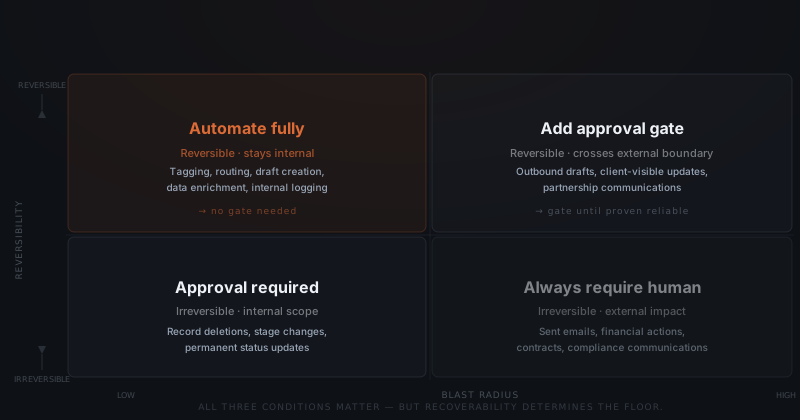
The table below applies the three conditions to common agent action types and maps each to the recommended approach.
| Action type | Reversible? | Blast radius | Decision space | Recommended approach |
|---|---|---|---|---|
| Tag or classify a contact | Yes | Internal only | Narrow | Fully automatic |
| Create a draft reply | Yes | Internal (draft stage) | Variable | Automatic draft; gate the send |
| Log a call or meeting note | Yes | Internal only | Narrow | Fully automatic |
| Send an outbound message | No | External — client or partner | Variable | Always gate |
| Update a deal stage | Partial | Internal/external signals | Narrow | Gate for high-visibility accounts |
| Update invoice or payment record | No | External — financial impact | Narrow | Always gate |
| Assign item to internal queue | Yes | Internal only | Narrow | Automatic with exception escalation |
| Contract or compliance communication | No | External + legal | Any | Always gate — never automate |
The "recommended approach" column is not a fixed rule — it is the default starting position. An action type that is usually gated might move to automatic after consistent approval history. An action type that looks automatic might warrant a gate if the specific business context makes errors unusually costly.
Actions that should almost always require approval
Some action types carry enough weight that autonomous execution is not appropriate regardless of accuracy.
Outbound communication. Any message sent to a client, prospect, or partner in your name represents your judgment. An agent that drafts and sends that message without review is making judgment calls about tone, timing, and relationship context it cannot fully assess. The draft is useful — the agent assembles the right information and formats it correctly. The send requires a human, because the send is a commitment the agent is not positioned to make on your behalf.
Financial actions. Payments, invoices, refunds, and adjustments to financial records affect parties outside your control. Getting one wrong is not a private failure.
High-visibility CRM updates. Deal stage changes, close dates, and account health flags are inputs to decisions made by other people. A deal marked closed incorrectly affects pipeline forecasting, commission calculations, and team expectations. The downstream consequences of an error extend far past the record itself.
Anything with legal or contractual implications. Contract sends, compliance communications, and terms updates are not candidates for autonomous execution at any accuracy level. These are not engineering problems with a calibration solution — they are governance problems with a human-decision requirement, and that requirement does not change as the agent improves.
Actions that are safe to automate fully
The right question isn't accuracy — it's whether the mistake is reversible.
Some action types are reversible, bounded, and routine enough that an approval gate defeats the purpose of automation.
Internal classification and tagging. Labeling support tickets, categorizing leads, tagging contacts by type — these are reversible with a single edit and affect only internal state.
Draft creation. An agent that prepares a reply, populates a template, or formats a document for human review is not acting autonomously — the draft is an input to a decision, not a decision. Automating draft creation while keeping the send or publish step behind a gate is a sound design.
Data formatting and enrichment. Normalizing field formats, pulling company data from a lookup, filling empty CRM fields from known sources — these are low-stakes and easily corrected.
Internal routing and assignment. Assigning a ticket to the right queue, routing an inbound inquiry to the right person, marking an item as reviewed — errors stay inside the system and are easily fixed.
The common thread in safe-to-automate actions is that their failure mode is visible and bounded. When the agent mislabels a tag, the label is visible in the system. When a draft is created incorrectly, the human reviewing it catches the error before it moves. Full autonomy is appropriate when the failure is catchable before it becomes consequential — not because failure is unlikely, but because when it happens, it stays contained.
How to move an action from approved to autonomous
Starting with an approval gate on a new action type is the right default. The gate is not a sign of distrust — it is how you collect the evidence needed to make the autonomy decision safely.
Watch the approval history for the action type. Track how often the reviewer approves without editing, approves with small changes, makes significant edits, or dismisses entirely. After a meaningful sample — fifty decisions is a reasonable minimum, more for high-stakes action types — review the pattern.
Fifty decisions is typically two to four weeks of operation for an agent running daily at moderate volume. For high-frequency agents — handling hundreds of actions per week — fifty decisions arrive faster, and the sample can be evaluated sooner. For low-frequency agents — running weekly on a small contact set — fifty decisions may take three months, and the gate should remain in place throughout that period regardless of apparent performance.
If approvals are consistent, edits are minor, and dismissals are rare: the action is a candidate for autonomy. Remove the gate, monitor the first few weeks closely, and reintroduce it if new conditions produce unexpected outputs.
If the history shows regular significant edits or a pattern of dismissals: the agent's judgment on that action type is not reliable enough for autonomous execution. Narrow the scope before removing the gate.
The approval history pattern is the most reliable evidence for the autonomy decision because it reflects actual behavior on real inputs — not the agent's performance on test data or its accuracy in general.
| Approval pattern | What it signals | Decision |
|---|---|---|
| 90%+ approved without edits, 4+ weeks stable | Agent judgment matches expectations on this type | Remove gate; monitor first 2 weeks closely |
| 70–90% approved, minor edits only | Agent is close but not fully calibrated | Tighten instructions; do not remove gate yet |
| Regular significant edits before approving | Agent judgment unreliable on this type | Keep gate; narrow scope or revise instructions |
| 30%+ of items dismissed | Agent frequently wrong on this type | Keep gate; do not remove until pattern reverses over 4+ weeks |
| Pattern inconsistent week to week | Decision space may have widened or inputs have changed | Keep gate; investigate what changed |
One important note on the 90% threshold: consistency matters as much as rate. A week at 95% followed by a week at 60% is not evidence of reliable judgment — it is evidence of volatility. The threshold should be met for at least four consecutive weeks before removing any gate.
This decision sits inside the broader governance structure — see what approval workflows do in an AI agent system for how gates are designed in the first place, and AI agent governance for the policy layer that sets the rules gates like this one operate under.
How to communicate autonomy changes to your team
When an action type moves from gated to automatic, the team members who have been reviewing it need to know. Without a deliberate handoff, two things happen: some team members continue checking for items in the queue that are no longer there, wasting time; and others assume the agent is still producing items for review, missing the shift to full autonomy.
A simple communication covers the essentials: the gate for [action type] has been removed as of [date]; the agent now executes this automatically; if you notice unexpected behavior in [system], flag it to [owner] rather than waiting for the queue. One message, sent before the change goes live, prevents both of the common post-change failure modes.
The reverse — moving an action from automatic back to gated — is more disruptive and more important. If the agent's behavior on a previously automatic action deteriorates, reintroducing the gate before informing the team produces confusion. Communicate the reintroduction and the reason at the same time, so the team understands that the item appearing in the queue is expected, not a system error.
Frequently asked questions
When is it safe to let an AI agent act without human approval? When three conditions are all true: the action is reversible without another person's involvement, any error's impact stays within internal systems rather than reaching external parties, and the decision space is narrow enough that edge cases are rare and identifiable. All three must hold — not just one or two.
Why is accuracy the wrong measure for deciding on autonomous AI agent actions? A 95%-accurate agent makes one mistake per twenty actions. At meaningful volume, the mistake is certain — the question is what it costs. An error that updates an internal tag costs seconds to fix. An error that sends a message to the wrong client costs a relationship. Accuracy predicts frequency, not cost.
Which AI agent actions should always require human approval? Outbound communication to clients, prospects, or partners; financial actions including payments, invoices, or refunds; high-visibility CRM updates that affect forecasting or commission calculations; and anything with legal or contractual implications at any accuracy level.
How do you build evidence for removing an approval gate? Track the approval history for the action type across at least fifty decisions. Note how often the reviewer approves without editing, approves with small changes, makes significant edits, or dismisses. If approvals are consistent and dismissals rare, the action is a candidate for autonomy. If edits are regularly significant, the agent's judgment on that type is not ready.
Notes
- Anthropic. "Building Effective Agents." Anthropic Research, December 2024. https://www.anthropic.com/research/building-effective-agents