
Most AI agent prototypes never reach production because implementation is treated as a deployment step, not a project. Connecting an agent to live systems, designing the approval layer, and making it reliable under real conditions is a distinct discipline. Businesses that treat it that way get systems running. Businesses that don't get stuck with demos.
The prototype looked good. The agent drafted the right replies, logged the right updates, and ran through the demo without an error. Everyone agreed it was ready. That was three months ago. The system is still not in production.
This is not a rare story. It is the most common story in AI agent deployment. The prototype worked. The production system does not exist. The gap between those two states is not a capability problem — it is an implementation problem. Gartner noted in 2024 that 30% of generative AI projects would be abandoned after proof of concept through 2025 — not because the AI couldn't perform the task, but because the implementation work required to move from demo to production proved more substantial than teams anticipated.[¹]
Why does the demo always work?
Prototypes succeed because they are designed to succeed. Test data is clean. Inputs are controlled. Scenarios are chosen to show the agent performing well.
When something breaks in a demo, you fix the prompt and run it again. Nobody waits on the output. No real customer data is involved. No downstream system depends on what the agent decides.
The demo proves the AI is capable of the task. It does not show the system is ready to run inside your business.
Why is production a different project?
In production, the agent connects to live systems. It reads from a real inbox, writes to a real CRM, and acts on real customer records. It encounters data that was never in the demo — missing fields, duplicate entries, edge cases nobody anticipated.
When the agent acts in production, the action has consequences. A reply goes to a real client. A record gets updated. A task closes. None of that reverses the way a failed test prompt does.
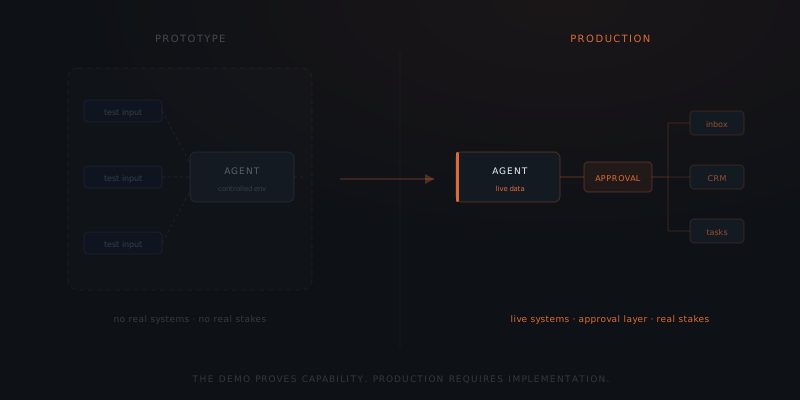
The gap between a prototype and a production system is not closed by better AI. It is closed by implementation work: connecting the agent to real systems, defining what the agent can and cannot do without asking, and making the system reliable under conditions a demo never tests.
Where do implementations stall?
Three things reliably stop AI agent implementations from reaching production.
Integration. An agent disconnected from your actual tools cannot do real work. Building those connections takes time — API access, data mapping, permissions, and handling the edge cases each system introduces. Most prototypes skip this entirely. Production systems cannot.
The control layer. A demo agent acts without restriction. A production agent needs defined boundaries: which actions run automatically, which require a human decision first. Designing that boundary and enforcing it in the system is not a setting you toggle. It is a deliberate design decision.
Real-conditions testing. A prototype passes against known inputs. A production system has to survive your actual data — duplicates, missing fields, requests outside the expected pattern. That testing requires real data and time to run through genuine edge cases.
The demo is always impressive. The system that runs in production is a different project entirely.
Most implementations stall because nobody planned for these three phases. The team assumed the hard part was the AI capability. The hard part is what comes after.
What does implementation actually require?
A real implementation is a sequence of decisions, not a deployment event.
It starts with scoping: which workflow, what are the inputs and outputs, what happens when an input is incomplete or ambiguous. From there, integration: connecting the agent to the systems it needs, configuring access, ensuring the agent has the right information at the right time.
Then the control layer: approval flows, permission boundaries, escalation paths for cases the agent should not handle alone. Then testing under real conditions — not sample data, but the actual inputs the workflow will encounter. Finally, ongoing maintenance: adjusting agent behaviour as the business changes and handling new edge cases as they surface.
The failure point is not the AI. It is the gap between a capable agent running in isolation and a connected agent running inside a real business — and that gap is filled by implementation work, not better prompts.
None of this is AI capability work. All of it determines whether the agent works inside your business.
What does the prototype skip, and what does production require?
The prototype skips messy real-world data, live system connections, a control layer, error handling, and ongoing maintenance — production requires all five, and the table below breaks each one down. Demos are designed to look complete: the agent handles the right inputs, produces the right outputs, and appears to integrate with the right tools. What the demo cannot show is what production actually requires.
| Element | What the prototype assumes | What production requires |
|---|---|---|
| Data | Clean, curated test records | Messy real data — duplicates, missing fields, unusual formats, edge cases nobody anticipated |
| System connections | Mocked or absent — agent operates in isolation | Live API connections with authentication, permissions, stable field mapping, and error handling |
| Control layer | None — agent acts freely on test inputs | Defined approval gates; explicit permission scopes; documented escalation paths |
| Error handling | Demo is rerun when the agent fails | Automated escalation; error logging; handoff routes for inputs the agent cannot handle |
| Testing | Controlled inputs chosen to demonstrate the happy path | Real inputs including ones no one anticipated — full edge case coverage under live conditions |
| Maintenance | Not needed — prototype is a fixed artifact | Active monthly review cadence with a named owner and defined success criteria |
Working through this table systematically before the build begins is the fastest way to surface implementation requirements that the prototype obscured.
Why do teams consistently underestimate the gap?
The gap looks small from the outside because the demo is designed to look complete. The agent handled the demo well. The team is confident. The tooling exists. The next step is assumed to be deployment.
What the demo could not show: the API connections that worked in the demo sandbox behave differently with live data volumes. The record the agent writes in testing has three fields — the production record has fourteen, with field validation rules the demo never encountered. The edge case that appears 15% of the time in the real workflow was never in the demo because the demo inputs were chosen to avoid it.
None of these surprises are unusual. They are the normal condition of real systems. But because the demo never shows them, teams routinely discover them during deployment — which is the worst time to find an integration gap or a missing control layer decision.
The difference between a team that discovers these problems during the build phase and one that discovers them after launch is whether the implementation was treated as a project with defined phases, or as a deployment step that happens after the demo succeeds. Both teams encounter the same problems. One encounters them when they are cheap to fix. The other encounters them when they have already affected real customers.
What pattern succeeds?
Implementations that reach production share a few characteristics. They start with a narrow, well-defined workflow — one where inputs are consistent, outputs are verifiable, and the stakes of a mistake are manageable. They treat integration and the control layer as core deliverables, not afterthoughts. They plan for ongoing maintenance from the start, not as something to figure out later.
The businesses that get agents running in production are not the ones with the most impressive prototypes. They are the ones that treated implementation as its own discipline — and gave it the time that discipline requires.
A useful framing: the prototype proves the AI is capable. The implementation proves the system is ready. Conflating those two milestones is the single most common reason prototypes never reach production.
For what that implementation discipline actually involves in practice, see what a real AI agent implementation involves. For the specific mistakes that recreate the demo-to-production gap even after teams know it exists, see what most businesses get wrong when implementing AI agents.
Frequently asked questions
Why don't AI agent prototypes reach production?
Prototypes prove capability — that the agent can do the task under ideal conditions. Production requires three additional phases that prototypes skip: integration with live systems, a control layer defining which actions require human approval, and real-conditions testing against actual business data. Most teams treat these as a deployment step rather than a separate project.
What is the difference between an AI agent prototype and a production agent?
A prototype runs on controlled test data in isolation, with no consequences for errors. A production agent connects to live systems, reads from real inboxes, writes to real records, and has irreversible effects on real customers. Every failure has a cost. That difference determines why the implementation work after the demo is a distinct project.
What does the control layer of an AI agent do?
The control layer defines which actions the agent takes autonomously and which require a human decision before executing. It is not a setting — it is a deliberate design decision about what the agent is permitted to do without asking. Without it, a production agent acts without restriction, which is appropriate in a demo and inappropriate with real customer data.
How long does it take to go from prototype to production?
It depends on the workflow and the number of systems the agent connects to. The realistic framing is not a timeline but a sequence: scoping, integration, control layer design, real-conditions testing, and ongoing maintenance planning — each treated as a distinct deliverable. Teams that compress these into a single deployment event consistently stall.
What is the most common mistake teams make after a successful prototype?
Treating deployment as the next step. A successful prototype proves capability under controlled conditions. After that, the next step is implementation planning — defining the scope precisely, identifying the integration requirements, designing the control layer, and scheduling real-conditions testing. Teams that skip directly to deployment discover the integration and control requirements during deployment, when they are significantly harder to address.
Can you run a prototype in parallel with a live workflow?
Yes, and this is often the most useful testing approach. Running the agent against real data in shadow mode — where it processes live inputs but does not send outputs — reveals the edge cases, integration gaps, and control layer decisions that demo testing never surfaces. Shadow mode testing should be treated as a required phase between prototype and full production deployment, not as an optional validation step.
What happens to an AI agent that makes it to production without a control layer?
The agent acts autonomously in cases it was not designed to handle. The most common outcomes are messages sent with incorrect tone or content, records updated based on incorrect inferences, and actions taken that the business would not have approved if asked. These events typically erode team confidence in the system faster than a technical failure would — because the team trusted the agent and the agent acted in ways that violated that trust. Rebuilding confidence after a pattern of unauthorized autonomous actions is harder than designing the control layer before launch.
Notes
- Gartner. "Gartner Predicts 30% of Generative AI Projects Will Be Abandoned After Proof of Concept Through 2025." Gartner Press Release, July 2024. https://www.gartner.com/en/newsroom/press-releases/2024-07-29-gartner-predicts-30-percent-of-generative-ai-projects-will-be-abandoned-after-proof-of-concept-through-2025