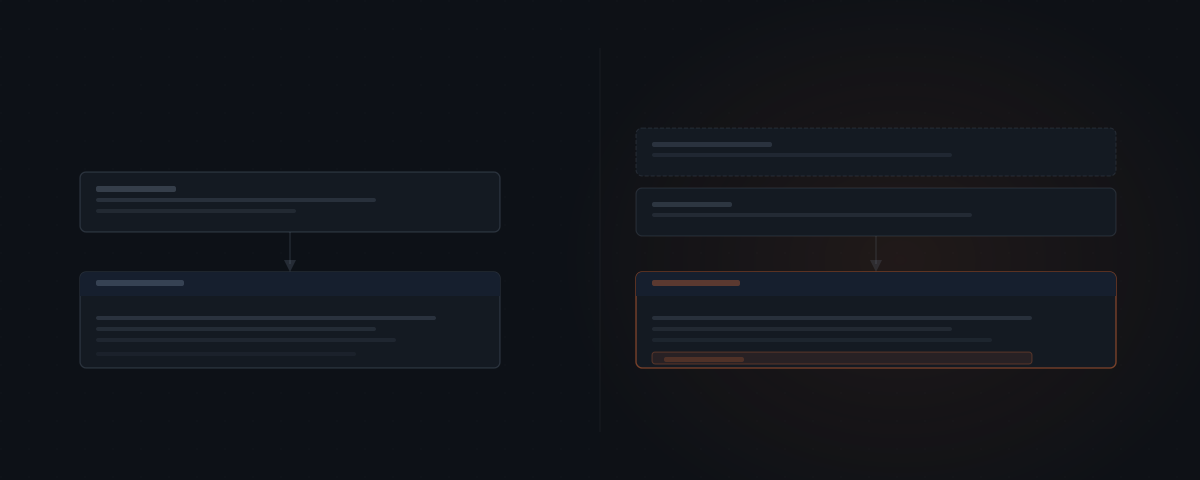
The demo worked perfectly. The agent handled every example correctly, the outputs looked right, and the team left confident. Six months later, the live system requires constant supervision and produces outputs the team doesn't trust. Nothing broke — but nothing works the way the demo suggested it would. The gap between a successful demo and a reliable live system is not a surprise. It is structural.
Why the demo environment is fundamentally different from production
A demo runs on inputs the presenter chose. Those inputs were chosen because the agent handles them well — they represent the workflow at its cleanest, not at its most common.
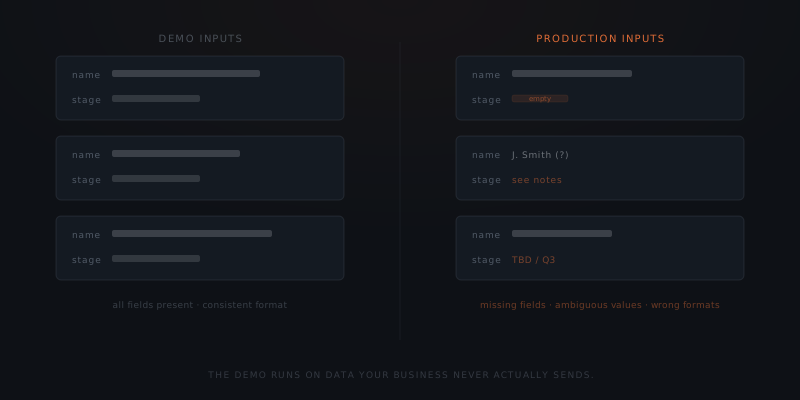
Real production systems process whatever arrives. That includes inputs with missing fields, inconsistent formatting, ambiguous context, and edge cases that nobody thought to include in the demo. The agent was never tested on these inputs. In the demo, they didn't exist.
This is not deception. The presenter may not even be aware of how unrepresentative the inputs are. The demo reveals what the agent can do under ideal conditions. It does not reveal how the agent behaves when conditions are not ideal.
How the demo environment differs from production
The gap between a demo and a live system is not a matter of degree. It is a structural difference between two operating environments. Understanding the dimensions of the gap makes it easier to evaluate what a demo is actually showing — and what it is not.
| Dimension | How it appears in a demo | How it appears in production |
|---|---|---|
| Input data | Clean, complete records specifically chosen to match the workflow description | Whatever arrives — missing fields, inconsistent formatting, unexpected values |
| Input volume | 3–10 examples, processed one at a time | Dozens to hundreds per day, processed concurrently |
| Edge cases | Absent — inputs are selected to avoid them | Present and increasing over time |
| System connections | Mocked or pre-configured for the demo environment | Live APIs with authentication requirements, rate limits, and schema changes |
| Failure handling | Prompt is rewritten and demo is re-run | Failure must escalate or be handled automatically |
| Consequences of error | None — demo output is discarded | Real clients, real records, real reputation |
| Maintenance | Not applicable | Active monthly review required |
Every dimension on this table represents a class of problems the demo cannot reveal — not because the demo was dishonest, but because the demo environment is structurally designed to remove them.
What real business data looks like
A demo that works on three prepared examples cannot be extrapolated to a production system processing hundreds of real inputs. The right question after a successful demo is not "did it work?" — it is "what would break this?"
Every business accumulates data in ways that were never designed for machine processing. CRM records have fields left blank, filled in with shorthand the team understands but a system doesn't, or updated inconsistently across team members. Emails arrive with subject lines that don't match their content. Dates are formatted differently by different senders.
A demo input is usually a clean, complete record that looks exactly like the workflow description said it would. Real inputs deviate from that description constantly — not because something went wrong, but because humans don't fill out forms the way engineers design them.
The questions to ask after a successful demo
The demo succeeded because the inputs were clean. Your data is not.
Three questions produce a clearer picture of what production will actually look like:
What were the inputs? Ask to see the raw data the agent processed. If the inputs are formatted identically, that is unlikely to reflect your actual business data. Ask what happens when a field is missing or inconsistently filled.
What would cause this to fail? Any honest implementer can name the failure modes of the system they built. If the answer is "it handles everything," the demo was not built on representative data.
How does it handle inputs it wasn't designed for? Show the agent an input that is partially wrong — a field missing, a date in a different format, an ambiguous value. Watch what it does. This is more informative than ten successful demo runs.
How to test an agent before production, not during it
An agent that has only been tested on curated demo inputs will encounter its first real input variation in production. Testing against real conditions before launch is what separates implementations that hold from ones that require constant remediation.
Pull a real input sample
Before testing the agent, pull 50–100 real inputs from the workflow the agent is being built to handle. Do not select them for quality. Take a consecutive sample from the live system — the last 50 emails, the last 100 CRM records, the last 50 support tickets. This sample will include the inconsistencies, missing fields, and edge cases the demo never showed.
Run the agent against the full sample
Process the entire sample, not a curated subset. Record how many inputs the agent handles correctly on the first pass, how many it flags as uncertain, and how many it mishandles. The correct-first-pass rate and the flag rate are the baseline metrics for monitoring the live system.
Review every flagged and mishandled input
For each input the agent flagged or handled incorrectly: what was the specific failure — missing data, ambiguous context, an input pattern not covered by the brief? Each identified pattern represents either a brief update (if the pattern should be handled) or a confirmed exception path (if it should be escalated manually).
Update the brief before launch
Address every pattern identified in the review: update the brief to cover patterns the agent should handle, define the escalation path for patterns that should be flagged, and document the patterns that should be rejected. The brief is not done until the agent can handle the real input sample correctly.
Define the success criteria before launch
Record the baseline metrics from the real input testing: correct-first-pass rate, flag rate, mishandling rate. These are the benchmarks against which the live system is monitored. A live system that is performing below these benchmarks is degrading — not operating normally.
What production-ready implementations do differently
Implementations built to survive production start from real data, not constructed examples. The first step is not building the agent — it is reviewing a sample of actual inputs to understand the variation the agent will face.
That review produces a scope document: a list of every input pattern the agent is designed to handle, every pattern it is designed to reject, and what happens to inputs that fall outside both categories. The demo equivalent of this is a hand-picked example set. The production equivalent is an exception handler.
An agent built against real input variation behaves predictably in production because it was tested against unpredictability before launch. The gap between demo and live narrows not because the AI is smarter, but because the implementation was built knowing the gap existed.
Frequently asked questions
Why do AI agent demos look better than live systems?
Demos use inputs the presenter selected — clean, complete records the agent handles well. Production processes whatever arrives, including missing fields, inconsistent formatting, and edge cases nobody anticipated. The demo reveals capability under ideal conditions. It does not reveal behavior under real ones.
What questions should I ask after an AI agent demo?
Three questions: What were the actual inputs the agent processed — are they representative of your real data? What would cause this to fail — can the implementer name specific failure modes? How does it handle inputs it was not designed for — show it a partial or edge-case input and watch what happens.
What is the difference between demo data and production data?
Demo data is curated for correctness — complete records formatted exactly as the workflow description specifies. Production data reflects how humans actually use systems: fields left blank, shorthand only the team understands, dates formatted inconsistently, subject lines that don't match the email body. The gap between the two is predictable and structural, not accidental.
What makes an AI agent implementation production-ready?
A production-ready implementation starts from real input samples, not constructed examples. It produces a scope document listing every input pattern the agent handles, every pattern it rejects, and what happens to inputs outside both categories. It is tested against unpredictable inputs before launch — and the control layer is designed before a single line of agent logic is written.
How many inputs should be used to test an AI agent before launch?
A minimum of 50 real inputs, taken as a consecutive sample from the live workflow rather than selected for quality. The goal is to include the inconsistencies, missing fields, and edge cases the curated demo data excluded. The real input sample is the closest proxy to production conditions available before launch. Testing against 50 real inputs before launch is more predictive of production behavior than 500 tests on curated demo data.
What is the correct-first-pass rate and why does it matter?
The correct-first-pass rate is the proportion of inputs the agent handles correctly without requiring human correction or flagging as uncertain. It is the baseline metric for monitoring a live agent. An agent that processes 90 inputs correctly and flags 10 has a 90% correct-first-pass rate. If that rate falls to 75% six months after launch without a corresponding change in input volume, the agent is degrading — and the degradation can be caught by tracking this metric on a monthly schedule.
Should you trust an AI agent demo from a vendor you're considering hiring?
A demo is evidence of capability, not evidence of delivery. Ask to see the raw inputs used in the demo, and ask the presenter to describe the three most common failure modes of the system they built. An implementation partner who can describe specific failure modes honestly is more trustworthy than one who claims the system handles everything. Also ask whether they would be willing to run the demo on a sample of your actual business data rather than their prepared examples — that request alone distinguishes experienced implementers from those who have only ever shipped demos.