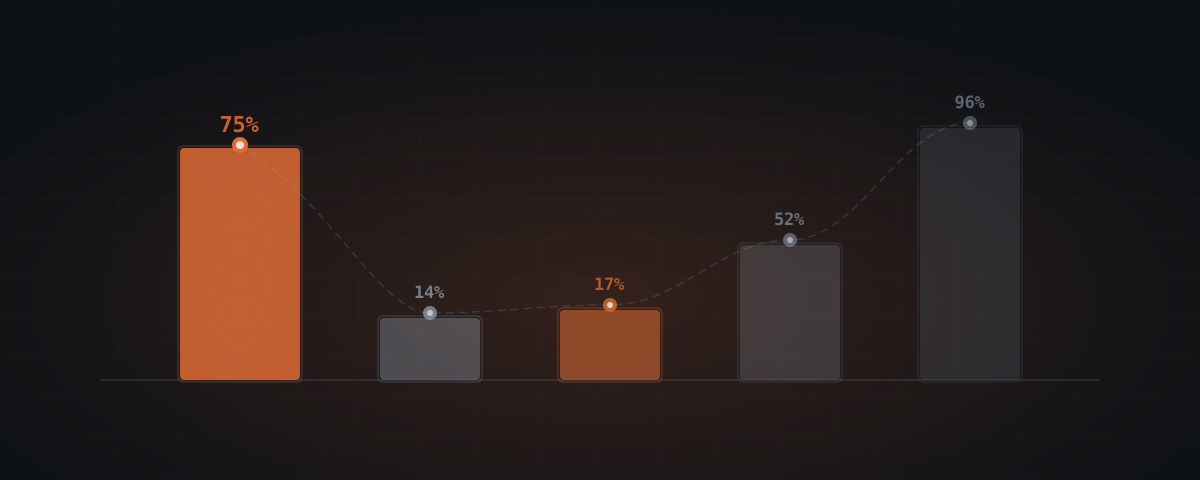
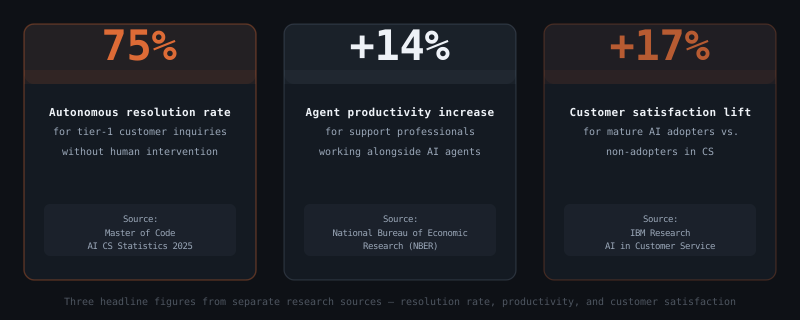
A figure repeats across AI customer service content: 75% of inquiries resolved by AI without human intervention, right now. It traces to no disclosed source. What is verified: mature AI adopters report 17% higher customer satisfaction scores than non-adopters, and NBER research found that human agents given AI assistance increase productivity by 14% on average. Gartner does project autonomous resolution of 80% of common issues — by 2029, a dated future forecast, not a current rate. These gains concentrate in teams using AI for specific query types — not those attempting to replace the entire support function.
The most cited number in AI customer service research — that 95% of customer interactions will be handled by AI — was a projection made in 2017 for the year 2025. Researchers and vendors repeated it so often it started reading as current reality. The number that has replaced it in 2026 content has the same problem: a widely-repeated claim that 75% of customer inquiries can now be resolved by AI tools without human intervention traces to no disclosed source — including on the page most often cited for it.[¹] What is dated and sourced is Gartner's actual prediction that agentic AI will autonomously resolve 80% of common customer service issues by 2029[⁵] — a five-years-out forecast, not a current rate, and eight points higher than the number being quietly retold as already true.
That distinction matters for any service business evaluating AI for support. The question is not whether AI will handle all customer interactions, now or by 2029. The question is which inquiry types AI resolves reliably today, what the productivity and satisfaction effects are on the rest, and what the adoption data shows about where businesses actually are.
What do the "resolution rate" numbers really measure?
The 2017 Gartner prediction that "95% of customer interactions will be handled by AI by 2025" entered the industry's vocabulary as a milestone to track toward. By the time 2025 arrived, the framing had shifted: the question was not whether AI would reach 95%, but what that number was actually measuring.
In 2025, 95% of customer interactions being "handled by AI" was a projection describing the involvement of AI at any point in an interaction — including AI-assisted routing, sentiment analysis running in the background, and AI-suggested responses that a human then edits. That pattern repeated in 2026: a "75% resolved now" figure circulated widely enough to be treated as established fact, and on inspection is not sourced anywhere it is cited, including the industry listicle most often pointed to for it. The real, current Gartner prediction it appears to be borrowed from and rounded down from is dated 2029, not now, and the real figure is 80%, not 75%.
Fully autonomous AI resolution — where no human touches the interaction — is real and concentrated in a specific band of work: password resets, order status checks, appointment changes, standard refund requests, common product questions. What is not credibly established is a single verified percentage for how much of total volume that band represents today. The other work — complaints, disputes, multi-step account issues, and novel problems — still requires human judgment, and no serious source disputes that split; what lacks a source is the specific number for the easy side of it.
NBER's verified 14% productivity figure and IBM's reported 17% satisfaction lift, both covered below, are the operationally useful numbers here — they describe a measured effect on real teams, not an unsourced resolution rate.
The "75% resolved by AI now" figure that circulates across AI customer service content has no disclosed source. Gartner's real prediction — agentic AI autonomously resolving 80% of common issues — is dated 2029, not now.[⁵] Treat any current-state resolution-rate percentage you encounter the way this page treats its own: ask what it's measuring and when the underlying study says it applies.
What does AI resolve in customer service today?
AI agents in customer service handle four categories of work well: tier-1 triage, first-response drafting, self-service guidance, and follow-up on open cases. (See what an AI agent is for how these systems differ from a scripted chatbot.)
Tier-1 triage and routing. 29% of businesses use AI for routing customer requests — classifying inquiry type and directing each to the right queue or team member.[¹] An agent that routes correctly on first read eliminates the manual sorting that consumes support coordinator time and adds latency to every inquiry.
First-response drafting. For the most common inquiry types — order status, refund acknowledgment, appointment rescheduling — AI agents draft the response against a template and place it in the review queue. A human reviews and approves. Response time drops from hours to minutes. Human time per response drops from composition to review.
Self-service resolution. 69% of consumers prefer AI-powered self-service tools for quick issue resolution, showing strong market acceptance of the format.[⁹] AI-powered self-service works for predictable queries with known answers. It fails on ambiguous or emotionally charged interactions.
Follow-up automation. AI agents monitor open cases and send follow-up messages when tickets age beyond defined thresholds. No case goes unanswered because a human forgot to circle back.
| Inquiry type | AI handles | Human handles | Frequency |
|---|---|---|---|
| Order status and tracking | Fully | Exceptions only | Daily |
| Standard refund request | Drafts + routes | Reviews + approves | Daily |
| Appointment reschedule | Fully | Conflicts only | Daily |
| Password reset | Fully | Never | Daily |
| Billing dispute | Routes + summarizes | Resolves | Weekly |
| Product defect complaint | Routes + acknowledges | Investigates + resolves | Weekly |
| Complex account issue | Routes + escalates | Owns | Occasional |
The top four rows — the daily-frequency, predictable inquiries — account for 60–70% of total ticket volume in most service businesses. AI autonomous resolution applies to those. The bottom three require human judgment and occur less frequently.
What is the productivity effect on human agents?
The productivity argument for AI in customer service is not that AI replaces agents. The NBER research finding is more specific: customer support professionals given access to AI agents increased productivity by 14% on average.[³]
14% productivity gain on a support team means the same headcount handles 14% more inquiries at the same quality level. For a team of five agents handling 500 tickets per week, that is 70 additional tickets per week without additional headcount.
The mechanism: AI handles the drafting, lookup, and first-pass classification. The agent reviews and approves instead of composing from scratch. The skill remains with the human — judgment about the right response — without the time cost of assembling it.
IBM data shows the effect compounds at scale: mature AI adopters — organizations that have moved AI from experimentation into core support operations — report 17% higher customer satisfaction scores compared to organizations that have not integrated AI into their support function.[²]
The satisfaction lift is not from AI interactions being better than human ones. It is from human agents spending their time on the interactions that actually require them, while AI handles the predictable volume.
A global camping company that implemented IBM AI tools saw a 33% increase in agent efficiency and an average customer wait time of 33 seconds.[²] Nutribees used HubSpot's Breeze Customer Agent to reduce human-handled tickets by 77% while simultaneously improving conversion rates and customer satisfaction.[⁸]
The agents who work alongside AI handle more inquiries at higher satisfaction. The time they save on drafting goes into the interactions that actually require judgment.
Where are customer service teams in adoption?
AI adoption in customer service is past the experimentation phase for most organizations. 52% of contact centers have invested in Conversational AI, and an additional 44% plan to adopt it, according to 8x8's State of Conversational AI report.[⁶] Nearly half of customer support units have implemented AI with additional investment planned.
The adoption picture by use case:
| Use case | Share of businesses using AI for this |
|---|---|
| Routing and triage | 29% |
| Customer feedback analysis | 28% |
| Chatbots and self-service tools | 26% |
| Response drafting | Active in early adopter segment |
| Predictive escalation | Emerging capability |
The most common entry point is routing — the lowest-risk, highest-volume use case with clear success criteria. Businesses that start with routing typically expand to drafting and self-service within six to twelve months.
At the leadership level, the consensus is strong: 96% of business leaders believe generative AI will enhance customer interactions, according to LivePerson's Customer Conversations Report.[⁷] That confidence is not universal across customers: 52.4% of Americans believe AI will improve customer service, leaving a substantial portion who have reservations.[¹]
The reservation resolves with specificity. Customers who prefer AI interactions want them for specific query types — fast, predictable answers — not as a replacement for human contact on complex issues.
What do customers actually want from AI support?
Customer preferences for AI in service interactions are more specific than industry headlines suggest. The broad confidence figure — 52.4% believe AI will improve customer service — masks a strong pattern in the preference data.
69% prefer AI for quick self-service resolution, according to Salesforce.[⁹] When the interaction is fast and the answer is predictable, customers favor the immediacy of AI over the wait for a human.
73% of buyers and 77% of companies favor human monitoring of AI, according to Master of Code's compiled survey data.[¹] This is the most consequential preference figure for implementation design: customers and the businesses serving them both want a human in the loop, not just AI in use. The businesses scoring highest on AI-related customer satisfaction are those where AI handles drafting and routing and humans hold approval authority.
The 73%/77% figures directly support the approval-based implementation model — where AI prepares the response and a human confirms before it sends. Both buyers and the companies serving them are signaling that they want the speed and availability of AI with the accountability of human oversight.
| Customer preference | Share | What it means for implementation |
|---|---|---|
| Prefer AI for quick resolution | 69% | Deploy AI for tier-1 predictable queries |
| Buyers who favor human monitoring of AI | 73% | Human approval on AI responses builds trust |
| Companies who favor human monitoring of AI | 77% | The preference for oversight isn't just customer-side |
| Believe AI will improve customer service | 52.4% | Confidence is real, not universal |
What does the ROI picture look like in customer service AI?
The cost efficiency case for AI in customer service is straightforward: AI reduces the labor time required per inquiry for the inquiry types it handles. The ROI case is more specific: it depends on the share of total volume that falls into AI-resolvable categories.
For a service business where 60–70% of daily ticket volume is tier-1 predictable inquiries, AI resolving those autonomously or reducing human time per ticket by 80% produces a measurable labor efficiency gain within the first quarter of deployment.
The satisfaction uplift — IBM's 17% higher customer satisfaction among mature AI adopters — compounds the cost efficiency case. Faster resolution, consistent acknowledgment, and no aging tickets produce customer satisfaction improvements that reduce churn and drive referrals. These are not quantifiable in the same way as cost-per-ticket metrics, but they appear in the retention and revenue data of organizations that have been running customer service AI at scale for more than 12 months.
Two limiting factors constrain the ROI:
Scope. AI customer service ROI concentrates in the tier-1 inquiry segment. Businesses that deploy AI against complex or emotionally charged interactions without clear escalation logic see lower resolution rates and customer dissatisfaction. The scope definition — what AI handles and what it doesn't — is the most important configuration decision.
Adoption curve. The 14% NBER productivity increase applies to agents who have been working with AI tools long enough to develop the review-and-approve workflow. Teams in the first month of deployment — still learning what to trust — don't see the same efficiency. The gains build with use.
The research base points to a consistent conclusion: AI in customer service improves outcomes when it is scoped to what AI does reliably, with humans in review on what it doesn't.
Frequently asked questions
What percentage of customer service interactions can AI handle? No credible primary source publishes a verified current-state figure — a widely-repeated "75% resolved now" claim traces to no disclosed source. What is dated and sourced: Gartner projects agentic AI will autonomously resolve 80% of common customer service issues without human intervention by 2029, and 90% of CX leaders expect AI to resolve 8 in 10 issues within the next few years, according to Zendesk CX Trends 2026. Today, autonomous resolution concentrates in tier-1 inquiries — order status, appointment changes, standard refund requests, password resets, and common product questions. Complex complaints, billing disputes, and high-value account issues remain with human agents.
Does AI in customer service increase agent productivity? Yes. NBER research found that customer support professionals given access to AI agents increased productivity by an average of 14%. IBM data shows that mature AI adopters report 17% higher customer satisfaction scores compared to non-adopters. A global camping company that implemented IBM AI tools saw a 33% increase in agent efficiency and an average customer wait time of 33 seconds.
What do customers think about AI in customer service? 52.4% of Americans believe AI will improve customer service, and 69% of consumers prefer AI-powered self-service tools for quick issue resolution, according to Salesforce. 73% of buyers and 77% of companies favor human monitoring of AI, according to Master of Code's compiled survey data — indicating strong preference for human oversight even when customers choose AI-first responses.
What is the current AI adoption rate in customer service? 52% of contact centers have invested in Conversational AI, and 44% plan to adopt it, according to 8x8. The most common applications are routing requests (29% of businesses), analyzing customer feedback (28%), and chatbots or self-service tools (26%). 96% of business leaders believe generative AI will enhance customer interactions, according to LivePerson.
Notes
- Master of Code. "AI in Customer Service Statistics: 50+ Actionable Insights." masterofcode.com/blog/ai-in-customer-service-statistics. Checked 2026-09-01. Its own "75% resolved by AI now" claim carries no source on that page — it is cited here as the checked, unsourced page, not as evidence for that figure. Retained only for: 29% routing / 28% feedback analysis / 26% chatbots use-case breakdown; 52.4% of Americans believe AI will improve customer service; 73% of buyers / 77% of companies favor human monitoring of AI. A further primary for these specific figures was not located in this research pass.
- IBM. "AI in Customer Service." ibm.com/think/topics/ai-in-customer-service. Accessed June 2026. Source for the camping-company case data (33% agent efficiency gain, 33-second wait time) and the 17% customer satisfaction lift reported for mature AI adopters. IBM's own vendor content about its own product — a reported case, not an independently audited study.
- Brynjolfsson, Erik, Danielle Li, and Lindsey R. Raymond. "Generative AI at Work." NBER Working Paper 31161, 2023 (published in The Quarterly Journal of Economics, 2025). nber.org/papers/w31161. Primary source for the 14% productivity increase among customer support agents with AI access, based on data from 5,179 agents; IBM's page also references this finding, but this is the original study.
- Zendesk. "59 AI Customer Service Statistics for 2026." zendesk.com/blog/ai/productivity/ai-customer-service-statistics. Accessed June 2026. Source for 90% CX leader expectation on AI resolving 8 in 10 issues without human involvement.
- Gartner, press release, 5 March 2025, "Gartner Predicts Agentic AI Will Autonomously Resolve 80% of Common Customer Service Issues Without Human Intervention by 2029." Analyst: Daniel O'Sullivan, Senior Director Analyst, Gartner Customer Service & Support Practice. Direct fetch returned 403; corroborated by five independent secondary sources (CX Today, TechMonitor, Call Centre Helper, Maven AGI, Veribl) reporting the same figure, date, and quote — verified 2026-09-01.
- 8x8. "State of Conversational AI." 8x8.com/docs/state-of-conversational-ai. Source for: 52% of contact centers have invested in Conversational AI, 44% plan to. Verified via direct citation on Master of Code's page 2026-09-01.
- LivePerson. "Customer Conversations Report." liveperson.com/customer-conversations-report. Source for: 96% of business leaders believe generative AI will enhance customer interactions. Verified via direct citation on Master of Code's page 2026-09-01.
- HubSpot. Breeze Customer Agent case studies. hubspot.com/products/artificial-intelligence/case-studies. Source for the Nutribees case: 77% reduction in human-handled tickets using HubSpot's Breeze Customer Agent. Verified via direct citation on Master of Code's page 2026-09-01. A vendor-published customer case study, not an independently audited result.
- Salesforce. salesforce.com/news/stories/salesforce-chatbots-customer-use-case. Source for: 69% of consumers prefer AI-powered self-service tools for quick issue resolution. Verified via direct citation on Master of Code's page 2026-09-01.