AI agents for managed service providers automate tier-1 service desk tickets, NOC alert triage, and routine remediation without adding headcount. MSPs deploying AI agents report tier-1 resolution time dropping from 25–45 minutes to 2–4 minutes, with alert noise reduced by 80–95%. Unlike hiring, AI agent capacity scales with client count, not payroll — so the same technicians support two to three times the endpoint base.
Three technicians. 600 endpoints. 81 client sites across two countries. That is LNC Data — a healthcare-focused MSP in San Francisco whose team handles more than most mid-sized IT departments. The math works because most of what fills the service queue every day does not require a senior technician. It requires pattern matching: read the ticket, match the issue, apply the fix. An AI agent does that part. The engineers handle what it cannot.
Where MSP engineering time actually goes
Most MSP ticket queues follow the same distribution: 60–70% of daily volume is password resets, account lockouts, basic software installs, VPN connectivity errors, and routine monitoring alerts. None of this requires expertise. All of it takes time.
A typical 1,000-device environment generates 50,000–200,000 raw alerts per month, according to Flamingo's analysis of MSP operations data.[¹] Most of those alerts are duplicates, false positives, or low-priority events that pattern-match known conditions. A technician sorting through them manually is not doing the work they were hired to do — they are doing triage.
Flamingo's 2026 MSP operations guide found that 64% of IT infrastructure teams report being buried in routine operational tickets.[¹] That is the majority of the workforce, spending the majority of their capacity, on work that does not require their training. The cost compounds when the same team is responsible for proactive monitoring, client strategy, and escalation response.
The downstream effect is predictable: reactive operations. Techs are always catching up. Proactive management — the higher-margin service every MSP wants to offer — stays aspirational because there is no capacity for it. A service business promising proactive IT management while their engineers spend four hours a day on password resets is promising something their current structure cannot deliver.
| Ticket category | Requires expert judgment | Share of daily volume |
|---|---|---|
| Password resets and account lockouts | No | 25–35% |
| Basic software installs and VPN issues | No | 15–20% |
| Routine monitoring alert triage | No | 20–25% |
| Patch and certificate failures | Sometimes | 10–15% |
| Complex multi-system troubleshooting | Yes | 15–20% |
| Client escalations and novel issues | Yes | under 10% |
The bottom two rows are where MSP engineers are irreplaceable. The top four rows are where AI agents work best.
What an AI agent handles in MSP operations
An AI agent for MSP operations covers three distinct functions: service desk automation, NOC alert triage, and auto-remediation.
Service desk automation. When a ticket arrives — via email, a PSA portal, or a chat message — the agent reads the content, classifies the issue against known resolution patterns, and acts. For password resets, account lockouts, printer issues, VPN errors, and standard software installs, the agent either resolves the ticket autonomously or prepares a response with all relevant context for a technician to review. Tier-1 resolution time drops from 25–45 minutes to 2–4 minutes.[¹] The technician who used to handle the ticket from open to close now approves a resolution the agent has already prepared.
NOC alert triage. AI agents correlate network events, suppress duplicate alerts, and auto-remediate known issues — service restarts, resource spikes, connectivity blips — using the same resolution patterns that technicians would apply manually. MSPs using AI event correlation report noise reduction of 80–95% within the first two weeks of deployment, provided the environment has accurate baseline configuration data.[¹] The alerts that remain on the engineer's desk are the ones that require human decision-making.
Auto-remediation. For known fix patterns — clearing disk space across endpoints, restarting services, deploying patches, renewing certificates, resetting configurations — the agent executes the fix directly. A technician who would have spent time writing a PowerShell script to clear temp files across 40 machines instead reviews the agent's execution log. Auto-remediation handles the scripted work; engineers handle everything that falls outside the known-fix library.
83% of MSP alerts do not require manual technician intervention. An AI agent handles those and surfaces the 17% that do — each one enriched with context, root-cause analysis, and a suggested resolution path before it reaches the engineer.
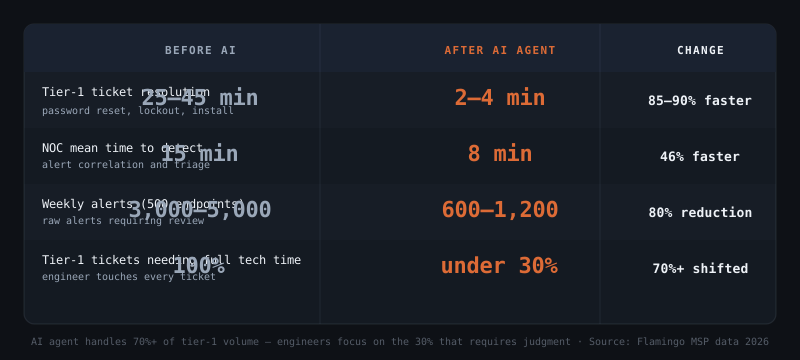
| Function | Before AI | After AI | Improvement |
|---|---|---|---|
| Tier-1 ticket resolution | 25–45 min | 2–4 min | 85–90% faster |
| Mean time to detect (NOC) | 15 min | 8 min | 46% faster |
| Weekly alerts requiring engineer (500 endpoints) | 3,000–5,000 | 600–1,200 | 80% reduction |
| Tier-1 tickets requiring full tech time | 100% | under 30% | 70%+ shift |
Source: Flamingo MSP operations data, 2026.[¹]
The MSP economics: what changes when tickets resolve themselves
MSPs operate on thin margins — typically 12–15% net — and labor runs 80% of operating costs. The economics of AI agents in MSP environments are direct: a Level 1 technician costs $55,000–$75,000 annually and is available 40 hours a week.[¹] An AI agent handling the same tier-1 volume operates around the clock without PTO, context switching, or the performance variation that comes with a full ticket queue on a Friday afternoon.
The financial case is not cost-per-ticket. The case is capacity. An MSP team of three technicians managing 600 endpoints spends most of its reactive capacity on tier-1 work. Remove that load, and those three technicians can manage 900–1,200 endpoints — the same payroll, two to three times the client base.
LNC Data, the San Francisco healthcare MSP mentioned above, deployed AI diagnostics and backend troubleshooting on its 600-endpoint, 81-client base. With three technicians and AI handling the routine load, the team now processes 20% more tickets than before — without adding headcount, and without having full automation enabled across all workflows yet.[¹]
The higher-margin outcome is what becomes possible when reactive capacity frees up. Proactive maintenance reviews — identifying patterns before they become client-facing incidents — generate client trust and reduce emergency escalations. Project work (migrations, security hardening, compliance prep) generates add-on revenue. Client onboarding, which sets the foundation for long-term relationships, gets proper attention instead of being squeezed between ticket responses.
The same three technicians. Two to three times the client base.
For MSPs evaluating the business case: the calculation is not AI agent cost vs. technician salary. The calculation is current client capacity vs. AI-enabled client capacity, measured against the cost of adding the AI layer. Most MSPs break even within the first two to four months of deployment and reach positive capacity ROI in month three to six, depending on how aggressively they expand the client base.
What MSP engineers do when they are not triaging tickets
The displacement concern — that AI agents will reduce technician headcount — runs counter to how MSPs are actually using them. Flamingo's data from early adopter MSPs shows a consistent pattern: technicians are redeployed to higher-value work, not out of the workforce.[¹]
The work that absorbs recovered capacity:
Tier-2 and tier-3 escalations. When AI handles 70% of tier-1 volume, engineers spend more time on the complex issues that actually require their expertise — multi-system failures, unusual configurations, problems that the agent escalates with full diagnostic context. Response quality on those escalations improves because engineers arrive to them with context already assembled.
Client onboarding. The first 30–60 days of a new client account determine retention as much as anything that happens afterward. With reactive capacity freed, engineers can do proper onboarding: inventory documentation, baseline configuration, relationship-building with the client's internal contact.
Proactive maintenance. Quarterly reviews, security audits, software lifecycle tracking, hardware refresh planning — the advisory work that differentiates a strategic IT partner from a break-fix shop. These activities are typically the first thing cut when the ticket queue is full. When the ticket queue is managed by an agent, they become possible again.
Project revenue. Migrations, new tool rollouts, security hardening, compliance preparation — billable project work that generates revenue above the managed services retainer. Engineers who are not burning hours on password resets have bandwidth for project scoping and delivery.
84% of ITSM professionals view AI positively in their operations, according to research cited in Flamingo's MSP operations guide.[¹] The consistent framing: AI handles the high-volume, low-complexity work so that engineers can work at the level their training justifies.
Mear Technology, a 5-technician MSP managing 1,000 endpoints in Edinburgh, reported that complex diagnostics which previously took hours resolved in seconds through AI-assisted analysis, and tasks that queued for 5–10 minutes in previous systems processed immediately.[¹] The result was not fewer technicians — it was technicians spending their time on diagnostic judgment rather than diagnostic mechanics.
What AI agents cannot do in MSP environments
Gartner warns that over 40% of agentic AI projects may be abandoned by 2027 due to unclear business value or poor alignment between what the agent handles and what the business actually needs.[¹] This matches the pattern identified in AI implementation failure research — most failures trace to scope problems, not technical ones. The MSPs that avoid this outcome define the boundary clearly before deployment.
There are four categories of MSP work that AI agents handle poorly or not at all:
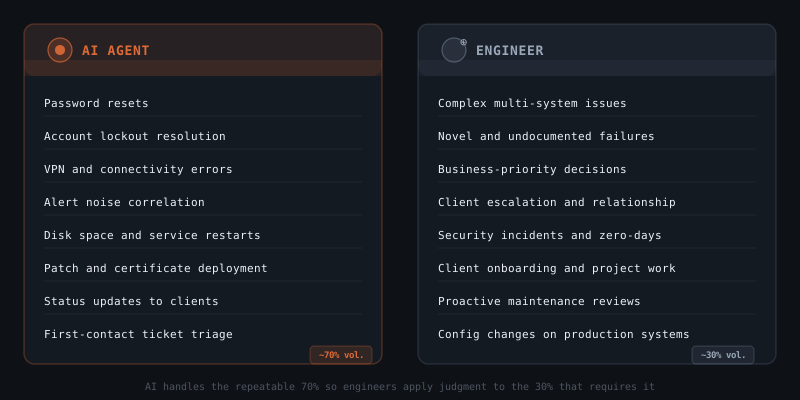
Complex multi-system troubleshooting. When an issue spans Active Directory, a SaaS application, a firewall rule, and a client's custom line-of-business software, the agent lacks the contextual judgment to navigate the interaction between systems. It escalates — usually correctly, and with useful diagnostic data — but it cannot resolve the issue.
Business-priority decisions. During a multi-client outage, which client gets attention first? That decision requires knowledge of client contracts, relationship history, and business context. The agent can surface the severity and impact data; an engineer makes the call.
Novel problems. AI agents match incoming tickets and alerts against known resolution patterns. A zero-day vulnerability, an undocumented vendor API behavior, or a misconfigured system no one has seen before falls outside those patterns. The agent escalates; the engineer investigates.
Client relationship management. An unhappy client in the middle of an outage does not want to interact with an AI. Escalation paths and human touchpoints matter, especially for high-stakes accounts. The agent handles the technical triage; a senior technician or account manager handles the relationship.
The practical framing that works for MSP teams: AI agents handle 70% of the volume so engineers can focus 100% of their judgment on the 30% that requires it.
How to sequence AI agent deployment for an MSP
MSPs that deploy AI agents successfully follow a consistent pattern: one function at a time, each one measured before expanding to the next. The same sequencing logic applies across service businesses — choosing the right first workflow determines how quickly the second one becomes possible.
Month 1 — Service desk tier-1
Deploy the agent for password resets, account lockouts, basic troubleshooting, and standard software requests. Measure resolution time, first-contact resolution rate, and client satisfaction. This is the lowest-risk entry point with the fastest measurable return — most MSPs see tier-1 volume drop by 60–70% in the first month.
Month 2 — NOC alert triage
Layer in alert correlation and noise suppression across your RMM. Track alert reduction rate and false positive filtering accuracy. Expect 80–95% noise reduction in the first two weeks if baseline configuration data is clean. Engineers shift from daily alert sorting to reviewing flagged exceptions.
Month 3 — Auto-remediation
Enable autonomous resolution for known fix patterns: disk space clearing, service restarts, patch deployment, certificate renewal. Each action logs fully. Engineers approve any change touching production configuration. Expand the auto-remediation library as new patterns are confirmed reliable in your environment.
The integration question determines most of the implementation timeline. The agent needs live access to your RMM (Tactical RMM, ConnectWise Automate, NinjaRMM, Datto RMM), your PSA (ConnectWise Manage, Autotask, HaloPSA, ServiceNow), and your communication channel. These integrations are where implementation time concentrates — not in AI configuration, which is typically the faster part.
Two additional considerations before deployment:
Baseline data quality. Alert correlation and auto-remediation depend on accurate baseline configuration data. An MSP with incomplete or inconsistent asset documentation will see lower noise-reduction gains in month two. The implementation process typically surfaces documentation gaps that need filling before the agent can be reliable.
Approval thresholds. Define what the agent can do autonomously versus what requires technician approval before go-live, not after. Destructive actions (deleting files, removing accounts, config changes on production systems) should require explicit approval. Routine fixes (password reset, service restart on a known-safe service) can run autonomously from day one.
MSPs that establish these parameters before launch avoid the category of Gartner's "abandoned" projects — where the agent was deployed before the scope was defined and pulled back after an autonomous action created an unintended consequence.
The relevant comparison for any MSP evaluating this: Flamingo's cohort data shows MSPs on the three-stage deployment sequence shifting from reactive ticket management to proactive client management within 90 days, without additional headcount.[¹] The work changes. The team size stays the same.
Frequently asked questions
What do AI agents do for managed service providers? AI agents for MSPs handle tier-1 service desk tickets, NOC alert triage, and auto-remediation for known fix patterns. The agent reads incoming tickets, resolves password resets and account lockouts autonomously, correlates and filters alert noise, and executes scripted fixes for recurring issues. Tier-1 resolution time drops from 25–45 minutes to 2–4 minutes. Alert volume reduces by 80–95%. Engineers focus on escalations, project work, and client-facing management.
How many tickets can an AI agent handle for an MSP? MSPs deploying AI agents for service desk operations report 70% or more of tier-1 ticket volume resolving without technician involvement. For a team managing 500 endpoints and 3,000–5,000 weekly alerts, AI triage typically reduces the engineer-required alert volume to 600–1,200 per week. The remaining 30% that requires a technician arrives enriched with context, root-cause data, and a suggested resolution path.
What does MSP AI agent implementation cost? The relevant cost comparison is a Level 1 technician at $55,000–$75,000 annually, available 40 hours per week. An AI agent handling the same tier-1 volume operates around the clock without PTO or performance variation. MSPs that deploy and scale AI agents report technicians supporting two to three times more clients without additional headcount. The economics are capacity expansion, not replacement of existing staff.
Should MSPs build AI agents or buy them? Most MSPs buy rather than build. Building a custom AI agent requires AI engineering skills that most MSP teams do not have internally, and maintenance costs in year two typically exceed the initial build. Off-the-shelf platforms built for MSPs offer pre-built integrations with common RMM and PSA tools. Custom triage logic and client-specific escalation rules are configurable within a platform without engineering the agent from scratch.
Notes
- Flamingo. "AI Agents for IT Operations – A Guide for MSPs (2026)." flamingo.run/blog/ai-agents-for-it-operations. Accessed June 2026. Includes data from Flamingo's MSP early-adopter cohort (LNC Data, Mear Technology) and Gartner citation on agentic AI project abandonment.
- Integris. "How AI Agents are Transforming Managed Services." integrisit.com/blog/how-ai-agents-are-transforming-managed-services. Accessed June 2026.