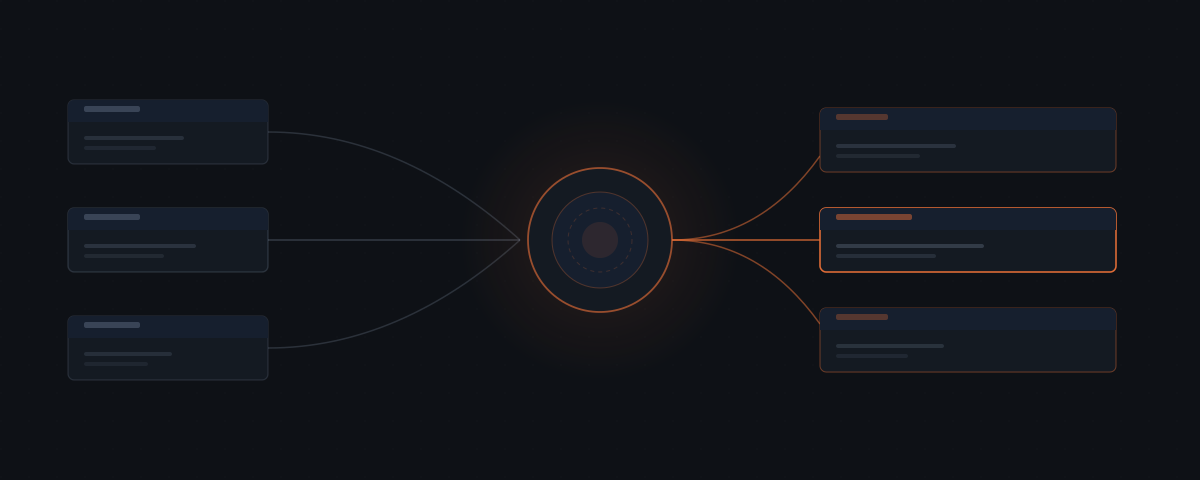
Hermes handles the client communication, research, and reporting layer for agencies running retainer work across Slack and Gmail. One deployment covers both channels simultaneously — status updates, follow-ups, and report assembly surfaced for approval, not composed from scratch. Skills build from each completed task, improving output on the agency's specific clients and formats the longer Hermes operates.
The client update that was due Tuesday. The follow-up from last Thursday that still hasn't gone out. The new brief sitting in the inbox, waiting on a first response before the prospect moves on. None of these require expertise. All of them require attention — and in most agencies, that attention belongs to whoever is nearest their inbox. Adding a hire doesn't fix this. A new account manager brings more clients to update, more handoffs to document, more reports to compile. Hermes handles the communication and research layer — drafting updates, queuing follow-ups, assembling reports — across Slack and Gmail from a single deployment. The team reviews and approves. Nothing sends without a sign-off.
Agency communication overhead grows with every hire
McKinsey Global Institute found knowledge workers spend 28% of their week managing email and 19% gathering information — nearly half the workweek on tasks that don't require the expertise the agency bills for.[¹] A decade later, Microsoft's 2023 Work Trend Index — drawn from productivity signals across 31,000 workers in 31 countries — found that knowledge workers now spend 57% of their time on communication: email, meetings, and chat.[²] The proportion has grown, not shrunk.
Hiring adds delivery capacity. Hiring does not reduce communication overhead — every new account manager brings more clients to update, more internal handoffs to document, and more reports to compile. The ratio of communication work to team size stays flat. The bottleneck in an agency isn't headcount. It's the communication layer wrapped around every project.
A 10-person agency running 20 retainer clients is sending roughly 100 client updates per month, managing 200+ email threads, compiling 80 weekly reports, and following up on 60–80 deliverables. The accounts team doing this work is not spending 60% of their time on it because they are inefficient — they are spending 60% on it because that is the volume the agency's growth has created. Hermes handles that volume without adding to it.
How Hermes handles client communication across Slack and Gmail
Hermes watches the agency's communication channels and handles three categories of work: drafting outgoing client updates, triaging incoming messages, and following up on outstanding requests.
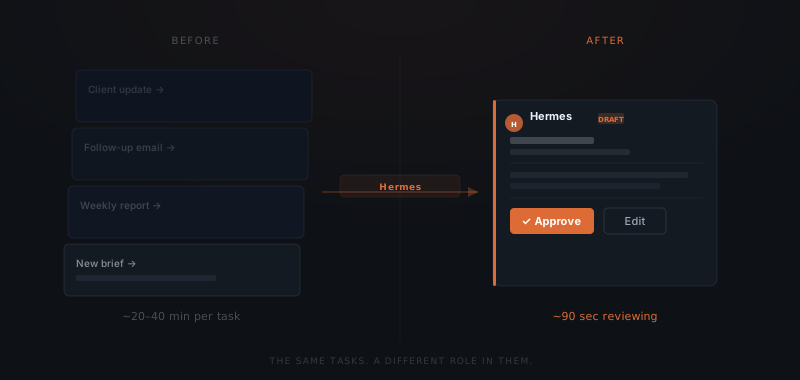
For a retainer client expecting a weekly update, Hermes pulls activity from the connected project tool — Linear, Asana, or Notion — drafts the update in the agency's format, and surfaces it for approval before sending. For an incoming client question, Hermes drafts the response and routes it to the relevant team member for review. For a deliverable without a follow-up in 72 hours, Hermes drafts the chase and queues it for sign-off.
The routing logic reflects the account structure. An incoming message from a strategic account gets routed to the account director; an incoming question on a standard retainer routes to the account manager. The routing rules are part of context definition — configured before go-live and updated as the account structure changes. An escalation that Hermes is uncertain about routes to the person named as exception handler for that workflow, rather than attempting to resolve it autonomously.
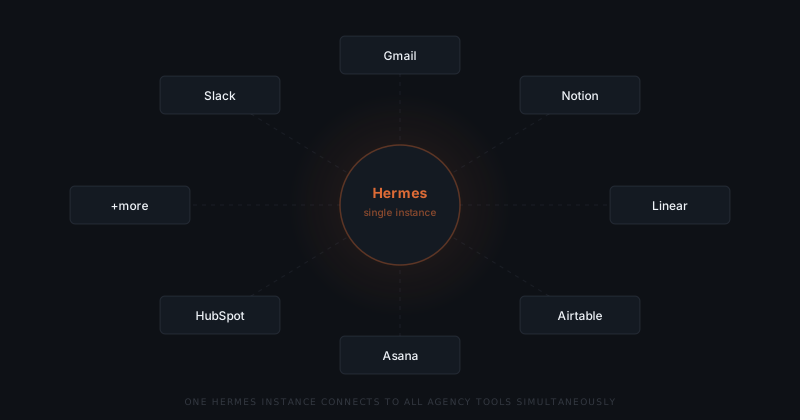
Hermes runs a single instance across Slack and Gmail simultaneously. Skills built from a client interaction in Slack carry to Gmail — there is no separate Skill library per channel. The same learning applies across every platform the agency uses.
Every draft surfaces for human review before anything sends. The account manager approves, edits, or dismisses. Hermes handles the assembly.
The table below shows what a typical agency deployment handles and the time comparison before and after.
| Workflow type | What Hermes does | Before Hermes | After Hermes |
|---|---|---|---|
| Weekly client status update | Pulls activity from project tool; drafts update in agency format | 20–30 min to compose per client | 90 sec to review and approve |
| Inbound client question | Drafts response; routes to relevant team member | 15–20 min per thread | 2 min to approve or edit |
| Deliverable follow-up | Drafts chase after 72-hour window; queues for sign-off | Often delayed or skipped | Runs on schedule; 1 min to approve |
| New brief acknowledgement | Drafts acknowledgement with timeline and next steps | 20–30 min to compose | 5 min to review and send |
| Weekly report assembly | Pulls data from project tool; formats in report template | 60–90 min per report | 10–15 min final review |
| Competitor or market research | Searches, summarises, structures as draft document | 2–3 hrs per brief | 20–30 min to edit and develop |
How Hermes handles research and reporting workflows
Reporting requires pulling information from project trackers, analytics tools, and CRM records — compiling it into a structured format and delivering it on schedule. Most agencies do this in manual steps, usually by the account manager or the founder. At 20 retainer clients, that is 80 weekly report compilations per month — each one drawing on the same data sources, in the same format, delivered on the same cadence. The assembly is consistent enough that Hermes handles it; the review and any analytical framing stays with the account manager.
Hermes handles the assembly. For a weekly client report, Hermes connects to the relevant tools, pulls the week's metrics and milestones, and drafts the report in the agreed format — ready for a final review before sending. The account manager reviews. Hermes assembles.
For ad hoc research — a competitor's recent campaign, a new platform's capabilities, background for a new client brief — Hermes searches, summarises, and structures the findings as a draft document. The output is ready to edit, not a list of links to read.
How Hermes improves on agency-specific workflows over time
Each completed task adds a Skill object to Hermes's library — a structured record of the task category, the approach used, and input-output examples. On the next similar task, Hermes applies the Skill and adds the new example to it.
The bottleneck isn't capacity. It's the communication layer around every project.
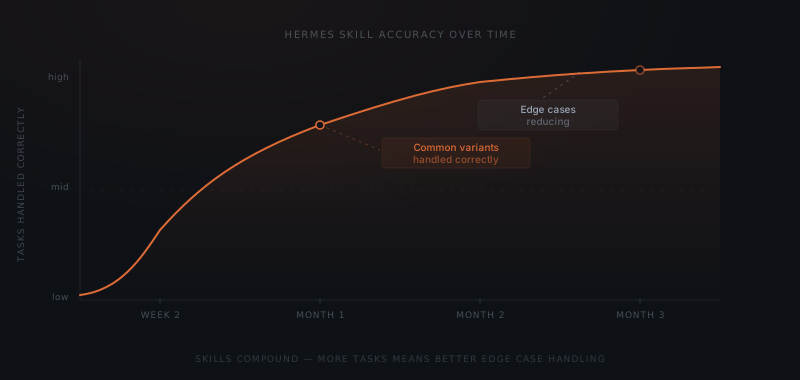
For an agency, Hermes in month three handles the variant client formats, mid-project scope emails, and late-deliverable chasers that month one could not. Skills encode the agency's specific clients — their preferred update format, their communication style, the level of detail they expect. A Skill built from 30 status updates to a specific fintech client understands that client's preferences in a way a freshly deployed Hermes does not.
The time an account manager spends editing Hermes's drafts decreases over the first three months. The goal is not for Hermes to operate without review — it's for the review to take 90 seconds instead of 20 minutes.
The practical implication for an agency is capacity recovery, not headcount reduction. An account manager spending three hours per day on status updates, follow-ups, and report assembly has three hours per day for the work clients are billing for: strategy, relationships, creative direction, account development. The agency does not shrink — the same team handles more clients at the same quality level.
What an agency Hermes deployment covers on day one
A Hermes deployment for an agency starts with three decisions: which channels to connect, which workflows to configure first, and how to define context — the information that shapes Skill quality from the beginning.
On day one, Hermes handles configured workflows at a baseline level. A status update workflow produces a structurally correct draft that needs editing for client-specific tone and detail. A follow-up workflow produces a draft that needs a human check before sending. The output is usable. It is not polished.
By month three, Skills built from real completed tasks have improved accuracy on the agency's specific clients, formats, and communication patterns. The same status update that took 15 minutes to compose in week one takes 90 seconds to review in month three. Hermes does not replace the account manager's judgment on strategy, scope, or relationships. Hermes handles the communication and research layer that consumes the time those judgments should be made in.
What the first month looks like in practice: weeks one and two involve close review of all outputs — the account manager approves, edits, or dismisses each draft and the corrections become the Skill's learning material. By weeks three and four, the correction rate on common task types begins to drop. The account manager is still reviewing everything but spending less time on each review. By month two, the drafts for established client formats require minimal edits. By month three, the review process looks like what it should have been all along: a 90-second decision, not a 20-minute composition task.
For the agency, the visible output of a Hermes deployment in month three is not a different quality of work — it is the same quality of work delivered by an account management team that now has three extra hours per day.
For a full overview of Hermes and how it works, see what is Hermes. For when off-the-shelf tools don't fit the agency's specific workflows, see what is a custom agent.
What Hermes does not handle at an agency
Understanding Hermes's scope prevents misaligned expectations at deployment. The communication and research layer is substantial — for most agencies, it consumes 40–50% of account manager time. But it is not the full account management role.
Strategic decisions and client recommendations. Hermes drafts the update that carries the week's project status. The account manager decides what to include, what to flag, and how to frame any concerns. Strategy, framing, and judgment remain with the person billing for those capabilities.
New business pitches and proposals. Hermes can research a prospect and draft a structure, but the insight and positioning that distinguish a winning pitch from a generic one require the expertise and relationship context Hermes does not have.
Scope changes and contract negotiation. A client pushing back on a deliverable or requesting scope expansion routes to a human decision. Hermes can draft the response options, but the decision is not automated.
Team performance and management. Hermes handles external communication and research. Internal team decisions, feedback, and management are outside its scope.
The boundary between what Hermes handles and what the account manager handles is the same boundary as what can be defined versus what requires judgment. Everything Hermes produces is a draft awaiting a human decision — including the decision to approve it without edits.
How to set up context definition for an agency Hermes deployment
Context definition is the step that determines whether Hermes produces agency-grade drafts from week one or requires six weeks of correction before it is useful.
For an agency, context definition for a status update workflow requires: real examples of status updates sent to that client (not invented ones), the format the client expects (length, structure, level of detail), the project tool where activity is tracked, and the account manager's name and contact for escalations.
The example quality drives Skill quality. An agency that provides five real status updates to a fintech client — with annotations showing what made each update right — gets a Skill that understands that client's preferences from the first real task. An agency that provides a general template gets a Skill that understands templates, not clients.
Context definition typically takes 1–2 days per workflow for an agency. The investment pays back in the first month of operation as the correction time per draft drops. A context definition completed in a day that reduces daily correction time by two hours pays back within the first week of operation — and continues to compound as the Skill library grows from every subsequent completed task.
How Hermes compares to other tools agencies evaluate
Agencies evaluating Hermes typically come from one of three places: a shared inbox tool like Front or Help Scout that handles routing but not drafting, a Zapier or Make sequence that automates a single trigger-response path but cannot compose context-aware updates, or a virtual assistant arrangement where a human handles communication but at fixed capacity. Front and Help Scout reduce inbox chaos — they do not produce drafts. Zapier sequences trigger off defined rules — they do not read project context to compose an update. A VA produces context-aware output — but scales with headcount, not with workflow volume. Hermes sits in a different category: it reads project context, drafts the communication, and improves from each completed task without adding a seat.
Frequently asked questions
How does Hermes help an agency manage client communication? Hermes watches the agency's Slack and Gmail channels, drafts outgoing client updates, triages incoming messages, and follows up on outstanding deliverables — each draft surfaced for approval before anything sends. Skills build from each completed task, so output improves on the agency's specific clients and formats over time.
Can Hermes run across both Slack and Gmail for the same agency? Yes. Hermes runs a single instance across all connected platforms simultaneously. Skills built from a client interaction in Slack carry over to Gmail — there is no separate Skill library per channel.
Does Hermes send messages without approval? No. Every draft Hermes produces surfaces for human review before sending. The account manager approves, edits, or dismisses each draft. Nothing sends without a sign-off.
How long does it take for Hermes to improve on an agency's specific workflows? Common task variants are typically handled accurately within the first two to four weeks. Edge case handling — variant client formats, scope-change emails, partial-information requests — improves through months two and three as Skills accumulate from real completed tasks.
What project tools does Hermes connect to for an agency deployment? Hermes connects to the tools the agency already uses for project tracking and communication: Notion, Linear, Asana, ClickUp, Airtable for project data; Gmail and Slack for communication; HubSpot or Pipedrive for CRM data. Connections are scoped to what each configured workflow actually requires — there is no requirement to connect every tool the agency uses, only the ones the specific workflows pull from.
Notes
- McKinsey Global Institute, The social economy: Unlocking value and productivity through social technologies, 2012. https://www.mckinsey.com/industries/technology-media-and-telecommunications/our-insights/the-social-economy
- Microsoft, "Will AI Fix Work?" Work Trend Index Annual Report 2023, Microsoft, 2023. https://www.microsoft.com/en-us/worklab/work-trend-index/will-ai-fix-work