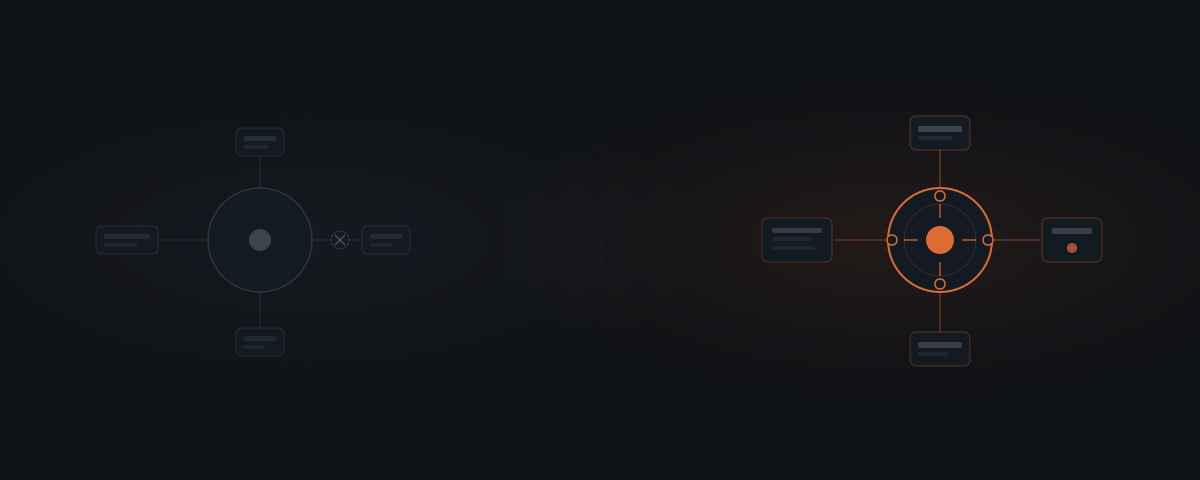
A custom agent is an AI agent built for one business's specific workflow, data structure, and output requirements. The language model underneath — Claude, GPT-5, Llama — is the same commodity technology every agent uses. What makes it custom is the integration layer, the workflow logic, and the approval controls built specifically for how that business operates. Off-the-shelf agents cover 80% of use cases well. Custom agents are built for the businesses whose 20% is the part that matters most.
An HR consultancy deploys an off-the-shelf agent to handle client onboarding emails. The agent works — mostly. But the firm's approval flow has three stages, not two. The client data format doesn't match the agent's field name assumptions. Outputs go to a custom CRM the tool doesn't natively connect to. Each gap gets a workaround. Three months in, the team spends more time managing the workarounds than the automation saves. A custom agent would have been built for those three requirements from day one.
What is a custom agent?
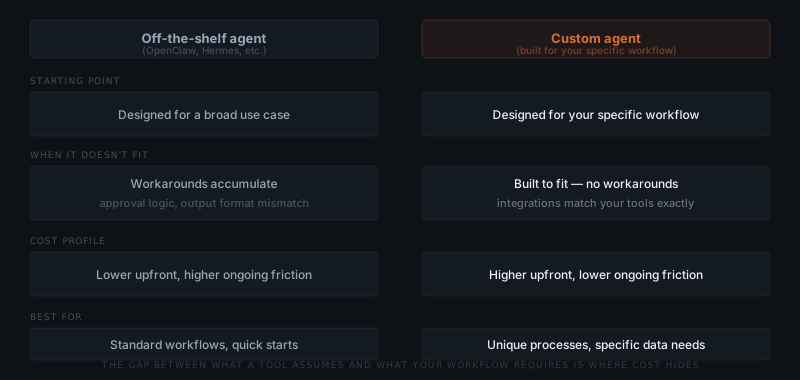
A custom agent is an AI agent built for one business's specific workflow, data structure, and output requirements. Off-the-shelf agents like OpenClaw or Hermes are designed for broad use cases — they work well when your workflow matches the assumptions they were built around. A custom agent is built when those assumptions don't fit.
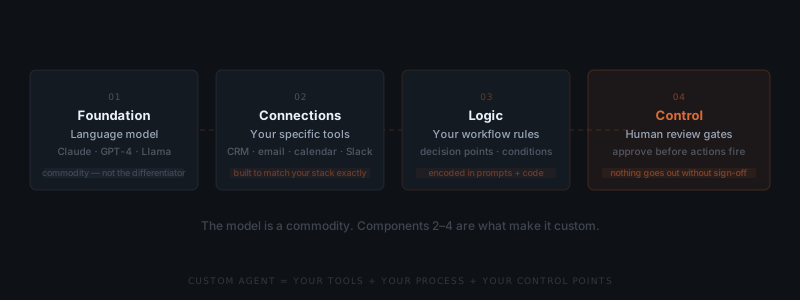
The language model that powers a custom agent — Claude, GPT-5, Llama — is a commodity. Every off-the-shelf agent uses the same models. The integration work, the workflow logic, the approval layer, and the output routing are what make an agent custom. That work is different for every business.
A custom agent does not mean building a new AI model. It means building the layer between the model and your specific business processes.
What makes an agent "custom"?
The model is not what makes an agent custom. Every agent — off-the-shelf or purpose-built — uses the same underlying language models from Anthropic, OpenAI, or Meta.
A custom agent is not a different AI model. It is the integration layer, workflow logic, and approval controls built specifically for your business. The model is a commodity. Everything built around it is what makes it custom.
| Component | Off-the-shelf | Custom |
|---|---|---|
| Language model | Shared commodity (GPT-5, Claude, Llama) | Shared commodity — same models |
| Integrations | Pre-built for common tools | Built for your specific tools at your permission level |
| Workflow logic | Generic — covers common patterns | Encoded for your exact decision flow |
| Approval controls | Configurable within tool limits | Designed for your oversight requirements |
| Output format | Standard — tool's assumed format | Matches your downstream system exactly |
| Data handling | Assumes standard field names and structure | Built around your actual data model |
The integrations connect to your specific tools — your ATS, not a generic CRM assumption. The workflow logic encodes which inputs trigger which actions, which edge cases escalate to a human, and which output format the downstream system expects. The approval controls reflect how your business actually reviews before acting. None of this is generic.
Custom or off-the-shelf: how do you decide?
The decision is not about preference. It is about whether the tool's assumptions match your workflow. When they do, off-the-shelf is faster and cheaper. When they don't, workarounds accumulate faster than the automation saves.
| Signal | Off-the-shelf is the right call | Custom build is the right call |
|---|---|---|
| Approval flow | Standard 1–2 step approval | 3+ stages or conditional routing |
| Output destination | Supported natively by the tool | Proprietary or non-standard system |
| Data format | Standard field names and structure | Industry-specific or custom schema |
| Tool stack | Common tools (HubSpot, Slack, Gmail) | Niche, proprietary, or legacy tools |
| Workaround count | Zero or one manageable gap | Multiple gaps each requiring custom code |
| Time horizon | Need to move in weeks | Can invest 4–8 weeks for the right fit |
| Budget | Under $5,000 for year 1 | Can invest $8,000–25,000 for year 1 |
The model is a commodity. The integration work is what makes it custom.
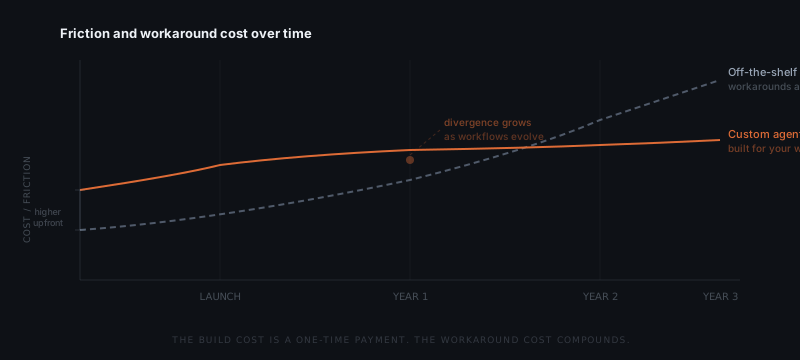
The clearest signal that off-the-shelf doesn't fit: you are writing custom code to bridge outputs to your tools. Each workaround adds maintenance overhead. Each update to the off-the-shelf tool risks breaking the workarounds. Over two to three years, the friction cost of a poor-fit tool often exceeds the build cost of a custom agent.
For a direct comparison of the two most common off-the-shelf options, see custom agent vs. off-the-shelf.
What does a custom agent build involve?
A custom agent build has four components that distinguish it from configuring an off-the-shelf product.
Foundation. Selecting the language model that fits the workflow's requirements — cost, speed, context window, and output consistency. For a workflow producing short, structured outputs at high volume, a smaller, faster model is often the right choice. For a workflow requiring nuanced reasoning across long documents, a more capable model justifies the higher cost.
Connections. Building integrations to your specific tools at the right permission level. A recruiting agency's custom agent connects to their ATS with read access to candidate records and write access to status fields — not a generic CRM integration that exposes more than it should.
Logic. Encoding the workflow decisions in prompts and code. Which inputs trigger the agent. Which outputs go where. Which cases escalate to a human and why. This is where the business's actual process gets translated into the agent's behaviour.
Control. Defining the approval layer. Where human review is required before the agent acts. How the agent logs its decisions for audit. A compliance consultancy may require sign-off on every client-facing output. A marketing firm may approve only external sends. This is configured per business, not per product.
How do you scope a custom agent build?
The businesses that build fast and with few surprises arrive with a documented process. The ones that struggle are defining the workflow during the build.
Document the workflow step by step
List your integration requirements
Define your approval and escalation points
Map edge cases before build begins
Set measurable success criteria
What does custom agent maintenance actually involve?
Most build estimates quote the build cost accurately and underestimate maintenance by 30–50%. Maintenance is not optional and it compounds.
Prompt drift. Business language changes. Clients begin asking for things differently. New service lines appear. The agent's instructions — written for how the business operated at build time — gradually diverge from how it operates now. Prompt updates are typically needed every 4–6 months for an actively used workflow.
Integration drift. Connected tools update their APIs. A CRM releases a new version that changes field names. An email platform changes authentication requirements. Each change can silently break part of the agent's workflow. Integration maintenance is not a one-time task.
Edge case accumulation. The agent was designed for the common cases. As it runs, it encounters situations not accounted for at build time. Each edge case either gets handled (through a maintenance update) or escalated to a human indefinitely. Unaddressed edge cases erode the agent's effective coverage over time.
How much does a custom agent cost?
The cost of a custom build depends on integration count, workflow complexity, and the number of edge cases handled at build time.
| Cost component | Typical range | Notes |
|---|---|---|
| Scoping and brief | $500–1,500 | Often credited toward build cost if proceeding |
| Build — single workflow | $5,000–15,000 | Depends on integration count and logic complexity |
| Build — 2–3 workflows | $10,000–25,000 | Integrations often shared, reducing marginal cost |
| Infrastructure and API — year 1 | $840–3,600 | Lower than off-the-shelf at low volume |
| Maintenance — year 2+ | $1,500–6,000/year | Prompt updates, integration drift, edge case handling |
| Total cost — year 1 | $8,000–25,000 | Scoping + build + year 1 infrastructure |
| Total cost — year 2+ | $1,500–6,000/year | Maintenance + infrastructure only |
The three-year total cost of a custom build often compares favourably with an off-the-shelf product that required significant workarounds — because the custom build's maintenance costs stay flat while the workaround costs compound. For the full comparison, see custom agent cost breakdown.
Understanding what a full agent implementation involves is the prerequisite to an accurate build estimate.
Frequently asked questions
What is a custom AI agent? A custom AI agent is built around one business, not a category of businesses — your tools, your approval flows, your process logic, instead of the generic assumptions an off-the-shelf product ships with. The underlying language model is the same commodity every agent runs on. The integration work is what turns it into something custom.
When should a business build a custom agent instead of using off-the-shelf? Build custom when off-the-shelf tools require significant workarounds: unusual approval chains, non-standard output formats, proprietary tool integrations, or data handling requirements that don't match the tool's assumptions. If you are writing custom code to bridge gaps in an off-the-shelf product, a custom build is almost always cheaper over a three-year horizon.
How much does it cost to build a custom agent? A single well-scoped workflow costs $5,000–15,000 to build. Two to three workflows sharing integrations typically cost $10,000–25,000. Year 2 maintenance runs $1,500–6,000/year for prompt updates, integration drift, and edge case handling. Total year 1 cost typically runs $8,000–25,000.
How long does it take to build a custom agent? A single well-scoped workflow takes four to eight weeks from brief to launch. Businesses that arrive with a fully documented process move significantly faster than those still defining the workflow during the build. Integration complexity — particularly non-standard or legacy tools — is the most common source of timeline extension.
What does custom agent maintenance involve? Maintenance covers prompt drift (business language changes over time), integration drift (connected tools update their APIs), and edge case accumulation (new situations the agent wasn't designed for). Most custom build estimates underestimate year 2 maintenance by 30–50%. Maintenance is ongoing, not optional.
What is the difference between a custom agent and off-the-shelf agents like OpenClaw or Hermes? OpenClaw and Hermes are purpose-built frameworks with defined architectures. A custom agent is built from scratch around your specific data model, tools, and process logic. Custom builds cost more upfront but have no architectural compromises — the approval model, integrations, and workflow logic are designed exactly for your requirements.