Hermes handles the research, report formatting, and client communication layer for boutique consultancies — across Slack and Gmail from a single deployment. Research summaries, status updates, and deliverable follow-ups surface for approval, not assembly. Skills build from completed deliverables, improving output on the firm's specific client types, output formats, and delivery patterns the longer Hermes operates.
Three hours on a Tuesday assembling a financial summary for a client who needs it by noon. Two hours on Thursday reformatting a market analysis into the firm's presentation template. An hour on Friday chasing a client who hasn't responded to last week's deliverable. None of these require the expertise the firm bills for. All of them consume the hours that do. Hermes handles the research, formatting, and communication layer — pulling data, drafting deliverables, queuing follow-ups — across Slack and Gmail from a single deployment. The consultants review and approve. The analysis stays with the people qualified to do it.
Where consultant hours actually go
McKinsey Global Institute found knowledge workers spend 28% of their week managing email and 19% gathering information — nearly half the workweek on tasks that don't require expert judgment.[¹] Microsoft's 2023 Work Trend Index, analyzing productivity signals from 31,000 workers in 31 countries, put that communication burden at 57% of the average knowledge worker's day when email, meetings, and chat are combined.[²] For a boutique consultancy with no dedicated research or ops staff, both categories fall directly on the consultants.
A fractional CFO spending three hours per week compiling a financial dashboard is spending three billable hours on assembly. An HR consultant spending two hours reformatting a benchmarking report is spending two hours on formatting. The analysis — the expert judgment that justifies the billing rate — sits behind the assembly work that precedes it. Hermes compresses that assembly phase so consultants spend their hours on the work clients are paying for.
The pattern repeats across professional services regardless of specialisation. For an operations consultant: two hours per week pulling activity data into a client report format, 30 minutes writing up post-meeting action items, 20 minutes chasing a client who hasn't signed off on last week's deliverable. None of these require the expertise the engagement was sold on. All of them appear on the timesheet. Hermes recaptures them without replacing the work that earns the billing rate.
How Hermes handles the research and synthesis layer
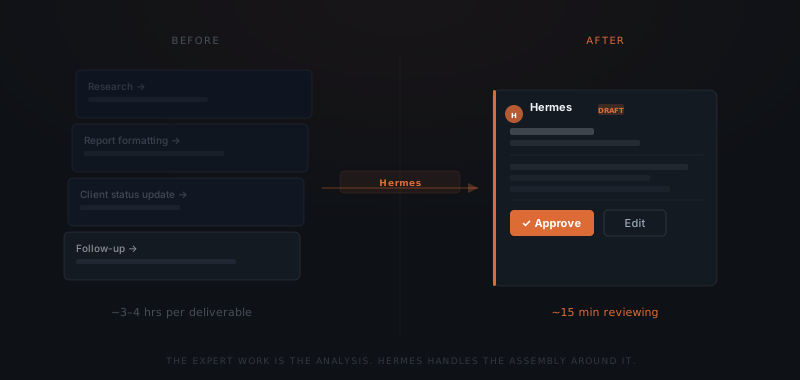
Hermes handles three categories of research work: gathering information from connected sources, summarising findings into a structured format, and assembling first-draft deliverables.
For a financial review, Hermes connects to the relevant data sources, pulls the required metrics, and produces a structured summary ready for the consultant to analyse and annotate. For a market analysis, Hermes searches for the required information, summarises the findings by category, and drafts the output in the firm's format. For a competitive landscape, Hermes pulls and structures the relevant data, producing a draft the consultant edits rather than a blank document to fill.
The consultant adds analysis and judgment. Hermes handles what precedes it.
| Workflow type | What Hermes does | Before Hermes | After Hermes |
|---|---|---|---|
| Financial dashboard compilation | Connects to data sources; formats metrics into structured summary | 2–3 hrs per week | 20 min to review and annotate |
| Market analysis first draft | Searches and summarises findings; formats to firm template | 2–4 hrs per report | 30–45 min to analyse and develop |
| Post-meeting action summary | Drafts action items from meeting notes; routes for approval | 30 min per meeting | 5 min to approve and send |
| Weekly status update | Pulls activity; drafts update in client format | 20–30 min per client | 5–10 min to review |
| Deliverable follow-up | Queues chase after deadline; routes for sign-off | Often forgotten or delayed | Runs on schedule; 1 min to approve |
| Benchmarking report formatting | Reformats data into firm's presentation template | 90–120 min | 15–20 min final review |
How Hermes handles client communication and follow-up
Client communication at a consultancy follows a predictable pattern: weekly status updates, post-meeting action item summaries, follow-ups on outstanding deliverables, and responses to ad hoc questions.
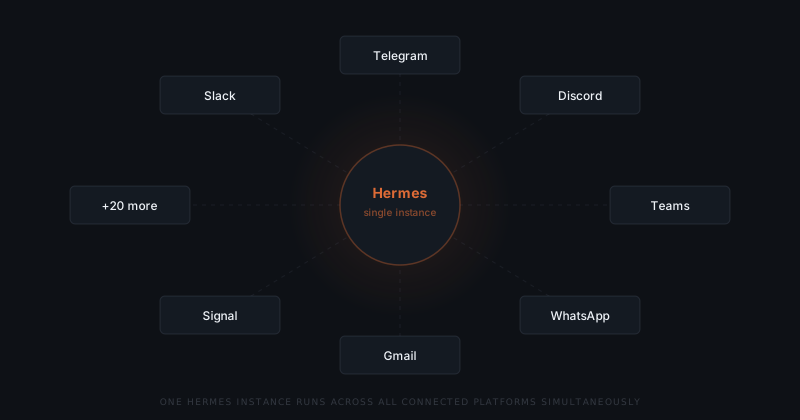
Hermes handles each category. For a weekly update, Hermes pulls the week's activity from the connected project tool, drafts the update in the firm's format, and surfaces it for the consultant's review. For post-meeting notes, Hermes drafts the action item summary from connected meeting notes and routes it for approval. For items past their expected delivery date, Hermes drafts the follow-up and queues it for sign-off.
Hermes does not send anything without human review. Every draft — status update, follow-up, research summary — routes to the relevant consultant for approval, edit, or dismissal before it goes anywhere.
Communication Skills compound the same way research Skills do. A Skill built from 20 post-meeting action item summaries for the same client understands that client's preferred level of detail, the terminology they use for action items, and the format they expect. The 21st meeting summary takes 5 minutes to review because the previous 20 have calibrated the Skill to that client's standards.
The consultant reviews the output. Hermes handles the production of it.
How Hermes encodes a consultancy's delivery patterns
The analysis is what clients pay for. Everything else is overhead.
Each completed deliverable adds a Skill object to Hermes's library — encoding the task category, the approach used, and input-output examples from the real work. Skills accumulate the longer Hermes operates on the firm's specific workflows.
For a consultancy, Hermes in month three produces first drafts that match the firm's house style, client terminology, and output format without prompting. A Skill library built from 20 client status updates for a compliance firm understands that firm's preferred level of regulatory detail, citation format, and summary structure — in a way a freshly deployed Hermes does not.
The practical effect: a deliverable that needed an hour of reformatting and tone editing in month one needs 10 minutes of review in month three. The consultant's judgment remains in the loop — applied at review, not at assembly.
What a consultancy Hermes deployment covers
A Hermes deployment for a consultancy starts with context definition — telling Hermes what the firm's clients look like, what the output formats are, and what the escalation patterns are. This step determines Skill quality from the first week.
Context definition for a consultancy deployment focuses on what "correct" looks like for each deliverable type: the output format for financial summaries, the structure of market analysis documents, the level of detail appropriate for different client tiers, and the terminology each client uses for their own business. Real examples — actual deliverables sent to actual clients — calibrate this faster than any template.
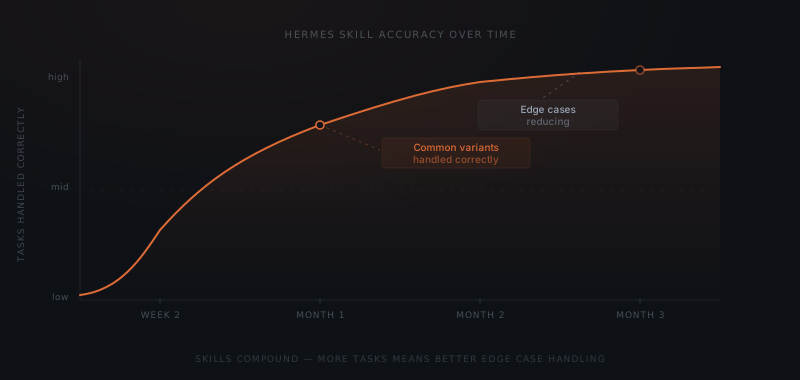
On day one, Hermes handles configured workflows at a baseline level. A research summary is structurally correct but needs editing for depth and analytical framing. A client update is in the right format but needs accuracy review. The output saves time from day one. It is not polished.
By month three, the Skill library built from real deliverables has encoded the firm's specific patterns. The gap between Hermes's first draft and a send-ready deliverable narrows as Skills accumulate from completed work. Hermes does not replace the consultant's expert judgment. Hermes handles the hours around it, so consultants can apply that judgment to more clients in the same week.
A consultancy that deploys Hermes with strong context definition — real deliverable examples, annotated for what makes each one correct — typically sees the correction time per deliverable drop from 30–45 minutes in week one to 5–10 minutes by month two. The Skill library is doing more of the calibration work that the consultant was doing manually.
For a full overview of Hermes and its learning mechanism, see what is Hermes. For when a consultancy's workflows need a purpose-built solution, see what is a custom agent.
The billable hours recovered from a Hermes deployment
The clearest way to frame the value of a Hermes deployment for a consultancy is in recovered billable time. Assembly work — data compilation, report formatting, status updates, follow-ups — is not billable. It is the overhead consultants carry on top of their billable client work.
A fractional CFO with 8 active retainer clients typically spends 2–3 hours per week per client on assembly tasks at the level described above. At 8 clients, that is 16–24 hours of non-billable work per week — 40–60% of a standard week. A Hermes deployment reduces this to 3–5 hours per week of review work (approving drafts, editing outputs, handling escalations).
The 11–19 recovered hours per week can go one of two directions: more clients at the same billing rate, or the same number of clients with more time for the deep analysis that differentiates the firm's work. Most consultancies opt for one then the other — handle capacity with the recovered hours first, then reinvest recovered time in higher-quality deliverables once the additional client load is absorbed.
What Hermes does not handle for a consultancy
Expert analysis and recommendations. Hermes assembles the first-draft financial summary. The consultant's interpretation of what the numbers mean, and what the client should do in response, is not produced by Hermes.
New methodology development. A framework the firm is building for the first time, a new analytical approach, or a novel deliverable format is not something Hermes handles until it has been built and the output format is defined. Hermes encodes patterns from completed work — it cannot originate methodology.
Client relationship management. The strategic decisions about how to handle a difficult client conversation, scope a new engagement, or navigate a complex stakeholder situation remain with the consultant.
Regulatory or legal review. Output from Hermes that contains regulatory references or legal implications should be reviewed by the relevant expert before delivery. Hermes handles the assembly and first draft; professional judgment governs the final content.
The scope boundary is clear in practice: Hermes handles everything the consultant currently does that does not require the expertise the engagement was sold on. That is usually 40–60% of their working hours. The rest — the analysis, the judgment calls, the strategy — stays where it belongs.
How context definition works for a consultancy
Context definition for a consultancy takes 1–3 days per workflow type. The key inputs are real deliverables — actual documents, reports, and status updates sent to actual clients, with annotations explaining what made each one correct.
The annotation work is the most important and most often skipped. A deliverable without annotation tells Hermes what the output looks like. An annotated deliverable tells Hermes why the output looked that way — which level of detail was appropriate for this client, which terminology they use, which format they expect. That distinction is what allows the Skill to generalise to new inputs rather than mimicking the specific examples provided.
For a consultancy that works across different client tiers — a mix of large enterprise and mid-market — separate context definitions per tier produce better Skill quality than a single context block trying to cover both. A market analysis for a Series B startup and a market analysis for a Fortune 500 client are different enough in format, depth, and terminology that the Skills should be separate.
How Hermes compares to other tools consultancies evaluate
Consultancies evaluating Hermes typically come from three directions: Notion AI or Confluence AI that summarizes within a single tool but does not pull from external sources or compose client-facing drafts, a ChatGPT Teams subscription where research assembly is manual and output is copy-pasted into deliverables, or a research VA who produces structured outputs but at fixed hours and hourly cost. All three produce something useful inside a constrained environment — Notion AI within Notion, a VA within their available hours, ChatGPT Teams within a session. Hermes connects to the tools the firm already uses, reads the relevant project data, and produces drafts in the firm's format — building from completed deliverables so that output quality improves on the specific client types and formats the firm actually works with.
Frequently asked questions
What types of research tasks can Hermes handle for a consultancy? Hermes handles research gathering, information synthesis, and first-draft formatting — pulling from connected data sources, summarising findings by category, and producing structured drafts in the firm's format. The consultant adds analysis and judgment. Hermes handles the assembly that precedes it.
Does Hermes replace the consultant's analysis? No. Hermes handles the research, formatting, and client communication layer — the work around the analysis. The expert judgment that justifies the billing rate remains with the consultant. Hermes handles the hours consumed by assembly, not the analysis itself.
How does Hermes improve on a consultancy's specific deliverables over time? Hermes builds a Skill object from each completed deliverable — encoding the task category, approach, and input-output examples. Skills accumulate from real work, so Hermes's output on the firm's specific client types, output formats, and delivery patterns improves the longer Hermes operates.
What tools does Hermes connect to for a consultancy deployment? Hermes connects to the tools the consultancy already uses: Gmail and Slack for communication, Notion or Confluence for knowledge management, and data sources relevant to each client engagement. Connections are scoped to what the configured workflows actually require — there is no requirement to connect every tool the firm uses, only the ones the specific workflows pull data from. For a fractional CFO, this typically includes the client's accounting software and the firm's own reporting templates. For a strategy consultant, it includes project management tools and any CRM that tracks client activity.
Does Hermes work for solo consultants or only teams? Hermes works for both. For a solo consultant with 6–8 active retainers, the communication and reporting layer consumes roughly the same proportion of working hours as it does for a small team — the difference is that there is no team to absorb the overflow. A solo deployment often produces the fastest visible return because there is no buffer between the assembly work and the billing capacity that replaces it.
Notes
- McKinsey Global Institute, The social economy: Unlocking value and productivity through social technologies, 2012. https://www.mckinsey.com/industries/technology-media-and-telecommunications/our-insights/the-social-economy
- Microsoft, "Will AI Fix Work?" Work Trend Index Annual Report 2023, Microsoft, 2023. https://www.microsoft.com/en-us/worklab/work-trend-index/will-ai-fix-work
For a full overview of how Hermes learns and builds Skills from completed work, see how Hermes learns.