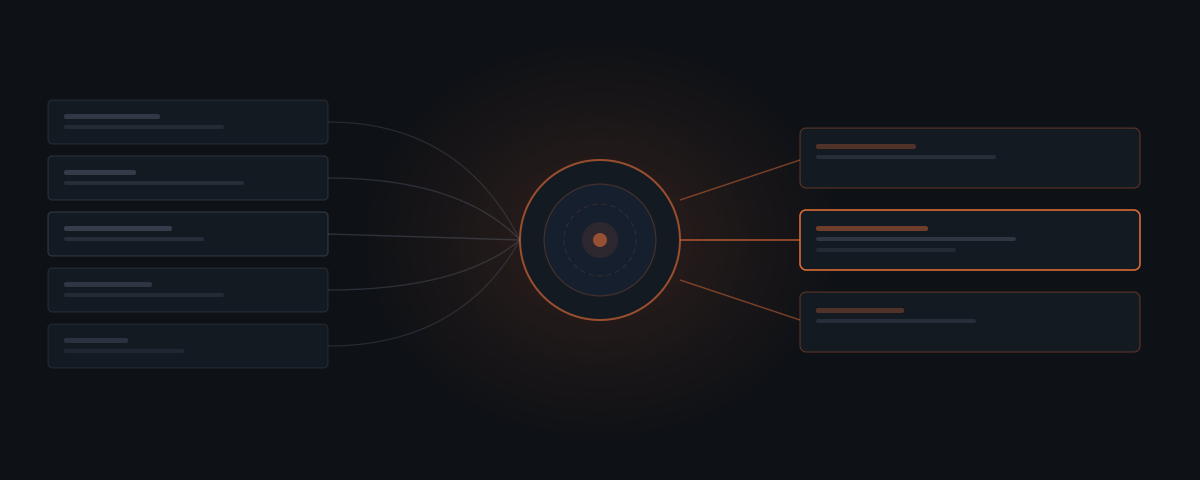
Hermes handles the repeatable communication and admin layer that absorbs a solo founder's week — inbox triage, prospect follow-ups, research drafts, and status updates — across Slack and Gmail from a single deployment. Each draft surfaces for approval before anything sends. Skills build from completed tasks, improving output on the founder's specific clients, communication style, and workflow patterns the longer Hermes operates.
Monday morning. The prospect who asked for a proposal on Thursday hasn't heard back. The client expecting a weekly update hasn't received one. The competitive research for a new pitch is still a tab of browser bookmarks. None of these tasks require the founder's judgment. All of them require the founder's time. Without support staff, there's no one else. Hermes handles the communication and research layer — drafting follow-ups, assembling updates, structuring research — across Slack and Gmail from a single deployment. The founder reviews and approves. Nothing sends without sign-off.
What fills a solo founder's week that shouldn't need them
McKinsey Global Institute found knowledge workers spend 28% of their week managing email and 19% gathering information — together nearly half the workweek.[¹] Microsoft's 2023 Work Trend Index found that figure has grown: across 31,000 workers in 31 countries, 57% of time now goes to communication tasks — email, meetings, and chat — leaving less than half the day for work that requires judgment or expertise.[²] For a solo founder with no support staff, both categories fall entirely on them. There's no assistant to triage the inbox. No coordinator to chase outstanding deliverables. No ops person to compile the weekly report.
The tasks consuming founder time aren't the decisions that require their judgment. They're the communication and admin work wrapped around those decisions. Following up on a proposal that went quiet. Drafting a client status update. Pulling together a competitive summary for a new pitch. Each takes 20–40 minutes. None of them require the founder. Hermes handles them.
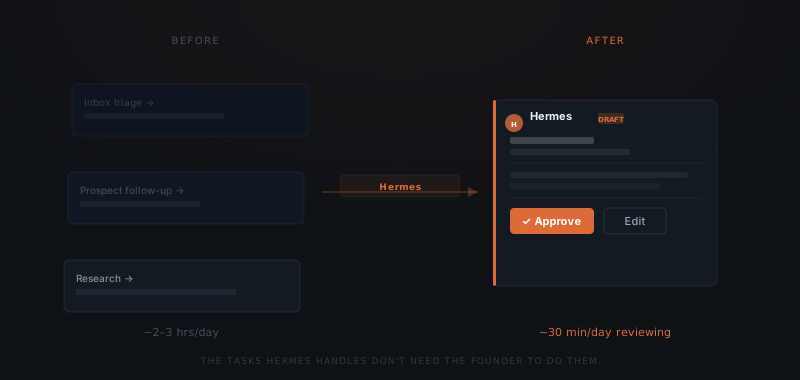
A solo founder with 8 active clients and 5–10 active prospects spends — at conservative estimates — 60–80 minutes per week on status updates, 90 minutes on prospect follow-ups, 60–90 minutes on research, and another 30–45 minutes on ad hoc inbox triage. That is 4–5 hours per week on communication and research before any client work starts. A Hermes deployment reduces this to 30–40 minutes of draft review for the same output. The founder does not need more time — they need the time they have spent on different work.
How Hermes handles the founder's communication layer
Hermes watches the connected channels — Slack, Gmail, or both — and handles the communication work that currently consumes the founder's attention.
For an unanswered prospect email sitting past 48 hours, Hermes drafts the follow-up and queues it for approval. For a client expecting a weekly update, Hermes pulls the week's activity from the connected project tool, drafts the update, and surfaces it for a 90-second review. For an incoming question Hermes can answer from context, Hermes drafts the reply and routes it for approval before sending.
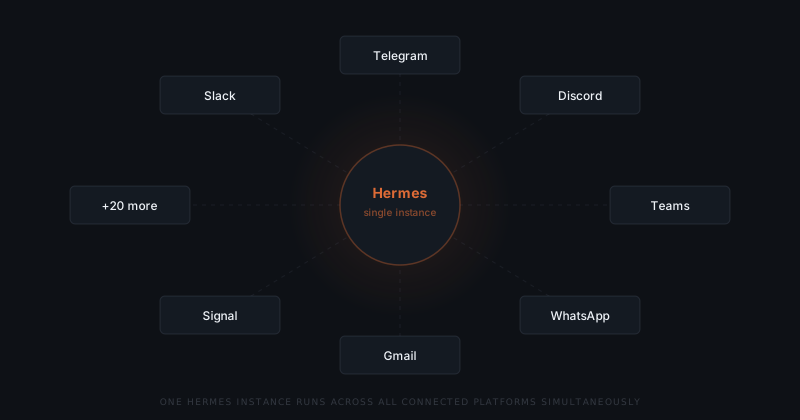
Hermes runs a single instance across Slack, Gmail, and any other connected platform simultaneously. A client message in Slack, a prospect email in Gmail, an internal note in Telegram — Hermes handles all three from one deployment. Skills built on one channel carry to the others.
The founder reviews and approves. Nothing sends without sign-off.
| Task type | What Hermes does | Before Hermes | After Hermes |
|---|---|---|---|
| Unanswered prospect follow-up | Drafts follow-up at configured interval; queues for approval | 20–30 min to compose | 2 min to review and send |
| Weekly client update | Pulls activity from project tool; drafts update in founder's format | 20–30 min per client | 90 sec to review |
| Incoming client question | Drafts response from available context; routes for approval | 15–20 min per thread | 2 min to approve or edit |
| Competitive research | Searches, summarises, structures as draft document | 60–90 min per brief | 20–30 min to edit |
| Meeting prep brief | Pulls recent communications; summarises context and key points | 30–45 min | 5 min to review |
| Report assembly | Pulls relevant data; formats into draft structure | 60–90 min | 15–20 min final review |
How Hermes handles research and prep work
Research is a different category of task. Competitive research for a new pitch. Background on a prospect before a first call. A market summary for a proposal. Each takes 60–90 minutes of reading, tab-switching, and note-taking.
Hermes searches, reads, and structures findings into a draft document ready for the founder to edit. For meeting prep, Hermes pulls recent communications with the contact, summarises the context, and produces a brief. For a proposal section, Hermes pulls relevant data, structures the findings, and drafts the content.
Every assistant needs managing. Hermes handles the admin that doesn't.
The output is a starting point, not a finished product. The founder edits and approves. Hermes handles the assembly.
How Hermes improves on a founder's specific patterns over time
Hermes creates a Skill object from each completed task — encoding the task category, the approach used, and examples from the actual work. Skills accumulate from real tasks completed on the founder's specific workflows, clients, and communication patterns.
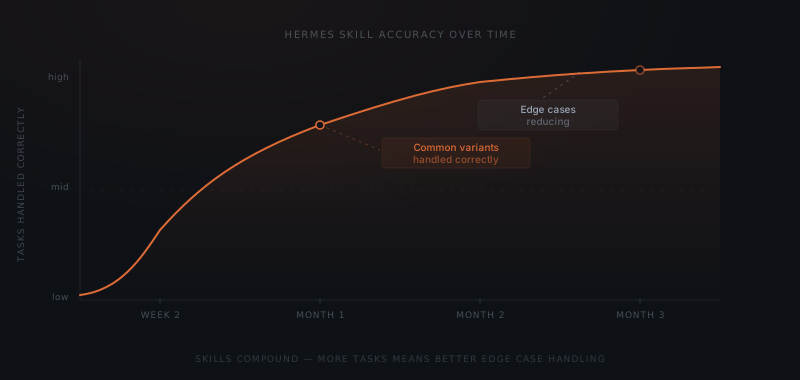
For a solo founder, Hermes in month three produces draft follow-ups that read closer to the founder's voice than the drafts in week one. Research summaries in month three match the structure and depth the founder expects without prompting. A Skill built from 15 prospect follow-ups for a specific client type understands the founder's tone, context, and preferred call to action in a way a freshly deployed Hermes does not.
The time the founder spends editing each draft decreases as Skills accumulate. The goal isn't autonomous operation — it's the review taking 90 seconds instead of the task taking 30 minutes.
For a founder, the Skill compounding is most visible on the highest-volume tasks. Prospect follow-ups — which a founder handling 10 active opportunities sends multiple times per week — accumulate Skill examples faster than ad hoc research requests. By month two, the prospect follow-up Skill understands the founder's preferred opening, their specific CTA format, and how long they typically wait before following up a second time. The review is a final check for accuracy, not a composition task.
The research Skill takes longer to mature because research requests are lower-frequency and more variable. But by month three, a research summary request on a familiar topic — a competitor the founder has researched before, a market the founder knows — produces a first draft that requires adding analysis, not building structure.
What a founder Hermes deployment looks like
A solo founder Hermes deployment starts with three connections: the inbox (Gmail), the communication tool (Slack), and the project or knowledge tool (Notion or equivalent). Context definition — telling Hermes what the founder's clients look like, what the output formats are, and what the escalation patterns are — determines Skill quality from the first week.
On day one, Hermes handles configured workflows at a baseline level. A draft follow-up is structurally correct but needs tone editing. A research summary is well-organised but needs depth added. The output saves time from day one. It does not replace the founder's review.
What the first month looks like in practice: the founder reviews every draft in weeks one and two. The correction rate is higher — but every correction is an example that improves the Skill. By week three, the correction rate on common task types starts to drop. By the end of month one, the drafts for established client communication types need minimal editing. By month two, the review process is what it should be: a quick check before sending, not a composition session.
By month three, Skills built from completed tasks have encoded the founder's specific patterns. The same follow-up that took 25 minutes to write in week one takes 2 minutes to review in month three. Hermes does not replace the founder's judgment on strategy, priorities, or relationships. Hermes handles the communication and research layer that consumes the time those judgments should be made in.
The visible output of a Hermes deployment for a founder is not a different quality of work — it is the same quality of work produced by a founder who now has 4–5 extra hours per week for the decisions and relationships that drive the business forward.
For a full overview of what Hermes is and how it works, see what is Hermes. For how AI agents compare to the tools founders already use, see AI agent vs. automation.
What Hermes does not handle for a founder
Understanding what Hermes does not do prevents the most common deployment disappointment: expecting Hermes to replace judgment, not assembly.
Business decisions and strategy. Hermes handles the communication layer. Whether to take on a new client, how to price a project, what to include in a proposal pitch — these require the founder's context and judgment. Hermes drafts the follow-up after the decision is made. It does not make the decision.
Sales conversations and relationship development. A first call with a new prospect is relationship work. Hermes handles the follow-up after the call — drafting the summary email, queuing the next touchpoint — but the conversation itself stays with the founder.
Novel situations without prior examples. Hermes improves on patterns it has seen before. A situation the founder has never encountered before — a genuinely unusual client request, an unexpected market development requiring a new approach — requires human judgment until it has happened enough times to become a pattern the Skill can encode. This is not a Hermes limitation; it is a constraint that applies equally to any AI or human assistant unfamiliar with the situation.
Financial and contractual decisions. Hermes can draft a proposal. Whether to agree to a contract term, how to respond to a payment dispute, or whether to extend credit to a client — these stay with the founder.
How to set up context definition for a founder deployment
Context definition is the step that determines whether Hermes's drafts save time from week one or require constant correction until the Skill calibrates. The quality of input examples determines the quality of output from day one.
For a founder, context definition requires: examples of actual emails sent to clients (not templates, not descriptions), examples of actual prospect follow-ups with the founder's specific tone, examples of research outputs the founder has created and found useful, and the founder's name for escalations (in this case, always themselves — with a defined path for what warrants human composition versus draft review).
Real examples produce Skills that understand the founder's actual communication style. Generic templates produce Skills that handle generic communication. The founder who provides five real prospect follow-ups with annotations about what made each one effective will have a noticeably different skill quality by week three than the founder who provides a follow-up template.
How Hermes compares to other approaches founders evaluate
The two most common alternatives founders consider are a virtual assistant and a general AI writing tool like ChatGPT or Claude used directly. A VA handles the same communication tasks but requires active management: onboarding, feedback cycles, availability windows, and a fixed cost that runs whether the workload justifies it that week or not. A direct AI writing tool produces drafts on demand but with no persistent memory of client context — the founder briefs it fresh each session, which shifts the overhead rather than removing it. Hermes differs on both dimensions: it operates from a persistent context definition built once from real examples, improves from every completed task without explicit instruction, and queues drafts for the founder's approval rather than requiring the founder to prompt for each one. The management overhead is replaced by a review step.
Frequently asked questions
What types of tasks can Hermes handle for a solo founder? Hermes handles the repeatable communication and research layer of a founder's week — inbox triage, prospect and client follow-ups, status updates, research summaries, and meeting prep. Each output is surfaced for the founder's approval before anything sends.
Does Hermes work across multiple platforms for a single founder? Yes. Hermes runs a single instance across all connected platforms — Slack, Gmail, Telegram, and others — simultaneously. Skills built from a task on one channel carry to the others. There's no separate setup per platform.
How much editing does Hermes's output need? In the first two to four weeks, drafts typically need moderate editing — structure is correct but tone and client-specific detail need adjusting. By month three, Skills built from completed tasks produce output that requires less editing. The rate of improvement depends on task volume and how accurately context was defined at setup.
What's the difference between Hermes and a virtual assistant? A virtual assistant requires onboarding, management, and ongoing communication overhead. Hermes starts from context definition and produces drafts for approval — no management overhead, no onboarding period beyond context setup. Hermes also improves over time: a VA learns preferences through conversation; Hermes encodes them into Skills from every task it completes.
What does context definition look like for a solo founder with no ops team? The founder does the context definition themselves — typically one to three hours per workflow type. The key inputs are real examples: actual emails sent to clients, actual prospect follow-ups, actual research outputs the founder has used. Generic templates do not produce the same Skill quality as real examples. The founder who can pull 5–10 actual examples of each task type from their sent mail folder will have a noticeably better Skill library by week three than one who writes examples from memory.
Does Hermes work during high-travel or unavailable periods? Hermes queues drafts for approval and waits. If the founder is unavailable for 48 hours, the approval queue accumulates but nothing sends without sign-off. The queue clears when the founder returns. This is a feature, not a limitation — Hermes does not send unsanctioned communication when the founder is unreachable.
Notes
- McKinsey Global Institute, The social economy: Unlocking value and productivity through social technologies, 2012. https://www.mckinsey.com/industries/technology-media-and-telecommunications/our-insights/the-social-economy
- Microsoft, "Will AI Fix Work?" Work Trend Index Annual Report 2023, Microsoft, 2023. https://www.microsoft.com/en-us/worklab/work-trend-index/will-ai-fix-work
For a full guide to deploying Hermes and writing context definitions that determine Skill quality from day one, see the Hermes setup guide. For a full explanation of how Skills compound over time, see how Hermes learns.