canonote
A markdown notebook your agent can write into.
Markdown, one representation, a name on every edit.
canonote stores markdown and nothing else: the editor shows the same text an agent reads, with no HTML copy and no rich-text model in between. An agent's edit lands in the note marked with its author and a rule down the side; a change it wants to discuss arrives as a proposal that never touches the text until a person applies it. Any earlier version restores in one click. No account, no server - your notes live in your browser.
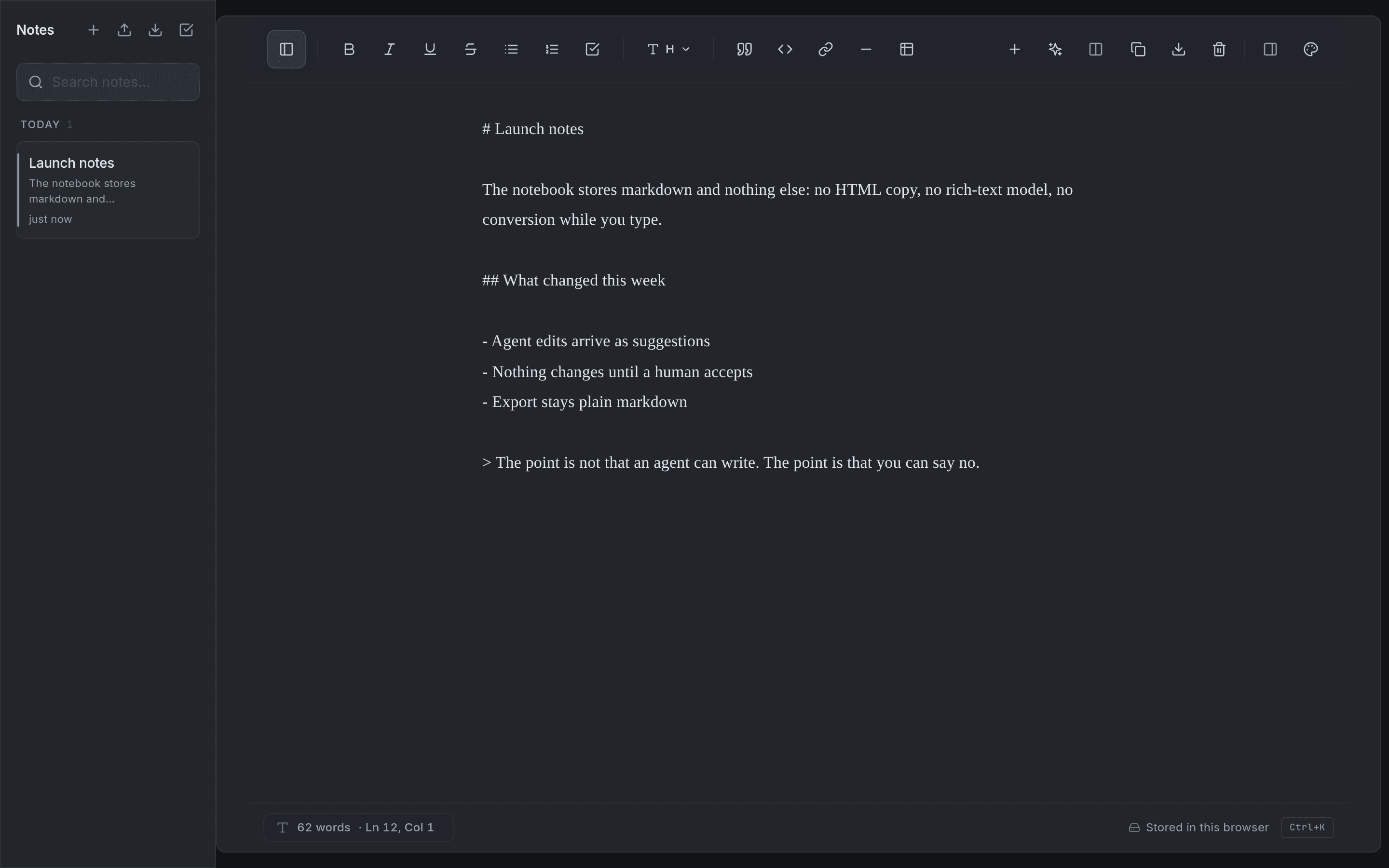
Written by an agent, still your note.
One representation
Editor, storage, export and the agent all read and write the same markdown - no conversion, no second copy to drift.
Edits wear a name
An agent's text is marked with its author and a rule down the left of every line it wrote, and the version before it is one click away.
Proposals, not rewrites
A change an agent wants to discuss waits on the note's thread until a person applies it.
Notes that come with you
IndexedDB by default, an ordinary folder of .md files if you prefer, and export to markdown, HTML, plain text or a ZIP.
Open it and start typing.
- Open the notebookcanonote.vercel.app needs no account and no install; the notes stay in the browser's own storage.
- Give an agent accessThe agent API is part of the optional hosted layer. On the hosted app, sign in and issue a scoped, revocable key; on your own install, point it at a database first.
- Review the writeThe edit appears in the note under the agent's name, with the previous version one click away.
- Keep a copyExport everything, or point the notebook at a folder your own drive already syncs.
Local-first, and honest about it.
Without a backend the notebook works entirely in the browser. Pointed at a folder, every note is one .md file any other program can read. Nothing is sent anywhere unless you connect an agent or a sync service yourself.
A notebook your agent cannot quietly rewrite.
Free, MIT, and small enough to read before you trust it with a note.
View source on GitHub