A patient calls Monday morning to book an appointment. Someone at the front desk takes the call, checks the schedule, confirms the slot, sends a reminder to the patient's email, and logs the booking. The same process runs fifty times that week. None of it requires clinical training. All of it consumes the hours that practices pay clinical staff to spend on patient care. An AI agent handles that scheduling and communication layer — confirmations, reminders, no-show follow-up, post-visit review requests — so the team's attention goes to the exam room.
A patient calls Monday morning to book an appointment. Someone at the front desk takes the call, checks the schedule, confirms the slot, sends a reminder to the patient's email, and logs the booking. The same process runs fifty times that week. None of it requires clinical training. All of it consumes the hours that practices pay clinical staff to spend on patient care. An AI agent handles that scheduling and communication layer — confirmations, reminders, no-show follow-up, post-visit review requests — so the team's attention goes to the exam room.
Where healthcare practice hours go
The American Medical Association tracks how physicians spend their working hours. The 2024 AMA data shows that for every hour of direct patient care, physicians spend nearly two additional hours on EHR entries and administrative deskwork — including one to two additional hours at home in the evenings.[¹] The clinical training physicians spend years acquiring is being consumed by scheduling coordination, documentation overhead, and communication sequences.
Front desk and administrative staff face the same compression from the other direction. A medical office staff member's week consists primarily of scheduling calls, confirmation messages, reminder follow-up, insurance verification, and intake paperwork — tasks with defined processes, predictable inputs, and known outputs.[²]
Administrative inefficiency costs the U.S. healthcare system an estimated $265 billion annually.[³] That figure includes billing complexity, insurance coordination, and compliance overhead — but a significant share comes from the basic communication layer every practice runs manually: the appointment confirmations, the reminder sequences, the no-show follow-up calls, the post-visit satisfaction requests.
| Administrative task | Average weekly volume (10-provider practice) | Requires clinical training? |
|---|---|---|
| Appointment scheduling | 40–80 bookings | No |
| Confirmation messages | 40–80 outbound | No |
| 48-hour reminders | 40–80 outbound | No |
| 2-hour reminders | 40–80 outbound | No |
| No-show follow-up | 5–15 outreach | No |
| Post-visit review request | 40–80 outbound | No |
| Intake form collection | 40–80 distributed | No |
None of the tasks in this table require clinical judgment. All of them occupy clinical staff hours that could go to direct patient care or genuine administrative complexity.
What AI agents handle in a healthcare practice
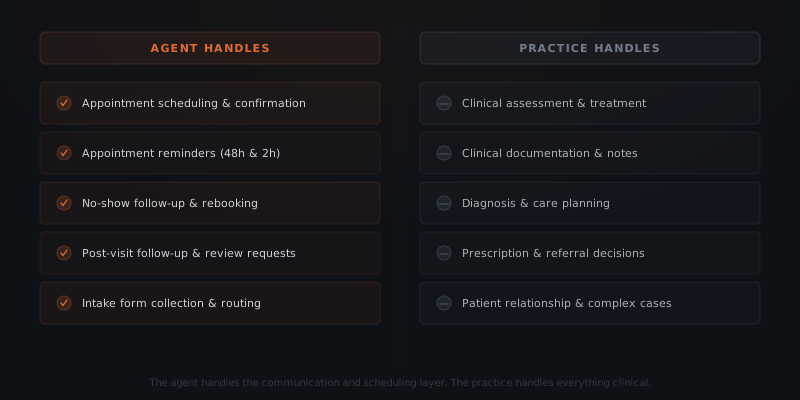
An AI agent for a healthcare practice handles the patient-facing communication and scheduling coordination that runs between appointment booking and the exam room. The agent reads appointment data from the connected practice management system, drafts the appropriate communication, and queues it for staff review before anything goes to a patient.
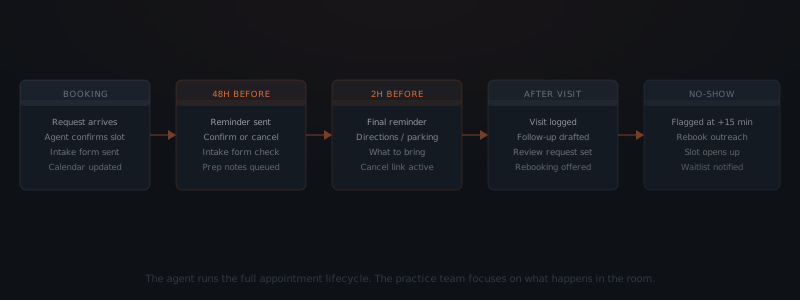
Appointment confirmation covers the communication immediately after booking. When a patient books — by phone, online form, or patient portal — the agent sends a confirmation with the appointment details, location, and any preparation instructions for the visit type. The confirmation arrives within minutes of booking instead of the next available staff moment.
Reminder sequences run automatically on a defined schedule. The agent sends a 48-hour reminder with an appointment summary and a confirmation link. The patient clicks to confirm or cancel. If no response arrives, a 2-hour reminder goes out on the morning of the appointment. Each message is drafted by the agent and sent under the practice's name from the practice's communication channel.
No-show follow-up turns a missed appointment into a rebooking opportunity. When a patient does not arrive within 15 minutes of their scheduled time, the agent flags the no-show and triggers an outreach sequence — a same-day rebooking offer and a waitlist notification to fill the slot. No-show rates at practices using automated reminder sequences drop 20–30% compared to manual reminder systems.[⁴]
Post-visit follow-up handles the communication that should happen after every appointment but rarely does consistently. The day after a visit, the agent sends a follow-up message — a thank-you, a reminder for any recommended next steps that were discussed, and a satisfaction or review request. Review requests sent within 24–48 hours of a visit convert significantly better than requests sent weeks later, because the experience is recent.
Intake form collection distributes forms before the appointment rather than in the waiting room. When a new patient books, the agent sends the intake packet with a completion deadline two days before the visit. Forms arrive completed. The front desk reviews them before the appointment. Clinician preparation time drops because the intake data is already in the system.
An AI agent handles the communication and scheduling coordination layer. An AI agent does not access clinical health records, make care decisions, answer clinical questions, or communicate any patient health information requiring HIPAA-covered handling. Every message goes through staff review before reaching a patient.
The no-show problem and what actually solves it
A missed appointment is a scheduling failure, not a patient failure. The reminder that didn't arrive is what created the no-show.
Healthcare practice no-show rates average 5–30% depending on specialty and patient population.[⁴] Each missed appointment costs the practice the appointment value — typically $150–$400 for a standard visit — plus the slot that could have gone to another patient. A practice with 200 weekly appointments and a 15% no-show rate loses 30 appointments per week to patients who didn't receive an effective reminder or couldn't easily cancel and rebook.
Manual reminder systems fail because they are inconsistent. A front desk team handling scheduling, check-in, phone calls, and paperwork simultaneously sends reminders when time allows. High-volume periods — Monday mornings, post-holiday weeks, summer vacation staffing gaps — produce inconsistent reminder coverage. The patients who get reminders show up. The patients who don't, often don't.
Automated reminder sequences eliminate the inconsistency. Every booked appointment receives the same sequence at the same timing: confirmation within minutes, 48-hour reminder, 2-hour reminder, response tracking, and no-show follow-up if needed. The variable is not whether the reminder goes out — it is whether the patient responds.
Research on appointment reminder effectiveness consistently shows that multi-touchpoint automated sequences (confirmation + 48h + 2h) outperform single-reminder or phone-call-only approaches by 15–25% in no-show reduction.[⁵] The mechanism is not that the patient needed more convincing — it is that the reminder system worked consistently instead of inconsistently.
The slot recovery piece adds another layer. When a patient cancels through the reminder link, the slot is available immediately. The agent notifies the waitlist. A waitlisted patient takes the slot. The practice fills the calendar without a phone call, without a manual search through the waitlist, and without a front desk team member spending 20 minutes on callbacks.
How the agent connects to practice management software
Healthcare practices run on dedicated practice management software. AI agents connect to the tools already in use rather than requiring a migration.
| Tool category | Common platforms | What the agent reads or writes |
|---|---|---|
| Practice management | Jane App, Cliniko, SimplePractice, DrChrono, Practice Fusion | Reads appointment data, writes confirmations, updates status |
| Email / SMS | Gmail, Outlook, Twilio, EHR messaging | Sends reminders and follow-up, reads patient responses |
| Patient portal | Health Gorilla, Klara, patient portal API | Distributes intake forms, reads completion status |
| Calendar | Google Calendar, Microsoft 365 | Reads availability, confirms slot changes |
| Reviews | Google Business Profile, Healthgrades | Triggers post-visit review requests |
The integration scope determines implementation speed. A practice running Jane App or SimplePractice with Gmail can go live in two to three weeks. The agent reads appointment data from the practice management system, sends communications through the existing email and SMS channels, and updates appointment status back into the system. No new tools required.
Practices with existing EHR-integrated patient portals add one connection to the intake form workflow. The agent distributes the intake packet through the portal and reads completion status before the appointment date.
See what AI agent implementation actually costs for a small business for a full cost breakdown across tool configurations.
What goes live first and how long it takes
Healthcare agent implementations start with the scheduling communication layer — the sequence every practice already runs, but manually.
Scoping
Map the current scheduling communication process — who sends reminders, when, through what channel. Identify the practice management system and confirm API availability. Define which message types the agent handles and the approval flow for each.
Integration
Connect the agent to the practice management system, email provider, and SMS platform where applicable. Map the data fields the agent reads — patient name, appointment date, appointment type, provider, location.
Template build
Draft the message templates for each sequence point — confirmation, 48-hour reminder, 2-hour reminder, no-show follow-up, post-visit follow-up. The practice reviews and edits each template until the language reflects the practice's communication style.
Approval workflow
Set the review process. For standard communication sequences (reminders, confirmations), the practice may set auto-approval after a two-week monitoring period. For no-show follow-up and post-visit messages, staff reviews each draft before it sends.
Go-live
The confirmation and reminder sequence goes live. The practice monitors outputs for two weeks, flags adjustments, and the agent refines. No-show follow-up and intake form sequences are added in weeks three and four.
A standard implementation covering appointment confirmations, reminders, and no-show follow-up goes from scoping call to first live sequence in two to three weeks. Post-visit follow-up and intake form automation typically follow in week four.
The capacity shift becomes visible within the first month. A front desk team that spent two to three hours daily on reminder calls and confirmation follow-up has that time returned to in-person patient interaction, phone triage for clinical questions, and insurance coordination — the tasks that actually require human presence.
Gartner projects that by end 2026, 85% of healthcare organizations will have deployed at least one AI agent in clinical or administrative workflows.[⁶] Practices that build the administrative communication layer now spend less time catching up and more time on the margin improvement that follows consistent scheduling and reduced no-shows.
Frequently asked questions
How can AI agents help a healthcare practice? AI agents help healthcare practices by handling the patient communication and scheduling coordination layer — appointment confirmations, 48-hour and 2-hour reminders, no-show follow-up and rebooking outreach, intake form collection, and post-visit review requests. The agent drafts each message and queues it for staff review before anything reaches a patient. Practices using automated reminder sequences reduce no-show rates by 20–30% and return front desk hours to in-person patient interaction.
What healthcare admin tasks can an AI agent automate? An AI agent automates appointment confirmation sequences, multi-touchpoint reminders, no-show follow-up and rebooking outreach, intake form distribution and collection, post-visit satisfaction requests, and returning patient recall sequences. Tasks requiring clinical judgment — care plan discussions, prescription questions, and urgent symptom triage — route to a licensed staff member immediately. AI agents handle the scheduling communication layer; clinical communication stays with clinical staff.
Does a healthcare AI agent work with practice management software? AI agents connect to practice management software — including Jane App, Cliniko, SimplePractice, Practice Fusion, and DrChrono — through standard API integrations. The agent reads appointment data and patient contact records, and writes confirmed bookings, logged communications, and appointment status updates back into the system. No migration to a new platform is required. The agent works with the software the practice already uses.
What does a healthcare practice AI agent implementation cost? A standard implementation covering appointment scheduling, reminders, and no-show follow-up typically runs $2,000–$5,000 for the initial build, depending on the practice management system and the number of communication sequences. Monthly operating costs at typical appointment volumes run under $100. A practice reducing no-shows by 15–20% at an average appointment value of $150–$300 recovers implementation cost within weeks. Post-visit recall sequences are typically added in a second phase.
Notes
- American Medical Association, "Doctors work fewer hours, but the EHR still follows them home." 2024. https://www.ama-assn.org/practice-management/physician-health/doctors-work-fewer-hours-ehr-still-follows-them-home
- MGMA, "Data Mine: The administrative burden of operating a medical group." https://www.mgma.com/articles/data-mine-the-administrative-burden-of-operating-a-medical-group
- Wellbeing Magazine, "How Healthcare Practices Can Reduce Administrative Burden and Improve Patient Care in 2026." https://wellbeingmagazine.com/how-healthcare-practices-can-reduce-administrative-burden-and-improve-patient-care-in-2026/
- Upskillist, "AI Agents in Healthcare: Top Examples and Use Cases 2026." https://www.upskillist.com/blog/top-ai-agents-use-case-for-healthcare-in-2025/
- DrChrono Blog, "How to Reduce Administrative Burden in Healthcare with Technology." 2025. https://drchrono.com/blog/2025/11/how-to-reduce-administrative-burden-in-healthcare-with-technology/
- Gartner, cited in TATEEDA Global, "2026 AI Trends in US Healthcare." https://tateeda.com/blog/ai-trends-in-us-healthcare