Monday morning at a five-person ecommerce team: forty weekend tickets to process, half of them asking where an order is. None of it requires expertise. All of it competes with the work that actually grows the business. An AI agent handles that layer — order status replies, return sequences, shipping delay notifications, post-delivery review requests — drafting each one and queuing it for approval so the team's time goes to product, growth, and the cases that actually need a human.
Monday morning at a five-person ecommerce team: forty weekend tickets to process, half of them asking where an order is. None of it requires expertise. All of it competes with the work that actually grows the business. An AI agent handles that layer — order status replies, return sequences, shipping delay notifications, post-delivery review requests — drafting each one and queuing it for approval so the team's time goes to product, growth, and the cases that actually need a human. That drafting-and-approval pattern is a direct application of what an AI agent is: a system that executes the repeatable part of a workflow and defers the judgment calls.
Where ecommerce team hours actually go
Ecommerce customer service runs on a small set of recurring questions. Industry analysis consistently finds that 60–80% of support tickets across most stores fall into five categories: order status checks, return and refund requests, shipping delay questions, product inquiries, and post-delivery follow-up.[¹]
None of these require expertise. All of them take time.
Small ecommerce businesses spend up to 15% of revenue on customer support — three times the 5% figure for larger operators who have automated the tier-1 layer.[²] The difference is not service quality. Larger operations have already taken the repeatable questions out of the ticket queue. When a customer asks "where is my order?" at 11pm on a Sunday, the answer comes from a system, not a team member who saw it first thing Monday.
In-house ecommerce customer service costs $8–$20 per ticket once agent labor, management overhead, helpdesk software, and staff turnover costs are fully loaded.[²] Customer service roles at ecommerce companies turn over at 30–45% annually, making each trained agent genuinely expensive to replace.[¹] The ticket volume doesn't shrink when a team member leaves. The remaining team absorbs it until backfill is complete.
| Ticket type | Typical volume share | Requires human judgment? |
|---|---|---|
| Order status check | 25–35% | No |
| Return initiation | 15–25% | No (standard policy) |
| Shipping delay inquiry | 10–20% | No |
| Product question | 10–15% | Sometimes |
| Review request / follow-up | 5–10% | No |
| Escalation / complaint | 5–10% | Yes |
The first four categories are repeatable processes with defined inputs and outputs. The sixth is the work that actually requires a human. An AI agent runs the first four. The team focuses on the sixth.
What AI agents handle in an ecommerce store
An AI agent for an ecommerce store handles the communication layer around orders. The agent reads order data from the connected store platform, determines the right response type, drafts the message, and queues it for approval before it reaches the customer.
Order status replies cover the most common ticket type. When a customer sends a "where is my order?" message, the agent reads the order record, checks fulfillment status in Shopify or WooCommerce, and drafts a reply with the current status and tracking link. No manual lookup. No ticket assignment. No delay until the team opens their helpdesk.
Return and refund sequences follow defined policy. When a return request arrives matching standard criteria — within the return window, eligible product category — the agent initiates the sequence: confirmation message, return label generation trigger, and a processing timeline for the refund. Cases outside policy criteria — late returns, damaged-on-arrival claims requiring photos — route to a human with the order record already pulled.
Shipping delay notifications prevent the ticket rather than respond to it. When the agent detects a fulfillment delay through connected logistics data, it drafts a proactive outreach to the affected customer before the customer contacts support. Proactive notification on delay events reduces inbound ticket volume on those orders significantly, because the customer already knows and doesn't need to ask.[³]
Post-delivery review requests are messages most stores want to send consistently and rarely do. After confirmed delivery, the agent queues a review request at the optimal timing window — typically 5–7 days post-delivery. Stores using timed review automation see 2–4x higher review volumes compared to stores relying on organic reviews, because the timing is consistent and the request goes to every customer, not just the ones who are already motivated.[⁴]
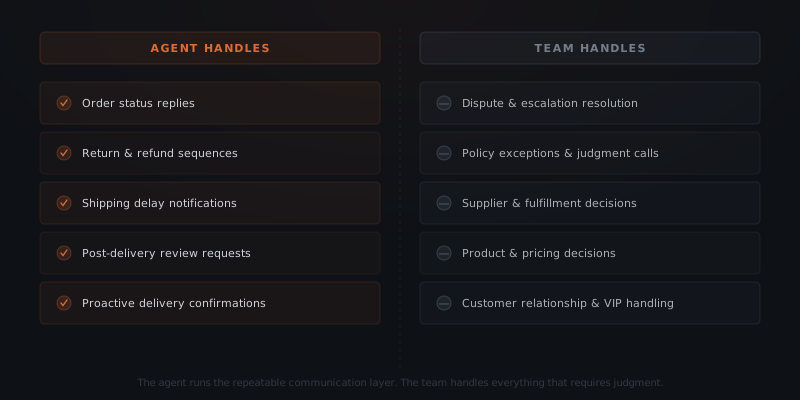
An AI agent handles the communication layer around orders — status replies, return sequences, delay notifications, review requests. An AI agent doesn't handle disputes requiring policy judgment, refund escalations involving third-party issues, or damaged-goods claims requiring case-by-case review. Every draft waits for operator approval before reaching a customer.
Customer support is a volume problem, not a complexity problem
A support queue that handles the same six questions isn't a complexity problem. It's a volume problem — and volume is exactly what agents solve.
The instinct when a ticket queue grows is to hire. More orders mean more support demand, and more tickets mean more people to work through them. This reasoning is correct for the hard cases — disputes, complaints, escalations that require judgment. It is not correct for the tier-1 layer.
If 70% of tickets are answerable by order status lookup, policy application, or a standard message sequence, and the team is spending 70% of its time on those tickets, then the staffing math is wrong. The hire funds the backlog, not the judgment work. Volume grows, headcount grows, but the cases that require a human still compete for attention.
An AI agent inverts this. The agent runs the tier-1 layer without a queue. No backlog. No weekend delay. No Monday morning catch-up. The team's time goes to the 10–20% of cases that actually need a person. Response times for standard queries drop from hours to minutes. Capacity that was processing repeatable requests becomes available for product decisions, supplier relationships, and growth.
Salesforce research on service team productivity found that AI-powered service operations reduce average handle time by 40% and increase first-contact resolution by 26%.[⁵] Both gains come primarily from removing the tier-1 layer from human queues — the repeatable-question category that most ecommerce businesses still handle manually.
This matters more at small scale than large. A 50-person operations team absorbs ticket volume through headcount. A three-person team does not. For lean ecommerce operations, the choice is not between an agent and a better process — it is between an agent and a hire who spends most of their time on order status questions.
How the agent connects to ecommerce tools
Ecommerce operations typically run across four or five tool categories: a store platform, a fulfillment or logistics tool, an email marketing platform, a helpdesk, and a payment or subscription tool. An AI agent connects to the existing stack rather than requiring a migration.
| Tool category | Common platforms | What the agent reads or writes |
|---|---|---|
| Store platform | Shopify, WooCommerce, BigCommerce | Order data, fulfillment status, customer records |
| Email / CRM | Klaviyo, Mailchimp, Gmail | Sends order communication, reads replies |
| Helpdesk | Gorgias, Zendesk, Freshdesk | Routes tickets, logs resolved cases |
| Logistics | ShipStation, EasyPost, carrier APIs | Reads tracking events, detects delays |
| Reviews | Okendo, Judge.me, Trustpilot | Triggers post-delivery review requests |
The integration scope determines implementation speed. A Shopify store running Klaviyo for email and Gorgias for support can go live in two to three weeks. The agent reads order events from Shopify, drafts communications through Klaviyo and Gmail, and logs activity in Gorgias. No new tools. No migration. No retraining the team on a new platform.
Stores with more complex fulfillment setups — multiple warehouses, third-party logistics, international shipping — add integration time but not complexity in the underlying process. The agent reads the same order record regardless of where the inventory lives.
See what AI agent implementation actually costs for a small business for a full breakdown of tool configurations and their impact on build cost.
How to choose the first workflow to automate
Not every workflow is ready for agent implementation on day one. The best starting point has three characteristics: it runs on a defined, repeatable process; the inputs come from a connected data source; and the outputs are messages, not decisions.
Order status replies meet all three. The trigger is a customer message. The input data is the order record in Shopify. The output is a templated status reply with a tracking link. The agent handles this entirely, and the operator sees the draft before it sends.
Return initiation is a strong second workflow. The trigger is a return request. The policy criteria are defined in advance. The agent reads the criteria, determines eligibility, and initiates the sequence or flags for human review. Operators spend two minutes approving a batch of return confirmations instead of individually processing each one.
Delay notifications are the highest-leverage addition. They turn a reactive ticket into a proactive communication. The agent reads the logistics data, detects a delay event, and drafts the notification before the customer reaches out. One workflow change reduces inbound ticket volume on delay events by preventing the inquiry entirely.
See how to know if a business process is ready to hand to an AI agent for a full assessment framework across any workflow type.
What goes live first and how long it takes
Scoping
Map the highest-volume ticket categories — typically order status, returns, and shipping delays. Confirm the store platform and connected tools. Define which ticket types the agent handles and which route to a human.
Integration
Connect the agent to the store platform, email tool, and helpdesk. Map the specific data fields the agent reads for each communication type — order ID, fulfillment status, tracking number, return eligibility.
Template build
Draft the message templates for each ticket type. The operator reviews and edits each template until the tone matches the brand. Approval thresholds are set for each message type.
Approval workflow
Set the review flow. For each outbound message, the operator sees a draft notification and approves with one click. High-confidence message types can run on shorter approval cycles as trust builds.
Go-live
The first workflow goes live — typically order status replies. The operator monitors outputs for two weeks, flags adjustments, and the agent refines from there. Return and delay workflows follow in weeks two and three.
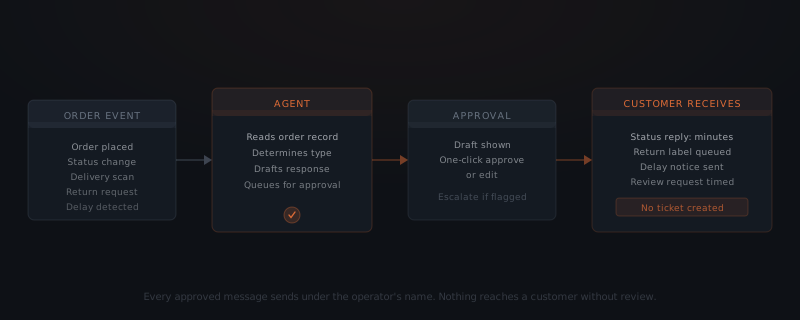
A standard implementation covering order status, returns, and delay notifications goes from scoping call to first live output in two to three weeks. Review automation and post-delivery sequences typically follow in week four.
The volume argument becomes concrete once the first workflow goes live. A store processing 200 orders per week generates roughly 30–50 customer service touchpoints — order status inquiries, return requests, shipping questions. An agent handling that volume without adding a single ticket to the human queue means the team's Monday morning looks different. The 40-ticket backlog from the weekend doesn't exist.
Ecommerce AI adoption is accelerating: AI-related traffic to retail sites grew 693% year-over-year during the 2025 holiday season as buyers began transacting through AI interfaces rather than search.[⁶] Stores building the agent layer now — on operations, not just marketing — are positioned for the shift.
Frequently asked questions
How do AI agents help ecommerce businesses? AI agents help ecommerce businesses by handling the communication layer around orders — status replies, return sequences, shipping delay notifications, and post-delivery review requests. The agent drafts each message and queues it for operator review before sending. Stores using agent workflows recover the time their team spent on repeatable ticket types and redirect it to product development, supplier relationships, and escalated cases that require human judgment.
What ecommerce tasks can an AI agent automate? An AI agent automates order status replies, return initiation sequences, proactive shipping delay notifications, post-delivery review requests, and delivery confirmation messages. Tasks requiring policy judgment — disputes outside standard return windows, damaged-goods claims, refund escalations — route to a human with the relevant order record already pulled. AI agents handle the volume. The team handles the judgment.
How does an AI agent connect to Shopify? An AI agent connects to Shopify through the Shopify API, reading order data, fulfillment status, and customer records in real time. When an order status changes — shipped, delayed, or delivered — the agent reads the event, drafts the appropriate customer communication, and queues it for approval. The same integration pattern works with WooCommerce, BigCommerce, and other major platforms. No migration to a new store platform is required.
What does an ecommerce AI agent implementation cost? A standard implementation covering order status, return sequences, and delay notifications typically runs $2,000–$5,000 for the initial build, depending on the number of integrations and message sequence complexity. Monthly API operating costs at typical order volumes run under $150. Stores recovering one day per week of team capacity — at $30–$50 per hour equivalent — recover implementation cost within the first month. See what AI agent implementation actually costs for a small business for a full cost breakdown.
Notes
- eDesk, "100+ eCommerce Customer Service Statistics 2025." https://www.edesk.com/blog/ecommerce-customer-service-statistics/
- Simple Distribution, "Ecommerce Customer Service: What It Costs to Handle In-House." https://simple-distribution.com/resources/ecommerce-customer-service-costs
- Opensend, "32 Order Processing Time Statistics for eCommerce Stores." https://www.opensend.com/post/order-processing-time-statistics
- Judge.me, "How Review Requests Work." Product documentation. https://judge.me
- Salesforce, "State of Service, Sixth Edition." 2024. https://www.salesforce.com/resources/research-reports/state-of-service/
- Ecommerce Guide, "Ecommerce Statistics 2026: AI, LLMs, and Agentic Commerce." https://ecommerceguide.com/a/ecommerce-statistics/