
European AI adoption is uneven by business size, country, and sector. Eurostat measured AI use in 17% of small EU enterprises, 30.36% of medium enterprises, and 55.03% of large enterprises in 2025. Professional, scientific, and technical services reached 40.43%. The figures describe AI technologies broadly, not autonomous agents specifically.
Eurostat's 2025 numbers step up steadily with company size: small EU enterprises at 17%, medium enterprises at 30.36%, large enterprises at 55.03%. The professional, scientific, and technical sector sits above the medium tier, at 40.43%.
These figures describe broad AI use, not autonomous-agent deployment. They show a clear size and sector gap, but they do not tell a small business which workflow to automate. This analysis maps the gap and explains what it means for workflow readiness, expertise, legal clarity, and privacy.
Which three baselines does European AI adoption have?
European AI adoption is not one number. The answer changes when the question changes from any use, to production use, to an autonomous agent inside a business process.
Eurostat's 2025 survey measured whether enterprises with at least 10 employees or self-employed persons used at least one listed AI technology. The list includes text mining, language generation, speech recognition, image recognition, machine learning, workflow automation, and related systems. The survey therefore gives us a market baseline, not an agent-specific deployment count.
For the plain-language distinction between a model, an agent, and a workflow, see what is an AI agent. That explainer is the conceptual owner; this report owns the European evidence.
That distinction prevents a common mistake. A business that uses an AI writing tool once belongs in a broad “AI use” statistic. A business that runs an agent which reads a CRM record, drafts a follow-up, waits for approval, and writes an activity log belongs in a much narrower implementation category. Both uses matter. They should not share a label.
Eurostat's figures describe measured AI technologies and purposes. They do not prove that a business has deployed an autonomous agent, achieved a specific return, or moved a workflow into production.
The survey also defines the size classes that shape the rest of the analysis:
| Eurostat size class | Definition | Why it matters |
|---|---|---|
| Small | 10–49 employees or self-employed persons | The closest official category to many lean service businesses, but not to every solo operator |
| Medium | 50–249 employees or self-employed persons | More capacity for dedicated technology and process ownership |
| Large | 250 or more employees or self-employed persons | More budget and specialist capacity, so adoption is not directly comparable with a ten-person firm |
The survey covered approximately 157,000 of 1.53 million EU enterprises. Around 83% of the population were small enterprises, 14% medium, and 3% large. The sample is substantial, but the size definition still excludes many solo businesses and micro-businesses that Yardwork may serve.
Why does enterprise size explain the largest adoption gap?
Large European firms use AI more often than small firms. Eurostat measured AI use in 17% of small enterprises, 30.36% of medium enterprises, and 55.03% of large enterprises in 2025.
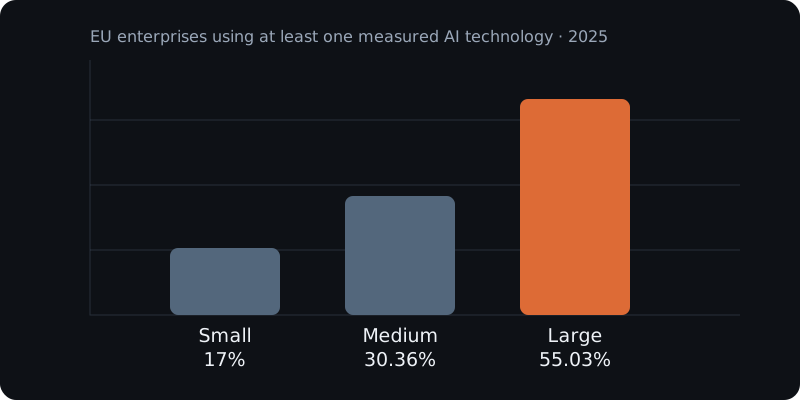
The gap is not evidence that large firms have discovered a secret prompt. Large firms have more budget, specialist staff, cleaner ownership of data, and more time to connect systems. Small firms have the opposite operating shape: the founder owns the workflow, the data sits across several tools, and the person who would approve an agent's actions is already doing the work.
Adoption is not the same as a controlled workflow in production.
The size gap also changes the meaning of “adoption.” A large firm can count a controlled pilot inside one department while maintaining a separate data, security, and procurement function. A small agency can have a working agent in production while one operator owns the permissions, review queue, and failure response. The same headline measure can hide very different operating realities.
The comparison should therefore guide questions rather than produce a verdict:
- Is the business measuring tool experimentation or live workflow use?
- Does one named person own the process and the agent's output quality?
- Can the business define what the agent may read, write, draft, or send?
- Does the workflow have a baseline before automation begins?
- Can the team review exceptions without creating a second full-time job?
Yardwork's service sits in that gap between broad interest and practical operation. The relevant work is not convincing a founder that AI exists. The relevant work is turning one real process into a bounded system with connected tools, approval points, and a way to see whether the output is right.
The size figures do not prove that every small business needs an implementation partner. They show why a small business should not copy an enterprise adoption plan. The first unit should be one workflow with one owner and one measurable outcome.
How do country and sector patterns change the story?
The EU average hides a wide country range. Eurostat measured enterprise AI use from 5.21% in Romania to 42.03% in Denmark in 2025. Finland reached 37.82%, and Sweden reached 35.04%. Twenty-six EU countries recorded a higher share than in 2024.
These rankings describe a statistical distribution, not a league table for individual businesses. Country-level differences can reflect sector mix, digital infrastructure, survey behavior, labor markets, and the kinds of tools counted by the question. The Netherlands also has a 2025 break in its time series, which makes a simple year-over-year story unsafe.
Sector differences are just as important. Information and communication activities reached 62.52%. Professional, scientific, and technical services reached 40.43%. Real estate reached 24.76%, while construction reached 10.79%.
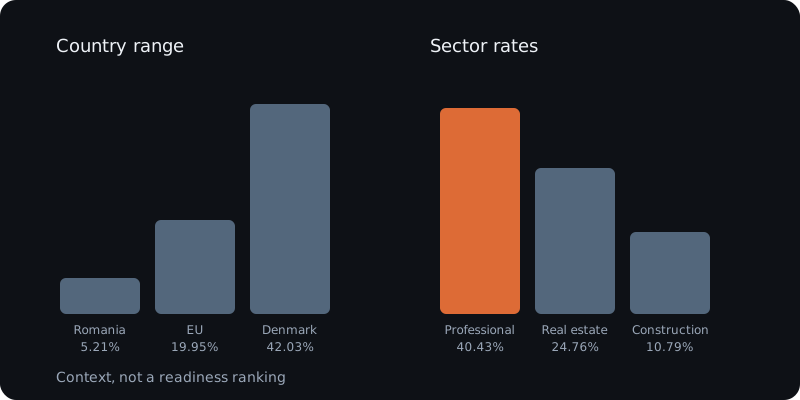
The professional-services result matters for Yardwork's audience because it describes a sector where information work, client communication, reporting, and document handling are common. It does not mean every consultancy should deploy an agent. It means the sector has a stronger measured baseline for investigating what happens next.
The next question is not “Which country should adopt AI?” The decision question is “Which operating conditions make a workflow easier to measure and control?” A ten-person consultancy in a high-adoption country may still lack a system of record. A small agency in a lower-adoption country may already have a clear workflow and a willing owner.
Country and sector data clarify the decision when they narrow it without replacing it. A founder can use the figures to compare context, then return to the work itself: repeated inputs, stable outputs, clear ownership, acceptable risk, and a human review point.
Which operating purposes do businesses use AI for?
Eurostat's purpose data shows where businesses place AI inside operations. Among enterprises using AI technologies, 34.70% used them for marketing or sales, and 31.04% used them for the organisation of business administration processes or management.
The figures point toward the workflow questions an implementation conversation should ask. Marketing and sales include drafting, lead analysis, content generation, and campaign decisions. Business administration includes reporting, document handling, scheduling, data entry, and process coordination. The statistic does not reveal which step the system performed or whether a person approved the output.
Eurostat also records meaningful differences by enterprise size. For business administration and management, the reported rate was 28.49% among small firms and 43.38% among large firms. For production processes, the rate was 19.02% among small firms and 33.46% among large firms. ICT security showed an even wider difference: 14.51% for small firms versus 47.51% for large firms.
Purpose data redirects attention from tool names to work. A founder does not need to start with OpenClaw, Hermes, or a model provider. The first question is whether a recurring process produces a measurable output that a system can prepare, route, or complete under defined controls.
That process includes:
- collecting information from a client intake;
- drafting a weekly account report;
- routing an inbound request to the right owner;
- preparing a proposal from approved information;
- checking a record for missing fields;
- preparing a follow-up that waits for human approval.
The agent is not the business outcome. The workflow is the business outcome. An agent that sends more messages but creates more corrections has not improved the process. An agent that reduces forgotten handoffs while keeping external actions under approval may create value even if it never acts autonomously.
This is why which workflows to automate first remains the internal owner for sequencing decisions. The European data establishes context. The workflow page makes the implementation decision. The two should support each other rather than compete for the same intent.
What do the reported barriers point to?
European businesses that had ever considered using AI reported operational barriers. Eurostat found that lack of relevant expertise was reported by 70.31% of this group. Lack of clarity about legal consequences reached 53.61%. Concerns about data protection and privacy reached 52.72%.
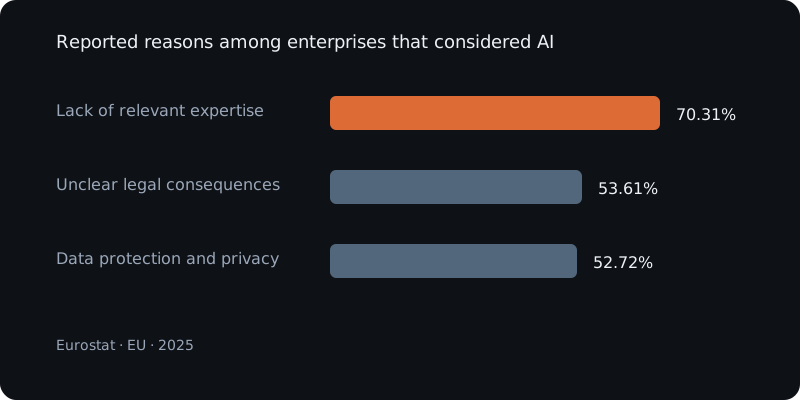
The expertise figure does not mean every non-adopter needs an engineer. It means the business does not know enough about the relevant workflow, tools, controls, or implementation path to proceed confidently. A small team can know exactly what it wants and still lack the time to connect the systems and test the edge cases.
The legal-clarity figure matters even more after the EU AI Act's 2026 transparency obligations began applying. The number does not tell us which firms face which duties. It does show why a deployment conversation needs a current source check and a clear boundary between implementation guidance and legal advice.
The privacy figure also changes how an implementation should begin. An agent should not receive broad access because the team has not mapped the data. The team should identify the system of record, the fields required for the workflow, the actions that need approval, and the records that need logging.
The barriers therefore support a practical sequence:
- Name one workflow and its measurable outcome.
- Identify the systems, data, owner, and failure modes.
- Decide which outputs remain drafts and which actions may run.
- Connect only the permissions needed for the approved scope.
- Test normal inputs, missing data, edge cases, and unsafe requests.
- Review the results against a baseline before expanding.
That sequence does not turn Eurostat into a sales claim. It translates a population-level observation into the kind of work a founder can inspect.
The OECD's 2025 discussion paper on SME adoption makes a related point: “SME AI adoption remains relatively low compared to other digital technologies and to larger firms.” The OECD also groups adoption pathways by digital maturity, complexity of use, and scope. That context does not tell Yardwork which workflow a specific company should choose.
Where is the implementation boundary in European adoption data?
European adoption statistics provide context. They do not answer the deployment question by themselves.
Eurostat does not report the percentage of European businesses running autonomous AI agents. It does not measure whether an agent has approval gates, whether a person checks the output, or whether the system writes to a CRM correctly. Eurostat also does not establish whether an enterprise achieved a return, recovered a specific number of hours, or reduced headcount.
The dataset has other boundaries:
- Enterprises with fewer than 10 employees or self-employed persons are outside the reported population.
- “AI technology” includes several categories that do not involve agents.
- Survey responses capture reported use, not an audited deployment.
- Country and sector comparisons can reflect different economic mixes.
- The Netherlands has a 2025 time-series break.
- Reported barriers are reasons given by enterprises that considered AI, not causal estimates for all non-users.
Those limits do not make the data weak. They make the data usable. A founder can use the figures to understand context, then ask a more specific question about the workflow they own.
The practical dividing line is not whether a business belongs to a high-adoption country or sector. The dividing line is whether the business can define a process clearly enough to test. The process needs an owner, a repeatable trigger, a measurable output, and an acceptable boundary for mistakes.
Yardwork's role begins after that question becomes concrete. Yardwork scopes the workflow, connects the agreed tools, defines approval and escalation points, launches against real data, and supports the system after go-live. The AI agent adoption statistics page covers broader adoption context, while this report is intended to make the European context reproducible and decision-relevant.
Method, calculations, and refresh policy
This page publishes its method beside its findings. The method is part of the asset.
The method records the Eurostat dataset codes, survey population, size classes, sector definitions, country exclusions, calculation formulas, rounding rules, and retrieval date. Every chart carries a source label. Every derived comparison points to the fields used to calculate it.
A chart is not permanent. Eurostat can revise a series, update a survey, or change a definition. Yardwork reviews the page annually or when Eurostat releases a materially new enterprise AI dataset. The published date remains stable during a refresh; the updated date changes only when the evidence changes.
The dataset should remain separate from the article prose. The prose explains the finding. The table and method let another reader check it. That separation makes the page more useful to a journalist, analyst, or answer engine looking for a precise fact.
The conclusion is clear: European AI adoption is growing, but the opportunity is uneven. Small firms are not waiting for a perfect future. They need a defined workflow, an owner, and enough implementation support to move from broad interest to controlled use.
Frequently asked questions
What percentage of European small businesses use AI?
Eurostat reported that 17% of small EU enterprises used at least one measured AI technology in 2025. The figure covers enterprises with 10 to 49 employees or self-employed persons and does not measure autonomous AI agents specifically.
How does AI adoption differ between small and large European firms?
Eurostat measured AI use in 17% of small enterprises and 55.03% of large enterprises in 2025. Medium enterprises sat between them at 30.36%. The gap reflects different resources and operating structures, not a guaranteed outcome for an individual company.
Which European sectors use AI most often?
Information and communication activities had the highest measured use at 62.52% in 2025. Professional, scientific, and technical activities followed at 40.43%. The percentages describe broad AI technologies and should not be reported as autonomous-agent adoption.
Why are European businesses not using AI?
Among enterprises with 10 or more employees that had ever considered using AI technologies, Eurostat recorded lack of relevant expertise at 70.31%, unclear legal consequences at 53.61%, and data-protection or privacy concerns at 52.72%.
Notes
- Eurostat, “Use of artificial intelligence in enterprises”, accessed August 10, 2026. The page provides the 2025 enterprise-size, country, sector, purpose, barrier, and methodology figures used here.
- Eurostat, “The use of artificial intelligence (AI) technologies in the European Union”, 2026 statistical report, used for supporting context and dataset verification.
- OECD, “AI adoption by small and medium-sized enterprises”, 2025 discussion paper for the G7, used for contextual adoption taxonomy and enablers.
- Czech National Bank, “AI in European firms”, used as secondary interpretation of European size differences.
- Eurostat API dataset
isoc_eb_aiandisoc_eb_ain2, retrieved August 10, 2026. The reproducible query definitions and reconciled values are recorded in the working evidence table. - The calculations, table selection, definitions, and limitations described in this draft are Yardwork work-product. No Eurostat figure is presented as an AI-agent adoption rate.