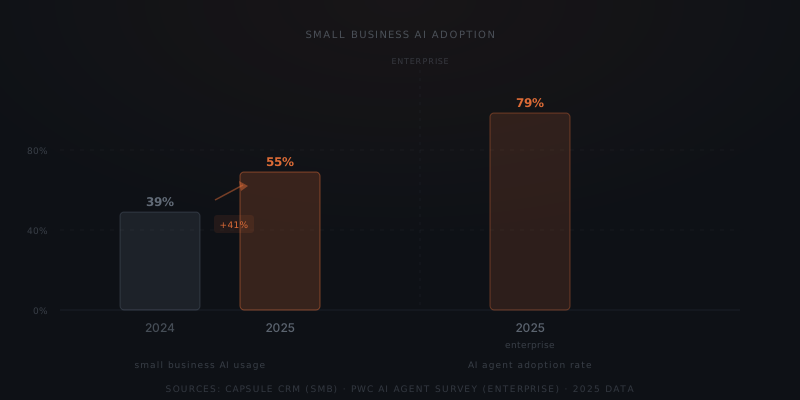
AI agent adoption crossed the majority threshold in 2025. PwC surveyed 308 US business executives in April 2025 and found that 79% of companies report AI agents already being adopted. Among small businesses, 55% reported using AI in 2025 — up from 39% in 2024, a 41% year-over-year increase. The data now spans enterprise and small business, multiple functions, and specific outcome metrics.
In April 2025, PwC surveyed 308 US business executives — C-suite, vice presidents, and directors. 79% of companies in the survey reported AI agents already being adopted.[1] That number did not distinguish between a full enterprise deployment and a single agent running one workflow. But it confirmed what the anecdotal evidence had been suggesting: AI agent adoption is no longer an early-adopter story.
AI agent adoption rates in 2025
The PwC AI Agent Survey found that 35% of companies adopting AI agents are doing so broadly, with another 17% reporting full adoption across almost all workflows and functions.[1] Combined, more than half of companies that have adopted agents have moved past initial pilots.
Among small businesses, the picture is consistent. A June 2025 survey released by Reimagine Main Street, fielded in partnership with the National Small Business Association (NSBA) and PayPal, found that 76% of small businesses are either actively using AI or exploring its use.[2] Usage of generative AI among small firms jumped from approximately 40% in 2024 to over 58% in 2025.[3]
The Federal Reserve's April 2026 monitoring note on AI adoption in the US economy found that 8.8% of small businesses (under 250 employees) reported using AI in the production of goods or services as of August 2025, up from 6.3% six months earlier.[4] The pace of increase — 2.5 percentage points in six months — indicates active adoption, not a steady state.
The headline figures from all major sources, consolidated for reference:
| Metric | Figure | Source | Year |
|---|---|---|---|
| Companies reporting AI agents adopted | 79% | PwC AI Agent Survey | 2025 |
| Companies at broad or full adoption | 52% | PwC AI Agent Survey | 2025 |
| Small businesses actively using AI | 55% | Capsule CRM | 2025 |
| Small businesses using or exploring AI | 76% | NSBA / Reimagine Main Street | 2025 |
| Year-over-year SMB adoption increase | +41% | Capsule CRM | 2024–2025 |
| SMBs reporting $500–$2,000/month savings | 66% | Capsule CRM | 2026 |
| Active deployers reporting productivity gains | 66% | PwC AI Agent Survey | 2025 |
| Active deployers reporting cost savings | 57% | PwC AI Agent Survey | 2025 |
| Executives planning AI budget increases | 88% | PwC AI Agent Survey | 2025 |
| Small business production AI use | 8.8% | Federal Reserve | Aug 2025 |
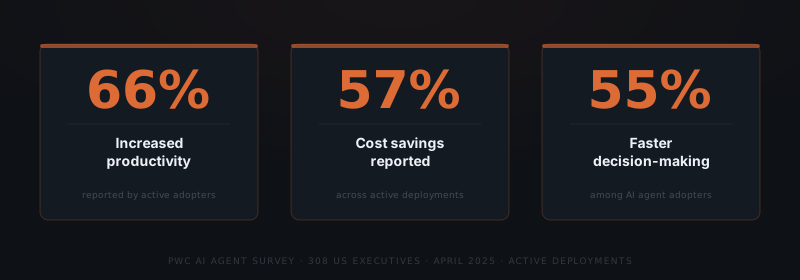
The PwC survey covered 308 US executives and asked specifically about AI agents, not AI broadly. Among companies that had adopted agents, 66% reported increased productivity and 57% reported cost savings. These are active deployments, not pilots.
What businesses report after adopting AI agents
The PwC data covers outcome metrics, not just adoption counts. Among companies with active AI agent deployments:
- 66% report increased productivity — the most commonly cited outcome
- 57% report cost savings — more than half of active adopters
- 55% report faster decision-making — cited alongside cost savings
- 54% report improved customer experience — consistent across business sizes
These figures cover companies with active deployments. PwC notes that most respondents (68%) report that half or fewer of their employees interact with agents in their everyday work — suggesting the productivity gains are concentrated in specific functions, not spread evenly.[1]
For a framework on which functions to automate first, see which workflows to automate first.
Small business AI adoption is accelerating
The small business adoption trajectory is steeper than the enterprise figure suggests. In 2024, 39% of small businesses reported using AI. By 2025, that figure was 55% — a 16 percentage point increase in one year.[3]
The NSBA data adds a broader dimension: 76% of small businesses are actively using or exploring AI adoption.[2] The gap between exploring and actively using is significant, but the direction is consistent — small businesses are moving toward adoption.
Nearly two-thirds of small businesses that use AI (66%) report saving between $500 and $2,000 per month from AI-assisted workflows.[3] At 20 hours of team time per week recovered — a typical figure for a business automating its most repetitive workflows — the savings align with the reported range for a firm with 3–8 staff members.
Prefactor's 2026 analysis shows 40% of enterprise applications will embed task-specific AI agents by the end of 2026, up from less than 5% in 2025.[5] The gap between enterprise and small business adoption rates is narrowing as purpose-built agent systems reach SMB price points.
The SMB-specific figures, separated from the enterprise data:
| SMB metric | Figure | Source |
|---|---|---|
| Active AI usage (2024) | 39% | Capsule CRM |
| Active AI usage (2025) | 55% | Capsule CRM |
| Using or exploring AI (2025) | 76% | NSBA / Reimagine Main Street |
| Reporting $500–$2,000/month savings | 66% of AI users | Capsule CRM |
| Production AI use, firms under 250 employees (Aug 2025) | 8.8% | Federal Reserve |
| 6-month production AI increase | +2.5 percentage points | Federal Reserve |
The $500–$2,000/month savings figure deserves context. At the lower end, $500 corresponds to roughly 10–15 hours of staff time recovered per month — consistent with a single workflow automation (follow-up sequences, report generation, inbox triage). At the upper end, $2,000 corresponds to a business with two or three automated workflows running simultaneously, where the combined time recovery is large enough to redirect staff to higher-value tasks rather than simply reduce hours.
The Federal Reserve's production AI figure — 8.8% — is more conservative than general usage surveys because it covers AI deployed in the production of goods or services, not AI tools used occasionally for drafting or search. A business using a language model to write marketing copy does not appear in this figure. A business running an agent on client intake does. The gap between 8.8% production use and 55% general usage reflects the difference between exploring AI tools and committing agents into live workflows.
Which functions are deploying AI agents first
The PwC survey identifies customer support (49%) and operations (47%) as the two functions with the highest AI agent deployment rates.[1] These are also the functions most frequently handling variable, context-dependent inputs — the task type that AI agents handle better than traditional automation.
For service businesses specifically, the workflows being automated first follow a consistent pattern:
| Function | Most common agent tasks |
|---|---|
| Client communication | Follow-up emails, intake responses, meeting confirmations |
| Operations | Document collection, CRM updates, scheduling coordination |
| Reporting | Weekly summaries, pipeline digests, status updates |
| Lead management | Intake qualification, inquiry routing, first-response drafts |
The pattern holds across the buyer profile: agency founders, consulting firms, and professional services businesses are starting with client communication and operations — the two functions where manual handling costs the most senior staff time. See which industries use AI agents for adoption stage broken down by specific professional-services industry.
Small business AI adoption jumped 41% in one year.
Where AI agent adoption is concentrated by industry
The combined adoption figures mask significant variation by sector. The function-level data — customer support (49%) and operations (47%) leading — reflects which industries handle the highest volume of those two functions with the least tolerance for slow response or missed steps.
| Industry | Adoption stage | Primary agent use cases | Primary driver |
|---|---|---|---|
| Professional services (consulting, legal) | Early majority | Client communication, document drafting, intake processing | High cost of senior time on low-judgment tasks |
| Marketing and agencies | Early majority | Campaign reporting, follow-up sequences, briefing coordination | Repetitive communication volume across multiple accounts |
| Recruiting and HR services | Early majority | Candidate intake, scheduling, status updates | Process-heavy workflows at consistent volume |
| Financial services (advisory, accounting) | Early adopters | Client onboarding, compliance reporting, document collection | Audit trail requirements and regulatory volume |
| Real estate | Early majority | Lead follow-up, showing coordination, CRM updates | Response-time competitive pressure |
| Retail and e-commerce | Mainstream | Customer support, order updates, inventory notifications | 24/7 inquiry volume across multiple channels |
| Healthcare administration | Early adopters | Patient scheduling, intake, billing coordination | Documentation burden and labor shortage |
| Construction and trades | Laggards | Scheduling, supplier coordination, quoting | Irregular workflow patterns and lower baseline digital adoption |
The "adoption stage" column is this post's own synthesis across the PwC, McKinsey, and Federal Reserve data above, not a diffusion-stage rating published by any single source — no cited study assigns industries to "early majority" or "laggard" categories directly.
For service businesses — the sector with the most overlap between function priority (communication, operations) and agent capability — the adoption pattern from the data maps directly to what practitioners report on the ground. Agencies and consultancies build follow-up and reporting agents first. Recruiting firms build intake agents. Real estate professionals build lead-response agents. The shared pattern is high-volume, structured, repeated tasks where the cost of manual handling is a senior person's time.
Industries lagging in the data are not slower because agents are poorly suited to their workflows. Construction and healthcare face a different constraint: their most expensive workflows are often less structured, involve more variable inputs, and require coordination with external parties whose systems are less API-accessible. The adoption curve is delayed, not absent.
The adoption gap is widening
The PwC data also surfaces a risk for businesses that have not yet moved. 88% of senior executives plan to increase AI-related budgets in the next 12 months because of agentic AI.[1] That level of investment concentration means the productivity gap between early adopters and laggards grows with each passing quarter.
A widely cited Gartner projection — 40% of enterprise applications embedding task-specific agents by end of 2026 — describes a standard, not an edge case.[5] This figure is cited here via Prefactor's compilation rather than directly from a Gartner report this post has reviewed; treat it as a secondhand data point consistent with the broader trend, not a figure this post has independently verified against the original source. Organizations running these workflows without agents process the same tasks at higher cost and lower throughput than competitors who have automated them.
The SBA Research Spotlight from September 2025 found that small firms are closing the gap with larger firms in AI adoption, with the pace of increase higher among smaller businesses than among enterprises.[6] The direction of travel is consistent across all data sources: adoption is accelerating, outcomes are measurable, and the gap between early and late movers is widening.
Frequently asked questions
What percentage of businesses are using AI agents in 2025? PwC's 2025 AI Agent Survey polled 308 US business executives and put agent adoption at 79%. A separate June 2025 NSBA survey found a similar signal for small business: 76% report they are already using AI or actively exploring it. Both surveys point the same direction — most businesses have moved past the pilot stage.
What ROI do businesses see from AI agent adoption? Among companies with active AI agent deployments, PwC found that 66% report increased productivity, 57% report cost savings, and 55% report faster decision-making. Nearly two-thirds of small businesses using AI (66%) report saving $500–$2,000 per month from AI-assisted workflows.
How fast is small business AI adoption growing? Small business AI usage grew from 39% in 2024 to 55% in 2025 — a 41% year-over-year increase. The Federal Reserve's April 2026 monitoring note found the rate of production AI adoption among small businesses increased by 2.5 percentage points in just six months (February to August 2025).
Which industries and functions are adopting AI agents first? Customer support (49%) and operations (47%) have the highest deployment rates according to PwC. For service businesses specifically, client communication, document collection, CRM updates, and scheduling coordination are the most common starting points — the workflows with the highest volume of repeated, low-judgment tasks.
Notes
- PwC, "AI Agent Survey," PwC, 2025.
- NSBA, "NSBA Highlights New Data on AI Adoption, Trends in Small Businesses," NSBA, June 2025.
- Capsule CRM, "Small business AI adoption statistics for 2026," Capsule CRM, 2026.
- Federal Reserve, "Monitoring AI Adoption in the US Economy," Federal Reserve, April 2026.
- Prefactor, "AI Agent Adoption Statistics 2026," Prefactor, 2026. A secondary compilation attributing the 40%-by-2026 figure to Gartner; this post has not independently verified that number against a primary Gartner report.
- SBA Office of Advocacy, "Research Spotlight — AI In Business: Small Firms Closing In," SBA, September 2025.