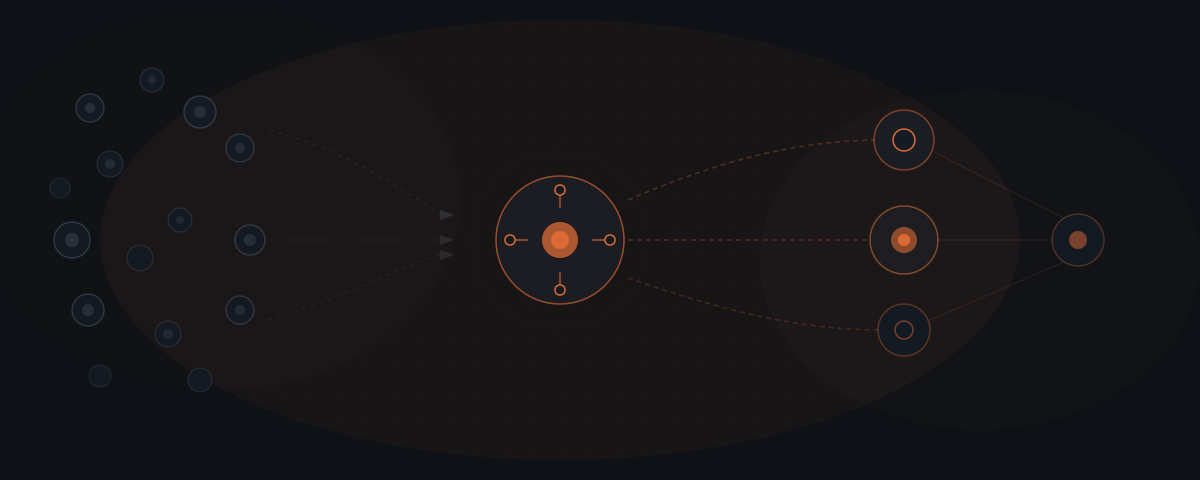
An AI agent for recruiting firms handles the candidate communication layer between sourcing and placement — outreach sequences, interview scheduling, ATS updates, and pipeline reporting. Recruiting teams that have deployed agents report 75% reductions in coordination time. The recruiter retains all assessment, client relationships, and final decisions.
A recruiter working five active requisitions sends roughly the same email forty times a week. Outreach, follow-up, confirmation, reminder, post-interview nudge, offer-stage check-in. Every candidate in every pipeline needs the same sequence at the same intervals — and the recruiter is the one writing each message, tracking each response, and updating the ATS after every interaction. The candidates are different. The work is identical.
The problem is not finding candidates. Most recruiting firms can source. The problem is the administrative layer between sourcing and placement — the steady volume of structured, repeatable communication that fills the week before a recruiter can get to assessment work. An AI agent handles that layer. The recruiter handles everything that requires judgment.
The real bottleneck is not sourcing — it is communication volume
Sixty-seven percent of hiring decision-makers who use AI cite time savings as the primary benefit.[¹] Time savings on what, specifically? Not sourcing — 58% of AI-using recruiters find AI most valuable for sourcing, which means sourcing already has tool coverage.[¹] The unresolved workload is downstream: the hours spent keeping candidates moving through a pipeline by sending the right message to the right person at the right time.
A recruiter managing five active searches is running five separate communication timelines simultaneously. Candidate A needs a follow-up message. Candidate B's interview confirmation goes out today. Candidate C needs an ATS stage update after this morning's call. Candidate D is waiting on a post-interview note. Candidate E's offer timing needs to be coordinated with the client.
None of these tasks requires judgment. All of them require attention, consistency, and timing. Across five searches with ten to twenty active candidates each, the coordination layer consumes 11–17 recruiter hours per week — time not spent on qualification calls, client briefings, or offer negotiations.
Recruiting teams have shrunk from an average of 31 to 24 staff between 2022 and 2024, without a corresponding reduction in placement volume expectations.[²] Per-recruiter workload has increased. The firms that maintain placement rates with smaller teams are the ones removing the administrative layer — not the ones asking recruiters to work faster.
What the agent takes over
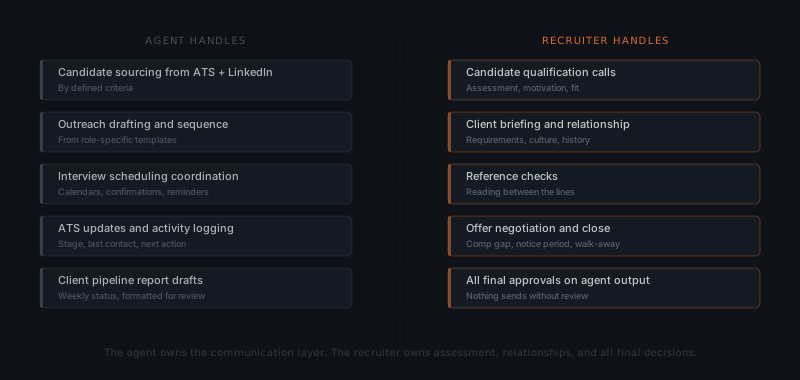
An AI agent does not assess candidates or make placement decisions. Every outreach message, shortlist draft, and pipeline report the agent produces requires recruiter review before any action is taken. The agent handles what is predictable. The recruiter handles what requires judgment.
The agent handles four categories of work in a recruiting firm.
Candidate outreach and follow-up sequencing. The agent sends the initial outreach message based on a role-specific template, tracks responses, and follows up at defined intervals for candidates who have not replied. A standard outreach sequence for a recruiting firm runs four to six touches over twelve to eighteen days. Across fifty candidates on five active requisitions, that is two hundred to three hundred individual messages — each sent at the right time, each logged in the ATS, each routed to the recruiter when a response requires human action.
Interview scheduling coordination. The agent reads calendar availability, proposes interview slots to the candidate, confirms the booking, sends the confirmation to both parties, and sends a reminder twenty-four hours before. Recruiting firms that deploy agents for scheduling report a 75% reduction in interview coordination time.[³] The recruiter provides the available time windows; the agent handles the back-and-forth logistics.
ATS stage updates and activity logging. After every candidate interaction — sent message, received response, confirmed interview, completed call — the agent updates the candidate's stage in the ATS and logs the last action and next planned step. Without an agent, this data entry happens manually after the recruiter completes each task, often with a day or more of lag. With an agent, the ATS reflects real-time pipeline status at all times.
Client pipeline report drafts. The agent pulls current stage data from the ATS weekly, formats it into a pipeline summary showing candidate status per role, and drafts the client update for recruiter review. The recruiter edits and sends. Formatting the raw data and drafting the report is the part that takes thirty to forty-five minutes per client per week. The agent handles that part.
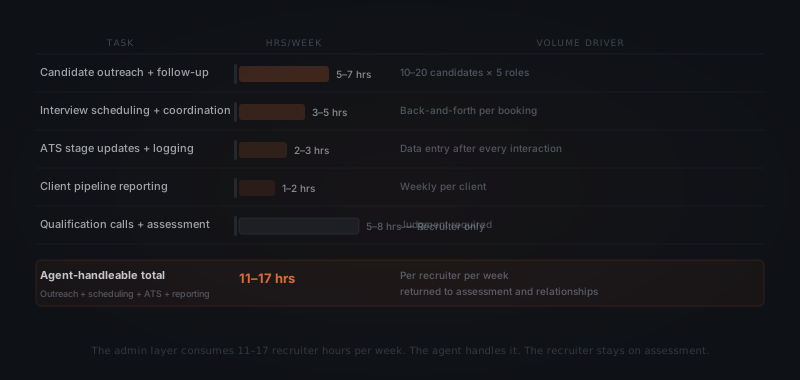
The admin layer shifts from 80% of a recruiter's workload to roughly 20% when agents handle outreach, scheduling, and ATS updates.[³] The recruiter's attention shifts from execution to assessment — the work that actually closes placements.
Which tools the agent connects to
A recruiting firm agent integrates with the existing stack rather than replacing it. The connection scope for a standard deployment covers three to four systems.
ATS connection (Bullhorn, Greenhouse, Lever, Workday, Vincere, or similar) — reads candidate records, current stage, and last contact date; writes stage updates, activity logs, and next-action notes after each agent interaction. The ATS is the source of truth for candidate status. The agent reads from it and writes back to it; the recruiter always sees the same data the agent is working from.
Email connection (Gmail or Outlook) — sends outreach and follow-up from the recruiter's own email address, with the recruiter's signature. Candidates receive messages that appear to come from the recruiter directly, not from a tool. The agent drafts each message against a role-specific template and routes the draft for recruiter review before sending if the workflow requires it.
Calendar connection (Google Calendar or Outlook Calendar) — reads the recruiter's and the interviewing manager's available slots, proposes times to candidates, processes replies, and confirms bookings. Calendar events are created in the recruiter's calendar with the correct participant list and meeting details.
LinkedIn (for sourcing-stage workflows) — searches candidate profiles against stored criteria, surfaces matching candidates for recruiter review, and in some configurations drafts connection messages or InMail to approved candidates. LinkedIn sourcing workflows are separate from the outreach-and-scheduling layer; firms typically implement one before the other.
Some firms add a Slack or Teams connection for internal notifications — the agent pings the recruiter when a candidate responds, when an interview is confirmed, or when a pipeline report draft is ready for review. Internal notifications keep the recruiter informed without requiring manual ATS checks throughout the day.
What the recruiter retains
The agent sends the messages. The recruiter decides who is worth presenting.
The agent removes administrative work. Recruiting firms sell the recruiter's judgment — the ability to identify candidates worth presenting and to close placements the client's internal team could not. That judgment does not transfer to an agent.
Candidate qualification calls. The agent sequences outreach and books the call. The recruiter conducts it. Assessing motivation, reading what a candidate says between the lines, judging whether a career pivot is credible — these require conversation, not data retrieval.
Client briefing and relationship management. Understanding why a client passed on a candidate in the last search, what the hiring manager's real priorities are beneath the job description, and how to position a candidate whose background does not match on paper — this knowledge comes from relationships built over placements. The agent does not manage client relationships.
Reference checks. The agent can schedule reference calls and send the standard question list. The recruiter conducts the call and reads the responses — what is said and what is avoided, the pause before an answer, the shift in tone when a specific topic comes up.
Offer negotiation and placement close. Comp gap, competing offer, notice period, counter from the current employer — offer negotiations require judgment about what a candidate will accept, what the client will flex on, and how to close without losing either side. The agent does not negotiate.
All final approvals on agent output. Every message the agent drafts, every shortlist it produces, every pipeline report it formats requires recruiter review before action is taken. The agent can run outreach autonomously for established role types where the recruiter has validated the templates — but only within the approval boundaries the recruiter set. Nothing sends without human sign-off on the workflow that sends it.
How recruiting firms start with an agent
Identify the two or three workflows with the highest candidate volume
Start with the workflows where the agent will produce immediate value — typically candidate outreach and interview scheduling for the practice areas with the most active requisitions. Do not start with every workflow at once. Pick the one where the recruiter spends the most hours per week on repeatable communication, deploy the agent for that workflow alone, and validate before expanding.
Map the existing stack and confirm integration access
The agent connects to what the firm already uses — ATS, email, and calendar. Before the deployment starts, confirm that the ATS has an API connection available, that email integration is technically feasible (most Gmail and Outlook configurations support it), and that the recruiter's calendar is accessible for scheduling workflows. Most recruiting firm stacks are straightforward to connect; the exception is older proprietary ATS systems with limited API access.
Write the initial outreach templates for your top role types
The agent sends outreach from templates that the recruiter defines. For each role type in the initial deployment, write the initial outreach message, the first follow-up, and the second follow-up. The templates should reflect how your firm actually reaches out — the language, the subject line, the specific value proposition for the candidate. Generic templates produce generic response rates. The recruiter's existing best-performing outreach messages are the right starting point.
Define the approval boundaries before the first sequence runs
Decide which agent actions require review before execution and which run automatically. A safe default starting point: the agent drafts all outreach for recruiter review before sending. After the recruiter validates that the first ten to fifteen drafts require minimal edits, autonomous sending for established role types is a reasonable next step. Interview scheduling confirmations and ATS updates can typically run autonomously from the start — the risk of error is low and the recruiter sees the ATS in real time.
Run the first live sequence and collect feedback actively
The first two to three weeks of a live deployment are calibration. Review every outreach draft, every shortlist, every ATS update the agent produces. Flag anything that requires adjustment — the sequence timing, the message tone, the sourcing criteria. Active feedback in the first month builds a more accurate agent faster than passive observation. After three weeks of active calibration, most recruiting firm agents reach a state where the recruiter's edit rate on outreach drafts drops below 20%.
A standard agent deployment for a recruiting firm — covering outreach, scheduling, and ATS updates across one practice area — goes from scoping call to first live candidate sequence in two to four weeks. For the full deployment timeline and what the implementation process looks like, see what a real AI agent implementation involves.
For a comparison of how agent tools differ in what they learn and retain between searches, see the posts on OpenClaw for recruiting firms and Hermes for recruiting firms. For the broader context on what AI agents do for recruiting agencies, see the full workflow overview.
Frequently asked questions
What does an AI agent do for a recruiting firm? An AI agent for a recruiting firm handles the candidate communication layer between sourcing and placement. The agent manages outreach sequences, follow-up timing, interview scheduling coordination, ATS stage updates, and client pipeline report drafts. These tasks consume 11–17 recruiter hours per week without an agent. The recruiter retains candidate assessment, client briefing, reference checks, offer negotiation, and all final approvals on agent output.
Can an AI agent replace a recruiter? No. An AI agent handles structured, repeatable communication tasks — outreach sequences, interview scheduling logistics, and data entry. An agent cannot assess a candidate's motivation, read the subtext of a reference call, judge culture fit, or negotiate a compensation gap. The recruiter's judgment is the product a recruiting firm sells. The agent removes the administrative layer that prevents recruiters from applying that judgment to more searches simultaneously.
Which tools does an AI agent connect to in a recruiting firm? A recruiting firm AI agent typically connects to the ATS (Bullhorn, Greenhouse, Lever, or Workday) for candidate records and stage tracking; LinkedIn for candidate sourcing; Gmail or Outlook for outreach and scheduling; and Google Calendar or Outlook Calendar for interview coordination. Some firms also connect Slack for internal notifications when candidates reach key pipeline milestones. The integration scope depends on the firm's existing stack and which workflows carry the highest communication volume.
How long does it take to deploy an AI agent for a recruiting firm? A standard agent deployment covering outreach, scheduling, and ATS updates across one practice area takes two to four weeks from the scoping call to the first live candidate sequence. The timeline depends on the number of integrations and whether the ATS has an available API connection. Post-launch, the agent typically stabilises within two to three weeks of active recruiter feedback on the first outreach drafts and shortlists.
What is the first workflow to automate in a recruiting firm? For most recruiting firms, the first workflow to automate is candidate outreach and follow-up sequencing. Volume is highest here, the task is most repetitive, and the risk of error is lowest — outreach drafts can be reviewed before sending. Interview scheduling coordination is typically the second workflow, followed by ATS stage updates. Starting with outreach lets the agent prove value quickly while the recruiter retains full approval on everything that goes to candidates.
Notes
- DemandSage. (2026). "AI Recruitment Statistics 2026." DemandSage, citing LinkedIn Talent Solutions and Statista. https://www.demandsage.com/ai-recruitment-statistics/ — source for: 67% of hiring decision-makers cite time savings; 86.1% say AI makes hiring faster; 58% find AI most valuable for candidate sourcing.
- Eightfold AI. (2026). "AI Agents for Recruiting." Eightfold AI Blog, citing PwC 2025 Global AI Jobs Barometer. https://eightfold.ai/blog/ai-agents-recruiting/ — source for: recruiting teams shrunk from an average of 31 to 24 staff between 2022 and 2024 with no reduction in placement volume expectations.
- Aqore. (2026). "AI Agents in Staffing: Time Impact Report." Aqore Blog. https://aqore.com/blog/ai-agents-staffing/ — source for: 75% reduction in interview coordination time; administrative workload shifts from approximately 80% to 20% of recruiter time with agent deployment.