Hermes for recruiting firms builds role-specific screening patterns as reusable skills from recruiter feedback. When a recruiting firm places the same type of role repeatedly, Hermes learns the criteria, the preferred profile, and the evaluation logic from prior placements — so the next search starts from where the last one finished, not from a blank brief.
A recruiter who fills senior accountant roles for mid-size manufacturers knows what makes a candidate worth presenting to that client after the second or third placement. The right tenure, the right ERP background, the right reason for the job change. The fourth search starts with that knowledge. The problem is the knowledge lives in the recruiter's head — not in the tool. Every new search with a generic AI requires the recruiter to re-brief the agent on the same criteria that closed the last three placements. Hermes builds that knowledge as a reusable skill. The fourth search starts where the third one ended.
The re-briefing problem in recruiting
Recruiting firms place the same role types repeatedly. A staffing agency specialising in accounting and finance may run the same controller search fifteen times a year across different clients. Each time, the sourcing criteria are largely the same. The preferred profile is largely the same. The screening questions that separate good candidates from placeable ones are largely the same.
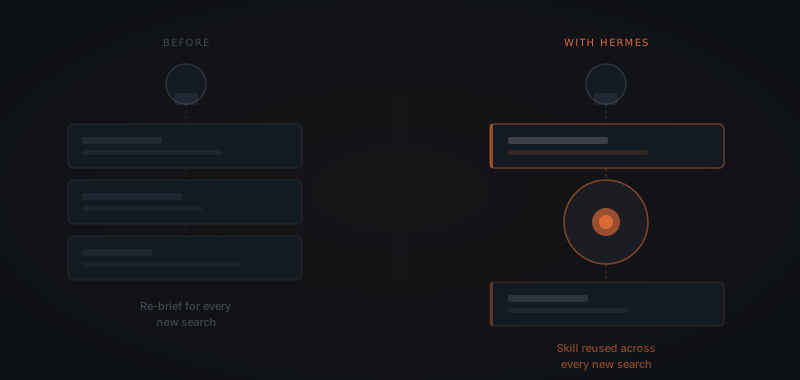
Generic AI tools reset with each search. The recruiter defines criteria, the tool searches, the recruiter reviews the results, adjusts the criteria, and runs again. The next search starts at the same starting point.
58% of recruiters who use AI find it most valuable for candidate sourcing — and the sourcing logic is exactly what gets lost between searches with static tools.[¹] The compounding value of a search agent comes from what it learns across placements, not from what it executes on a single search.
| Search type | Static AI tool | Hermes |
|---|---|---|
| First search for a role type | Recruiter defines criteria | Recruiter defines criteria |
| Second search (same role) | Recruiter re-defines same criteria | Hermes applies stored skill |
| Third search (same role) | Recruiter re-defines again | Hermes refines from prior feedback |
| Tenth search (same role) | Same from scratch | Hermes reflects 9 placements of history |
| New client, same role type | Criteria reset | Hermes adapts stored skill to new client |
By the tenth search for a role type, a static tool has zero advantage from experience. Hermes has nine placements of recruiter feedback embedded in its screening logic.
How Hermes builds skills for recruiting
Hermes does not pre-load skills — it builds them from recruiter actions. When a recruiter reviews a candidate shortlist, approves some candidates, and rejects others, Hermes reads the pattern across those decisions and stores it as a skill for that role type. The skill does not come from an initial prompt. It comes from the recruiter's actual decisions on real placements.
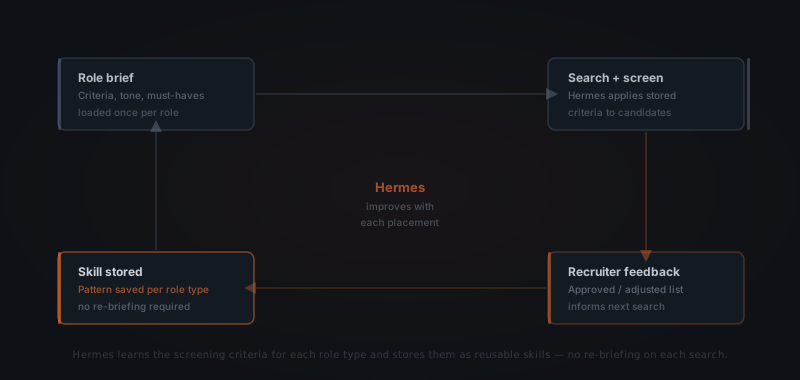
Hermes's skill-building loop in a recruiting context works as follows:
The recruiter runs the first search for a role type. Hermes sources candidates using the initial criteria the recruiter defined. The recruiter reviews the shortlist — approves ten candidates for outreach, rejects fifteen, and flags three as "wrong tenure." Hermes reads the pattern across the approved and rejected candidates, identifies the differentiating attributes, and stores them as a screening skill for that role type.
On the next search for the same role type, Hermes applies the stored skill from the start. Sourcing criteria include the tenure range and the specific ERP background that closed the prior shortlist. The recruiter receives a tighter first list with fewer adjustments required. After the recruiter's review and feedback on that list, the skill updates.
Each placement adds signal. After five searches for the same role type at the same client, Hermes's screening skill reflects the actual placement history for that combination — the experience range that gets candidates to offer, the industry background the client's hiring manager values, the career trajectory that correlates with acceptance and retention.
The fourth search starts where the third one ended. The recruiter reviews a shortlist, not a starting point.
What Hermes learns in a recruiting context
Hermes builds skills across four dimensions for each role type a firm places repeatedly.
Sourcing criteria. What qualifications, experience range, and industry background characterise the candidates the recruiter approves for this role type at this client. Hermes refines these criteria from the recruiter's shortlist decisions — not from a job description rewritten each search.
Profile-matching logic. Which candidate attributes predict successful placement for this specific role at this specific client. After multiple placements, Hermes can weight attributes by their historical correlation with recruiter approval and client acceptance — not by generic AI scoring.
Screening question sequence. What questions effectively separate qualified from non-qualified candidates during the first outreach. Hermes stores the questions that generate useful screening responses for this role type and prioritises them in subsequent candidate communications.
Communication tone and timing. How candidates for this role type prefer to be approached — formal or conversational, what platform (email vs. LinkedIn), what response time typically indicates interest. Hermes adjusts outreach timing and tone based on response patterns from prior searches.
What Hermes handles versus what the recruiter handles
Hermes handles the pattern-recognition and execution layer. The recruiter handles judgment.
| Task | Hermes | Recruiter |
|---|---|---|
| Candidate sourcing against stored role criteria | ✓ | |
| First-touch outreach drafts using role-specific tone | ✓ | |
| Follow-up sequencing for non-respondents | ✓ | |
| Skill refinement after each shortlist review | ✓ | |
| Interview scheduling coordination | ✓ | |
| Shortlist review and candidate approval | ✓ | |
| Qualification calls and candidate assessment | ✓ | |
| Client briefing and requirement clarification | ✓ | |
| Reference checks and background verification | ✓ | |
| Offer negotiation and placement close | ✓ |
Candidate assessment, client relationship management, and offer negotiation stay with the recruiter. Hermes handles the sourcing, sequencing, and skill accumulation that makes the recruiter's judgment more targeted — not replaced.
Recruiting teams have shrunk from an average of 31 to 24 staff between 2022 and 2024, with no corresponding reduction in placement volume expectations.[²] Per-recruiter workload has increased. An agent that learns across placements compounds in value as the team gets leaner — each recruiter can manage more active searches without losing the quality signal that experience provides.
How recruiting firms deploy Hermes
Define the three to five role types you place most often
Hermes builds the deepest skills for role types with repeated searches. Start with the roles your firm places most frequently — accounting and finance, operations management, technical recruiting, sales leadership, whatever your firm's core practice is. For each role type, write the initial sourcing criteria and the screening questions you use to qualify candidates. These become Hermes's starting point.
Connect Hermes to your ATS and sourcing channels
Link Hermes to Bullhorn, Greenhouse, Lever, or Workday for candidate record access and stage tracking. Connect LinkedIn for sourcing. Connect Gmail or Outlook for outreach. The initial connection scope for a standard recruiting firm covers three to four integrations. See the Hermes setup guide for the full technical connection walkthrough.
Run the first search for each role type with explicit shortlist review
For the first search in each role type, review every candidate Hermes surfaces with explicit feedback — approved, rejected, and a brief note on the reason for each rejection. The reason is the training signal. "Wrong industry background" gives Hermes more to work with than a silent rejection. Three to five searches with explicit feedback builds a skill strong enough to produce tight shortlists without step-by-step correction.
Define which decisions require recruiter review and which run autonomously
After the first three searches, decide which Hermes actions run automatically (sourcing and initial outreach for established role types) and which require review (shortlist approval, second-stage outreach, interview communications). Autonomous sourcing for known role types is a safe starting point. Autonomous shortlist approval requires high confidence in the stored skill — typically after five or more placements with consistent feedback.
Expand to new role types and new clients as skills mature
Once Hermes has strong skills for your core role types, introduce new role types one at a time. When a new client requires a role type Hermes already knows, introduce the client context as an adjustment layer — Hermes adapts the existing skill rather than starting from scratch. A new client who wants accountants with specific software experience adds one attribute to the established accountant skill.
A standard Hermes deployment for a recruiting firm — covering three core role types across ATS, LinkedIn, and email — goes from scoping call to first live search in two to four weeks. For the full timeline, see what a real AI agent implementation involves.
For more on how Hermes builds skills from experience rather than static prompts, see how Hermes learns. For context on what AI agents do for recruiting agencies more broadly, see the full workflow post.
Frequently asked questions
How does Hermes help recruiting firms? Hermes helps recruiting firms by building role-specific screening patterns as reusable skills from recruiter feedback. When a recruiter reviews a shortlist and approves or rejects candidates, Hermes stores the pattern across those decisions as a skill for that role type. The next search for the same role type applies the stored skill from the start — no re-briefing required. After multiple placements, the skill reflects actual placement history, not generic AI criteria.
What skills does Hermes build for recruiting? Hermes builds sourcing criteria skills (qualifications, experience range, and industry background for a specific role type), profile-matching logic (which candidate attributes predict recruiter approval and client acceptance for this role at this client), screening question sequences (what first-touch questions generate useful qualification responses), and communication tone and timing preferences (how candidates for this role type respond to outreach). Skills are stored per role type and per client and improve with each completed search.
How is Hermes different from a static AI recruiting tool? A static AI tool applies the same logic to every search regardless of what prior searches revealed. Hermes builds skills from completed searches and refines them with recruiter feedback. After ten searches for the same role type, Hermes's screening logic reflects nine placements of recruiter decisions — not the initial prompt. The agent improves with each search rather than resetting.
What does Hermes not do for recruiting firms? Hermes does not make placement decisions, conduct qualification calls, negotiate offers, or manage client relationships. Hermes handles sourcing, screening logic, outreach drafting, and communication sequencing based on stored skills. The recruiter makes all assessment, relationship, and placement decisions. Every Hermes shortlist and outreach draft requires recruiter review before action is taken.
Notes
- DemandSage. (2026). "AI Recruitment Statistics 2026." DemandSage, citing LinkedIn Talent Solutions. https://www.demandsage.com/ai-recruitment-statistics/ — source for: 58% of AI-using recruiters find AI most valuable for candidate sourcing.
- Eightfold AI. (2026). "AI Agents for Recruiting." Eightfold AI Blog, citing PwC 2025 Global AI Jobs Barometer. https://eightfold.ai/blog/ai-agents-recruiting/ — source for: recruiting teams have shrunk from an average of 31 to 24 between 2022 and 2024, increasing per-recruiter workload and the productivity case for self-improving agent tools.
- Nous Research. (2025). "Hermes Overview." Nous Research, HuggingFace model documentation. https://huggingface.co/NousResearch — source for: Hermes is an open-source autonomous AI agent that builds skills from experience, runs across 20+ platforms, and maintains persistent memory across sessions. The skill-building mechanism is documented in model release notes.