End of the month. Fifteen campaign reports due, each one requiring an account manager to open Meta Ads, cross to Google Ads, pull GA4, and turn three sets of data into a document a client will actually read. Hermes reads campaign data directly from connected platforms, drafts the performance report in the agency's format, and surfaces it for review. The account manager approves the narrative — not assembles it. Skills build from every completed report cycle, improving output on each client's preferred format the longer Hermes runs.
End of the month. Fifteen campaign reports due, each one requiring an account manager to open Meta Ads, cross to Google Ads, pull GA4, and turn three sets of data into a document a client will actually read. The data is all there. Compiling it into a client-facing narrative takes 4–5 hours per client — before any strategy discussion, before any recommendations. Hermes reads campaign data from connected platforms, drafts the performance report in the agency's format, and surfaces it for review. The account manager approves the narrative. Hermes assembled it.
A 15-client agency spends 60–75 hours a month assembling campaign reports
AgencyAnalytics puts client reporting at 4–5 hours per client per month for the typical marketing agency account manager.[¹] At 15 retainer clients, that is 60–75 hours per month — before strategy work, client calls, or campaign optimisation. The assembly is not billable. It is pulling numbers from three platforms, reconciling them in a spreadsheet, and writing a document that should have taken 20 minutes if two hours of data gathering had not come first.
The assembly process looks the same at every agency: open Meta Ads Manager, export the performance report, switch to Google Ads, pull the equivalent export, open GA4 for traffic and conversion data, reconcile the numbers in a spreadsheet, then open a Google Doc and write the client narrative. Per client. Every month.
McKinsey Global Institute found knowledge workers spend 19% of the workweek gathering information.[²] For marketing agency account managers, that information is campaign data — coming from Meta, Google, and GA4 simultaneously, in three different export formats, all due in one client-facing document by Thursday. The gathering is not the expertise the client is paying for. The analysis and strategic recommendation are the expertise. Most agencies cannot separate the two because the same person doing the strategic work is also pulling the CSVs.
At a blended senior rate of £60/hr, 60–75 hours per month on report assembly costs £43,000–£54,000 per year in senior time — for a process that produces no strategic value in itself. The value is in the analysis and client relationship. The assembly just gets in the way.
Dashboard tools solve the data problem — not the writing problem
Marketing agencies evaluating reporting automation reach for tools like DashThis, AgencyAnalytics, or Swydo. All three are legitimate tools for what they do. All three solve the data aggregation problem. None of them solve the writing problem.
DashThis, AgencyAnalytics, and Swydo connect to campaign platforms, pull live metrics, and display them in formatted dashboards. The account manager sends the client a dashboard link or exports it as a PDF. The data is current, the visualisation is clean, and the account manager still writes the accompanying narrative — the commentary, the context, the next month's recommendations — from scratch.
The writing layer is where senior agency time disappears. An account manager looking at a dashboard showing CPM up 12%, click-through rate down 8%, and conversion rate flat needs to explain what those shifts mean for the client's goals, what the agency is adjusting, and what to expect next month. That explanation is a 30–40 minute writing task sitting on top of the data pull. Dashboard tools remove the data pull. The writing task remains.
Hermes handles the writing layer. Hermes does not replace DashThis or AgencyAnalytics — it sits alongside them, or connects to the campaign platforms directly, and drafts the document the client receives. The dashboard shows the numbers. Hermes writes around them.
Hermes reads campaign data and drafts the client report
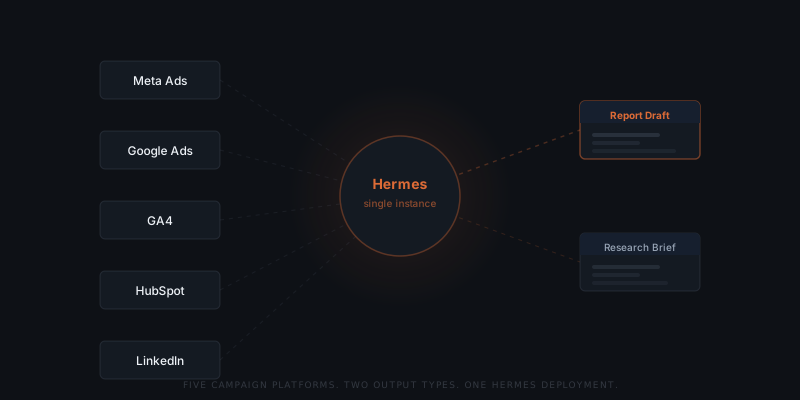
Hermes connects to the platforms the agency's clients run campaigns on — Meta Ads Manager, Google Ads, GA4, LinkedIn Campaign Manager, and HubSpot for email and CRM data — and reads live campaign performance for the reporting period defined in the workflow.
Hermes does not replace DashThis or AgencyAnalytics. Hermes reads what those tools surface — or connects to the campaign platforms directly — and drafts the client-facing narrative the dashboard does not write. The dashboard shows the numbers. Hermes writes the document.
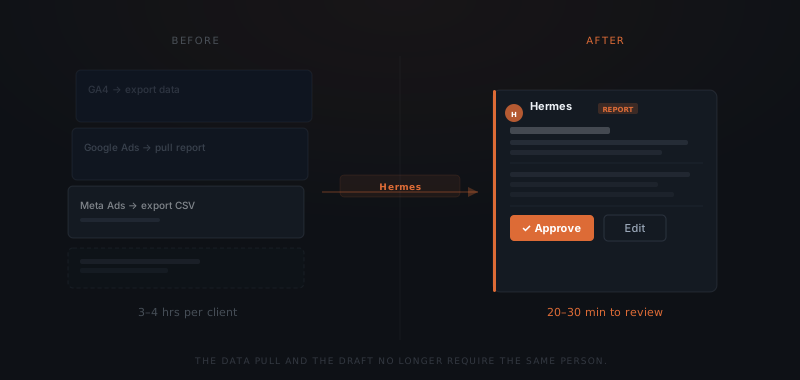
For a monthly campaign report, Hermes reads each connected platform, identifies the metrics the reporting template covers, and drafts the performance document in the agency's format — section by section, in the account manager's voice, with client-specific variables populated. The draft surfaces for review. The account manager reads it, adjusts the commentary where strategic framing needs a human decision, and approves. The document goes to the client from the account manager's address, as if written by hand.
The review task is different from the assembly task. Reading a draft report for accuracy and strategy takes 20–30 minutes. Pulling the data, reconciling it across three platforms, and writing the document from scratch takes 3–4 hours. Hermes handles the longer task. The account manager handles the shorter one.
| Reporting task | What Hermes does | Before Hermes | After Hermes |
|---|---|---|---|
| Monthly performance report | Pulls platform data; drafts narrative in agency format | 3–4 hrs per client | 20–30 min review |
| Mid-month check-in summary | Reads current metrics; drafts status note | 45–60 min per client | 5 min to approve |
| Campaign close report | Pulls full-period data; drafts results document | 4–5 hrs per campaign | 30 min final review |
| Quarterly strategic summary | Aggregates three months; drafts trend commentary | 6+ hrs per client | 45 min to review and frame |
Hermes handles campaign research and brief preparation
Campaign reporting is not the only repetitive document work in a marketing agency. The second category is campaign research: audience landscape documents for new client briefs, competitor campaign analysis, keyword and content opportunity summaries. Each one requires searching across multiple sources, reading the results, and writing a structured document someone else can act on.
A new client brief for a B2B SaaS company requires competitor ad analysis, audience segment research, and a keyword landscape — typically two to three hours of research before the strategist writes the actual campaign plan. Hermes handles the research and initial structure: searches for competitor campaigns across Meta and Google, summarises the findings, and drafts the brief document in the agency's template. The strategist adds the angle, the positioning, and the creative direction. Hermes assembled the inputs.
The same pattern applies to monthly strategic updates — the competitive landscape section, the platform news summary, the emerging format recommendations. Hermes researches, drafts the structure. The account director adds the framing and the strategic recommendation.
What changes for the account director is not who owns the strategy — the account director still owns it — but how much of Tuesday afternoon goes toward reaching it. A brief that required three hours of solo research now requires an hour of reviewing a structured draft and adding the strategic layer the client is paying for.
Skills build from every completed campaign cycle
Each completed report adds a Skill object to Hermes's library — a structured record of what this client's report covers, how they prefer data framed, what level of commentary they expect, and what the account manager changed in the last draft. On the next reporting cycle, Hermes applies the Skill and extends it with the new completed example.
The data isn't the problem. Writing the report around it is — and that's exactly what Skills learn to do.
A client who prefers revenue-focused metrics framed as cost-per-acquisition improvements, with a brief competitive note and a three-line forward look, develops a Skill that encodes exactly that preference after three to four completed cycles. The next month's draft reflects what that client expects — not a generic performance document formatted from a shared template.
By month three, established client reports require minimal edits. The account manager's review shifts from correcting structure and tone to checking strategic accuracy and adding contextual notes the month's results require. Common report variants — monthly performance, campaign close, quarterly strategic review — are handled accurately for established clients. Edge cases and newly onboarded clients continue to improve through months two and three.
The practical implication for the agency is capacity recovery. An account manager who recovers 60–75 hours per month from report assembly has 60–75 hours per month for strategy, client development, and creative direction. The agency does not reduce headcount. The same team handles a larger client book at the same quality level.
Setting up Hermes for campaign reporting
Context definition determines whether Hermes produces agency-grade report drafts from the first cycle or requires six weeks of correction before the output is usable. Five decisions need to happen before the first report runs.
Connect campaign platforms
Grant Hermes read access to each campaign platform the reporting workflow requires: Meta Ads Manager, Google Ads, GA4, HubSpot, or LinkedIn Campaign Manager. Scope access to the platforms relevant to the specific clients in scope — not every tool the agency uses. Read access only; Hermes does not create or modify campaign data.
Define the first reporting workflow
Choose one report type and one client segment to start: monthly performance reports for retainer clients is the highest-leverage starting point. Define the reporting period, the metric set to pull, and the template format. One workflow, fully defined, produces better early results than three workflows defined partially.
Provide real example reports per client
For each client in scope, provide three to five real past reports — not generic templates. Annotate what each report got right for that client: the metrics they care about, the commentary depth they expect, the tone they prefer. Example quality drives Skill quality; generic templates produce generic drafts.
Define routing and review ownership
Assign a named reviewer for each report type — the account manager responsible for approving before the client receives it. Define the review window: how long the draft sits in the queue before escalating. Clear ownership prevents drafts from sitting approved but unsent.
Run the first draft cycle with close review
The first month, review every draft carefully — not just for accuracy but for what each client's Skill should encode. Corrections from close first-month review compress the learning curve from three months to four to six weeks. By month two, the correction rate on established clients begins to drop.
For how Hermes handles the broader agency communication layer beyond campaign reporting, see Hermes for agencies. For a complementary view of how OpenClaw handles the inbound request routing and approval queue at the same agency, see OpenClaw for marketing agencies.
What account managers still own
Hermes handles the assembly layer. The strategic layer stays with the account manager.
Interpretation and strategic recommendations. A report showing click-through rate declining 15% month-on-month requires an explanation and a response plan. Hermes drafts what the data shows. The account manager explains what it means for the client's goals and what to do about it. Those are different tasks. Hermes handles the first; the account manager handles the second.
Client relationship and context. Some months, the data does not tell the full story. A campaign that underperformed because the client changed the offer mid-month, or because a key audience segment was unavailable during a regional period, requires context Hermes does not have access to. The account manager adds it before the report sends.
Campaign strategy and optimisation decisions. Where to run next month, what to test, what to cut, how to reallocate budget — these decisions belong to the account team. Hermes reports on what ran. The account manager decides what runs next.
New client onboarding and scope-change conversations. When a client adds a new channel or changes their campaign objective mid-quarter, the account manager handles the strategic realignment. Hermes updates the reporting template in the next cycle once the new scope is defined.
Escalation and difficult conversations. A client whose campaigns missed targets by a significant margin needs a direct conversation, not a drafted report. Hermes flags the underperformance in the data. The account manager handles the call.
The boundary between what Hermes handles and what the account manager handles is the boundary between what can be assembled from structured data and what requires judgment about that data. Hermes produces a draft. The account manager decides whether to approve it, edit it, or set aside a section and write it with the strategic framing the month requires. Every output from Hermes surfaces for review before any client receives it.
For an overview of how Hermes works as a self-improving agent across all deployment types, see what is Hermes.
Frequently asked questions
What does Hermes do for a marketing agency? Hermes connects to Meta Ads, Google Ads, GA4, HubSpot, and LinkedIn Campaign Manager, reads live campaign data, and drafts the client-facing performance report in the agency's format. The account manager reviews the draft and approves or edits before anything sends. Skills build from each completed report cycle, improving draft accuracy on each client's preferred format over time.
Does Hermes replace DashThis or AgencyAnalytics for marketing agency reporting? No — Hermes handles a different layer. DashThis and AgencyAnalytics aggregate campaign data into dashboards. Hermes reads what those tools surface — or connects to the platforms directly — and drafts the narrative document the account manager sends to the client. The dashboard shows the numbers; Hermes writes the document around them.
How long before Hermes improves on a specific client's reporting format? After three to four completed monthly reports for the same client, Hermes handles that client's preferred metrics hierarchy, commentary style, and level of detail accurately. By month three, report drafts for established clients typically require minimal edits. Edge cases and new clients continue to improve through months two and three.
What campaign platforms does Hermes connect to for a marketing agency deployment? Hermes connects to the platforms the agency's clients run campaigns on: Meta Ads Manager, Google Ads, GA4, LinkedIn Campaign Manager, and HubSpot for CRM and email data. Connections are scoped to what each configured reporting workflow requires — not every tool the agency uses needs to be connected.
Notes
- AgencyAnalytics, "8 Best Marketing Agency Reporting Tools to Scale Up [2026]." https://agencyanalytics.com/blog/marketing-agency-reporting-tools
- McKinsey Global Institute, The social economy: Unlocking value and productivity through social technologies, 2012. https://www.mckinsey.com/industries/technology-media-and-telecommunications/our-insights/the-social-economy