A recruiter at a mid-size staffing agency spends the first two hours of every morning building a candidate list, writing outreach emails, and updating the ATS from yesterday's calls. Another hour goes to scheduling coordination. By noon, half the day is gone and the recruiter has not had a single conversation that moves a placement forward. AI agents handle the sourcing, the outreach drafts, the scheduling coordination, and the ATS updates — so recruiters spend their hours on the conversations that close placements.
A recruiter at a mid-size staffing agency spends the first two hours of every morning building a candidate list, writing outreach emails, and updating the ATS from yesterday's calls. Another hour goes to scheduling coordination. By noon, half the day is gone and the recruiter has not had a single conversation that moves a placement forward. AI agents handle the sourcing, the outreach drafts, the scheduling coordination, and the ATS updates — so recruiters spend their hours on the conversations that close placements.
Where recruiting agencies lose recruiter hours
Recruiting agencies sell candidate access, relationship networks, and placement judgment. The administrative work that surrounds every placement — finding names, writing outreach, coordinating schedules, updating the ATS, sending client reports — consumes a large fraction of the hours the agency charges for.
67% of hiring decision-makers cite time savings as the primary advantage of AI in recruitment workflows, according to Statista research.[¹] The tasks driving that wasted time are consistent across agencies: candidate list building, outreach message drafting, interview coordination, and ATS maintenance are all high-volume, low-judgment work that repeats identically for every role.
A recruiter managing five open roles simultaneously runs this cycle for each: build a sourcing list, write twenty outreach emails, follow up with non-respondents, coordinate interview slots by email, log the outcomes in the ATS, and send the client a weekly pipeline update. Each cycle takes five to eight hours of recruiter time that does not require the recruiter's judgment.
| Task | Typical hours per week per recruiter | Agent handles |
|---|---|---|
| Candidate list building | 4–6 hrs | Yes — searches by defined criteria |
| Outreach message drafting | 3–4 hrs | Yes — drafts personalized, queues for review |
| Follow-up sequences | 2–3 hrs | Yes — runs on cadence after first touch |
| Interview scheduling | 2–4 hrs | Yes — coordinates availability, sends confirmations |
| ATS updates | 2–3 hrs | Yes — logs activity, updates stages |
| Client pipeline reports | 1–2 hrs | Yes — pulls data, formats, queues for review |
| Candidate assessment and interviews | 5–8 hrs | No |
| Client relationships and briefing | 3–5 hrs | No |
| Offer negotiation and close | 2–4 hrs | No |
The first six rows are repeatable, rule-based work. The last three are the reason clients hire the agency.
What AI agents handle in a recruiting agency workflow
An AI agent for a recruiting agency connects to the ATS, outreach tools, and CRM the agency already uses, and handles the admin pipeline — without needing direction for each role or each candidate.
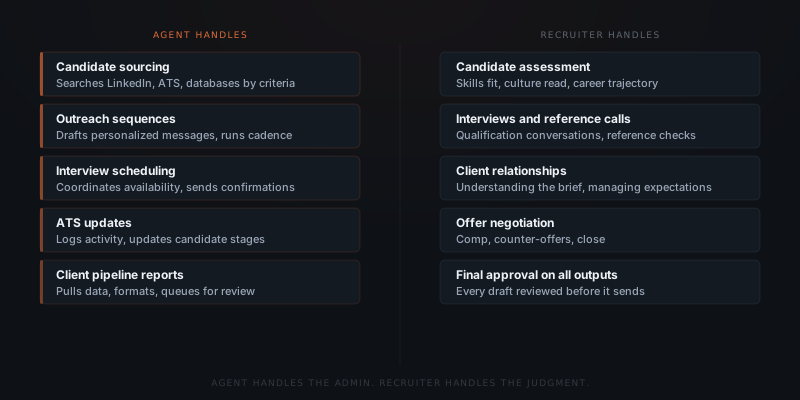
Candidate sourcing. The recruiter defines the role criteria — title, years of experience, location, skills, industry background — and the agent searches LinkedIn, the ATS database, and any other connected candidate sources, deduplicates against the existing pipeline, and surfaces a qualified list for recruiter review. 58% of recruiters who use AI find it most valuable for candidate sourcing — it is the highest-volume, most repetitive part of the workflow.[¹]
Outreach and follow-up sequences. The agent drafts the first-touch outreach message for each candidate based on the role description and the candidate's background. The recruiter reviews and approves the draft before it sends. The agent then runs the follow-up cadence for non-respondents — second touch, third touch — without the recruiter tracking which candidates need a follow-up on which day.
Interview scheduling. Once a candidate expresses interest, the agent reads the available times from the recruiter's and client's calendars, proposes slots to the candidate, and confirms the meeting when the candidate accepts. The agent sends confirmation emails to all parties and sets reminders. The recruiter focuses on preparing for the interview — not on the back-and-forth of scheduling it.
ATS updates. After every recruiter call, email exchange, or interview, the agent reads the conversation, extracts the relevant outcome, and updates the candidate's record in the ATS — stage change, last contact date, notes, next action. Recruiters stop doing data entry between conversations and the system.
Client pipeline reports. The agent reads the current pipeline from the ATS, formats it against the agency's report template, and queues it for recruiter review. The recruiter adds commentary, adjusts any numbers that need context, and approves before it goes to the client.
How the recruiting workflow changes with an agent
AI agents for recruiting agencies do not assess candidate fit. The agent builds the list, drafts the outreach, coordinates the schedule, and updates the ATS — so the recruiter's hours go to the assessment interviews, the reference calls, the client briefings, and the negotiations that actually close placements.
Without an agent, a recruiter managing five active roles might spend 60–70% of available hours on sourcing, outreach, scheduling, and ATS work — with 30–40% available for the conversations that determine whether placements happen.
With an agent handling the admin layer, the ratio inverts. Recruiters who implement agent workflows report spending the majority of their hours on candidate and client conversations, with the admin handled in review and approval time — checking the sourced list, reviewing outreach drafts, confirming scheduling confirmations before they send.
The 86.1% of recruiters who report that AI makes the hiring process faster are describing exactly this shift — not replacing recruiter judgment but removing the work that surrounds it.[¹]
What changes immediately: The recruiter's morning. Instead of two hours building a list and writing outreach, the recruiter reviews the agent's draft list and outreach queue — a thirty-minute task — and spends the remaining ninety minutes on calls.
What changes over time: Client capacity. A recruiter handling five active roles with an agent can manage seven or eight. The constraint shifts from admin bandwidth to relationship and judgment capacity, which is the actual limiting factor for most strong recruiters.
The best recruiters in any agency spend most of their day on tasks that don't require their judgment. That ratio is the problem agents fix.
How agents connect to the existing ATS and CRM stack
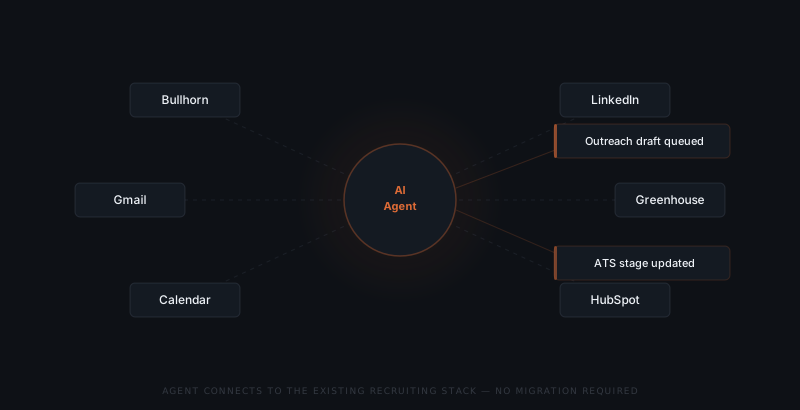
Recruiting agencies run on a combination of applicant tracking systems, LinkedIn Recruiter, email, and client CRM. AI agents connect to this stack through APIs — no migration to new platforms required.
Applicant tracking systems. Bullhorn, Greenhouse, Lever, Workday, and Jobvite all expose candidate records, job requisitions, stage definitions, and activity logs via API. The agent reads candidate data from and writes activity back to the ATS — updating stage, logging call outcomes, and adding notes — without the recruiter entering data manually between conversations.
LinkedIn. LinkedIn Recruiter API access allows the agent to search profiles based on defined criteria, save candidate profiles to the ATS, and draft initial InMail or connection request messages for recruiter review. The recruiter reviews and approves before any message is sent from the recruiter's profile.
Email. Gmail and Outlook connect via OAuth. The agent drafts outreach emails and follow-up messages into a review queue. The recruiter reads each draft, edits if needed, and sends with one approval action. No candidate email goes out without a human reviewing it.
Calendar. Google Calendar and Outlook Calendar connect for scheduling coordination. The agent reads available slots, proposes them to candidates, and creates confirmed calendar events when candidates accept. Recruiter and client calendar availability are both taken into account before any slot is proposed.
Client CRM. HubSpot, Salesforce, or Pipedrive connect for client-side pipeline tracking — account status, key contacts, open requisitions, recent activity. The agent keeps client records current from email and call activity, generating the weekly client report from live CRM data.
What AI agents cannot do for a recruiting agency
Agents handle the pipeline and the admin. The judgment that makes placements happen stays with the recruiter.
Candidate assessment. Screening a candidate for a specific role requires understanding the job requirements, the client's team dynamics, the candidate's career trajectory and motivation, and whether the match will hold through a notice period and first ninety days on the job. An agent can build the sourcing list and surface the candidate. The recruiter determines whether the candidate is worth presenting.
Qualification interviews. Whether a candidate will accept an offer at the expected comp range, leave their current role, and thrive in the client's environment requires conversations that draw on the recruiter's experience with similar candidates and similar roles. An agent cannot conduct a qualification interview or read the candidate's motivations from a call.
Reference checks. Reference conversations involve reading between the lines of what a former manager says and does not say. An agent cannot conduct a reference call or assess the weight of hesitation in a reference's answers.
Client relationships and briefing. Understanding what a client actually wants versus what they wrote in the job description requires an ongoing relationship and the ability to ask the right questions in a briefing call. An agent can draft the post-briefing summary — the recruiter has the briefing conversation.
Offer negotiation. Closing the gap between a candidate's expectation and a client's offer ceiling requires the recruiter's relationship with both parties, knowledge of both parties' walk-away positions, and the ability to move each party toward an agreement. An agent cannot negotiate.
For a framework on which recruiting workflows are ready for agent automation, see how to know if a business process is ready to hand to an AI agent.
How recruiting agencies start with AI agents
Start with one role type that runs the same way every time
Not all roles have the same sourcing criteria, outreach message, or scheduling sequence. Start with the role type the agency places most often with the most consistent requirements — a recurring job category where the sourcing criteria are stable. The agent's first configuration is easier when the criteria do not change week to week.
Document the sourcing criteria and outreach template for that role
Write down exactly what makes a candidate qualified: the required skills, experience range, location parameters, and any filters the recruiter applies manually. Write the outreach message template and the follow-up sequence. This documentation becomes the agent's operating brief for that role type. If the recruiter cannot write it down in a single page, the criteria are not defined enough to hand to an agent.
Connect the ATS, outreach tool, and calendar
Map the specific connections the workflow requires: the ATS for candidate records, Gmail or Outlook for outreach, and Google Calendar or Outlook Calendar for scheduling. A standard recruiting setup covers three to four integrations. Each is a standard API connection — no custom development required for Bullhorn, Greenhouse, LinkedIn, Gmail, or HubSpot.
Review every agent output for four weeks before trusting the cadence
Run the agent on one active role for four full weeks. Review every sourced candidate list before the recruiter acts on it. Read every outreach draft before it sends. Confirm every scheduling email before it goes out. Note where the agent consistently gets it right and where edge cases appear. Adjust the configuration based on what the first four weeks reveal.
Measure placement rate and time-per-role before expanding
Before rolling out the agent to additional role types, measure what changed: how long does sourcing take now compared to before, how many candidates does the recruiter reach per week, and has the placement rate for that role type changed. Concrete measurement before expansion catches configuration issues early and sets baseline expectations for additional role types.
A standard recruiting agency implementation goes from scoping call to first live candidate list and outreach queue in two to three weeks. See what a real AI agent implementation involves for the full timeline.
For context on what building a custom recruiting workflow costs versus an off-the-shelf tool, see custom vs. off-the-shelf AI agents.
Frequently asked questions
How do AI agents help recruiting agencies? AI agents help recruiting agencies by handling the admin layer that consumes recruiter hours: candidate list building from LinkedIn and ATS databases, outreach message drafting and follow-up sequences, interview scheduling coordination, ATS stage updates after calls, and client pipeline report generation. 58% of recruiters who use AI find it most valuable for candidate sourcing — the highest-volume task in the workflow.[¹] The recruiter handles candidate assessment, qualification interviews, client relationships, and offer negotiation.
What tasks can an AI agent automate for a recruiting agency? An AI agent automates candidate list building, first-touch and follow-up outreach sequences, interview scheduling across recruiter and client calendars, ATS activity logging and stage updates, and weekly client pipeline report generation. The agent drafts every output and queues it for recruiter review — no candidate message sends without a human reviewing it. Candidate assessment, reference checks, client briefings, and offer negotiations remain with the recruiter.
What ATS and CRM tools do AI agents connect to for recruiting? AI agents connect to Bullhorn, Greenhouse, Lever, Workday, or Jobvite for applicant tracking; LinkedIn Recruiter for candidate sourcing; HubSpot, Salesforce, or Pipedrive for client CRM; Gmail or Outlook for outreach; and Google Calendar or Outlook Calendar for scheduling. The agent works inside the existing stack — no migration required. The integration scope depends on which tools the agency already runs.
How long does it take to implement an AI agent for a recruiting agency? A standard implementation covering candidate sourcing, outreach sequences, scheduling coordination, and ATS updates goes from scoping call to first live output in two to three weeks. The AI configuration takes days. The time is filled by connecting the ATS and outreach tools and mapping the agency's sourcing criteria and outreach templates for each role type. See the implementation timeline for a week-by-week breakdown.
Notes
- DemandSage. (2026). "AI Recruitment Statistics 2026." DemandSage, citing LinkedIn Talent Solutions and Statista. https://www.demandsage.com/ai-recruitment-statistics/ — source for: 67% of hiring decision-makers cite time savings as AI's primary advantage (Statista); 86.1% of recruiters say AI makes hiring faster (Statista); 58% of AI-using recruiters find AI most valuable for candidate sourcing (LinkedIn Talent Solutions).
- Eightfold AI. (2026). "AI Agents for Recruiting: Stop Managing and Start Automating." Eightfold AI Blog, citing PwC 2025 Global AI Jobs Barometer. https://eightfold.ai/blog/ai-agents-recruiting/ — source for: organizations using advanced AI see up to 3x higher revenue growth; recruiting teams have shrunk from 31 to 24 on average between 2022 and 2024, increasing pressure to automate admin work.
- Aqore. (2026). "Staffing Industry Trends 2026: AI Agents, Full Automation, and the Strategic Reset." Aqore. https://www.aqore.com/staffing-industry-trends-2026/ — source for: AI agents handle 80% of transactional recruitment tasks autonomously; recruiting teams shift from 80% admin / 20% relationships toward 20% admin / 80% relationships with agent adoption; 75% reduction in interview coordination time with AI-driven scheduling.