AI failure figures describe different stages and outcomes. Use them to ask better questions about the task, data, acceptance and ongoing responsibility, then judge your own workflow from its results.
What you'll learn
- Keep companies, projects and deployments separate.
- Test real operating conditions before and after launch.
- Name who can stop, correct or retire unsuitable work.
There is no single AI implementation failure rate that applies to every business. Current research counts different populations, stages and outcomes. Separate abandoned initiatives, a pilot’s move into production and a measurable financial return, then use the findings to plan the checks and responsibilities for your own workflow.
AI failure-rate headlines can describe different outcomes. In S&P Global’s 2025 survey, 42% of companies reported abandoning most AI initiatives before production, up from 17% in the prior year. That is a share of companies reporting a pattern across their projects, not a claim that 42% of every project fails.[6]
Keep the stage and outcome attached. A stopped experiment, a failed live action and an investment without a measurable financial return require different decisions. Understanding what an AI agent is helps define the work you are evaluating.
What does the AI failure rate actually measure?
Read the measured outcome before calling a project a failure. S&P Global’s May 2025 report covers 1,006 IT and business professionals in North America and Europe. Alongside its company-level abandonment finding, respondents reported that an average 46% of projects were scrapped between proof of concept and broad adoption. Those are different denominators.[6]
Before using a failure percentage, ask what was counted: companies, projects or deployments; which stage they reached; and whether “success” means technical completion, a launch or a financial result. Do not combine unrelated figures into a single odds-of-failure estimate.
Project NANDA’s preliminary July 2025 report describes a “zero return” finding for 95% of organisations in its research. Its method combines reviews of publicly disclosed initiatives, organisational interviews and conference-based leader surveys. The report itself says category samples and success definitions vary; the figure is not a representative census of all AI projects.[4]
The NANDA report also defines successful task-specific implementation through users’ or executives’ reports of sustained productivity or financial impact. That is different from simply getting software into a live system. Keep that distinction when someone retells its headline as a technical failure rate.[4]
For a newer scaling measure, Gartner’s September 2026 release reports 22% of organisations successfully scaling AI across multiple business units or adopting an AI-first approach. Its survey covered 1,303 respondents from organisations with at least $50 million in annual revenue. The remainder is not automatically a failed-project group.[1]
Gartner’s February 2025 forecast is narrower: through 2026, it expects 60% abandonment among projects unsupported by AI-ready data. This is a conditional forecast about a vulnerable group, not an observed failure rate for every implementation.[5]
Why do AI pilots stall before production?
A pilot can stall because the task, data or operating conditions have not been resolved. RAND’s August 2024 research interviewed 65 experienced practitioners and identified problems spanning business understanding, data, technology choices, infrastructure and the limits of what AI can do. These concerns can continue after launch.[2]
Unclear success criteria. If a team tests only whether an answer looks plausible, it can miss whether the customer task is completed correctly. Define the decision the trial is meant to inform. A useful result may be approval to proceed, a narrower scope or evidence that the task should remain with people.
A sample that misses real work. Include unusual inputs, missing information and cases that need escalation. A clean demonstration is useful for understanding a feature; a business trial should also expose the conditions under which it must stop or hand over. Moving into production does not remove those data questions.
No transition plan. Decide who will supply live information, approve actions, receive failures and maintain the connections. Do this before the trial depends on them. A trial can be deliberately limited while still testing the conditions that matter for a later launch.
RAND also warns against choosing the newest technology instead of a suitable solution, or assigning a problem beyond the technology’s capabilities. Clear ownership cannot make an unsuitable model or missing data adequate. Check feasibility alongside the process, not after buying the tool.[2]
How do pilot failure causes differ from production failure causes?
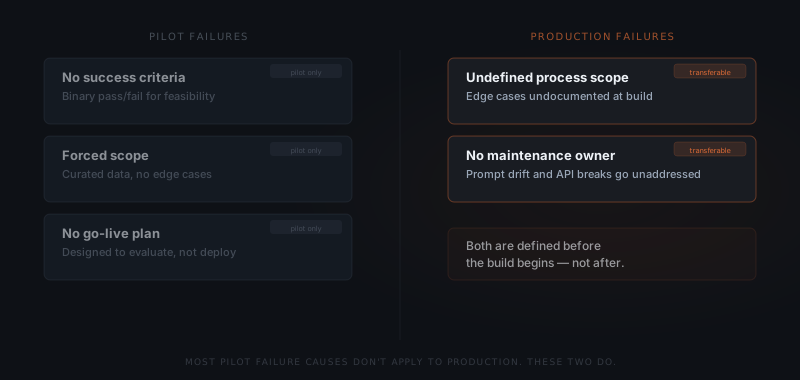
Pilot and production risks overlap. Use the pilot to investigate the same data, decisions and handovers that the live workflow will need, then continue checking them after launch. The following table is a practical planning map, not a measured allocation of failure causes.
| Risk | What to test in a pilot | What to keep checking in production | Practical response |
|---|---|---|---|
| No defined success criteria | Whether the result meets a written task outcome | Quality and completed work against that outcome | Set acceptance criteria before live actions |
| Limited or curated input | Missing, unusual and disputed cases | Changes in the actual incoming work | Keep representative examples and exception routes |
| No transition plan | Live data, approvals and support responsibilities | Whether the handover still works | Agree the operating model before launch |
| Undefined process scope | What the agent may read, prepare or change | Requests outside that boundary | Document permitted actions and escalation |
| No maintenance owner | Who receives failures and makes changes | Whether problems are resolved and recorded | Name an owner with authority and time |
| Changed connections | Failed or altered access to required records | Changed tools, permissions and fields | Test after relevant changes |
| Changed instructions | How current policy changes the answer | Old wording or rules still being used | Review when policy or observed results change |
| Inadequate data or infrastructure | Whether the task can run on available inputs | Reliability and availability of those inputs | Resolve the dependency before expanding |
| Capability limit | Tasks the system cannot reliably complete | New cases outside tested capability | Narrow scope or keep the task with people |
Do not treat a checked box as a guarantee. The evidence you need is the actual result on representative work and a reliable route for exceptions. Keep the technical and organisational questions together.
Which failure concerns remain important after launch?
Scope and ownership remain useful areas to define, but they are not an exhaustive explanation of production failures. Gartner’s June 2025 forecast expects over 40% of agentic AI projects to be cancelled by the end of 2027, citing escalating costs, unclear business value or inadequate risk controls.[3] Our agentic AI statistics collect the 2026 adoption and return figures this forecast sits beside.
Process scope. Describe what happens with an incomplete record, an unusual request or an action outside permission. Say a customer asks for a refund with no matching order: the workflow should have a defined route to a person rather than inventing the missing evidence. That is a proposed example, not a reported client case.
Keep the description current when the business changes its policy or tools. For the ongoing work, see AI agent maintenance. A successful initial test should become a reference for later checks, not a reason to stop reviewing the workflow.
Operating ownership. Name who receives alerts, can stop actions and can authorise a correction. Give that person access to the records and a route to technical support. Match review effort to task volume, consequences and observed failures rather than assuming a fixed small monthly allowance is always enough.
Costs and capability still matter alongside ownership. If the system cannot meet the acceptance criteria, narrow the task or stop the affected action while investigating. A project with a named owner can still be unsuitable or uneconomic.
A pilot should test the conditions the live workflow will need, including its limits and handover.
What do failure-resistant implementations define before starting?
Define the work, the acceptance decision and the operating owner before granting live actions. These are practical preparation steps, not a promise that every risk can be prevented or that a fixed review schedule suits every task.
Write the workflow as a process document
Define success criteria before the trial
Name the operating owner before launch
A process description. Instead of a broad goal such as “automate follow-up”, describe a proposed case: a new enquiry arrives, the agent finds the existing customer record, prepares a permitted reply and sends it for approval. Include what happens when the record is missing or the customer raises a dispute. How to brief an AI agent covers the full brief.
A defined review decision. You might choose an initial review after 30 days and another after 90 days if those periods cover representative work. These are example checkpoints, not research-backed thresholds for reliability. Define the results that would justify continuing, narrowing or stopping the trial.
A named owner. Make responsibilities usable: who is covering absence, which incidents stop actions, where failures are recorded and who agrees a revised policy? A name on a document is only the beginning. The workflow needs a person able to act when the agreed conditions are not met.
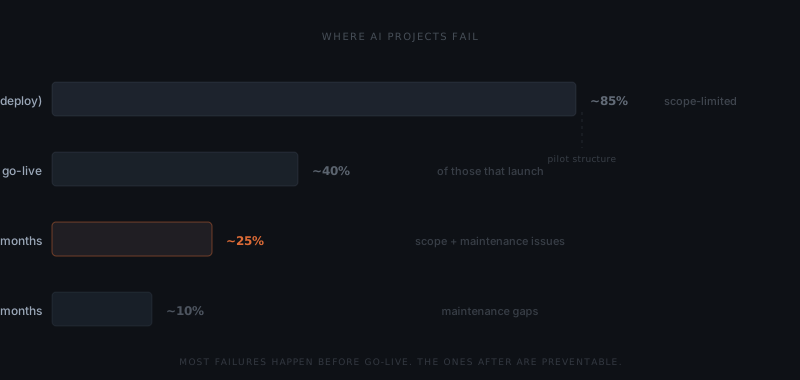
What does the data say about post-go-live failure?
A production-conversion statistic tells you whether work reached production, not how long it remained reliable afterwards. Lenovo’s January 2026 release of IDC-commissioned research reports 46% of AI proofs of concept progressing into production, based on 3,120 IT and business decision makers. That does not provide a universal post-launch survival curve.[7]
The research was conducted in September–October 2025 and spans several world regions. Its production measure differs from Gartner’s organisational scaling finding and NANDA’s impact definition. Read each as its own study rather than treating changes in percentages as a directly measured industry trend.[7]
| Stage to monitor | Evidence to record in your business | Decision it supports |
|---|---|---|
| Before launch | Representative cases, missing data, permitted actions, acceptance result | Proceed, narrow the task or stop |
| Early live operation | Completed work, errors, transfers and review effort | Whether the initial scope is working |
| After a policy or tool change | Repeated acceptance checks and changed failure patterns | Whether actions can safely continue |
| Ongoing operation | Costs, useful outcomes, incidents and unresolved exceptions | Maintain, change or retire the workflow |
This is a monitoring plan, not an estimated rate for each stage. Keep technical failures, rejected trials and weak financial results distinguishable in your own records. That gives you a better basis for the next decision than applying a market headline to every incident.
A decision to stop can be responsible when the intended work cannot be done adequately at an acceptable cost. Record the reason, preserve the relevant evidence and move the task back to people. The aim is a useful operating process, not an implementation kept alive to improve a success count.
Frequently asked questions
What percentage of AI projects fail in 2026? There is no single comparable rate. S&P Global’s 2025 survey reports 42% of companies abandoning most initiatives before production; Gartner’s 2026 research measures organisational scaling. A stopped pilot, technical failure and lack of financial return are separate outcomes. Keep the population and definition attached.[1][6]
Why do most AI pilots fail? A pilot can stall when the business task, success criteria, data or transition responsibilities remain unclear. RAND’s practitioner research also identifies unsuitable technology choices, infrastructure gaps and tasks beyond AI capability. These risks are not exclusive to pilots.[2]
What causes live AI implementations to fail? Scope and ownership matter alongside data quality, system capability, operating costs and risk controls. Gartner’s over-40% cancellation figure is a forecast for the end of 2027, not an observed rate caused only by missing maintenance ownership.[2][3]
How do I reduce the risk of an AI implementation failing? Define permitted work, representative tests, acceptance criteria and a person able to handle failures. Choose reviews around task cycles and changes. Treat stopping or narrowing a task as an available decision when quality or cost does not meet the agreed requirements.
Notes
- Gartner Survey Finds Only 22% of Organizations Have Successfully Scaled AI Across Multiple Business Units. September 1, 2026; survey January–April 2026 Accessed October 15, 2026.
- The Root Causes of Failure for Artificial Intelligence Projects and How They Can Succeed. August 13, 2024 Accessed October 15, 2026.
- Gartner Predicts Over 40% of Agentic AI Projects Will Be Canceled by End of 2027. June 25, 2025 Accessed October 15, 2026.
- The GenAI Divide: State of AI in Business 2025 — preliminary report. July 2025; research January–June 2025; original report copy hosted by AI News. Accessed October 15, 2026.
- Lack of AI-Ready Data Puts AI Projects at Risk. February 26, 2025; data survey July 2024 Accessed October 15, 2026.
- Generative AI experiences rapid adoption, but with mixed outcomes — Highlights from VotE: AI & Machine Learning. May 30, 2025 Accessed October 15, 2026.
- Research From Lenovo Reveals AI Is Paying Off, Yet Most CIOs Aren’t Ready for What Comes Next. January 27, 2026; research September 16–October 17, 2025 Accessed October 15, 2026.