A small business owner needs one workflow automated — lead follow-up, invoice processing, meeting notes. The instinct is to post the job and hire whoever looks qualified on paper. Three months later, the freelancer has gone quiet mid-project, or the in-house hire is costing $150,000 a year to maintain one system nobody else understands. The mistake isn't picking the wrong person. It's picking a hiring route that puts your entire automation on one person's availability. There are four ways to hire an AI developer for a small business, and the route matters more than the resume.
The hiring decision matters more than the shortlist. Route determines who carries the risk when the build stalls, who owns the system afterwards, and what happens when the person who wrote it stops answering.
What are the four ways a small business can hire an AI developer?
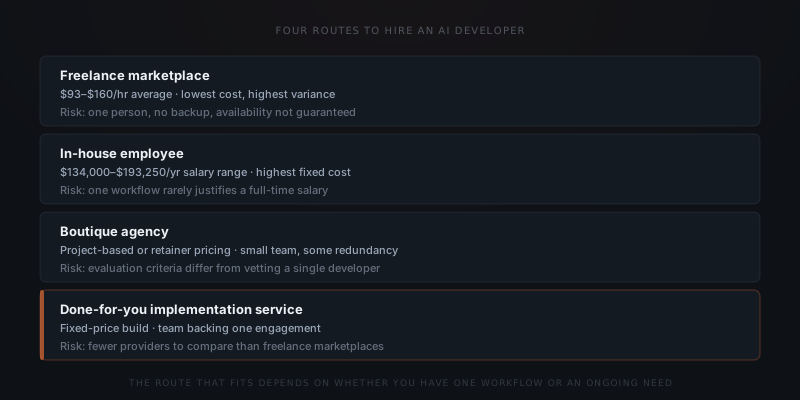
Every hiring decision for an AI build falls into one of four routes: a freelance marketplace, an in-house employee, a boutique agency, or a done-for-you implementation service. Each has a different cost structure and a different failure mode.
| Hiring route | Typical cost | Best fit | Biggest risk |
|---|---|---|---|
| Freelance marketplace | $93–$160/hr | Small, well-defined project with flexible timeline | One person, no backup, availability not guaranteed |
| In-house employee | $134,000–$193,250/yr | Ongoing technical need spanning many workflows | One workflow rarely justifies a full-time salary |
| Boutique agency | Project or retainer pricing | Multiple related builds, ongoing relationship | Evaluation criteria differ from vetting one developer |
| Done-for-you implementation | $1,000–$15,000 per workflow | One or two specific, well-scoped workflows | Fewer providers to directly compare than freelance marketplaces |
The route decision should come before the candidate search, not after. A business that decides "we need to hire someone" and then browses freelance profiles has skipped the step that actually determines the outcome — matching the hiring structure to the size and duration of the need.
What does each hiring route actually cost?
Freelance AI developers charge $93 to $160 an hour on average in 2026, according to hourly rate data from goLance's freelance developer guide, with senior specialists and narrow-niche AI work reaching $250 or more.[¹] A defined project — one workflow, clearly scoped — typically totals a few hundred to several thousand dollars depending on complexity, paid either hourly or as a fixed project rate.
In-house AI and machine learning engineers earn an average total compensation of $134,000 to $193,250 a year in the US, according to Robert Half's 2026 salary guide for AI and ML roles, with Indeed's aggregate of more than 5,000 recent salary data points putting the average base salary at $189,407.[²] That is a full-time, ongoing cost — appropriate when the technical need spans many workflows and continues indefinitely, and a poor match when the need is a single automation project.
Boutique agencies and done-for-you implementation services typically price a single, well-scoped workflow build between $1,000 and $15,000, depending on the number of integrations and the complexity of the process. That price reflects a fixed-scope engagement backed by a team rather than an open-ended hourly relationship with one person.
The cost comparison is not just about the number. A $95-an-hour freelancer working 40 hours costs less upfront than a $6,000 fixed-price build — until scope creeps past the estimate, which happens routinely in hourly engagements with no defined endpoint. The U.S. Department of Labor estimates that a bad hire costs at least 30% of the role's first-year earnings once recruiting, onboarding, and lost productivity are factored in — a figure built for full-time roles, but the underlying risk (paying for capability you didn't actually get) applies to any hiring route.[³]
Why is a single developer a single point of failure?
Vetting a developer's AI skill from outside is nearly impossible for a non-technical buyer — a working demo can be built from a template in an afternoon. What is actually verifiable is whether the same person will be available in six months, and whether anyone besides them understands how the system works.
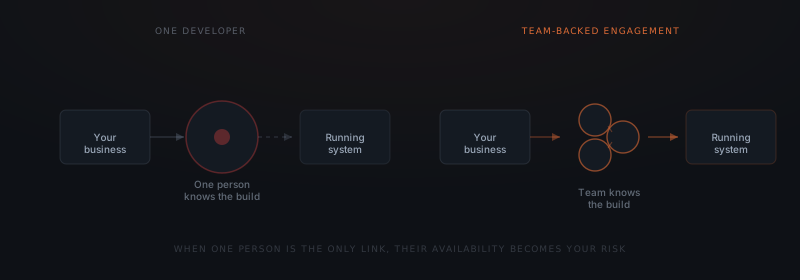
A freelancer or a solo in-house hire creates a structural risk that has nothing to do with their skill: they are the only person who understands how the system works. If that person takes another contract, changes their rate, or simply stops responding, the business is left holding a system it cannot maintain, debug, or extend.
A $95-an-hour freelancer with no backup isn't cheaper than a $6,000 fixed-price build — until the freelancer disappears mid-project.
This risk shows up differently depending on the route. A freelance marketplace hire is the highest-variance version of it — no employment relationship, no obligation beyond the current contract, and a track record that is often unverifiable beyond the platform's own review system. An in-house hire reduces some of that risk through an employment relationship but does not eliminate it: one employee is still one point of failure, and that employee's departure takes the institutional knowledge with them unless documentation was a deliverable from day one.
A boutique agency or a done-for-you implementation service structurally avoids this failure mode, not through better vetting but through team redundancy. More than one person on the provider's side understands the build, so the engagement does not depend on any single individual's calendar.
What should you vet before signing with an individual developer?
If a freelance or in-house hire is still the right route for a specific need, four checks matter more than a portfolio review.
Ask to see an undocumented handoff. Request an example of documentation the developer wrote for a past client — not a sales deck, but the actual technical handoff. A developer who can produce this proves they document as a habit, not just when asked. A developer who cannot produce anything is telling you what year two of the relationship will look like.
Confirm availability in writing, not just for the build. Ask directly: if a change is needed in six months, what is the expected response time, and at what rate? A vague answer here is the single most common precursor to being unable to reach a freelancer when something breaks.
Test with a small, paid scoping task before the full engagement. A short paid task — mapping the workflow, writing the specification — reveals how the developer communicates and structures work before committing to the full build. It costs a few hundred dollars and removes most of the guesswork a portfolio review cannot resolve.
Ask who else could pick this up. For a solo freelancer, the honest answer is usually "no one, until they document it." For an agency or implementation service, the answer should name a specific colleague or process. The quality of that answer is more diagnostic than years of experience.
If the route under consideration is a boutique agency rather than an individual, the evaluation criteria shift — see how to choose an AI implementation partner for the five criteria specific to vetting a partner organization. And see before you hire for what to prepare on your side before the first call, regardless of which route you pick.
Which red flags show up before the contract?
Most hiring mistakes with AI developers are visible during the search and proposal stage, not after work begins.
A rate significantly below the $93–$160/hr market range for freelance AI work is not a discount — it typically means the developer is early in their career, working from a template with limited customization, or both.[¹] A portfolio with no examples in a similar business type or workflow means the first several hours of the engagement will be spent on your dime while the developer learns the domain. An unwillingness to put a fixed price on a well-defined, single workflow signals either inexperience estimating scope or an intent to bill hourly against an open-ended timeline. And a developer or provider who cannot describe, in plain language, what happens if the automation produces a wrong output has not thought through the approval and error-handling layer — which is the part of the system that actually protects the business.
Define the workflow first
Match the route to the need
Run the four vetting checks
Get scope and price in writing
Frequently asked questions
How do I hire an AI developer for my small business? Small businesses hire AI developers through four routes: freelance marketplaces, in-house employment, boutique agencies, or done-for-you implementation services. The right route depends on whether the need is a single workflow or an ongoing technical function. A single workflow rarely justifies a full-time salary.
How much does it cost to hire an AI developer? Freelance AI developers charge $93–$160 an hour on average in 2026. In-house AI or machine learning engineers earn $134,000–$193,250 a year in average total compensation in the US. Boutique agencies and done-for-you implementation services typically price a defined workflow build between $1,000 and $15,000.
What is the biggest risk when hiring a freelance AI developer? The biggest risk is a single point of failure — one person is the only one who understands how the system works. If that person becomes unavailable, there is no backup and no institutional knowledge to fall back on. This risk applies to a single in-house hire as well, not just freelancers.
Should a small business hire an AI developer or use an implementation service? A small business automating one or two specific workflows is typically better served by a done-for-you implementation service or boutique agency, where a team backs the engagement at a fixed price. An in-house hire makes sense when the technical need is ongoing and spans many workflows.
Notes
- goLance, "AI Developer Hourly Rate Guide 2026 — How Much to Pay." https://golance.com/hiring/best-freelance-ai-developers-hourly-rate
- Robert Half, "AI/ML Engineer Salary (Updated for 2026)." https://www.roberthalf.com/us/en/job-details/aiml-engineer; Indeed, "Machine learning engineer salary in United States, 2026." https://www.indeed.com/career/machine-learning-engineer/salaries
- U.S. Department of Labor cost-of-bad-hire estimate (30% of first-year earnings), as cited in Textio, "The true cost of a bad hire." https://textio.com/blog/the-true-cost-of-a-bad-hire