Choosing an AI implementation partner on credentials and portfolio tells you whether the partner can build. It predicts almost nothing about whether you will be able to run what they built after the engagement ends. The question that determines long-term value is simpler: what does the partner leave behind? The businesses that get the most from implementation over time hired partners who transferred capability, not partners who maintained dependency.
Choosing a partner to build an AI agent system — see what an AI agent is if the term itself is still fuzzy — looks like choosing any specialist contractor: check credentials, look at past work, compare quotes. Those signals confirm the partner can build the thing. They say nothing about who operates it once the contract ends.
The second question is the one that determines long-term value — and most buyers do not ask it until they are already locked into a maintenance relationship they did not expect.
What businesses miss when evaluating implementation partners
The standard evaluation covers three areas: technical capability (which tools does the partner work with), portfolio (what have they built for businesses like mine), and cost.
None of those criteria reveal whether the partner plans to transfer knowledge or maintain access. They are supply-side signals — evidence that the partner can do the work. They say nothing about the demand-side outcome: whether your business will be able to operate, adjust, and extend the system after the partner leaves.
Menlo Ventures found that 76% of enterprise AI use cases are now purchased rather than built internally, up from 53% in 2024.[¹] As more businesses move from in-house experimentation to external implementation, the choice of partner has become the primary determinant of AI outcomes — more than tool choice, more than use case selection. A wrong tool choice can be swapped. A dependency relationship, once established, is significantly harder to exit.
This post assumes an agency or implementation partner is the route. For the alternative — hiring someone in-house instead — see how to hire an AI developer for a small business.
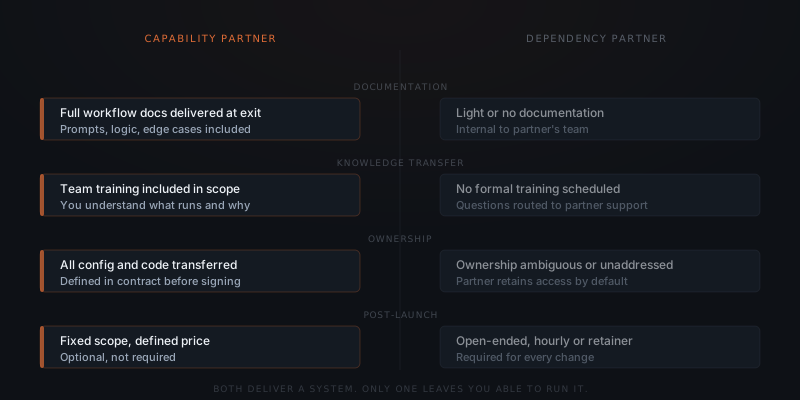
The distinction is structural. A capability-transfer partner builds the system and documents how it works — workflow logic, prompt structure, integration connections, edge cases. A dependency partner builds the same system and retains the knowledge. Both deliver a working system at the end of the engagement. Only one leaves the client in control of it.
| Evaluation signal | What it reveals | What it misses |
|---|---|---|
| Technical credentials and certifications | Partner's technical ability | Whether they plan to transfer it |
| Portfolio of past builds | Execution track record | Exit structure of those engagements |
| Proposal cost | Price for the build | Cost in year two if dependency is baked in |
| Client references | General satisfaction | Whether those clients can run the system today |
The missing question to ask every reference: "If you wanted to make a change to the system today without involving the partner, could you?" That answer is more diagnostic than any portfolio review.
What criteria actually predict implementation quality
Technical credentials and portfolio are necessary but insufficient. These five criteria reveal whether the engagement structure will serve your business after the partner is gone.
Industry knowledge. Not general AI expertise — specific familiarity with how your kind of business operates. A partner who has built agent systems for marketing agencies understands that client-specific tone requirements exist, that CRM data is usually inconsistent across accounts, and that approval timelines vary by client. A partner without that context will learn it during your engagement at your cost. Ask specifically: what other firms in this space have you worked with, and what were the most common complications in those builds?
Knowledge transfer. The most important criterion. Ask directly: what documentation will we receive at the end of the engagement? What format — a shared document, a recorded walkthrough, an annotated codebase? What training do you provide for our team? The answer reveals whether knowledge transfer is part of the model or not. A partner who responds with "you can always contact us for support" is signaling that dependency, not capability, is the intended exit.
Integration scope. Most agent systems connect to multiple existing tools — CRM, email, calendar, project management, communication platforms. The number of integrations, the quality of those connections, and edge-case handling determine how much of the value depends on the system versus the partner's ongoing involvement. Ask: which integrations are included in the build scope? What happens when one of those tools changes its API — is that covered or billed separately?
Post-launch support definition. There is a significant difference between a partner who offers "post-launch support" and one who defines exactly what post-launch support includes. Open-ended support creates an ongoing billing relationship whose scope the partner defines after the fact. Ask for the post-launch scope in writing: what is covered, for how long, what response times are guaranteed, and what falls outside the defined scope.
Exit terms. What do you own at the end of the engagement? All configuration and code? Access to the prompts and workflow logic? The API connections? A partner who structures the engagement so that ongoing involvement is required — rather than optional — benefits from your inability to exit without disruption. Define ownership explicitly in the contract before signing.
The dependency trap — what it looks like before you are in it
A partner who does not define knowledge transfer in the contract will default to dependency. Every maintenance call, every prompt update, every integration change becomes billable — not because the partner is dishonest, but because knowledge transfer was never scoped.
Dependency does not usually happen through bad intent. It happens through vague scope. The engagement is structured around delivering a working system. Knowledge transfer is never mentioned explicitly. Documentation is light. The partner's team handles the integration work internally. At the end of the engagement, the system works — and the client has no clear picture of how it works or how to change it.
Six months later, the CRM changes its API. Or a new workflow needs to be added. Or the prompts need updating because the business has shifted its offering. Each of those changes requires the partner's involvement — and each is billed at their hourly rate or against an open maintenance retainer.
The structure feels like support. It functions as an exit barrier that was designed into the original scope.
The earliest warning sign is a proposal that is specific about what will be built and vague about what will be transferred. Partners sell the build — that specificity is expected. Vagueness about transfer is the diagnostic. Ask the question directly during evaluation: if we wanted to modify this system ourselves or hand it to an internal team in a year, what would that take? The answer reveals the intended structure of the relationship.
For a full picture of what good implementation involves at each stage, see what a real AI agent implementation involves.
What the first engagement should scope
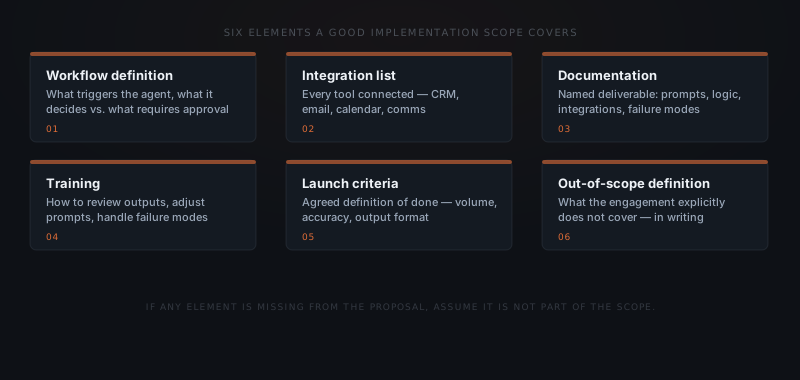
A well-scoped AI agent engagement covers six elements in writing before work begins.
The workflow definition. A precise description of the process being automated: what triggers the agent, what actions the agent takes, what decisions the agent makes independently, and what requires human approval before proceeding. Without this, scope drifts and the build drifts with it.
The integration list. Every tool the system connects to — which systems, which APIs, what data flows in and what flows out. This list also defines the maintenance surface: every integration is a dependency that can break independently. More integrations mean more potential failure points. The scope should name all of them.
Documentation deliverables. What documentation the client receives at the end of the engagement — as a named, specific deliverable. This should include the workflow logic, the prompt structure, the integration configuration, and any known edge cases or failure modes. If documentation is not a named deliverable in the proposal, assume it is not part of the scope.
Training. How the partner will transfer working knowledge to your team. At minimum: a walkthrough of how the system works, how to review agent outputs, how to adjust the prompts when business needs change, and how to handle common failure modes. A recorded session, a written guide, or a live training call — but it must be explicitly included in scope.
Launch criteria. How both parties know the system is working. The agent should be doing what, at what volume, with what accuracy threshold. Without agreed launch criteria, "done" is whatever the partner decides it is.
Out-of-scope definition. What the engagement explicitly does not cover. This boundary prevents scope creep during the build and prevents surprise billing after it ends. Any changes that extend beyond this definition should trigger a scope revision conversation, not an invoice.
Evaluating the platform underneath the partner
Partner selection and platform selection are separate decisions that arrive at the same time. Whatever a partner builds sits on a platform, and that platform's control model is harder to change later than the partner is. Once workflows are built around one model of human oversight, switching means rebuilding every workflow.
Most software marketed as an "AI agent platform" falls into one of three categories, and conflating them is the most common evaluation mistake.
| Category | Examples | Control model | Approval layer | Best for |
|---|---|---|---|---|
| Purpose-built agent | OpenClaw, Hermes | Built-in, configurable | Native | Variable workflows requiring oversight |
| Automation + AI | Zapier Agents, Make AI | Limited or absent | Add-on only | Structured tasks with AI assist |
| LLM with integrations | GPT with Actions, Claude tool use | User-built | Manual | Custom builds where you control everything |
Purpose-built platforms are architected around the approval model: what the agent can do unattended, what requires a checkpoint, and how a human reviews and releases queued actions. In automation platforms with AI added, the underlying system was designed for rule execution and the AI layer is additive rather than architectural. With general-purpose LLM interfaces, every action is a model decision unless a developer builds approval logic on top of the API.
For most businesses running a first or second agent, the honest answer to "how much can the agent do without a checkpoint?" is: very little. Not because the agent cannot be trusted, but because the review process is how the business learns what the agent is actually doing. A platform that makes checkpoints easy to add is more useful at that stage than one optimised for autonomy — and one that lets checkpoint frequency decrease as trust is established is more valuable than either.
Four criteria decide whether a platform survives contact with real workflows, and none appear in a standard feature comparison:
Approval model flexibility. Can approval requirements vary by workflow and action type? A fixed autonomy model will not match a business whose oversight requirements evolve, and most do.
Integration depth versus breadth. A platform connecting to 100 tools with read-only access across most is less useful than one connecting to 10 with full action support. Map the specific actions your workflows require — not just the tools — before comparing integration counts.
Failure behaviour. What happens when the agent hits an edge case outside its scope? Halting and notifying a human is a fundamentally different control infrastructure from making a best-effort attempt. This is rarely in a feature table; ask for it directly.
Vendor lock-in surface. If you build ten workflows and then need to switch, what does it cost? Proprietary prompt formats, non-exportable configuration, and no API access for portability create switching costs that grow with every workflow. Assess this before workflow one, not workflow ten.
Two platform red flags are worth naming alongside the partner red flags below. If a vendor describes oversight as "you can turn on approval mode," approval is a configuration option that can be bypassed rather than a structural block at the infrastructure level. And if workflow configuration cannot be exported, every workflow built becomes a switching cost — ask for the export format before building the first one.
Red flags in the proposal stage
Most issues with implementation partners are visible before the contract is signed. These warning signs appear during the proposal and evaluation phase.
No documentation deliverable named. If the proposal describes what will be built but does not list documentation as a specific output, documentation will not be prioritized. Ask for it to be added explicitly. If the partner resists or frames it as unnecessary, that is diagnostic.
Vague post-launch terms. "Ongoing support available" is not a scope. A defined post-launch scope — what is included, for how long, at what response time, at what price — should appear in the proposal. Open-ended support language benefits the partner, not the client.
Hourly billing on the build phase. Fixed-price engagements align the partner's incentive with delivery efficiency. Hourly billing is appropriate when scope is genuinely uncertain — but it shifts all delivery risk to the client. If the proposal is hourly, ask for a budget range and a clear trigger for scope review conversations.
Credentials without specifics. "We have worked with hundreds of businesses" is not a reference. Ask for two or three specific clients in your industry or business type, with permission to contact them directly. Ask those references whether they can run and modify the system without involving the partner.
No ownership language. If intellectual property, configuration ownership, or your ability to migrate the system to another provider is not addressed in the proposal, assume it is ambiguous. Get it in writing before signing.
Both partners deliver a system. Only one leaves you able to run it.
Menlo Ventures found that AI deployments convert to production at 47% — nearly twice the 25% rate of traditional SaaS implementations.[¹] The conversion advantage comes from AI's adaptability to specific workflows. But conversion to production is not the end of the story. Long-term value goes to the businesses that can adjust, improve, and extend the system themselves — without calling the partner every time something changes.
The right implementation partner makes that possible. The wrong one makes it expensive. The difference is visible in the scope document before work begins — if you know what to look for. Before any engagement, know two things: what the system will do, and who will own it when it is running.
See before you hire for how to prepare your business before the first implementation call, implementation timeline for what the build period actually looks like from scoping to go-live, and the AI implementation failure rate for what tends to go wrong when partner selection is the weak link.
Frequently asked questions
What should I look for when choosing an AI implementation partner? The five criteria that predict outcomes are: industry knowledge specific to your workflows, a defined knowledge-transfer plan, a named integration list with maintenance terms, a written post-launch scope, and explicit exit terms covering what you own. Technical credentials matter — but they predict whether a partner can build, not whether you can run the result.
How do I know if an AI implementation partner is creating dependency? Warning signs: documentation stays internal to the partner's team, your staff is not trained on how the system works, every change requires contacting the partner, and the contract does not define what you own at exit. Ask directly: "If we wanted to modify this system ourselves in a year, what would that take?" The answer is the most diagnostic question in the evaluation.
How long does an AI agent implementation typically take? A standard service business workflow goes from scoping to live in two to four weeks. The AI configuration takes days; integrations with existing tools and process documentation fill the rest of the timeline. Builds with multiple systems or custom data connections can extend to six to eight weeks. Timeline should be named in the scope of work, not left open-ended.
What is a reasonable cost for an AI agent implementation? A defined workflow build for a small or mid-size service business typically ranges from $1,000 to $15,000, depending on complexity and the number of integrations. Ongoing management or maintenance is billed separately — either as a fixed monthly retainer or time-and-materials. Ask for a fixed price on the build and a written scope for post-launch support before signing.
Notes
- Menlo Ventures. (2025). "2025: The State of Generative AI in the Enterprise." Menlo Ventures. https://menlovc.com/perspective/2025-the-state-of-generative-ai-in-the-enterprise/ — source for: 76% of enterprise AI use cases now purchased rather than built (up from 53% in 2024); 47% AI deal conversion to production vs. 25% for traditional SaaS.
- CIO / Lenovo. (2025). "What to look for in an AI implementation partner." CIO. https://www.cio.com/article/4089704/what-to-look-for-in-an-ai-implementation-partner.html — source for: Lenovo-commissioned survey of 2,920 IT and business decision-makers; organizations heavily rely on professional services partnerships for AI deployment; top driver is data management challenges and quality data availability.