An HR consultancy owner has fourteen retainer clients this month. One client's handbook needs its annual update before open enrollment. Another has a new hire in a state the firm hasn't onboarded anyone in before. A third is three days from missing a benefits deadline nobody flagged. None of this requires an HR judgment call. All of it requires tracking fourteen separate compliance calendars without mixing one client's policy with another's. An AI agent handles that layer: the deadlines, the document collection, the handbook version control. Every termination call, policy interpretation, and employee relations conversation still comes from the consultant.
An HR consultancy owner has fourteen retainer clients this month. One client's handbook needs its annual update before open enrollment. Another has a new hire in a state the firm hasn't onboarded anyone in before. A third is three days from missing a benefits deadline nobody flagged. None of this requires an HR judgment call. All of it requires tracking fourteen separate compliance calendars without mixing one client's policy with another's. An AI agent handles that layer: the deadlines, the document collection, the handbook version control. Every termination call, policy interpretation, and employee relations conversation still comes from the consultant.
Every new client multiplies compliance surface area, not just revenue
The human resource consulting market is worth $84.58 billion in 2026 and is growing at a 7.02% compound annual rate toward $118.76 billion by 2031, according to Mordor Intelligence's industry analysis.[¹] The small and medium enterprise segment is the fastest-growing cohort inside that market, expanding at a 9.25% CAGR as lower-cost platforms and public grants pull more small businesses into formal HR arrangements for the first time.[¹] That growth is good news for consultancies. It is also the source of the bottleneck most of them hit before they hit a revenue ceiling.
A solo HR consultant or small firm typically builds its book one client at a time, each on a fractional or retainer arrangement. Fractional HR leadership is the single most commonly offered service among HR consultants, according to Shrlock's State of the HR Consulting Industry Report 2026, based on a survey of more than 200 HR consultants and fractional leaders.[²] Every client added to that book brings its own state jurisdiction, its own headcount thresholds, its own handbook version, and its own filing deadlines. A ten-client roster spanning four states does not have ten times the compliance workload of one client — it has ten distinct compliance calendars running in parallel, none of which can be merged or templated without risk.
That distinction matters because 71% of HR consultants are in their first three years of independent operation, per the same Shrlock report.[²] A consultancy in that window is still building its book, which means the compliance-tracking load is increasing every quarter even as the strategic advisory relationships that justify higher retainers are still forming. The tracking work does not wait for the practice to mature into it.
| Client-facing workload | Frequency | Requires consultant judgment? | Agent-handled? |
|---|---|---|---|
| Compliance deadline tracking (per client, per state) | Very high | No | Yes |
| Onboarding paperwork collection | Very high | No | Yes |
| Handbook version control across clients | High | No | Yes |
| Benefits enrollment reminders | High | No | Yes |
| Termination risk review | Medium | Yes | No |
| Policy interpretation for a specific situation | Medium | Yes | No |
| Employee relations investigation | Low | Yes | No |
The client-tracking bottleneck has nothing to do with HR expertise
Every retainer client moves through the same recurring cycle: onboarding new hires, maintaining the handbook, running benefits enrollment, tracking state-specific filing deadlines, and handling the occasional termination or dispute. Two distinct kinds of work sit inside that cycle, and most consultancies don't separate them operationally even though they require entirely different skills.
One kind requires a consultant's judgment: whether a termination carries legal risk, how a policy applies to an unusual situation, what to say in an employee relations conversation. The other kind is tracking: confirming a client's I-9 forms are complete, flagging that a handbook hasn't been updated since a state law changed, sending the third reminder to an employee who hasn't completed benefits enrollment.
A consultant who personally chases missing I-9 paperwork gives it the same attention as advising a client through a wrongful-termination risk. Both feel urgent when the client is asking. Only one requires the expertise the retainer is priced for.
The paperwork stakes are real even when the work itself doesn't require judgment. Form I-9 paperwork violations carry civil penalties ranging from $288 to $2,861 per form, under the inflation-adjusted range published in the Federal Register and confirmed by U.S. Immigration and Customs Enforcement's employer fact sheet.[³] A consultancy managing onboarding across ten clients with rolling hires is tracking dozens of I-9 completion windows at once — not because any single form is complicated, but because a missed one has a fixed dollar cost attached regardless of client size.
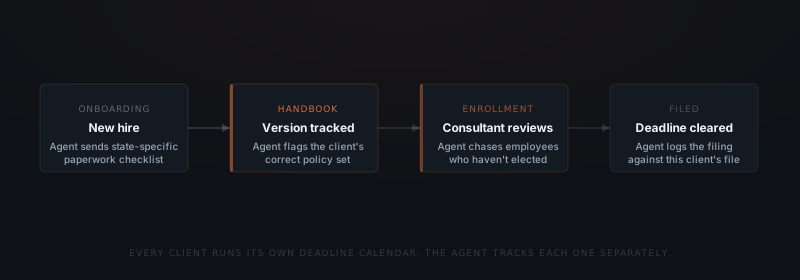
This is not one shared compliance calendar the agent applies across every client. Each client has a distinct deadline set, headcount, and jurisdiction — the agent tracks each one separately, because merging them is exactly how a consultancy sends the wrong state's handbook to the wrong client.
Take a multi-state hire as an example. A client based in Texas hires a fully remote employee in California. The consultant's judgment enters once: confirming which California-specific policies now apply to that client's handbook and whether the client's existing PTO accrual language meets California's requirements. Everything after that decision is tracking — requesting the California-specific new-hire paperwork, confirming the state filing deadline, updating that one client's handbook version without touching the Texas-only language used by six other clients on the same firm's roster.
What an AI agent handles across an HR consultancy's client roster
An AI agent for an HR consultancy operates across four workflow categories: compliance deadline tracking, onboarding document collection, handbook version control, and benefits enrollment coordination.
Compliance deadline tracking covers every filing window, renewal date, and state-specific requirement across every client, tracked individually rather than on a shared timeline. When a deadline is 10 days out and the required documentation hasn't been collected, the agent flags it to the consultant before it becomes a same-day scramble. Multi-state clients get their state-specific deadlines tracked separately from clients operating in a single jurisdiction.
Onboarding document collection handles the initial paperwork request for each new hire — I-9, W-4, state new-hire reporting, benefits enrollment forms — and follows up when an item sits incomplete past a set window. The agent tracks which client and which state each hire belongs to, so the checklist matches that jurisdiction's actual requirements instead of a generic template.
Handbook version control tracks which policy version is active for each client and flags when a state law change means a specific client's handbook is out of date. This is the workflow where mixing clients causes the most damage — sending one client's PTO policy to another client operating under different state law is a real error, not a hypothetical one. The agent keeps each client's handbook version isolated and current.
Benefits enrollment coordination tracks the open enrollment window for each client, sends reminders to employees who haven't completed their elections, and flags the consultant when a client's enrollment rate lags close to the deadline. The consultant reviews plan design and answers coverage questions. The agent handles the chasing.
What stays with the HR consultant
No client's handbook has ever updated itself correctly by accident.
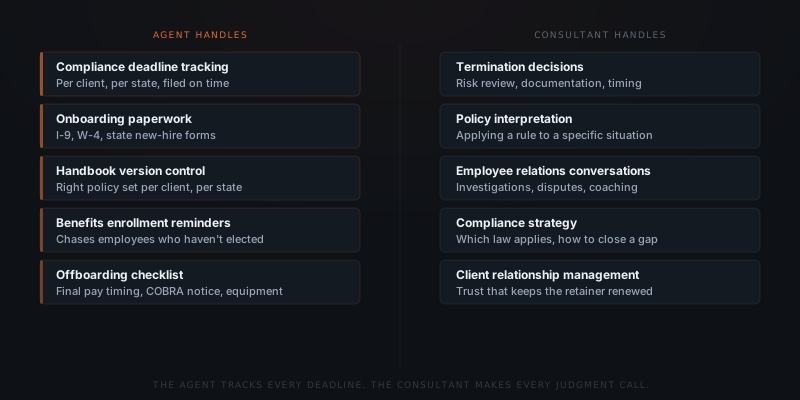
An AI agent does not decide whether a termination carries legal risk, interpret how a policy applies to an unusual situation, or conduct an employee relations investigation. Those decisions require a consultant's judgment and stay entirely with the person the client is paying for expertise.
Termination risk review is a legal and relational judgment, not a tracking task. The consultant weighs documentation, jurisdiction, and the client's specific circumstances before advising on next steps. Policy interpretation that requires context — how a remote-work policy applies to a hybrid arrangement nobody anticipated, whether a disciplinary pattern justifies termination — requires a conversation the agent cannot have on the consultant's behalf. Employee relations investigations, harassment complaints, and disputes between an employee and a client's management stay with the consultant because they require reading a room the agent has no access to.
Client relationship management — the trust that turns a first engagement into a multi-year retainer — stays personal. The agent can send the deadline reminder a client is waiting on. The agent cannot build the confidence that keeps that client renewing instead of shopping for a cheaper consultant next quarter.
How an HR consultancy AI agent connects to existing tools
HR consultancies rarely standardize on a single HRIS across their client roster, since each client typically arrives with its own existing platform. An AI agent connects to whichever tools each client already runs rather than forcing a single system across the book.
| Tool category | Common platforms | What the agent reads or writes |
|---|---|---|
| HRIS / PEO | BambooHR, Gusto, Rippling, Justworks, TriNet | Reads employee records, compliance status; updates checklists |
| Practice management / CRM | HubSpot, Shrlock, Karbon, generic CRM | Tracks client relationships, retainer scope, communication history |
| E-signature | DocuSign, HelloSign | Tracks document completion and signature status |
| Email and messaging | Gmail, Outlook, Slack | Sends deadline reminders; reads client and employee replies |
| Scheduling | Google Calendar, Calendly | Books enrollment sessions and consultant review calls |
Integration scope determines how quickly a consultancy can go live. A firm where most clients run the same one or two HRIS platforms can launch deadline tracking and document collection in two to three weeks. A firm with clients spread across five or six different platforms needs a longer integration phase, since each connection is scoped per platform rather than per client.
Isolation between client data is the failure mode that matters most. An agent that lets one client's handbook language, deadline, or employee data bleed into another client's file does real damage — both to the affected client and to the consultancy's credibility. A correctly scoped implementation keeps every client's data, documents, and calendar in a separate, clearly bounded workspace, even when multiple clients run on the same underlying HRIS platform.
See how to know if a business process is ready to hand to an AI agent for a framework on picking the right starting workflow for a multi-client practice.
What it costs and how fast it goes live
HR consultancy implementations start with the highest-frequency workflow across the client roster — usually compliance deadline tracking and onboarding document collection — and expand from there.
Scoping call
Map every client's HRIS platform, state jurisdictions, and highest-volume workflow. Identify which clients share a platform and which need individual integration.
Integration
Connect the agent to each client's HRIS or PEO platform, practice management tool, and email or Slack channel. Set up isolated data boundaries per client.
Calendar build
Build the compliance deadline calendar for each client individually — state filing dates, handbook renewal cycles, benefits enrollment windows. The consultant reviews and confirms accuracy for a sample of clients before rollout.
Approval workflow
Set the review flow for client-facing messages. Deadline reminders and document requests queue for consultant approval before sending, with routine reminders moving to auto-send once accuracy is confirmed.
Go-live
The first workflow goes live across the full client roster. The consultant monitors outputs for the first two weeks and flags any client-specific adjustments needed.
A standard implementation covering deadline tracking, onboarding document collection, and handbook version control typically runs $2,500–$6,000 for the initial build, scaling with the number of active clients and HRIS platforms connected. Monthly API costs at a typical caseload run under $200. A consultant managing 10 or more clients who recovers 6–8 hours a week in deadline tracking and document chasing sees the setup cost repaid within one to two months.
The market's growth toward $118.76 billion by 2031 means more consultancies will be adding clients faster than their current tracking processes can absorb.[¹] A firm that can onboard its fifteenth client without adding a fifteenth parallel manual checklist is the firm positioned to take that growth. See what AI agent implementation actually costs for a small business for a full breakdown of pricing across implementation types.
The implementation timeline for a service business follows the same two-to-three-week pattern for the first workflow across industries. An HR consultancy's specifics are the per-client data isolation and the multi-platform HRIS integration — not the underlying process.
Frequently asked questions
What does an AI agent do for an HR consultancy? An AI agent for an HR consultancy tracks compliance deadlines across every client file, collects and chases onboarding paperwork, maintains handbook version control per client and per state, and sends benefits enrollment reminders. Termination decisions, policy interpretation, employee relations conversations, and every judgment call that carries legal exposure stay with the licensed consultant.
How does an AI agent track compliance deadlines for multiple HR clients? An AI agent tracks compliance deadlines by maintaining a separate calendar and document set for each client, keyed to that client's state, headcount, and policy version. When a filing deadline or benefits enrollment window approaches, the agent flags it against that specific client's requirements and escalates to the consultant when a deadline is at risk.
What tools does an HR consultancy AI agent connect to? An HR consultancy AI agent typically connects to each client's HRIS or PEO platform — BambooHR, Gusto, Rippling, or Justworks — a practice management tool for client relationships, DocuSign for document collection, and email or Slack for client communication. The exact integration set depends on which platforms each client already runs.
What does AI agent implementation cost for an HR consulting firm? A standard implementation covering deadline tracking, onboarding document collection, and handbook version control typically runs $2,500–$6,000 for the initial build. Monthly API costs run under $200. A consultant managing 10 or more clients who recovers 6–8 hours a week sees the setup cost repaid within one to two months. See what AI agent implementation actually costs for a small business for a full breakdown.
Notes
- Mordor Intelligence, "Human Resource Consulting Market Size & Growth to 2031." https://www.mordorintelligence.com/industry-reports/human-resource-consulting-market
- Shrlock, "State of the HR Consulting Industry Report 2026." https://www.shrlock.com/playbooks-and-reports/industry-report
- U.S. Immigration and Customs Enforcement, "Form I-9 Inspection Under Immigration and Nationality Act § 274A" fact sheet, citing the inflation-adjusted civil penalty range published in the Federal Register, January 2, 2025. https://www.ice.gov/factsheets/i9-inspection