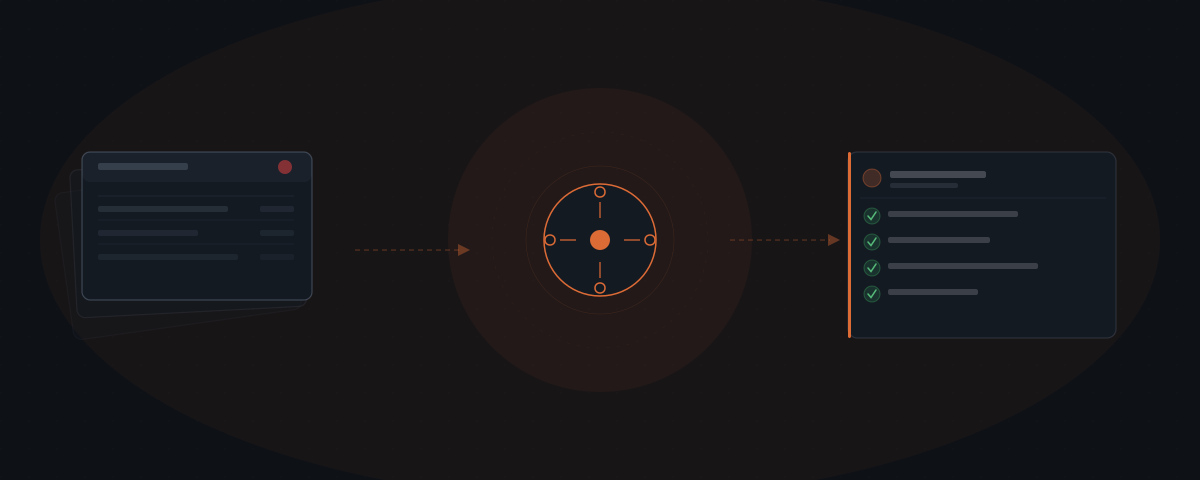
A bookkeeping firm has 24 clients closing this month. Six bank feeds broke sync over the weekend. Eleven clients haven't sent the receipts a transaction is waiting on. Three close cycles are already past the 10th and the financial statements aren't ready. None of that is bookkeeping — it's the coordination that has to happen before the bookkeeping can. Every client runs its own close cycle, every month, on its own timeline. An AI agent runs that cycle: the feed checks, the document chasing, the categorization queue. Every judgment call about how a transaction actually gets coded stays with the bookkeeper.
A bookkeeping firm has 24 clients closing this month. Six bank feeds broke sync over the weekend. Eleven clients haven't sent the receipts a transaction is waiting on. Three close cycles are already past the 10th and the financial statements aren't ready. None of that is bookkeeping — it's the coordination that has to happen before the bookkeeping can. Every client runs its own close cycle, every month, on its own timeline. An AI agent runs that cycle: the feed checks, the document chasing, the categorization queue. Every judgment call about how a transaction actually gets coded stays with the bookkeeper.
Every client's close cycle resets on its own schedule every month
The US Payroll & Bookkeeping Services industry is worth $80.9 billion in 2026, spread across 331,000 businesses, growing at a 2.5% compound annual rate since 2021 with an estimated 3.8% boost in 2026 alone, according to IBISWorld's industry analysis.[¹] That is a large, fragmented market of small practices — most running the same close cycle, every month, across a growing client roster.
Professional services firms lost ground on capacity in 2025. SPI Research's Professional Services Maturity Benchmark found billable utilization fell to 68.9%, below the 75% level firms need to hit their margin targets.[²] For a bookkeeping firm, that gap is not time lost on accounting work. It's time lost checking whether a feed is still syncing, following up on a receipt, and waiting on a client reply before a transaction can be coded at all.
A close cycle that should take one focused day of categorization work stretches across two or three weeks because it depends on inputs the bookkeeper doesn't control: whether the bank feed synced correctly, whether the client sent the missing invoice, whether last month's uncategorized transaction ever got an answer. Industry benchmarking from APQC's General Accounting Open Standards Benchmarking survey of more than 2,300 organizations puts the median close at 6.4 calendar days — and that's for internal teams closing their own books, not a bookkeeping firm juggling 20 or more separate client calendars at once.[³]
| Close-cycle task | Frequency | Requires bookkeeping judgment? | Agent-handled? |
|---|---|---|---|
| Bank feed sync monitoring | Very high | No | Yes |
| Missing receipt or statement chasing | Very high | No | Yes |
| Categorization queue prep for ambiguous transactions | High | No | Yes |
| Client sign-off request on completed close | High | No | Yes |
| Transaction categorization decision | High | Yes | No |
| Reconciling discrepancy investigation | Medium | Yes | No |
| Financial statement review | Medium | Yes | No |
The close-cycle bottleneck has nothing to do with categorization skill
A bookkeeping engagement runs the same cycle every month: bank feeds sync, transactions land, most get categorized automatically by rule, some need a human decision, receipts get matched, the close gets reconciled, and the client signs off on the resulting statements. Two distinct kinds of work sit inside that cycle, and most firms don't separate them operationally.
One kind requires a bookkeeper's judgment: how to categorize a transaction the rules can't resolve, whether a discrepancy in the reconciliation is a timing issue or an actual error, what a client's financial statements are telling them. The other kind is coordination: confirming a feed actually synced this week, requesting the receipt a $4,200 charge needs before it can be coded, reminding a client for the third time that a bank statement is still missing.
A bookkeeper who spends an afternoon manually checking whether twelve client feeds are still connected gives that the same attention as reconciling a discrepancy that could change a client's tax position. Both feel necessary in the moment. Only one requires the skill the client is paying for.
This is not the agent doing the bookkeeping. It's the agent running the close-cycle logistics — feed checks, document chasing, categorization queue prep, client sign-off requests — for every client separately, so the bookkeeper opens each file already staged for the decisions that actually need a bookkeeper.
Take a stalled reconciliation as an example. A client's feed silently disconnected from their bank three weeks ago. Nobody noticed until the bookkeeper sat down to close the month and found two weeks of transactions missing. The bookkeeper's judgment enters once the feed is reconnected and the backlog needs categorizing — deciding how a batch of aged transactions should be coded and whether anything needs a client conversation. Everything before that point was preventable coordination: a feed-health check that would have caught the disconnection the day it happened, not three weeks later when it blew up the close.
What an AI agent handles across a bookkeeping firm's client roster
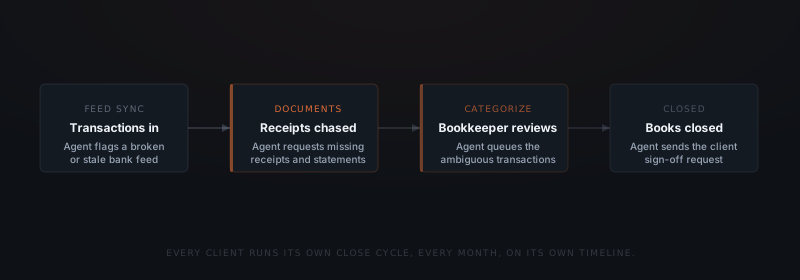
An AI agent for a bookkeeping firm operates across four workflow categories: feed monitoring, document chasing, categorization queue prep, and close sign-off coordination.
Bank feed monitoring checks the sync status of every client's connected accounts on a daily basis and flags a broken, stale, or duplicate feed before it silently drops transactions from a close. A feed that stops syncing on the 3rd of the month gets caught on the 3rd, not discovered on the 28th when the close is already late.
Document chasing requests the receipts, invoices, and statements a specific transaction needs to be coded and follows up when an item sits unanswered past a set window. The agent tracks exactly which transaction is blocked by which missing document, so the request to the client references the actual charge instead of a generic reminder.
Categorization queue prep sorts transactions the platform's existing rules can't resolve automatically — a new vendor, an ambiguous charge, a transaction that could split across two categories — and stages them for the bookkeeper's review in one batch instead of scattered across the month. The agent does not decide the categorization. It removes the manual sorting that happens before the decision.
Close sign-off coordination sends the client the completed financial statements once the bookkeeper has reviewed and approved them, tracks whether the client has acknowledged the close, and follows up if sign-off is still outstanding close to the firm's own reporting deadline.
What stays with the bookkeeper
The books don't stay open because the math is hard. They stay open because the receipt never showed up.
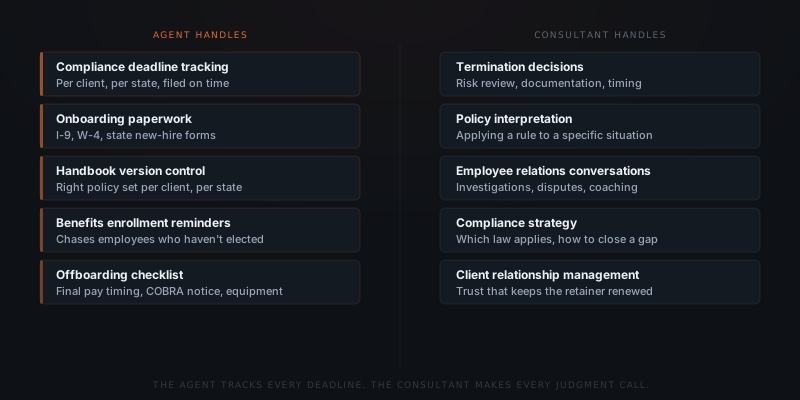
An AI agent does not decide how a transaction gets categorized, investigate a reconciling discrepancy, or review what a set of financial statements is telling a client about their business. Those decisions require a bookkeeper's judgment and stay entirely with the person the client is paying to make them.
Transaction categorization is an accounting decision, not a sorting task. The bookkeeper applies context the agent doesn't have — whether a large deposit is a loan, a customer refund, or owner's equity — and that judgment shapes the client's financial statements. Reconciling discrepancy investigation requires tracing a mismatch back to its source, which often means understanding something specific about how that client's business actually operates. Financial statement review and the conversation that follows — explaining what the numbers mean, flagging a cash flow concern, recommending a change — stay with the bookkeeper because that is the advisory value the retainer is priced for.
Client relationship management, the trust that keeps a client renewing instead of shopping for a cheaper monthly rate, stays personal. The agent can chase the receipt a client hasn't sent. The agent cannot build the confidence that makes a client pick up the phone when something in their business changes.
How a bookkeeping firm AI agent connects to existing tools
A bookkeeping firm typically runs each client on one of a handful of accounting platforms, connected to that client's bank feeds, and tracked through a practice management tool. An AI agent connects to the platforms already in use rather than requiring clients to migrate.
| Tool category | Common platforms | What the agent reads or writes |
|---|---|---|
| Accounting platform | QuickBooks Online, Xero, FreshBooks | Reads transaction feed, categorization rules; flags exceptions |
| Bank feed layer | Plaid, platform-native feeds | Monitors sync status per client account |
| Practice management | Karbon, Financial Cents, Keeper | Tracks close status, deadlines, client communication history |
| Document collection | Client portal, email, DocuSign | Requests and tracks receipts, statements, and sign-off |
| Client communication | Gmail, Outlook, Slack | Sends chase messages and close-complete notifications |
Integration scope determines how fast a firm goes live. A firm where most clients run on QuickBooks Online or Xero can launch feed monitoring and document chasing in two to three weeks. A firm with clients spread across five or six different platforms needs a longer integration phase, since feed monitoring is scoped per platform, not per client.
Categorization rule accuracy is the failure mode that matters most. An agent that queues too many transactions as "ambiguous" defeats the point — the bookkeeper ends up reviewing almost everything anyway. A correctly scoped implementation starts with each client's existing categorization rules, tunes the exception threshold against several real closes, and only expands auto-routing once the queue reliably surfaces the transactions that actually need a human decision.
See how to know if a business process is ready to hand to an AI agent for a framework on identifying the right starting workflow for a multi-client practice.
What it costs and how fast it goes live
Bookkeeping firm implementations start with the highest-friction step in the close cycle — usually feed monitoring and document chasing — and expand from there.
Scoping call
Map each client's accounting platform, bank feed setup, and typical close bottleneck. Identify which clients share a platform and which need individual configuration.
Integration
Connect the agent to each client's accounting platform and bank feed layer, plus the firm's practice management tool. Set feed-health check frequency per client.
Rule calibration
Tune the categorization exception threshold against the firm's existing rules, using several real client closes to confirm the queue surfaces genuinely ambiguous transactions, not routine ones.
Approval workflow
Set the review flow for client-facing messages. Document requests and close-complete notifications queue for bookkeeper approval before sending, with routine chase reminders moving to auto-send once accuracy is confirmed.
Go-live
The first workflow goes live across the client roster. The bookkeeper monitors the categorization queue for the first two closes and adjusts rule thresholds as needed.
A standard implementation covering feed monitoring, document chasing, and categorization queue prep typically runs $2,500–$5,500 for the initial build, scaling with client count and accounting platforms connected. Monthly API costs at a typical caseload run under $200. A firm running 20 or more clients that recovers 6–8 hours a week in coordination time sees the setup cost repaid within one to two months.
With utilization already down to 68.9% industry-wide, the firms gaining ground are the ones that can add client 25 without adding a proportional amount of manual feed-checking and receipt-chasing to every bookkeeper's week.[²] See what AI agent implementation actually costs for a small business for a full breakdown of pricing across implementation types.
The implementation timeline for a service business follows the same two-to-three-week pattern for the first workflow across industries. A bookkeeping firm's specifics are the per-platform feed integration and the categorization rule calibration — not the underlying process.
Frequently asked questions
What does an AI agent do for a bookkeeping firm? An AI agent for a bookkeeping firm monitors bank feed sync status across every client, chases missing receipts and statements, queues ambiguous transactions for the bookkeeper's categorization decision, and sends the client sign-off request once a close is complete. Every categorization judgment, reconciling entry, and financial statement review stays with the bookkeeper.
How does an AI agent handle the month-end close for multiple bookkeeping clients? An AI agent tracks each client's close on its own calendar, checks bank feed sync status daily, flags a broken or stale feed before it stalls the close, chases the client for any receipt a transaction needs, and queues transactions the categorization rules can't resolve for the bookkeeper to review.
What tools does a bookkeeping firm AI agent connect to? A bookkeeping firm AI agent typically connects to each client's accounting platform — QuickBooks Online, Xero, or FreshBooks — the bank feed layer via Plaid, a practice management tool such as Karbon or Financial Cents, and email or a client portal for document requests.
What does AI agent implementation cost for a bookkeeping firm? A standard implementation covering feed monitoring, document chasing, and categorization queue prep typically runs $2,500–$5,500 for the initial build. Monthly API costs run under $200. A firm running 20 or more clients that recovers 6–8 hours a week sees the setup cost repaid within one to two months. See what AI agent implementation actually costs for a small business for a full breakdown.
Notes
- IBISWorld, "Payroll & Bookkeeping Services in the US - Industry Analysis, 2026." https://www.ibisworld.com/united-states/industry/payroll-bookkeeping-services/1397/
- SPI Research (Service Performance Insight), "2025 Professional Services Maturity Benchmark Report." https://forms.workday.com/content/dam/web/en-us/documents/reports/SPI_2025_Benchmark_Report.pdf
- APQC, General Accounting Open Standards Benchmarking survey, cited in Numeric, "How Long Does Month-End Close Take? Examining Benchmarks." https://www.numeric.io/blog/how-long-does-month-end-close-take