
The ops gap every growing service business hits looks like a hiring problem: more work than the founder can handle, a team too small to absorb it, and a shortlist of part-time VAs or operations coordinators. An AI agent is not a cheaper version of that hire. An agent handles work that is defined — the same trigger, the same steps, the same output every time. A hire handles work that isn't. Most founders need both. The question is which one to build first.
Agents and hires solve different problems
An AI agent is not a cheaper version of an operations hire. An agent executes a defined workflow — a consistent trigger, numbered steps, and a specified output — without variation and without asking clarifying questions. A hire adapts to whatever the work requires on a given day.
That distinction determines which one fits a gap. A recruiting agency sending 40 follow-up emails per week to candidates who haven't responded in seven days has defined work: the same trigger, the same output format, the same decision rule every run. An agent handles this reliably. A hire assigned the same task would likely add judgment calls the agency didn't ask for — personalising messages differently each time, skipping contacts that seem unlikely, following up at inconsistent intervals.
The ops gaps that belong to an agent are the ones with a written process: a trigger, steps, a defined output. The ops gaps that belong to a hire are the ones where the right action depends on context the agent can't read — a client's tone in their last message, a relationship dynamic, an exception the founder would recognise instantly.
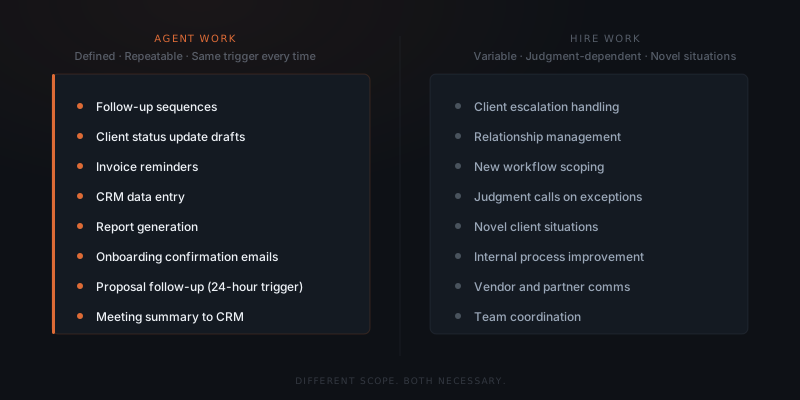
How agents and hires compare across eight dimensions
The practical differences between agents and hires come down to how each one handles trigger sensitivity, volume, consistency, and the scope of what it can take on.
| Dimension | AI Agent | Operations Hire |
|---|---|---|
| Best for | Defined, repeatable workflows with a consistent trigger | Variable, judgment-dependent work that changes by situation |
| Volume capacity | Fixed cost at any volume — 50 tasks or 500 runs nearly the same | Capped by hours — higher volume requires more headcount |
| Output consistency | Identical output every run, regardless of workload | Varies by day, energy level, and how clearly the task was briefed |
| Setup requirement | Full process documentation required before implementation | Can start with partial documentation and figure out the rest |
| Exception handling | Routes undefined situations to a human; cannot adapt on its own | Adapts to novel situations without a pre-written process |
| Cost structure | Setup investment plus low per-run cost; scales without adding headcount | Monthly salary or retainer regardless of task volume that week |
| Time to deploy | 2–4 weeks from scoping to live | 2–6 weeks recruiting plus 4–8 weeks to reach full productivity |
| Escalation path | Flags exceptions for human decision on a defined escalation route | Makes the judgment call directly, or asks for guidance in context |
The definition threshold is the same for both
The threshold that makes a workflow implementable as an agent is identical to the threshold that makes it hirable: the process must be written down.
A VA following a client check-in process needs the same documentation an agent needs: the trigger that starts the check-in, the steps to take, the decision points, the output format, and the edge cases. A check-in process that exists only in the founder's head cannot be handed to a VA or an agent — until someone writes it down.
An agent does not lower the documentation bar. An agent and an experienced hire share the same requirement: a written process the person or system can follow independently. The difference is that the agent follows it exactly, every time, without asking clarifying questions.
This reframe is useful. A founder who says "I need to hire someone for ops" is often solving the wrong problem first. Documenting the process — trigger, steps, output — comes before choosing the executor. Once the process is documented, the right executor becomes clear: an agent for the repeatable parts, a hire for the exceptions.
What agents handle better than a hire
Agents outperform a hire on three specific dimensions: volume, consistency, and availability.
Volume. A recruiting agency managing 200 active candidates cannot have a coordinator send 40 individually drafted follow-up emails per week on top of other responsibilities. An agent sends those 40 emails to consistent quality standards, on schedule, regardless of what else is happening. The coordinator's capacity goes to the 5 replies that need judgment.
Consistency. An agent produces the same output format every run. A hire's output varies by day, energy level, and how much context they were given on a specific task. For client-facing processes — status updates, invoice reminders, onboarding confirmations — that consistency matters.
Availability. An agent runs at the configured trigger time. A follow-up that should go out Monday at 9am goes out Monday at 9am, not when the coordinator gets to the task list. For time-sensitive sequences — a proposal follow-up 24 hours after sending — trigger precision outperforms a human task queue.
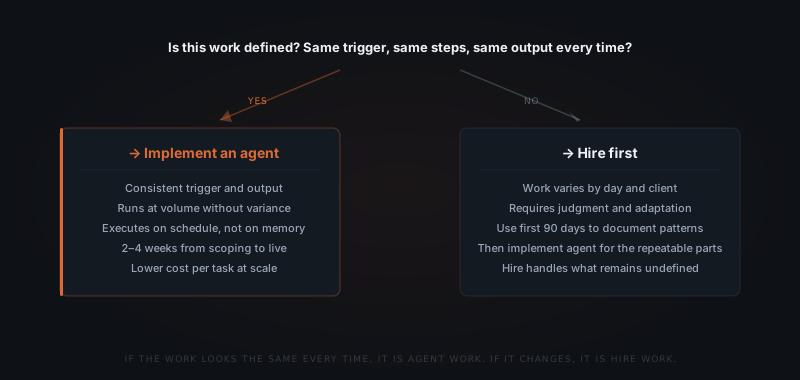
If the work looks the same every time, it is agent work. If it changes based on the situation, it is hire work.
What a hire handles better than an agent
Hires outperform agents on everything that requires judgment, relationship context, or adaptation to novel situations.
A client who responds to a status update with frustration needs a response that acknowledges the specific concern — not the next message in a defined sequence. An agent cannot read the relationship history the way a founder can. A hire can.
A new workflow the business has never run before cannot be implemented as an agent until the process is documented. A hire figures out the process by doing it; then the founder documents what they learned. The hire is how a business discovers which workflows are ready to implement as agents.
New client onboarding at a consultancy often starts as hire work — the first ten clients are handled manually, the process is refined, edge cases are documented. By client 15, the onboarding sequence is documented clearly enough to implement as an agent for the repeatable parts. The hire continues to handle the parts that don't follow the standard path.
How the cost structures compare
For defined, repeatable work at volume, agent economics change the calculation in a specific way: the marginal cost of the 200th task is nearly zero, while the 200th task in a coordinator's task queue costs the same as the first.
A recruiting coordinator managing 200 active candidates spends a predictable portion of their week on follow-up sequences, status update drafts, and CRM data entry. An agent running those specific tasks costs the same at 50 candidates as at 500. The coordinator's cost stays the same either way — but what the coordinator is doing changes.
| Scenario | Without agent | With agent running defined tasks |
|---|---|---|
| 200 candidate follow-ups per week | Coordinator spends 4–6 hrs managing sequences | Agent runs all sequences; coordinator reviews flagged replies only |
| Weekly status updates to 50 clients | VA drafts updates manually, 3–4 hrs per week | Agent generates update drafts; VA reviews and sends |
| Monthly invoice reminders across 80 clients | Coordinator tracks and sends manually (~2 hrs/month) | Agent runs on schedule; coordinator handles disputes |
| New client onboarding documents | Coordinator assembles per-client (~45 min/client) | Agent populates standard templates; coordinator handles custom sections |
The value is not replacing the hire — it is redirecting what the hire does. A coordinator who was spending eight hours per week on defined-process tasks and four hours on judgment-dependent work now has twelve hours for judgment-dependent work. The agent capacity gain shows up as coordinator capacity gain.
Running both: how the hybrid model works in practice
Most service businesses that have implemented agents describe the same pattern: the first implementation does not reduce headcount. It changes what the headcount does.
Before implementation, a recruiting coordinator at a mid-sized agency was spending three hours per day on follow-up sequences, status update drafts, and CRM updates. After implementation, those three hours shifted to reviewing flagged responses, managing client relationships generating unusual volume, and handling candidate escalations the agent had routed to her. The coordinator's role did not shrink — it changed. The backlog of relationship work that had been deferred because defined-task volume was too high finally had capacity allocated to it.
The hybrid model works when the work split is intentional. It fails when agents are added but the hire's task list is never updated to reflect what the agent now owns.
Three practices that make the hybrid model work:
Define the handoff explicitly. Every task the agent takes over should be removed from the hire's responsibility list — not delegated to the agent and also monitored by the hire. Reviewing what the agent did is a different task from doing the same task twice.
Route escalations clearly. An agent that encounters a situation outside its defined scope routes to a specific person for a decision. That person should be the hire handling relationship work, not the founder. The escalation path should be set at implementation, not discovered during an exception.
Document the hire's patterns. Once the defined-process work is running on the agent, the hire's judgment calls in the first 90 days become raw material for the next implementation. A pattern the hire handles the same way three times out of five is a candidate for the next agent's defined scope.
Which to build first
The answer depends on which type of gap is creating the most friction.
If the primary friction is volume — there are 40 defined tasks per week that follow the same process and aren't getting done on time — implement the agent first. The implementation takes 2–4 weeks, and the time savings redirect to higher-judgment work immediately.
If the primary friction is undefined — the founder can't step away without things falling through the cracks because nobody else knows how to handle novel situations — hire first. Use the first 90 days with that hire to document the processes that repeat, then implement the agent for those.
| Primary friction | Right first move | Why |
|---|---|---|
| Volume — defined tasks not getting done on time | Implement the agent first | The process is already documented; implementation takes 2–4 weeks and frees capacity immediately |
| Undefined — founder can't step away without things falling through | Hire first | The hire discovers and documents the process; the agent comes second |
| Both — high volume and unclear process | Hire first, document in parallel | An undocumented process cannot be implemented reliably; a hire that documents as they go sets up the next implementation |
| New workflow with no prior documentation | Hire first | Agents require a written process to follow; the hire creates it |
| Repeating pattern the founder handles manually | Implement the agent | The founder's manual handling is the documentation; scoping extracts it |
Frequently asked questions
Is an AI agent cheaper than hiring a virtual assistant?
For defined, repeatable work at volume, yes. An agent running a candidate follow-up sequence for 200 contacts costs less per run than a VA performing the same task. For variable, judgment-dependent work, the comparison doesn't apply — an agent cannot replace a hire for work that requires reading context or adapting to novel situations. The relevant question is not cost comparison but whether the work is defined enough for an agent to run it correctly.
What kind of work should go to an agent vs. a hire?
Defined, repeatable work with a consistent trigger and output format belongs to an agent: follow-up sequences, status update drafts, invoice reminders, data entry, report generation. Variable, judgment-dependent work belongs to a hire: client escalations, relationship management, novel situation handling, new workflow scoping. Most service businesses have both types. The agent handles the defined subset; the hire handles everything else.
Can an AI agent replace an operations coordinator?
An agent can handle the repeatable, defined portion of what an operations coordinator does — but not the full role. Operations coordinators adapt to new requests, manage exceptions, and handle situations the process didn't anticipate. Those capabilities require human judgment. An agent running the defined-process portion frees the coordinator to focus on judgment-dependent work. The agent reduces coordinator capacity requirements; it does not eliminate them.
How do I know if my ops gap is an agent problem or a hire problem?
Write the process down: trigger, numbered steps, decision points, output, and edge cases. If the written process would let a new hire run it correctly on day one without asking questions, it is agent work. If the written process still requires the new hire to make judgment calls the process can't anticipate, it is hire work — at least until those judgment patterns are documented and the agent's handling is defined.
Notes
No external statistics cited. Workflow scope examples described in this post reflect common implementation patterns across recruiting agencies, consultancies, and professional services firms.