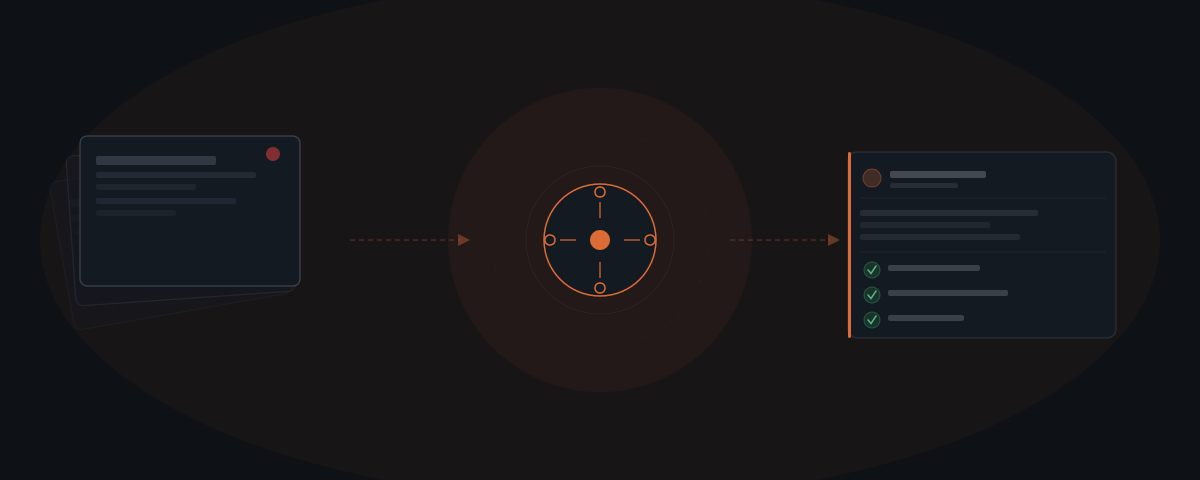
AI agents for financial advisors handle compliance documentation, meeting preparation, client follow-up, and annual review scheduling — the operational layer that consumes most of an advisor's week. Kitces Research found that financial advisors spend less than 36% of their working hours on client-facing activity. The remaining time goes to back-office tasks: building plans, logging compliance records, preparing for reviews, following up on outstanding items. An AI agent handles that layer consistently, every time, without the documentation errors that create regulatory exposure under deadline pressure.
An advisor sits down after a two-hour client meeting. She has four more back-to-back. The meeting notes from the first one still aren't written. The compliance log for last Thursday's call is incomplete. Two annual review letters are sitting as drafts because she hasn't had time to pull the updated performance data. None of this is advisory work. All of it is essential. And all of it competes with the eight other clients waiting for her attention. The documentation backlog is not a time management problem. It is a structural feature of how advisory practices operate — and it is exactly what an AI agent fixes.
Financial advisors lose time to work outside client advice
Kitces Research found that financial advisors spend less than 36% of their working hours on client-facing activities.[¹] The remaining 64% goes to non-client-facing work:
- Building financial plans
- Preparing meeting materials
- Logging compliance records
- Managing follow-up
- Coordinating the administrative layer that keeps the practice running
The average financial plan takes more than 15 hours to produce, according to Kitces's time-tracking research across advisory practices.[¹] A practice managing 100 clients — most requiring annual plan reviews — faces 1,500 hours of plan production per year. That is the equivalent of one full-time employee doing nothing else.
The same Kitces research found that advisors with a paraplanner average 64% more clients and 80% higher take-home pay.[¹] The constraint is not capacity for advice. It is capacity for the documentation, preparation, and follow-up that surrounds every client engagement.
AI agents address that constraint directly. The agent handles the operational layer — notes, logs, prep, follow-up, scheduling — at the same consistent quality regardless of how many client meetings happen that week.
Compliance documentation is where the real risk lives
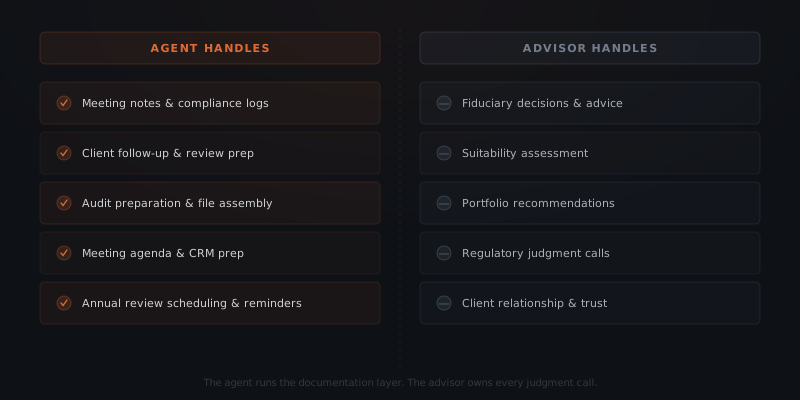
AI agents handle the documentation trail — meeting notes, disclosure logs, follow-up records, and audit file assembly. They do not make fiduciary decisions, give regulatory advice, or assess client suitability. Every judgment call stays with the advisor.
Compliance documentation requirements for financial advisors have increased 340% since 2008. Dodd-Frank, Reg BI, and ongoing SEC recordkeeping rules drove those expansions.[²] Independent RIAs and broker-dealer advisors now document all of the following:
- Client meetings
- Client communications
- The basis for recommendations
- Disclosure acknowledgments
- Evidence that best-interest obligations were met
The failure consequence is concrete. In January 2025, the SEC fined 12 firms more than $63 million for recordkeeping failures — not for bad advice, but for inadequate documentation of client interactions.[³] Firms that fail examinations typically do not fail because an advisor gave wrong recommendations. They fail because documentation gaps make it impossible to verify that right recommendations were made.
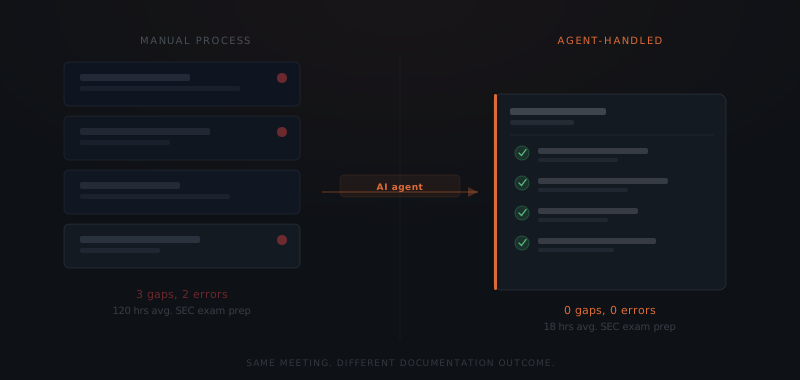
Firms that automate compliance documentation spend 85% less time on exam prep and face 73% fewer deficiencies than firms relying on manual systems.[²] The time gap is equally stark. Manual documentation processes require 120 hours to prepare for a single SEC examination. Automated documentation cuts that to 18 hours.[²]
The difference is not sophistication. It is consistency. A human documentation process produces one quality of output when the advisor has time and a different quality when the advisor is running behind. An agent produces the same output — the same timestamped meeting log, the same disclosure confirmation, the same follow-up record — every time.
What AI agents handle in an advisory practice
An AI agent for an advisory practice handles five categories:
- Compliance documentation
- Meeting preparation
- Client follow-up
- Annual review logistics
- Scheduling
Compliance documentation. After each meeting or call, the agent logs a timestamped record:
- Topics discussed
- Any recommendations made
- Disclosures delivered
- Follow-up items committed to The log is filed in the CRM — Redtail, Wealthbox, or Salesforce Financial Services Cloud — and in the document repository. The advisor does not write this. The agent produces it from the meeting notes, structured data from the CRM, and any relevant records from prior sessions.
Meeting preparation. Before each client meeting, the agent pulls the client's CRM history, flags outstanding follow-up items, and drafts the agenda. The advisor reviews a two-page briefing instead of opening four applications. At a practice of 100 clients, this preparation runs automatically for every scheduled meeting — no manual assembly required.
Client follow-up. After each meeting, the agent sends the agreed follow-up:
- Account documents requiring signature
- Any materials referenced in the meeting
- A summary of next steps with dates The follow-up sequence runs automatically. HBR research found that responding within five minutes is 9× more likely to convert than responding after 30 minutes.[⁴] The same logic applies after meetings: clients who receive structured follow-up within hours report higher satisfaction and are more likely to refer.
Annual review logistics. Annual reviews require scheduling, data preparation, document assembly, and outreach. An agent manages the scheduling sequence: review invitation, timing back-and-forth, confirmation, and reminders. Before the review, the agent assembles the updated performance summary, flags changes since the last review, and prepares the agenda. The advisor focuses on the conversation. The agent handles everything around it.
Billing and document delivery. Fee invoices, service agreement renewals, and required disclosures go out on schedule without the advisor tracking them. The agent logs delivery confirmation for compliance purposes.
| Task | Agent | Advisor |
|---|---|---|
| Meeting notes and compliance log | ✓ | |
| Pre-meeting briefing and agenda | ✓ | |
| Post-meeting follow-up sequence | ✓ | |
| Annual review scheduling and reminders | ✓ | |
| Audit file assembly and exam prep | ✓ | |
| Invoice and disclosure delivery | ✓ | |
| Fiduciary decisions and advice | ✓ | |
| Suitability assessment | ✓ | |
| Portfolio recommendations | ✓ | |
| Regulatory judgment calls | ✓ | |
| Client relationship management | ✓ |
Meeting preparation and financial plan production
Agents don't miss documentation under deadline pressure.
Meeting prep at a well-run advisory practice takes 30 to 90 minutes:
- Reviewing the prior interaction
- Checking account performance against the plan
- Identifying changes in the client's situation since the last meeting
- Drafting the agenda
Across 100 clients meeting annually — or 200 meetings per year with quarterly-review clients — that preparation totals 600 to 3,000 advisor hours per year.
An agent reduces that to review time. The agent pulls from Redtail or Wealthbox, flags items that require follow-up, and drafts the meeting agenda against the advisor's template. The advisor reads the briefing and adjusts before the meeting. What took 60 minutes takes 10 minutes of review.
Financial plan production gets the same treatment. The agent pre-populates the plan template with current data from the custodian, the CRM, and the client's last documented goals. The advisor does not start from a blank document. The plan exists in draft. The advisor reviews the reasoning and updates the recommendations — not the data structure.
This distinction matters for practice growth. Advisors who can prepare for and document ten client meetings per week instead of five can serve twice as many clients with the same hours. The growth constraint is not the quality of advice. It is the time cost of the surrounding work.
What agents cannot do for financial advisors
AI agents at a financial advisory practice handle operational work. They do not handle the work that creates the advisor's professional obligation.
Fiduciary decisions. An AI agent does not determine what is in the best interest of a specific client. Reg BI and fiduciary standards require a human professional to assess the client's situation, goals, risk tolerance, and investment horizon before making a recommendation. The agent logs that a recommendation was made and what the basis was. It does not make the recommendation.
Suitability assessments. Every investment recommendation requires a suitability determination. It weighs the client's financial situation against the proposed product or strategy. This assessment requires professional judgment — it cannot be systematized. The agent documents the suitability reasoning after the advisor has made it. It does not perform the assessment.
Regulatory interpretation. Financial services regulation changes. Interpreting new SEC guidance for a specific client situation requires legal and compliance expertise. So does assessing how a product's disclosure requirements affect documentation. The agent does not provide regulatory interpretation.
Relationship management. The reason a client stays with an advisor through a down market is not documentation quality. It is trust, judgment, and communication in difficult moments. The advisor owns those moments. The agent makes space for them by removing the operational overhead.
The boundary between what agents handle and what advisors handle is simple: repeatable operational work vs. judgment-dependent professional work. See how to know if a business process is ready to hand to an AI agent for a structured way to apply this test to any workflow.
How a small advisory practice gets started with agents
A typical RIA or independent advisor practice has five integration points:
- CRM (client records, compliance logs)
- Email client (follow-up, communication delivery)
- Calendar (scheduling, review appointments)
- Document storage (compliance files, annual review records)
- Custodian data feed (performance and account data)
CRM (Redtail, Wealthbox, Salesforce Financial Services Cloud) is the primary data source for meeting prep and the destination for compliance logs. The agent reads client records and writes back after every interaction. Setup requires read-write API access, which all major CRM platforms provide.
Email and calendar (Gmail, Outlook, Microsoft 365) handle client communication delivery and scheduling. The agent sends follow-up emails, schedules review appointments, and logs sent communications for compliance purposes.
Document storage (Google Drive, SharePoint, Dropbox Business) receives the compliance files the agent produces: meeting logs, disclosure delivery confirmations, annual review records.
Custodian data (Schwab, Fidelity, TD Ameritrade) provides the performance and account data that populates meeting prep materials. Many custodians provide read-only API access or data export integrations.
Scoping call
Map the highest-volume workflows — typically post-meeting documentation and annual review prep — and identify which integrations are already in place. Most practices have CRM, email, and document storage connected within the first two weeks.
Template configuration
Build the meeting notes template, the compliance log structure, and the follow-up sequence to match how the practice documents interactions today. The agent follows the practice's existing format, not a generic one.
Integration setup
Connect the CRM, email client, calendar, and document storage via API. Test that the agent reads client records correctly and writes back to the right fields. Most integrations are live within a week.
First live run
Run the agent on a single upcoming meeting. Review the output — the pre-meeting briefing, the post-meeting log, the follow-up email. Adjust the templates if anything is off before scaling to the full client list.
Full deployment
Enable the agent for all scheduled meetings. The documentation and follow-up workflow runs automatically from that point forward. Review logs weekly for the first month to confirm quality.
The average advisory practice is live within two to three weeks. Annual review scheduling and exam prep assembly take another one to two weeks to configure. For the broader implementation framework, see what a real AI agent implementation involves.
The business case closes quickly. Three hours per week on documentation, prep, and scheduling at $300/hr is $46,800 per year. An agent handles that layer. Setup costs run $3,000 to $6,000. The payback period is four to eight weeks.
Frequently asked questions
What does an AI agent do for a financial advisor? An AI agent handles compliance documentation, meeting prep, client follow-up, and annual review scheduling. The agent produces the documentation trail that compliance requires after every client interaction. Fiduciary decisions, portfolio recommendations, and suitability assessments stay with the advisor.
How do AI agents help with financial advisor compliance documentation? AI agents log meeting notes, produce a timestamped record of every interaction, and assemble the documentation file that SEC and FINRA examinations require. Firms that automate spend 85% less time on exam prep and face 73% fewer deficiencies than firms using manual systems. The agent creates the same compliance trail after every meeting, regardless of how busy the week is.
What tools does a financial advisor AI agent connect to? Financial advisor agent workflows connect to Redtail, Wealthbox, or Salesforce Financial Services Cloud for CRM; Gmail or Outlook for email; Calendly or Microsoft Bookings for scheduling; and Google Drive, SharePoint, or Dropbox for document storage. The integration depends on which platforms the practice already uses.
How much does an AI agent cost for a financial advisory practice? A complete compliance documentation, meeting prep, and client follow-up workflow costs $3,000 to $6,000. Operating costs at a typical RIA volume run $100 to $200 per year in API costs. At $300/hr, recovering 3 hours of documentation time per week recoups setup costs within 3 to 4 weeks.
Notes
- Kitces, M. (2022). "How Do Financial Advisors Actually Spend Their Time?" Nerd's Eye View. https://www.kitces.com/blog/how-do-financial-advisors-spend-time-research-study-productivity-capacity-efficiency/
- Zocks. (2026). "Financial Advisor Productivity: Time Management Guide 2026." https://www.zocks.io/blog/financial-advisor-productivity
- SEC enforcement data and recordkeeping fine reporting, January 2025. Referenced via FinTech Global: https://fintech.global/2026/01/19/financial-advisor-compliance-policies-tech-and-audits/
- Oldroyd, J., McElheran, K., Elkington, D., and Boulton, C. (2011). "The Short Life of Online Sales Leads." Harvard Business Review. https://hbr.org/2011/03/the-short-life-of-online-sales-leads