A service business with 40 vendors runs on a set of renewal deadlines, compliance certificates, and onboarding checklists that nobody formally owns. The contracts renew without review. The insurance certificates expire unnoticed. The performance check-ins never happen because there's no one whose job it is to remember. An AI agent handles that administrative layer — tracking every contract, flagging every expiry, collecting every onboarding document — so the operations team makes decisions instead of chasing paperwork.
A service business with 40 vendors runs on a set of renewal deadlines, compliance certificates, and onboarding checklists that nobody formally owns. The contracts renew without review. The insurance certificates expire unnoticed. The performance check-ins never happen because there's no one whose job it is to remember. An AI agent handles that administrative layer — tracking every contract, flagging every expiry, collecting every onboarding document — so the operations team makes decisions instead of chasing paperwork.
Where vendor management costs more than the bill shows
The visible cost of vendor management is the vendor spend itself. The hidden cost is the operations time that goes to the administrative layer around that spend — chasing documents, tracking renewal dates, following up on compliance certificates, and managing the onboarding sequence for each new vendor.
McKinsey estimates a 25–40% efficiency improvement potential from agentic AI applied to procurement and vendor management workflows.[¹] KPMG's analysis of the same workflows found that 50–80% of current procurement work is automatable.[²] Neither figure refers to the strategic work — vendor selection, negotiation, or relationship management. Both figures refer to the operational work that currently fills the gaps between those decisions.
The gap between strategic vendor management and operational vendor management is stark. A procurement leader making vendor decisions spends a fraction of the day on those decisions. The majority of time goes to the administrative overhead: onboarding a new vendor, ensuring their compliance documents are up to date, tracking when each contract expires, following up on outstanding invoices, and running the performance reviews that are supposed to happen quarterly but rarely do.
49% of procurement teams have piloted AI in some capacity, but only 4% have reached meaningful scale.[³] The pilots that stall don't fail because the AI wasn't capable. They fail because the pilot was run against a complex strategic workflow that required judgment — rather than the administrative workflows where agents deliver immediate, measurable results.
| Vendor management task | Time per vendor per year | Judgment required? | Agent-handled? |
|---|---|---|---|
| Onboarding document collection | 2–4 hours | No | Yes |
| Contract renewal tracking and alert | 1–2 hours | No — alert only | Yes |
| Compliance certificate monitoring | 1–3 hours | No | Yes |
| Quarterly performance check-in | 1–2 hours | No — scheduling only | Yes |
| Invoice status follow-up | 1–2 hours | No | Yes |
| Vendor selection and qualification | Variable | Yes | No |
| Contract negotiation | Variable | Yes | No |
| Dispute resolution | Variable | Yes | No |
What AI agents handle in a vendor management workflow
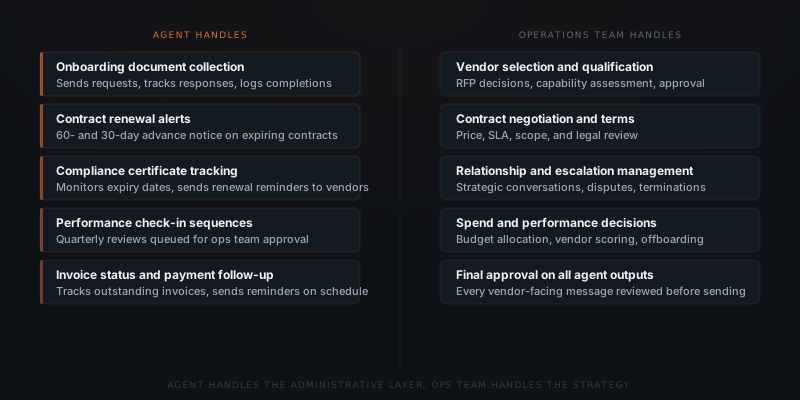
An AI agent for vendor management operates across four workflow categories: vendor onboarding, contract and compliance tracking, performance administration, and invoice follow-up. Each category handles the administrative overhead that surrounds vendor relationships — not the relationships themselves.
Vendor onboarding covers the document collection sequence for new vendors. When a new vendor is approved, the agent sends the onboarding checklist — W-9, insurance certificates, compliance agreements, bank details — tracks which documents have been received, and sends reminders for outstanding items. The operations team approved the vendor. The agent handles the paperwork.
Contract and compliance tracking covers the expiry calendar for every active vendor. The agent reads contract data, calculates renewal windows, and queues alerts for the operations team at 60 days and 30 days before expiry. The same system applies to compliance certificates — insurance policies, professional licences, regulatory certifications — with vendor-facing reminders sent when expiry dates approach.
Performance administration covers the scheduling and collection layer for quarterly or annual vendor reviews. The agent queues review requests on schedule, collects responses from the relevant internal stakeholders, and presents the aggregated data to the operations team before the review meeting. The team conducts the review. The agent ensures it happens.
Invoice follow-up covers outstanding invoices from vendors who have not received payment within the agreed terms. The agent tracks invoice aging and sends status updates to the relevant internal accounts payable contact, flagging which invoices require attention.
An AI agent handles the administrative layer of vendor management — onboarding documents, renewal alerts, compliance tracking, performance check-ins. Vendor selection, contract negotiation, relationship strategy, and dispute resolution stay with the operations team. Every vendor-facing message goes through operations team review before anything sends.
Vendor onboarding and contract setup
80% of vendor management is tracking, reminding, and routing — not relationship work. The agent handles the 80% so the team can do the 20%.
Vendor onboarding is the most consistently underestimated workflow in business operations. Approving a new vendor is a decision that takes minutes. Onboarding that vendor — collecting the required documents, confirming compliance, setting up the account, and getting the relationship operational — takes days. Deloitte's 2025 Global CPO Survey found that contract summarisation and compliance documentation are among the top three use cases for AI in procurement, behind only spend analytics and RFP generation.[⁴]
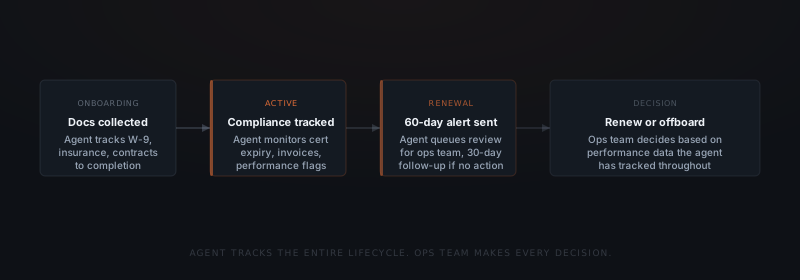
An AI agent handles the onboarding sequence automatically from the moment a vendor is approved. The agent sends the onboarding checklist to the vendor, tracks which documents have been received and which are outstanding, and sends reminders at defined intervals until the onboarding is complete. The operations team doesn't have to monitor the sequence — the agent surfaces the status when something is missing or overdue.
The same logic applies to contract setup. When a contract is signed, the agent reads the effective and expiry dates, logs the renewal window, and adds the vendor to the compliance tracking calendar. The operations team doesn't need to maintain a separate renewal spreadsheet — the agent tracks the expiry dates and alerts before decisions become urgent.
This is where most vendor management systems break down without automation. Renewal dates slip unnoticed because the person who signed the contract has moved on. Insurance certificates lapse because nobody remembers to request the annual renewal. The agent doesn't forget. The agent's job is to remember so the operations team can do the work that requires judgment.
Renewal tracking and compliance monitoring
Contract renewals and compliance monitoring are the two highest-risk administrative workflows in vendor management. A missed renewal triggers either an automatic rollover at unfavourable terms or a service disruption. A lapsed compliance certificate creates legal exposure. Both are entirely preventable — and both happen regularly in businesses where the tracking is manual.
An AI agent tracks every contract and compliance deadline across the vendor base. Sixty days before a contract expires, the agent queues an alert for the relevant operations team member: contract summary, current terms, vendor performance notes, and a decision prompt — renew, renegotiate, or offboard. Thirty days out, if no decision has been logged, the agent sends a second alert. The operations team makes the decision. The agent ensures the decision happens before the deadline, not after.
Compliance certificate monitoring follows the same pattern. Insurance policies, professional licences, and regulatory certifications all have expiry dates. The agent reads the expiry date when the certificate is filed, calculates the renewal window, and sends a reminder to the vendor — and a parallel alert to the operations team — when the window opens. The operations team confirms receipt of the renewed certificate. The agent logs it.
80% of CPOs plan to deploy generative AI in vendor and procurement workflows within three years, per EY's 2025 Global CPO Survey.[⁵] The firms moving fastest aren't starting with strategic sourcing or supplier intelligence platforms — they're starting with the administrative workflows that currently consume the most operational time for the least strategic return.
How a vendor management AI agent connects to existing tools
Vendor management runs across contract repositories, email, accounting systems, and sometimes dedicated vendor management platforms. An AI agent connects to the tools already in use rather than requiring a new system.
| Tool category | Common platforms | What the agent reads or writes |
|---|---|---|
| Contract storage | Google Drive, SharePoint, DocuSign, or dedicated VMS | Reads contract terms, effective and expiry dates, vendor details |
| Gmail, Outlook | Sends onboarding requests and renewal alerts, reads vendor responses | |
| Accounting | QuickBooks, Xero, NetSuite | Reads invoice aging, tracks payment status by vendor |
| Spreadsheet tracking | Google Sheets, Excel | Reads and updates vendor compliance status and renewal calendar |
| CRM or operations | HubSpot, Notion, Airtable | Logs performance check-in results, tracks vendor relationship notes |
The integration scope determines implementation time. A business tracking vendors in a shared Google Drive with Gmail for communication can go live in two to three weeks. Businesses with a formal vendor management system or DocuSign-connected contract workflows typically run three to four weeks.
See which workflows to automate first for a framework on sequencing vendor management alongside other automation priorities in the same business.
What goes live first and how long it takes
Vendor management agent implementations start with the highest-risk workflows — contract renewals and compliance tracking — and expand from there.
Scoping call
Map the vendor base: number of vendors, types of contracts, compliance requirements, and current tracking method. Identify where renewals are currently missed and which workflows consume the most operations time.
Integration
Connect the agent to the contract storage system, email, and accounting tools. Map the specific fields the agent reads for each workflow — expiry dates, vendor contacts, invoice aging, compliance certificate types.
Tracking setup
Load the existing vendor database into the agent's tracking system. Set the renewal window thresholds (60 days, 30 days, 14 days) and the compliance monitoring rules for each certificate type.
Alert workflow
Configure the operations team alert flow. Decide which alerts go to which team members, which require immediate action, and which can queue for the weekly vendor review meeting.
Go-live
The agent begins monitoring the entire vendor base. The operations team receives the first round of renewal and compliance alerts and adjusts the cadence based on what they see in the first two weeks.
A standard implementation covering contract renewal tracking, compliance monitoring, and onboarding document collection goes from scoping to first live alerts in two to three weeks. Adding invoice follow-up and performance check-in sequences typically runs another week of configuration.
For procurement and vendor management workflows, the efficiency gain from agentic AI — 25–40% per McKinsey's research — comes primarily from eliminating the manual tracking that currently happens across spreadsheets, email threads, and calendar reminders.[¹] Each of those tracking mechanisms is an individual judgment call: whether to check the renewal spreadsheet today, whether to follow up on the compliance certificate, whether the performance review can wait another week. The agent makes none of those judgment calls — it tracks everything on schedule so the operations team only makes the decisions that require judgment.
The implementation timeline for a service business follows the same two-to-three-week pattern for vendor management as for other operational workflows. The specifics are the contract data integrations and the alert thresholds — not the underlying process.
Frequently asked questions
How can an AI agent help with vendor management? An AI agent helps with vendor management by handling the administrative tracking layer — onboarding document collection, contract renewal alerts at 60 and 30 days, compliance certificate expiry monitoring, quarterly performance check-in sequences, and invoice status follow-up. The operations team handles vendor selection, contract negotiation, relationship management, and all vendor-facing decisions. The agent ensures the administrative work happens on schedule.
What vendor management workflows are best suited for AI agents? The highest-ROI starting points are contract renewal tracking, compliance certificate monitoring, and onboarding document collection. Invoice status follow-up and performance check-in sequences are typically added in the second phase. Vendor selection, contract negotiation, and dispute resolution stay with the operations team.
How does an AI agent track vendor contract renewals? An AI agent tracks vendor contract renewals by reading contract data from the connected system, calculating the renewal window for each vendor, and queuing alerts for the operations team at 60 days and 30 days before expiry. The alert includes the contract summary and a prompt for the team to decide whether to renew, renegotiate, or offboard. Renewal decisions stay with the operations team.
What does AI agent implementation cost for vendor management? A standard implementation covering contract renewal tracking, compliance monitoring, and onboarding document collection typically runs $1,500–$4,000 for the initial build. Monthly API costs run under $80. A business that avoids one missed renewal or lapsed compliance certificate per quarter recovers implementation cost in the first month. See what AI agent implementation actually costs for a small business for a full breakdown.
Notes
- McKinsey & Company, via Art of Procurement, "State of AI in Procurement 2026." https://artofprocurement.com/blog/state-of-ai-in-procurement
- KPMG, via Art of Procurement, "State of AI in Procurement 2026." https://artofprocurement.com/blog/state-of-ai-in-procurement
- The Hackett Group, "2025 CPO Agenda." Via Art of Procurement. https://artofprocurement.com/blog/state-of-ai-in-procurement
- Deloitte, "2025 Global CPO Survey." Via Art of Procurement. https://artofprocurement.com/blog/state-of-ai-in-procurement
- EY, "2025 Global CPO Survey." Via Art of Procurement. https://artofprocurement.com/blog/state-of-ai-in-procurement