A recruiter sources a strong candidate on Tuesday and submits their profile to the client on Wednesday. By Friday, nobody has followed up. The client moves on to the next submission. The placement is lost not because the candidate wasn't right, but because follow-up slipped between tasks. An AI agent handles that layer — candidate status updates, client job order tracking, submission sequences, timesheet reminders — so recruiters work placements, not email queues.
A recruiter sources a strong candidate on Tuesday and submits their profile to the client on Wednesday. By Friday, nobody has followed up. The client moves on to the next submission. The placement is lost not because the candidate wasn't right, but because follow-up slipped between tasks. An AI agent handles that layer — candidate status updates, client job order tracking, submission sequences, timesheet reminders — so recruiters work placements, not email queues.
Where staffing agencies lose placements after sourcing
The common assumption is that staffing agencies lose placements in sourcing — the candidate pool wasn't deep enough, the ATS search missed someone, the outreach didn't convert. That's rarely the actual problem.
Recruiterflow's platform data finds that 71% of placements come from candidates already in the firm's existing database.[¹] The candidates are there. What's missing is a consistent follow-up system to surface them and move them through the pipeline at the right time.
Recruiters spend approximately 40% of their working week on administrative tasks — CRM updates, email drafting, status checks, scheduling coordination, and submission tracking.[¹] When a recruiter manages 20 open roles across 15 clients, the follow-up that should happen on day two after a submission gets delayed to day five or skipped entirely. The client follows up with whoever checked in. The placement goes to the firm that sent the same candidate two days later but followed up the next morning.
52% of talent acquisition leaders are now deploying autonomous agents to handle this operational layer.[²] Agencies running manual admin workflows are competing against firms where agents draft submissions, track pipeline stages, and send follow-ups on schedule. The gap between a follow-up that happens and one that doesn't is the gap between a placement fee earned and a placement fee lost.
| Communication gap | When it should happen | Cost when missed |
|---|---|---|
| Candidate status after submission | 24–48 hours post-submission | Candidate disengages, accepts elsewhere |
| Client job order update | 3–5 days after submission | Client assumes nobody is working the role |
| Interview reminder to both parties | 24 hours before interview | No-show, rescheduling delay, lost candidate |
| Week-one placement check-in | Day 7 post-start | Early issues surface late, client relationship suffers |
| Timesheet reminder for placed worker | Weekly, day before deadline | Timesheet late, billing delayed one cycle |
What AI agents handle in a staffing agency workflow
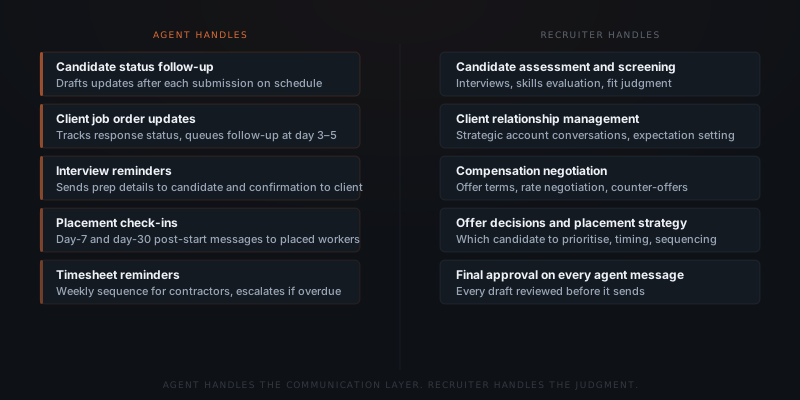
An AI agent for a staffing agency operates across three workflow categories: candidate communication, client communication, and placement administration. None of this replaces recruiter judgment. All of it replaces the administrative overhead that pushes judgment work off the calendar.
Candidate communication covers every touchpoint from screening through placement confirmation. Application acknowledgment after a candidate submits. Status updates after the recruiter submits to a client. Interview preparation reminders. Offer stage follow-up. Post-placement check-ins at day seven, thirty, and ninety. Each message is drafted by the agent and reviewed by the recruiter before it sends.
Client communication covers job order acknowledgment, submission follow-ups, interview feedback requests, and replacement notifications when a placement doesn't hold. Clients don't leave staffing agencies because the candidates were wrong. They leave because the agency went quiet after the submittal or never followed up after an interview.
Placement administration covers timesheet reminders for placed contractors and temps, billing coordination, and compliance document tracking — the operational layer that runs between go-live and invoice. This is the work that nobody formally owns and consistently falls to the recruiter between placements.
An AI agent handles the communication and tracking layer — candidate follow-up, client updates, submission status, timesheet reminders. Agents don't assess candidates, evaluate cultural fit, negotiate compensation, or manage client relationships. Every message goes through recruiter review before anything sends.
Candidate follow-up and database reactivation
71% of placements come from candidates already in the database. The work is the follow-up, not the sourcing.
Most staffing agencies have years of candidates in their ATS — screened, interviewed, and previously placed professionals who are open to new roles. The problem isn't that these candidates are unavailable. The problem is that no system surfaces them consistently when a relevant role opens.
Database reactivation is one of the highest-ROI workflows for a staffing AI agent. When a new job order arrives, the agent cross-references the ATS for candidates who match the criteria and haven't been contacted in 30–90 days. It drafts outreach messages for recruiter review — not mass emails, but personalized reach-outs that reference the candidate's background and the specific role. The recruiter approves each message and the outreach goes out before any new sourcing begins.
Recruiterflow's platform data shows that systematically working existing databases increases placement rate without increasing sourcing spend.[¹] The candidates are already there. The bottleneck is contact frequency and follow-up consistency — both of which an agent addresses without adding recruiter workload.
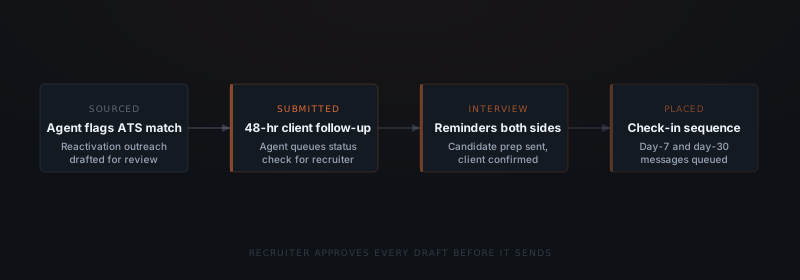
Post-submission follow-up works the same way. After a candidate is submitted to a client, the agent queues a status check at 48 hours: a brief message to the candidate confirming the submission and a parallel check-in to the client confirming receipt and asking about timeline. If neither responds within 72 hours, the agent flags the gap to the recruiter. Nothing falls through unnoticed. The recruiter knows exactly which submissions are pending response and for how long.
Client job order management and submission tracking
Client relationships in staffing depend on two things: speed and communication consistency. Speed of the initial candidate match. Consistency of updates after the submission goes in. Clients who receive prompt acknowledgment, regular status updates, and proactive outreach after interviews stay with the agency. Clients who hear nothing between a submission and an award or rejection migrate to a firm that checks in.
An AI agent handles the client communication cadence systematically. When a new job order arrives, the agent acknowledges receipt, confirms the requirements, and sets a timeline for the first submission. After submission, the agent tracks client response status and queues a follow-up if the client hasn't provided feedback within the agreed window — typically three to five days. The recruiter reviews and approves each follow-up before it sends.
Interview coordination runs through the same system. After an interview is scheduled, the agent sends preparation details to the candidate and a confirmation to the client. Twenty-four hours before the interview, it sends a reminder to both. After the interview, it drafts a feedback request to the client and a debrief check-in to the candidate. The recruiter doesn't have to remember to do any of this. The agent tracks the pipeline stage for each role and queues the right communication at the right time.
AI-driven scheduling coordination in staffing produces a 75% reduction in the coordination time spent on interview scheduling — the back-and-forth of confirming slots, chasing confirmations, and resolving conflicts.[²] For a recruiter managing 15 active roles, that's hours per week returned to candidate work and client relationship management.
How a staffing agency AI agent connects to existing tools
Staffing agencies run on ATS platforms, email, and CRM or pipeline tracking tools. An AI agent connects to the tools already in use rather than requiring migration to a new system.
| Tool category | Common platforms | What the agent reads or writes |
|---|---|---|
| ATS | Bullhorn, Greenhouse, Recruiterflow, Lever | Reads candidate records, submission status, placement history |
| Gmail, Outlook | Sends follow-up sequences, reads replies and status changes | |
| CRM or pipeline | HubSpot, Salesforce, or built into ATS | Logs communication touchpoints, updates pipeline stage |
| Scheduling | Calendly, Google Calendar | Books and confirms interview slots, sends reminders |
| Timesheet | Bullhorn Time and Expense, Deputy, or spreadsheet | Reads submitted hours, sends reminders for outstanding timesheets |
| Billing | QuickBooks, Xero | Reads invoice status, triggers payment reminders on aging invoices |
The integration scope determines implementation time. An agency running Gmail with Bullhorn or Recruiterflow as the ATS can go live in two to three weeks. Agencies with multi-office structures or complex ATS configurations typically run three to four weeks for the initial scope.
See how to know if a business process is ready to hand to an AI agent for a framework on which workflows are ready for implementation.
What goes live first and how long it takes
Staffing agent implementations start with one or two workflows confirmed working before expanding.
Scoping call
Map the highest-value communication workflows — typically candidate submission follow-up and client job order updates. Identify the ATS and email tools in use and confirm what data each contains.
Integration
Connect the agent to the ATS, email, and scheduling tools. Map the specific candidate fields and pipeline stages the agent reads and writes for each workflow.
Template build
Draft the message templates — candidate status updates, client follow-ups, interview reminders, placement check-ins. Each recruiter reviews and edits until the phrasing matches how the firm communicates.
Approval workflow
Set the review flow for each message type. Recruiters see drafts queued in their inbox or Slack, approve with one click, and the message sends immediately.
Go-live
First workflow goes live. The agent runs candidate follow-up sequences across active submissions. Recruiters monitor outputs for the first two weeks and flag any adjustments needed.
A standard implementation covering candidate follow-up, client updates, and timesheet reminders goes from scoping to first live output in two to three weeks. Adding database reactivation workflows typically runs one additional week of configuration.
Agents handling administrative tasks in staffing recover 10–15 hours per recruiter per week.[¹] For a firm with three recruiters, that's 30–45 hours per week shifted from administrative overhead to placement work — without adding headcount. For a firm billing on placement fees averaging $8,000–$12,000, recovering one additional placement per month from consistent follow-up repays the implementation cost in the first four weeks.
The implementation timeline for a service business follows the same two-to-three-week pattern across industries. Staffing's specifics are the ATS integrations and the message sequences, not the underlying process.
Frequently asked questions
How can AI agents help a staffing agency? AI agents help staffing agencies by handling the administrative communication layer between sourcing and placement — candidate status follow-up after submissions, client job order updates, interview scheduling reminders, timesheet sequences for placed workers, and placement check-ins. Recruiters spend approximately 40% of their workweek on administrative tasks. AI agents recover 10–15 hours per recruiter per week for relationship and placement work.
What staffing workflows are best suited for AI agents? The highest-ROI starting points are candidate follow-up sequences after submission, client job order status updates, and timesheet reminders for placed workers. Database reactivation — reaching out to pre-qualified candidates already in the ATS who haven't been contacted recently — is typically added in the second phase. Tasks requiring judgment — candidate assessment, cultural fit, client relationship management, and compensation negotiation — stay with the recruiter.
How does an AI agent handle candidate follow-up in a staffing agency? An AI agent handles candidate follow-up by drafting status messages after each submission, sending interview reminders to both candidates and clients, and flagging pipeline gaps to recruiters — submissions more than five days without client feedback, interviews without confirmations, placements awaiting offers with no recent update. Each message is drafted for recruiter review before it sends. Nothing goes out without approval.
What does AI agent implementation cost for a staffing agency? A standard implementation covering candidate follow-up, client updates, and timesheet reminders typically runs $2,000–$5,000 for the initial build. Monthly API costs at typical placement volumes run under $100. A staffing agency recovering one additional placement per month from consistent follow-up — at an average fee of $5,000–$15,000 — recovers implementation cost within the first month. See what AI agent implementation actually costs for a small business for a full breakdown.
Notes
- Recruiterflow, "AI Agents in Recruitment (2026 Edition)." https://recruiterflow.com/blog/ai-agents-in-recruitment/
- Aqore, "Staffing Industry Trends 2026: AI Agents, Full Automation, and the Strategic Reset." https://www.aqore.com/staffing-industry-trends-2026/