A property manager with 120 units spends two to three hours every morning on tenant messages. Most of those messages ask the same questions — when is rent due, what is the maintenance request status, how does the renewal process work. None of it requires judgment. All of it takes time. An AI agent handles the routine communication layer — inquiry responses, maintenance request routing, rent reminder sequences, lease renewal outreach — so the property manager's time goes to the work that actually requires a human.
A property manager with 120 units spends two to three hours every morning on tenant messages. Most of those messages ask the same questions — when is rent due, what is the maintenance request status, how does the renewal process work. None of it requires judgment. All of it takes time. An AI agent handles the routine communication layer — inquiry responses, maintenance request routing, rent reminder sequences, lease renewal outreach — so the property manager's time goes to the work that actually requires a human.
The tenant communication problem at scale
Property management is a volume business. A single property manager handling 100–300 units receives the same questions hundreds of times each month — when is rent due, is the maintenance request scheduled, what does the renewal process look like, what is the pet policy. Each answer takes three minutes. At 20 messages per day, that's one hour of response time on questions that don't change.
Haven AI's 2026 property management statistics report found that 66% of property managers' time goes to routine, low-value operational tasks — and that 65% of support team time is dedicated to answering the same repetitive questions.[¹] AI adoption in property management companies surged from 20% in 2024 to 58% by 2025, a 35% compound annual growth rate.[¹] The firms leading that adoption aren't replacing property managers — they're freeing them from the routine communication layer so the property manager's time goes to judgment-dependent work.
70% of all tenant inquiries can be automated through layered AI approaches.[¹] That's not a ceiling — it's the result of property management companies mapping which inquiries follow predictable patterns and which require interpretation. The 70% that are predictable — routine questions, maintenance status updates, rent reminders, renewal outreach — an agent handles. The 30% that require judgment stays with the property manager.
| Tenant inquiry type | Frequency | Requires judgment? | Agent-handled? |
|---|---|---|---|
| Rent due date and payment portal | Very high | No | Yes |
| Maintenance request status | High | No | Yes |
| Lease renewal options | Medium | No — until tenant responds | Yes — initial outreach |
| Pet policy or building rules | Medium | No | Yes |
| Noise complaint or neighbor dispute | Medium | Yes | No |
| Lease break request | Low | Yes | No |
| Rent reduction negotiation | Low | Yes | No |
What AI agents handle in a property management workflow
An AI agent for a property management company operates across four workflow categories: tenant inquiry response, maintenance request routing, rent and lease administration, and move-out communication. Each category handles a specific part of the communication that currently lands on the property manager's desk.
Tenant inquiry response covers the most frequent questions: rent due dates and payment confirmation, maintenance request status updates, lease terms and renewal timelines, building policies and procedures. The agent routes each question to a prepared response, adapts it to the tenant's specific unit and lease, and queues it for property manager review before sending.
Maintenance request routing captures the tenant's description of the issue, categorises urgency and type, logs the request in the property management system, and routes the request to the appropriate vendor or internal team. The property manager approves vendor and scope. The agent handles the communication to both vendor and tenant after that decision is made.
Rent and lease administration covers rent reminder sequences for overdue accounts, lease renewal outreach at 60 and 30 days before expiration, and renewal confirmation tracking. Each message is templated for the specific unit and lease type and queued for property manager approval.
Move-out communication covers the move-out checklist delivery, inspection scheduling, deposit timeline updates, and post-move-out follow-up. Tenants moving out generate a predictable sequence of communications — an agent handles the sequence so nothing gets missed.
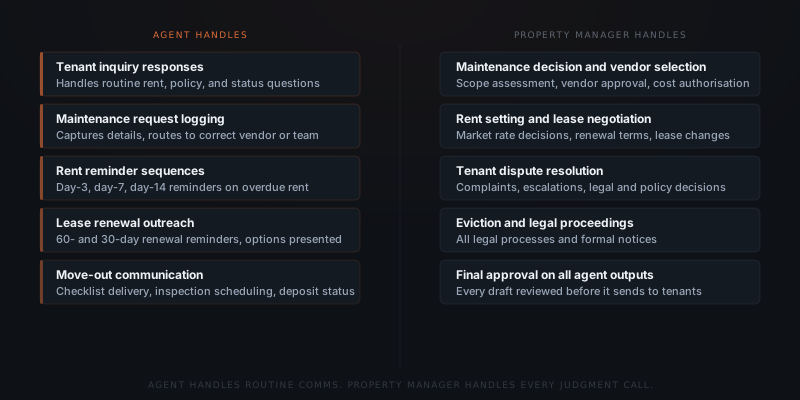
An AI agent handles tenant inquiry routing, maintenance request logging, rent reminder sequences, and lease renewal outreach. Agents don't make maintenance decisions, set rents, negotiate lease terms, resolve disputes, or initiate legal proceedings. Those stay with the property manager.
Maintenance request routing and vendor coordination
66% of property managers' time goes to routine tasks. An agent handles those — property manager time goes to the 34% that actually needs a human.
Maintenance requests are the highest-volume workflow in most property management operations. A 150-unit property receives 10–20 maintenance requests per week. Each request requires the same sequence: capture the tenant's description, identify the urgency and type, route to the right vendor, confirm access arrangements with the tenant, and follow up after the work is done. That sequence is entirely predictable — and almost entirely administrative.
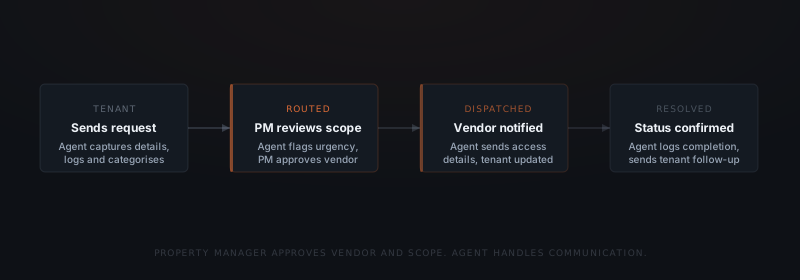
An AI agent handles the maintenance communication workflow from intake to resolution. When a tenant submits a maintenance request via email, text, or a portal, the agent captures the details, categorises the request by type and urgency, logs it in the property management system, and routes it to the property manager for vendor approval. The property manager approves the vendor and authorises the scope. The agent then sends the vendor access details and availability window, sends the tenant an update with the expected timeline, and follows up with both parties after the work is completed.
The property manager's judgment is applied once — at vendor and scope approval. Everything before and after that decision is handled by the agent. A property manager who currently spends 45 minutes per maintenance request processing the communication can reduce that to a 90-second approval window for routine work.
Vendors benefit from the same consistency. A vendor who receives structured access requests with accurate unit details, access instructions, and tenant availability windows arrives prepared and completes work faster. The property management company's reputation with vendors improves because the communication is professional and consistent — not dependent on whether a staff member had time to write a complete message.
Rent reminders, lease renewals, and move-out workflows
Rent collection, lease renewals, and tenant move-outs are the three deadline-driven workflows that property managers consistently manage manually — and consistently manage late. Not because the deadlines are hard to track, but because the communications required hit at the same time every month, and a property manager with 150 units can't write 40 rent reminders and 12 renewal notices by hand.
Rent reminders follow a predictable cadence. An AI agent sends a payment reminder at day three past due — a straightforward message with the payment amount, the portal link, and the late fee timeline. If payment hasn't been confirmed by day seven, the agent sends a second reminder. Day fourteen triggers a notice that references the lease terms. The property manager is notified at each stage. Legal proceedings, if necessary, are handled entirely by the property manager — the agent handles the communication, not the legal process.
Lease renewal outreach starts at 60 days before expiration. The agent sends the tenant the renewal options — same terms, adjusted rent, or month-to-month — and tracks the response. If the tenant hasn't responded by the 30-day mark, the agent sends a follow-up. The property manager sees exactly which leases are pending response, which tenants have confirmed renewal, and which units will be vacated — without manually chasing each one.
Move-out communication covers the checklist, inspection scheduling, deposit status, and post-move confirmation. A tenant who decides not to renew receives a structured sequence: move-out checklist, inspection appointment options, deposit timeline explanation, and a final confirmation of charges after the inspection. The property manager makes all financial decisions. The agent handles the communication that surrounds those decisions.
80% of property management companies implementing AI report higher customer satisfaction — driven primarily by faster response times and consistent communication, not by the quality of individual messages.[¹] The messages themselves aren't particularly novel. The difference is that they happen on schedule, every time, for every tenant.
How a property management AI agent connects to existing tools
Property management companies typically run on a property management platform, email, and sometimes a maintenance ticketing system. An AI agent connects to the tools already in use.
| Tool category | Common platforms | What the agent reads or writes |
|---|---|---|
| Property management | AppFolio, Buildium, Propertyware, Yardi | Reads lease terms, rent status, maintenance logs; updates request status |
| Email and messaging | Gmail, Outlook, or PM platform inbox | Sends tenant communications, reads replies and requests |
| Maintenance ticketing | Buildium work orders, Jobber, or platform-native | Logs requests, reads vendor assignment and status |
| Scheduling | Google Calendar, Calendly | Books inspection and vendor appointments |
| Accounting | QuickBooks, or built into PM platform | Reads rent ledger, triggers payment follow-up on overdue accounts |
The integration scope determines implementation time. A company running AppFolio or Buildium as the primary platform can go live with maintenance routing and rent reminders in two to three weeks. Adding lease renewal outreach and move-out communication typically runs another two weeks.
See how to know if a business process is ready to hand to an AI agent for a framework on identifying the right starting workflows for any business.
What goes live first and how long it takes
Property management agent implementations start with the highest-volume workflows and expand from there.
Scoping call
Map the highest-volume tenant communication workflows — typically inquiry response and maintenance request routing. Identify the property management platform and email tools in use and confirm what tenant data each contains.
Integration
Connect the agent to the property management platform, email, and maintenance ticketing systems. Map the specific fields the agent reads for each workflow — lease terms, rent status, maintenance log, tenant contact.
Template build
Draft the message templates — inquiry responses by category, maintenance acknowledgment and update messages, rent reminder sequence, renewal outreach. Property managers review and edit each one until the phrasing is right for their tenants and their properties.
Approval workflow
Set the review flow for each message type. Property managers see drafts queued for approval before any message reaches a tenant. High-frequency routine messages can be set to auto-approve after the first review period confirms accuracy.
Go-live
First workflow goes live. The agent begins routing maintenance requests and handling inquiry responses. Property managers monitor outputs for the first two weeks and flag any adjustments.
A standard implementation covering tenant inquiry response, maintenance routing, and rent reminders goes from scoping to first live output in two to three weeks. Adding lease renewal outreach and move-out workflows typically runs another two weeks.
Property management companies implementing AI report saving up to 10 hours of staff time per week on routine communication tasks.[¹] For a team managing 200 units, that's the equivalent of adding one part-time staff member's capacity — without the overhead of recruitment, onboarding, or ongoing management.
The implementation timeline for a service business follows the same two-to-three-week pattern for the first workflow in any industry. Property management's specifics are the platform integrations and the tenant communication templates — not the underlying process.
Frequently asked questions
How can AI agents help property management companies? AI agents help property management companies by handling the routine communication layer that consumes most of a property manager's day — tenant inquiry responses, maintenance request logging and routing, rent reminder sequences, lease renewal outreach, and move-out communication. 66% of property managers' time goes to routine operational tasks that follow predictable patterns. AI agents handle those tasks automatically, with property manager review before any message reaches a tenant.
What property management workflows are best suited for AI automation? The highest-ROI starting points are tenant inquiry response, maintenance request routing, and rent reminder sequences. Lease renewal outreach is typically added in the second phase. Tasks requiring judgment — maintenance scope decisions, rent setting, lease negotiation, tenant disputes, and eviction proceedings — stay with the property manager.
How does an AI agent handle maintenance requests in property management? An AI agent captures the tenant's description, categorises urgency and type, logs the request in the property management system, and routes it for property manager review. The property manager approves vendor and scope. The agent then sends access details to the vendor and an update to the tenant with the expected timeline. Every outbound tenant message goes through property manager review before sending.
What does AI agent implementation cost for a property management company? A standard implementation covering tenant inquiry response, maintenance routing, and rent reminders typically runs $2,000–$5,000 for the initial build. Monthly API costs at typical volumes run under $150. A company managing 100+ units that recovers 8–10 hours of staff time per week from routine communications sees the implementation cost repaid within the first two months. See what AI agent implementation actually costs for a small business for a full breakdown.
Notes
- Haven AI, "AI Property Management Statistics 2026." https://www.usehaven.ai/post/ai-property-management-statistics