A contractor sends twelve bids in a month and wins three. The other nine go quiet — not because the price was wrong, but because nobody followed up after the estimate went out. The estimator moved to the next job. The principal was on-site. The opportunity sat in a sent folder until the general contractor awarded it to whoever checked in. An AI agent handles that follow-up layer — bid sequences, subcontractor outreach, weekly project updates, invoice reminders — so the principal's time goes to jobs, not to chasing them.
A contractor sends twelve bids in a month and wins three. The other nine go quiet — not because the price was wrong, but because nobody followed up after the estimate went out. The estimator moved to the next job. The principal was on-site. The opportunity sat in a sent folder until the general contractor awarded it to whoever checked in. An AI agent handles that follow-up layer — bid sequences, subcontractor outreach, weekly project updates, invoice reminders — so the principal's time goes to jobs, not to chasing them.
Where construction businesses lose revenue between jobs
Construction firms lose revenue in two places: job cost overruns and the communication gaps between jobs. Job cost overruns get attention because they're visible — they show up in the final margin. Communication gaps don't. Nobody sees the bid that didn't get followed up. Nobody tallies the subcontractor who wasn't available because nobody confirmed three weeks out. Nobody measures the invoice that aged to 75 days because a reminder never went out.
McKinsey's research on construction productivity found the industry improved by only 10% over two decades, compared to 47% in manufacturing over the same period.[¹] McKinsey's analysis identifies coordination failures as a primary driver: handoffs between estimators, project managers, subcontractors, and clients that break down consistently because everyone is already running a job.
A survey of general contractors found that 62% identify lack of coordination and communication as the top factor reducing labor productivity on their projects.[²] That's not a site problem — it's an administrative problem. The physical work gets done. The communication that surrounds the work — the follow-up calls, the status updates, the bid confirmations — falls through the gaps.
| Communication gap | Frequency | Cost when missed |
|---|---|---|
| Bid follow-up after submission | Per bid, days 3 and 7 | Bid overlooked; GC awards to whoever checked in |
| Subcontractor availability check | Per project, 2–3 weeks before start | Scheduling conflict discovered too late |
| Weekly project status to client | Each active job, every week | Client calls asking — principal loses an hour |
| Invoice reminder on overdue payment | Per aging invoice, day 30 and day 45 | Payment stretches to 60–90 days |
| Post-project review request | After each completed job | No review, no referral trigger |
What AI agents handle in a construction or trade business
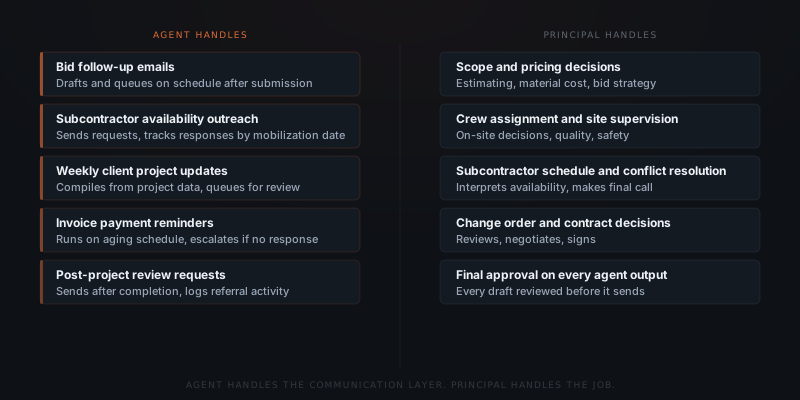
An AI agent for a construction business operates across two categories: outbound communication and document processing. Neither replaces site supervision. Both replace the work that falls between the principal and the next job.
Outbound communication covers the messages that should go out on a schedule and consistently don't. Bid follow-ups after submission. Subcontractor availability requests before mobilization. Weekly project updates to active clients. Invoice reminders at day 30 and day 45. Post-project thank-you messages with a review request. Each message is drafted by the agent, reviewed and approved by the principal, then sent under the principal's name from the principal's email.
Document processing covers the intake and routing of structured documents. New inquiry emails trigger a qualification sequence. Signed subcontractor agreements get filed and logged against the project record. Change order requests are queued for review with the relevant fields extracted.
An AI agent handles the communication layer — bid follow-up, subcontractor outreach, project updates, invoice reminders. An AI agent doesn't manage scope, crew, or schedule. Every draft goes through principal approval before sending.
Bid follow-up — the workflow contractors skip and competitors don't
Most lost bids weren't lost on price. They were lost in the silence after the estimate went out.
The average commercial contractor wins 25% of the bids they submit — one in four.[³] Best-in-class contractors reach 40–50% win rates on the same types of work.[³] The difference isn't estimating skill or price competitiveness. It's what happens in the days after submission.
Most estimators submit a bid and move on to the next one. The general contractor receives twelve bids. The contractors who check in — acknowledging submission, confirming availability, asking if there are questions — stay visible when the GC sits down to award the work. The contractors who don't are the easiest to skip. The GC doesn't remember which firm sent the quietest proposal.
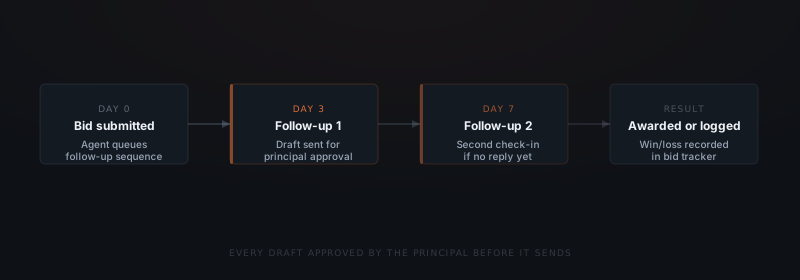
An AI agent handles the follow-up cadence. After a bid goes out, the agent queues a follow-up at day three: a short message acknowledging the submission, confirming the team's availability to answer questions, and noting the timeline. If no response arrives, a second message goes out at day seven. Both messages are drafted to sound like the principal wrote them — because the principal reviews and approves each one before it sends.
The agent doesn't win bids. The agent ensures bids don't disappear into a sent folder. A contractor following up consistently on all twelve bids is competing at a different level than one who follows up on two or three when time allows.
Subcontractor outreach and project communication
Construction projects run on subcontractor networks. A general contractor or specialty trade firm works with the same electricians, plumbers, HVAC crews, and concrete teams across multiple projects. Coordinating that network — confirming availability before mobilization, routing scope documents for signature, tracking outstanding agreements against the start date — takes hours that no single person fully owns.
An AI agent handles the coordination layer. When a project is awarded, the agent runs availability requests across the relevant sub network, routes scope documents for review and signature, and tracks response status against the mobilization date. If a sub hasn't confirmed by a set threshold — say, ten days before start — the agent flags the gap to the principal. The principal interprets availability and makes the final scheduling call.
The same pattern applies to client communication. Weekly updates on active jobs — completed milestones, upcoming work, any schedule changes — are messages most clients want and most contractors write inconsistently. The agent drafts each update from connected project data and queues it for principal review. Clients stay informed. The principal doesn't lose an hour every Friday assembling updates across four active jobs.
Post-job communication follows the same logic. After project completion, the agent sends a wrap-up message, confirms final payment status, and routes a review request to the client. Review requests sent within 48 hours of project completion convert significantly better than requests sent weeks later — but most contractors never send one at all because there's no one whose job it is to remember.
How a construction agent connects to existing tools
Construction businesses typically run on a mix of email, spreadsheets, project management software, and accounting tools. An AI agent connects to the tools already in use rather than requiring migration to a new platform.
| Tool category | Common platforms | What the agent reads or writes |
|---|---|---|
| Gmail, Outlook | Sends follow-ups and updates, reads replies | |
| Project management | Buildertrend, Procore, Jobber | Reads job status, milestones, client contact |
| CRM or bid tracking | HubSpot, Pipedrive, or spreadsheet | Logs bid activity, tracks win/loss by GC |
| Documents | DocuSign, Google Drive | Tracks sub agreement signatures, files documents |
| Accounting | QuickBooks, Xero | Reads invoice aging, triggers payment follow-up |
The integration scope determines implementation speed. A contractor running Gmail and QuickBooks with a spreadsheet for bid tracking can go live in two to three weeks. A contractor already on Procore or Buildertrend with structured project data moves faster — the data the agent needs already exists in a readable form.
See how to know if a business process is ready to hand to an AI agent for a framework on identifying which workflows in any business are ready for agent implementation.
What goes live first and how long it takes
Construction agent implementations start narrow: one or two workflows, confirmed working, then expanded.
Scoping call
Map the highest-value communication workflows — typically bid follow-up and subcontractor outreach. Identify the tools in use and confirm what data each contains.
Integration
Connect the agent to existing email, project management, and accounting tools. Map the specific fields the agent reads and writes for each workflow.
Template build
Draft the message templates — bid follow-ups, sub outreach, client updates, invoice reminders. The principal reviews and edits each one until the phrasing is right.
Approval workflow
Set the review flow for each message type. The principal sees a draft, approves with one click from email or Slack, and the message sends immediately.
Go-live
First workflow goes live. The agent runs the bid follow-up sequence across active bids. The principal monitors outputs for the first two weeks and flags any adjustments.
A standard implementation covering bid follow-up, subcontractor outreach, and weekly client updates goes from scoping call to first live output in two to four weeks. Adding document processing for change orders and lien waivers typically adds two more weeks.
AI adoption in construction remains low: 79% of construction organizations have either not implemented AI at all or are testing only in limited, isolated ways — while 87% expect AI to transform the industry.[⁴] The contractors who move from testing to production workflows claim a competitive advantage in the window before that transformation catches the majority of the market.
The implementation timeline for a service business AI agent follows the same two-to-four-week pattern across industries — construction's specifics are the message sequences and the tool integrations, not the underlying process.
Frequently asked questions
How can AI agents help a construction business? AI agents help construction and trade businesses by handling the communication layer between jobs — bid follow-up sequences, subcontractor availability outreach, weekly client project updates, invoice payment reminders, and post-project review requests. The agent drafts each message and queues it for principal review before anything sends. Construction firms that implement bid follow-up automation gain consistent visibility into every submitted bid and stop losing work to the silence after an estimate goes out.
What construction workflows are best suited for AI automation? The highest-ROI starting points for construction AI agents are bid follow-up sequences, subcontractor availability outreach, and client project updates. Invoice payment follow-up and post-project review requests are typically added in a second phase. Tasks requiring site judgment — scope decisions, crew assignment, change order negotiation — remain with the principal.
How does an AI agent handle subcontractor coordination? An AI agent handles subcontractor coordination by sending availability requests across the sub network when a project is awarded, routing scope documents for review and signature, and tracking response status against the mobilization date. If a sub hasn't confirmed by a set threshold, the agent flags the gap to the principal. The agent handles outreach and tracking; the principal makes all final scheduling decisions.
What does an AI agent implementation cost for a construction company? A standard implementation covering bid follow-up, subcontractor outreach, and weekly client updates typically runs $2,000–$5,000 for the initial build, depending on the number of tool integrations and the complexity of the message sequences. Monthly API operating costs at typical project volumes run under $150. A contractor winning one additional project per month from consistent bid follow-up recovers implementation cost within weeks. See what AI agent implementation actually costs for a small business for a full breakdown.
Notes
- McKinsey Global Institute, "Reinventing Construction: A Route to Higher Productivity," 2017. https://www.mckinsey.com/capabilities/operations/our-insights/reinventing-construction-through-a-productivity-revolution
- Bridgit, "AI Construction Statistics 2026." https://gobridgit.com/blog/ai-construction-statistics/
- OpenAsset, "The Construction Bidding Process + Strategies to Win More Bids." https://openasset.com/resources/construction-bidding-process/
- MASTT, "State of AI in Construction Project Management." https://www.mastt.com/research/ai-in-construction