An AI agent for contract renewals monitors every active contract for expiry dates, fires renewal workflows at defined lead times — typically 90, 60, and 30 days before expiry — and drafts the renewal communication for human review. Most contracts don't lapse because the client wanted to leave. They lapse because no one started the renewal conversation with enough time to address concerns, negotiate terms, or simply confirm the relationship. The agent solves the timing problem. The renewal conversation itself stays with the human.
A client's retainer contract expires in six weeks. The relationship has been fine. Nobody flagged the date. The account manager assumed someone else was tracking it. The client didn't receive a renewal conversation — so when the invoice arrived, they took it as an opportunity to pause and reconsider. The renewal was lost not because the client was dissatisfied, but because the conversation started too late to do anything about it. An AI agent for contract renewals monitors every expiry date and initiates the renewal workflow at the right moment — giving the human enough lead time to have a real conversation, not a last-minute scramble.
Why contracts lapse when the client relationship is still good
Contract non-renewal is rarely about a bad relationship. It is almost always about timing. A client who might have renewed with a proactive conversation three months before expiry will make a different decision when the first mention of renewal comes 10 days before the deadline.
Bain & Company research has consistently found that acquiring a new customer costs 5–25x more than retaining an existing one.[¹] Reducing customer defection by 5% can increase a firm's profitability by 25–95%, depending on the margin structure of the business.[¹] These are well-established findings, but they describe the cost of churn after it happens. The more useful operational question is: at what point does the renewal conversation need to start to prevent churn in the first place?
Most contract management research suggests that 90 days is the minimum meaningful lead time for a B2B service contract. Ninety days gives both parties room to review terms, raise concerns, negotiate changes if needed, and confirm the renewal without urgency distorting the conversation.[²] A renewal conversation that starts at 30 days compresses all of that into a window where one side is already under time pressure.
The problem most lean service businesses face is not that they want to have renewals start late. The problem is that there is no system watching the calendar across the full portfolio of active contracts. The account manager is managing ongoing delivery. The founder is managing new business. The renewal date arrives unannounced.
An AI agent solves this at the infrastructure level — not by replacing the renewal conversation, but by ensuring that conversation starts at the right time.
What a contract renewal agent monitors
A contract renewal agent does one primary job: watch every active contract's expiry date and fire the appropriate workflow when a configured threshold is crossed.
The monitoring layer is continuous. Once a contract record exists in the CRM or contract management system — with a named client, a contract value, and an expiry date — the agent tracks it. No active management is needed after the initial configuration. Every contract in the portfolio is monitored without anyone having to remember to check.
The trigger logic is structured by time-before-expiry:
| Days before expiry | Agent action | What the human receives |
|---|---|---|
| 90 days | Drafts renewal intent outreach | Email draft for account owner to review and send |
| 60 days | Drafts terms review message and check-in | Updated draft with terms language; account owner decides timing |
| 30 days | Drafts urgency-toned follow-up, sends pipeline alert | Escalation draft + CRM alert for immediate owner attention |
| Expiry date reached | Sends immediate escalation alert | Alert to account owner and manager that contract is at expiry without recorded outcome |
| Post-expiry (if no outcome) | Logs contract as unresolved, sends daily alert until outcome is recorded | Ongoing escalation until owner marks the contract as renewed, lapsed, or cancelled |
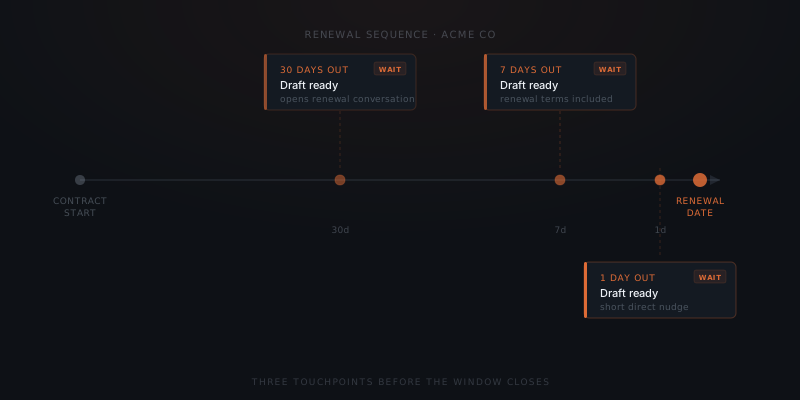
Every action at every window is a draft routed to a human for review. The agent generates; the account owner decides whether to send, adjust, or hold.
The renewal workflow the agent handles
The agent watches the calendar and initiates the workflow. It cannot read whether the client is satisfied with the relationship. The renewal conversation — the one where concerns surface and the decision is made — stays with the account owner.
When the 90-day trigger fires, the agent drafts a renewal intent email. The message acknowledges the upcoming expiry date, expresses intent to continue the engagement, and invites the client to schedule a renewal conversation. The tone is proactive, not urgent. The account owner reviews the draft, adjusts any relationship-specific language, and sends from their own address. The agent does not send on its own.
When the 60-day trigger fires, the agent drafts a message that includes the proposed terms for the renewal period: duration, pricing, scope changes if any. The account owner reviews the terms, confirms the pricing is correct, and decides whether to include adjustments based on the client relationship. This is the stage where the human judgment matters most — the agent knows the contract record; the account owner knows the relationship.
When the 30-day trigger fires, the tone shifts. The agent drafts a follow-up that acknowledges the 30-day window and requests a confirmation on whether the client is proceeding. The agent also sends a pipeline alert to the account manager — not just the account owner — so there is visibility beyond one person.
If the contract reaches its expiry date without a recorded renewal or cancellation, the agent sends an immediate escalation alert and flags the record as unresolved. This is not a message to the client — it is an internal alert to the account team. Every day that passes without resolution generates another alert until someone records an outcome.
A renewal that starts 90 days out is a conversation. One that starts at 30 days is damage control.
What the agent does not do in a renewal
The renewal agent handles the calendar, the drafts, and the escalations. It does not handle the renewal itself.
The renewal conversation stays human. The call where the client raises concerns about pricing, asks about changes to the scope, or requests a different term structure requires a person who understands the account history, the relationship context, and what the business can offer. The agent drafts the email that gets the conversation on the calendar. What happens on the call is entirely up to the account owner.
The agent cannot assess relationship health. A client who has been unreachable for six weeks and hasn't replied to status updates is a different renewal scenario than a client who sends weekly check-ins. The agent sees the contract record and the expiry date. The account owner sees the relationship. The agent fires the workflow at 90 days regardless of whether the relationship is strong or strained — the account owner decides what to do with the draft.
The agent does not negotiate. If a client responds to the 60-day terms email with a counter-offer or a request to change the pricing structure, that response routes to the account owner. The agent does not draft a negotiating response. The negotiation is not patterned enough to be automated, and the stakes are too high to treat it as if it were.
What to configure before the agent goes live
Contract record completeness. The agent needs three fields on every contract record: client name, contract value, and expiry date. If the current contract records are stored in spreadsheets, email threads, or PDFs without consistent structured fields, the agent cannot monitor them. Migration to a structured format — a CRM, a contract management tool, or even a clean spreadsheet that feeds a CRM — is a prerequisite.
Trigger windows by contract type. A high-value annual contract may warrant a 90-day start. A short-term monthly retainer may only need a 30-day trigger. Configure trigger windows by contract type, not universally. Apply the tightest windows to the highest-value contracts.
Owner routing rules. Every contract needs a named account owner — the person who receives the draft and the alerts. If contracts are owned by the firm as a whole rather than assigned to a named person, the alerts go nowhere useful. Define owners before deployment.
Escalation paths. When a contract reaches 30 days without a renewal conversation, who else receives the alert? Define the escalation chain: account owner → account manager → founder. An alert that sits unread with a single person is not an escalation.
Audit and structure your contract records
Pull every active contract and confirm that each has a named client, a contract value, and an expiry date in a structured format. Contracts stored as PDFs or email threads without CRM entries are not visible to the agent. Move them into a format the agent can read before connecting.
Assign an owner to every contract
Every contract needs a named account owner: the person who receives renewal drafts and alerts. If ownership is unclear across the existing portfolio, resolve that before deployment — an alert that routes to no one produces no action.
Configure trigger windows by contract type
Define which contracts get a 90-day start and which get a shorter window. High-value annual contracts: 90 days. Monthly retainers with low switching friction: 30–60 days. Apply the longest window to the contracts where losing the renewal would have the most impact.
Build renewal communication templates
For each trigger window, write a template: the 90-day renewal intent email, the 60-day terms message, the 30-day urgency follow-up. The agent personalizes from the contract record (client name, expiry date, contract value) — but the structural language, tone, and terms language come from the template. Templates that do not exist yet need to be written before deployment.
Connect the CRM or contract management system
Grant the agent read access to contract records and write access to the activity log. The agent needs to read expiry dates and write renewal status updates. Connect the calendar integration if meeting booking from a renewal email should create CRM-logged appointments automatically.
Run the first renewal cycle with full draft review
Process every renewal draft manually for the first full cycle — review and send each draft rather than approving in bulk. After one cycle, identify which drafts required substantive changes. Refine the templates based on what the review cycle revealed before expanding the workflow to the full contract portfolio.
Integrations for a contract renewal workflow
| Integration | Role | Access required |
|---|---|---|
| HubSpot | Contract and deal records, owner assignment, activity log | Read deal expiry fields, write activity log and renewal status |
| Salesforce | Contract object, renewal opportunity tracking | Read/write contract record and activity |
| Pipedrive | Deal record as contract proxy | Read deal close date as expiry, write activity |
| PandaDoc / DocuSign | Contract document delivery and e-signature tracking | API — send for signature, track completion event |
| Gmail / Outlook | Outbound renewal email send and inbox monitoring for client replies | OAuth — reads inbox for client reply detection, sends on approval |
| Slack | Internal escalation alerts for approaching expiry and unresolved contracts | Webhook — notification only |
Where renewal agent implementations fail
Contract records are incomplete. The most common failure: the agent cannot monitor a contract that isn't in the system. Contracts in inboxes, in shared drives, or on signed PDFs without CRM entries are invisible to the agent. The audit step before deployment is not optional. Every active contract must have a structured record before the agent goes live.
No one is assigned as owner. Alerts and drafts that route to a shared inbox or a general email address go unactioned. Every contract needs a named person. If the firm doesn't have clear account ownership, the renewal agent reveals that gap but cannot solve it.
Templates are written too generically. A renewal intent email that reads like a form letter — with no relationship context, no reference to the specific work done, no acknowledgment of the client's situation — is less likely to generate a positive response than a message that sounds like it came from the account owner directly. The agent personalizes with contract data, but the template provides the relational language. Generic templates produce generic results.
The 30-day window is the only trigger. Some firms configure only the last-chance alert and skip the 90-day and 60-day triggers. The result is a renewal process that starts under time pressure every time. Clients receive their first renewal communication when the deadline is 30 days away. There is no room to negotiate or address concerns. The client reads urgency as pressure. Configure the full trigger sequence.
Bain & Company research shows that a 5% increase in customer retention can increase company profitability by 25–95%.[¹] The businesses that achieve those retention rates are not operating on last-chance renewal notices — they are having renewal conversations early enough that the decision is made on relationship merit, not deadline pressure. The agent's job is to make sure the conversation starts at the right time. What happens in that conversation is the human's.
Frequently asked questions
What does an AI agent do for contract renewals? An AI agent for contract renewals monitors every active contract for expiry dates and fires renewal workflows at configured lead times — commonly 90, 60, and 30 days before expiry. At each trigger, the agent drafts the relevant renewal communication and routes it to the account owner for review and approval. The agent also sends an immediate escalation alert if a contract reaches its expiry date without a recorded renewal outcome.
How far in advance should contract renewals start? Most B2B service contracts with meaningful terms benefit from starting the renewal conversation 90 days before expiry. That window allows time for the client to review terms internally, raise concerns, and negotiate if needed — before the renewal becomes urgent. A 30-day window is often too tight for contracts over $10,000 annually. The 90-day start is the standard default; shorter windows work for straightforward, low-friction renewals.
Can a renewal agent send the renewal email automatically? No. Every draft the renewal agent generates waits in a review queue for the account owner to approve before it sends. Renewal communications are relationship-sensitive: a poorly worded message can introduce friction into a renewal that would otherwise have been straightforward. The agent drafts; the human decides.
What happens if a client does not renew by the expiry date? If a contract reaches its expiry date without a recorded renewal or cancellation outcome in the CRM, the agent sends an immediate escalation alert to the account owner. The agent does not make a judgment about whether the contract is in good standing — it flags the event and routes to the human for an immediate decision. Post-expiry outreach stays with the account owner.
Notes
- Bain & Company / Frederick F. Reichheld. "Prescription for cutting costs." Bain & Company, 2001. https://www.bain.com/insights/prescription-for-cutting-costs-bain-brief/ — source for the finding that acquiring a new customer costs 5–25x more than retaining one, and that a 5% increase in customer retention can increase profitability by 25–95%.
- Gatekeeper. "Contract Renewal Best Practices for 2026." Gatekeeper HQ Blog. https://www.gatekeeperhq.com/blog/contract-renewals — source for contract management guidance on 90-day renewal windows as standard lead time for B2B service agreements.