A lead fills out your GoHighLevel form at 9 PM and asks a specific question in the message field. GHL fires the confirmation and starts the nurture sequence. The follow-up that goes out next morning says the same thing it says to every lead — because GHL runs on triggers and templates, not on what the lead actually wrote. An AI agent reads what the lead wrote and drafts a response that addresses it. Every draft goes through your review before it sends.
A lead fills out your GoHighLevel form at 9 PM and asks a specific question in the message field. GHL fires the confirmation and starts the nurture sequence. The follow-up that goes out next morning says the same thing it says to every lead — because GHL runs on triggers and templates, not on what the lead actually wrote. An AI agent reads what the lead wrote and drafts a response that addresses it. Every draft goes through your review before it sends.
What GoHighLevel does and where the content gap opens
GoHighLevel is built on triggers and templates. A lead fills out a form — the trigger fires and the workflow runs. GHL sends the confirmation, enrolls the contact in the nurture sequence, and moves the pipeline stage. The automation is reliable because it is predictable: the same trigger always produces the same output.
That predictability is also the limit. GoHighLevel doesn't read what leads write in the message fields on your forms. GoHighLevel doesn't know if a lead mentioned a specific concern, asked a question, or named a competitor before the next follow-up fires. The next sequence step goes out the same way regardless of what happened between triggers.
The response timing problem is well established. Companies that contact leads within one hour of a form submission are seven times more likely to qualify the lead than companies that respond later.[¹] GoHighLevel solves the timing: an automated message fires within seconds of a form submission. But speed alone doesn't qualify leads. A canned message at two minutes doesn't produce the same outcome as a relevant message at two minutes.
The businesses extracting the most from GoHighLevel are the ones that have solved the content layer — what each outbound message actually says based on what each lead actually wrote. An AI agent provides that layer.
What an AI agent adds on top of GHL
An AI agent connected to GoHighLevel reads the CRM data GHL already holds — the contact record, the conversation history, the form submission content, the pipeline stage, any existing notes — and uses that context to draft outbound communication.
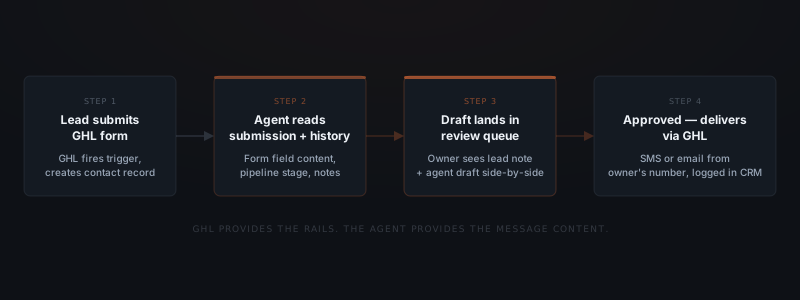
When a new lead arrives, the agent reads the form submission and any message content the lead included. The agent drafts a follow-up that addresses the specific details: the question asked, the service mentioned, the concern flagged. That draft lands in a review queue. The business owner or manager sees the lead's original submission alongside the agent's draft. One click approves it. The message delivers from the owner's own phone number or email, through GHL's communication layer, and GHL logs the send against the contact record.
The same process runs throughout the nurture sequence. When a lead replies, the agent reads the reply and the full conversation history, then drafts the next response. When a lead goes quiet, the agent queues a follow-up calibrated to the silence duration and the last topic discussed. When a lead books but doesn't show, the agent queues a recovery message based on the contact record.
GHL provides the infrastructure: the contact management, the pipeline stages, the messaging rails. The AI agent provides the intelligence layer: reading context, drafting content, and routing every output through human review before it delivers.
Lead follow-up that reads what the lead actually wrote
Lead follow-up is the highest-volume, highest-stakes workflow for most GoHighLevel service businesses. A med spa running paid ads generates 40–80 inquiries per month. An HVAC company doing local SEO sees leads arrive throughout the week at hours when no one is near a phone. An insurance brokerage fields requests that each require an individual response to move toward a quote.
The gap in each case is the same: GHL runs the sequence, but every step of the sequence says the same thing to every lead.
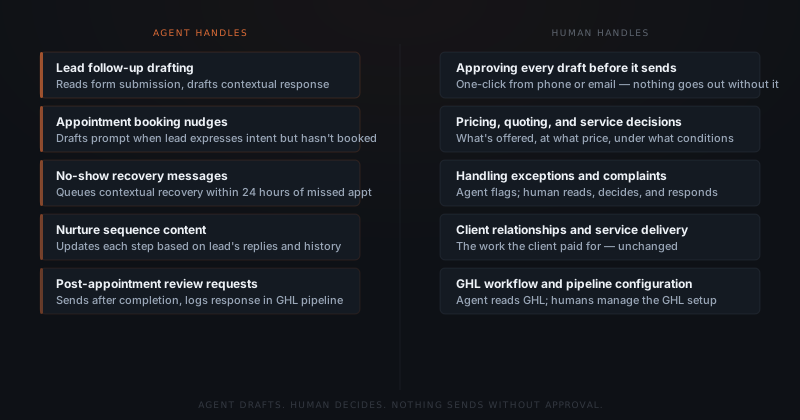
An AI agent changes the content of each step, not the timing. The cadence still comes from GHL's workflow. The agent provides the message content — reading each lead's form submission, any existing contact history, and the current pipeline stage, then drafting the next outbound message accordingly.
For a med spa: a lead fills out an inquiry form on a Tuesday evening. The lead writes that it is their first Botox treatment and they are nervous about the process. The agent reads the specific concern. The follow-up it drafts for next morning addresses the nervousness directly — what the first consultation involves, that the provider walks through the procedure beforehand, that first-time clients typically share that same feeling going in. The lead receives a message that sounds like someone at the practice read what they wrote. Because someone did — the agent drafted it, and the practice owner approved it.
For an HVAC company: an emergency repair request arrives at 11 PM. The lead writes "pipes frozen, flooding the utility room." The agent reads that description and flags for immediate human review rather than queuing the standard next-morning follow-up. The owner gets an alert. An appropriate response goes out within minutes from the owner's number via GHL.
The agent doesn't decide which situations warrant a flag — the owner sets the rules for escalation, urgency thresholds, and approval timing at implementation. The agent handles the reading, drafting, and routing.
Appointment booking and no-show recovery
Service businesses using GoHighLevel for appointment management face two failure modes: leads who express interest but don't book, and leads who book but don't show.
GHL's booking workflows push leads toward a calendar link. The agent adds the conversion layer between intent and action: reading when a lead has responded positively without completing a booking, drafting the message that moves them from interest to scheduled appointment, and following up when a calendar link was opened but no booking was confirmed.
GHL's automations run on triggers and templates — the same output regardless of what the lead said. An AI agent reads the conversation history and drafts a response that matches the specific situation. That distinction determines whether a follow-up feels like outreach or like spam.
No-show recovery is where agent implementations for GHL businesses typically produce the most visible early return. Appointment no-show rates in service categories — aesthetics, health and wellness, insurance consultations, home services — average 15–30% depending on the vertical.[²] Each no-show is a slot that can be offered to someone else or a booking that can be recovered with the right outreach.
Most GoHighLevel setups handle no-shows with a generic "we missed you" template or nothing at all. An agent handles no-show recovery with context. The agent reads the lead's history — first appointment or returning client, payment completed or not, the reason for the appointment — and drafts a recovery message appropriate to that record. A first-time no-show who opened the appointment reminder gets a different message than a returning client who has no-showed before. Every recovery draft goes to the owner for approval before sending.
Recovery rates for contextual no-show outreach in service businesses run 20–40% of no-show volume when messages go out within 24 hours of the missed appointment.[²] For a business running 50 appointments per month and losing 8–12 to no-shows, recovering 2–4 of those bookings is measurable revenue from messages that were not being sent before the implementation.
GHL tells the system when to reach out. The agent determines what to say when the moment arrives.
What the agent connects to in a GHL setup
An AI agent built on a GoHighLevel stack reads from GHL through GHL's API and writes back through the same connection. The agent accesses contact records, conversation history, pipeline stages, tags, and calendar data. Approved messages push back through GHL's communication infrastructure — SMS, email, or direct message depending on the contact's configured channel. GHL logs every outbound message against the contact record as usual.
| Tool category | Common platforms | What the agent reads or writes |
|---|---|---|
| GHL CRM | GoHighLevel | Contact records, conversation history, pipeline stage, tags |
| GHL Calendar | GoHighLevel | Appointment status, no-show detection, booking confirmation |
| Gmail, Outlook | External email drafts for contacts outside GHL's SMS rail | |
| Quoting / intake | Jobber, ServiceTitan, agency tools | Service history, quote status, job details for context |
| Accounting | QuickBooks, Xero | Invoice aging for payment follow-up workflows |
For businesses using GHL as their primary CRM and communication platform, the integration is straightforward. The agent reads from GHL and writes back to GHL. The existing pipeline stages, automation workflows, and tags all continue to operate as configured — the agent adds a contextual drafting layer on top of the automations, not a replacement for them.
External integrations expand the agent's context where the business needs it. An HVAC company with a service ticket system can give the agent access to job history — the agent knows what equipment was serviced and when, and references it in the follow-up. An insurance brokerage using a quoting tool can route quote data to the agent — the follow-up after a sent quote references the specific coverage amount and the client's stated concern.
See how to know if a business process is ready to hand to an AI agent for a framework on evaluating which specific workflows in your GHL setup are ready for agent implementation.
Implementation: what goes live and how fast
GoHighLevel service business implementations start with the workflow that has the highest volume and the largest gap between what's currently happening and what should happen. For most GHL businesses, that's lead follow-up — the window between form submission and first contextual response. For others, it's appointment confirmation and no-show recovery.
Scoping call
Map the highest-volume workflows — typically lead intake follow-up and no-show recovery. Confirm which GHL data fields the agent needs to read, and which message types require immediate escalation versus queued review.
GHL API integration
Connect the agent to GHL's API: contact records, conversation history, pipeline stages, and calendar. Confirm the review queue channel — most owners use SMS or a Slack message for draft approvals.
Baseline templates
Draft the starting templates for each workflow — the initial follow-up message, the nurture steps, the no-show recovery, the booking nudge. The owner reviews and edits each one until the phrasing matches how the business actually communicates.
Review flow setup
Define who approves, through which channel, and how fast. Set the escalation rules for high-urgency leads. The owner approves from their phone — one tap sends the draft as-is, or they edit before sending.
Go-live and calibration
The first workflow goes live. The owner reviews every draft for the first two weeks and flags any response that doesn't fit the situation. The agent calibrates based on corrections. Accuracy on well-defined scenarios typically reaches 90%+ within the first two weeks.
A standard implementation covering lead intake follow-up, appointment nudges, and no-show recovery goes from scoping call to first live messages in two to three weeks. The primary time investment is the review flow setup and the baseline template drafts — not the technical connection to GHL's API.
Adding workflows after go-live — win-back sequences for leads who went quiet, post-appointment review requests, renewal outreach for existing clients — typically takes three to five days per workflow once the base integration is stable.
GoHighLevel serves over 300,000 businesses, primarily SMBs and agencies.[³] The businesses that get the highest return from the platform are not necessarily those with the most automations. They are the ones that have solved what goes into the messages those automations send. An AI agent handles that content layer — reading what leads actually write, drafting responses that address it, and routing every draft through the owner before anything reaches a customer.
For a practical overview of the implementation process and timeline, see the AI agent implementation timeline guide. For the complete picture of what appointment booking automation covers, see AI agent for appointment booking.
Frequently asked questions
Can AI agents integrate with GoHighLevel? AI agents integrate with GoHighLevel through GHL's API, reading contact records, conversation history, pipeline stages, and calendar data. The agent drafts outbound messages based on that context and routes each draft to a review queue. The owner approves from phone or email, and the approved message delivers through GHL's communication layer — SMS or email — and is logged against the contact record in GHL.
What is the difference between GHL automations and AI agents? GoHighLevel automations run on triggers and templates: the same trigger always produces the same output regardless of what the lead said or did between steps. An AI agent reads the lead's conversation history, form submission content, and pipeline context, then drafts the next message based on that specific record. GHL fires the sequence at the right time. The AI agent determines what the next message in that sequence should actually say.
How does an AI agent improve lead follow-up in GoHighLevel? An AI agent improves GHL lead follow-up by reading what each lead wrote in their form submission and any subsequent messages, then drafting a contextual response rather than sending a template. Companies that contact leads within the first hour are 7x more likely to qualify the lead.[¹] GHL solves the timing. The AI agent solves the content quality — making each outbound message specific to that lead's stated situation.
What does a GoHighLevel AI agent implementation cost? A standard implementation covering lead intake follow-up, appointment nudges, and no-show recovery for a GHL service business typically runs $1,500–$4,000 for the initial build, depending on the number of workflows and integrations beyond GHL's core API. Monthly API operating costs at typical GHL business volumes run under $100. See what AI agent implementation actually costs for a small business for a full breakdown.
Notes
- Oldroyd, James B., Kristina McElheran, and David Elkington. "The Short Life of Online Sales Leads." Harvard Business Review, March 2011. https://hbr.org/2011/03/the-short-life-of-online-sales
- Dantas, Leandro F., et al. "No-shows in appointment scheduling — a systematic literature review." Health Policy, 2018. https://www.sciencedirect.com/science/article/pii/S0168851018300398
- GoHighLevel company announcements and press coverage. GoHighLevel reported crossing 300,000 businesses on its platform in 2024. https://www.gohighlevel.com/