AI agent pilots almost always succeed. The inputs are curated, the most engaged person on the team runs the workflow, and everyone is paying close attention. Those conditions do not exist in the real workflow. The gap between pilot success and six-month adoption is where most implementations stall — not because the technology failed, but because pilot conditions were never the real operating conditions.
What a pilot is actually designed to test
An AI agent pilot tests whether the technology can produce the correct output when given ideal inputs. A pilot typically runs for two to four weeks. The person running the pilot is the most engaged member of the team. The inputs are selected or cleaned before entering the workflow. Everyone involved knows the pilot is being evaluated.
These conditions produce success. These conditions are also not representative of any real AI agent workflow.
A real workflow receives inputs that arrive inconsistently — CRM records with missing fields, emails with ambiguous subject lines, invoices with duplicate entries. A real workflow runs in the background while the team handles other work. Nobody checks the output queue daily after month two.
A pilot cannot replicate these conditions because the pilot team prevents them. The test is structurally biased toward success.
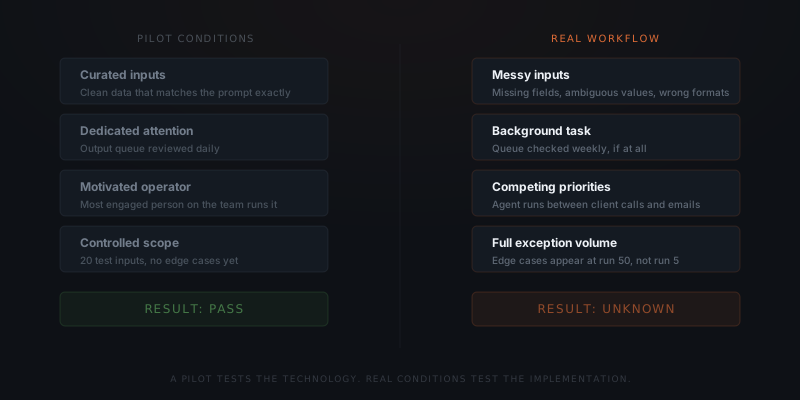
Pilot conditions vs real conditions
The gap between a pilot and a live implementation is structural, not accidental. The table below maps the differences across seven dimensions that determine whether an agent survives real operating conditions.
| Dimension | Pilot conditions | Real workflow conditions |
|---|---|---|
| Input quality | Curated or cleaned before entering the workflow | Whatever arrives — missing fields, formatting variations, edge cases |
| Input volume | 20–50 test records | Hundreds to thousands per month |
| Operator attention | Dedicated daily review of every output | Queue checked weekly or when something goes wrong |
| Operator motivation | Most engaged person on the team running the test | Regular team member handling as one of many tasks |
| Exception exposure | Edge cases excluded from test inputs | All exceptions appear at volume |
| Review consistency | Every output reviewed before sending | Only outputs that seem unusual get manual review |
| Time horizon | 2–4 weeks with close monitoring | 6–12 months with gradually reducing attention |
Every row in this table represents a condition a pilot cannot replicate — and every row represents a mechanism by which a pilot-passing implementation fails after go-live. The implementation that passes the right side of this table will survive. The implementation validated only by the left side is an unknown quantity.
What go-live reveals that a pilot cannot
The inputs that surface after go-live differ from pilot inputs in predictable ways. CRM records entered by different team members use different formats. Emails from long-term clients reference internal shorthand the agent was not briefed on. Invoice records from newer clients use field names that don't match the original integration configuration.
These inputs don't fail catastrophically — they produce outputs that are almost right. Almost-right outputs that go unreviewed accumulate. The queue fills with drafts that need editing before they can send. Reviewing them takes longer than writing the original email. The agent gets turned off.
This pattern — successful pilot, gradual abandonment between months one and three — is the most common outcome for implementations that were never evaluated past the pilot stage. Why most AI agent projects stall after ninety days covers the structural reasons in detail. The pilot problem is one of the primary contributors.
Pilot inputs are curated — the test run uses data that matches the prompt exactly. Real workflows contain the messy inputs, exception paths, and edge cases that only appear at volume. A pilot cannot surface these conditions, and pilot success is not evidence they don't exist.
What to evaluate instead of running a pilot
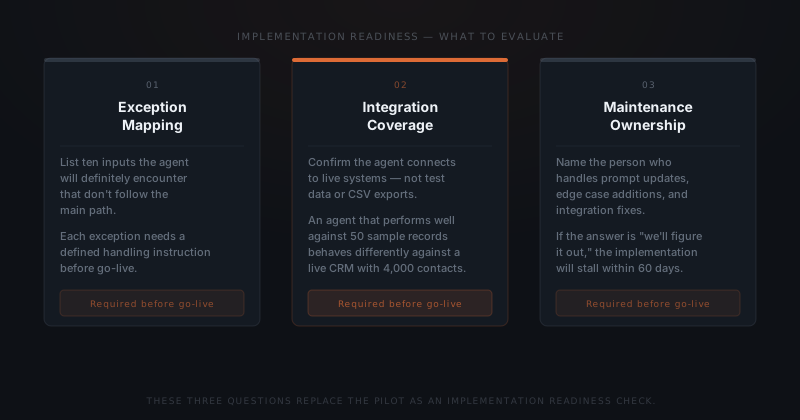
Three questions answer whether a workflow is ready for implementation. None of them require a pilot.
Exception mapping. Identify the ten inputs the agent will definitely encounter that don't follow the main path. For a CRM follow-up agent: contacts with incomplete records, contacts tagged as pending, contacts at two stages simultaneously. Each exception needs a defined handling instruction before go-live. If the exception cannot be defined, the process is not ready.
Integration coverage. Confirm the agent connects to live systems — not test data or CSV exports. An agent that performed well against 50 sample records behaves differently against a live CRM with 4,000 contacts and five years of inconsistent entry formats. Test against live data from day one.
Maintenance ownership. Name the person who handles prompt updates when business language shifts, edge case additions as new exceptions surface, and integration fixes when connected systems update. If the answer is "we'll figure it out," the implementation will stall at the first maintenance event — typically within sixty days of go-live.
A pilot proves the agent can work. Go-live reveals whether it does.
How to run a meaningful test before go-live
A meaningful pre-launch test does not look like a pilot. It looks like a shadow mode run against real conditions.
Shadow mode means the agent processes live inputs but does not send outputs. Instead, outputs are queued for review by the implementation team before any action is taken. The agent encounters the real inputs — the CRM records with missing fields, the emails from long-term clients with internal shorthand, the edge cases that only appear at volume. The outputs are evaluated before they affect any client or record.
Shadow mode testing for two to three weeks before go-live surfaces: the edge cases the scoping phase missed, the integration fields that don't map correctly to live data formats, and the exception volume the prompt's fallback conditions need to handle. These discoveries happen before any output reaches a client — which is the right time to find them.
After shadow mode testing, the brief is updated to handle the patterns identified, the integration mappings are corrected, and the exception handling is refined. Then the system goes live — not as a controlled pilot, but with the real-conditions validation already done.
A shadow mode run requires the same technical setup as full deployment. The only difference is that outputs are held for review before sending. This is not significantly more work than a pilot — and it produces information a pilot cannot.
How to read a pilot result correctly
A successful pilot answers one question: can this technology produce the correct output when given ideal inputs in a controlled environment? That question has a useful answer. That answer is not the deciding question.
The deciding question is whether the workflow will survive real operating conditions — messy inputs, reduced attention, maintenance overhead, exception volume. A pilot cannot answer that question because a pilot does not replicate those conditions.
A pilot result of "it worked" should be read as: the technology is capable of producing the correct output. The follow-on question is whether the process is documented well enough, the integrations connect to live data, and maintenance is assigned to a named person. Those three factors determine adoption. The pilot determines capability.
An implementation built on those three foundations survives go-live. An implementation built on pilot success alone usually doesn't reach month three.
Frequently asked questions
Why do AI agent pilots almost always succeed?
AI agent pilots succeed because the conditions are controlled. Inputs are curated or cleaned before entering the workflow. The person running the pilot is the most motivated team member. Everyone knows the pilot is being evaluated, so output review is thorough. These conditions are not representative of real operating conditions, which include messy inputs, background execution, and reduced attention. Pilot success indicates the technology works — not that the implementation is ready.
What does go-live reveal that a pilot cannot?
Go-live reveals real input quality — CRM records with missing fields, emails with ambiguous content, data entered by different team members in different formats. Go-live reveals edge case volume — the exceptions that never appeared in twenty pilot runs appear at run fifty. Go-live reveals maintenance reality — who updates the prompt when business language shifts, and how quickly. None of these surface during a two-week pilot with curated data.
What should be evaluated instead of running an AI agent pilot?
Three evaluations replace the pilot: exception mapping (identify the ten inputs the agent will encounter that don't follow the main path, and confirm each has a handling instruction), integration coverage (confirm the agent connects to live systems rather than sample data), and maintenance ownership (name the person responsible for prompt updates, edge case additions, and integration fixes). These questions reveal implementation readiness — which a pilot cannot.
When does an AI agent pilot have value?
A pilot is useful as a proof of technology — confirming that the underlying model can produce the correct output type for a given workflow. That question is typically answerable faster than a two-week pilot. A pilot has less value as a readiness assessment, because pilot conditions don't replicate real workflow conditions. The implementation design — exception handling, live integration, maintenance plan — determines go-live outcomes. Pilot performance does not.
What is shadow mode testing for an AI agent?
Shadow mode testing runs the agent against real live inputs — the actual CRM records, the actual incoming emails, the actual data the workflow processes — but holds all outputs for review before any action is taken. The agent encounters real edge cases and inconsistent data formats, but no client is affected while the outputs are being reviewed. After two to three weeks, the patterns identified (missing exception handling, incorrect field mapping, edge cases the brief did not anticipate) are addressed before full deployment. Shadow mode is the most accurate available proxy for real operating conditions.
What causes an implementation that passed a pilot to fail after ninety days?
Three mechanisms drive the gap between pilot success and ninety-day stall. First, edge case volume: exceptions that never appeared in twenty pilot runs start appearing at run fifty and beyond — and the agent's handling instructions for those cases were never written. Second, input quality degradation: as the implementation owner's attention moves elsewhere, curation stops and real inputs (with all their inconsistencies) start flowing through. Third, maintenance absence: the person who ran the pilot returns to regular work, and nobody is assigned to update the prompt when business language shifts. Each mechanism is avoidable — with shadow mode testing, documented exception handling, and a named maintenance owner.
How should a business interpret a vendor's pilot results?
Ask three questions. First: were the inputs curated or cleaned before entering the workflow? If yes, the pilot tested ideal conditions — which are not the business's real conditions. Second: did the pilot run against live data or test data? Live data reveals integration issues that test data cannot. Third: what was the exception rate — how many of the pilot inputs required human handling rather than being processed automatically? A pilot with a 5% exception rate on curated data may have a 25% exception rate on live data. The answers to these questions determine whether the pilot is evidence of readiness or evidence of technology capability under favorable conditions.
Notes
The 90-day adoption pattern described in this post is also analyzed in Why Most AI Agent Projects Stall After Ninety Days.