
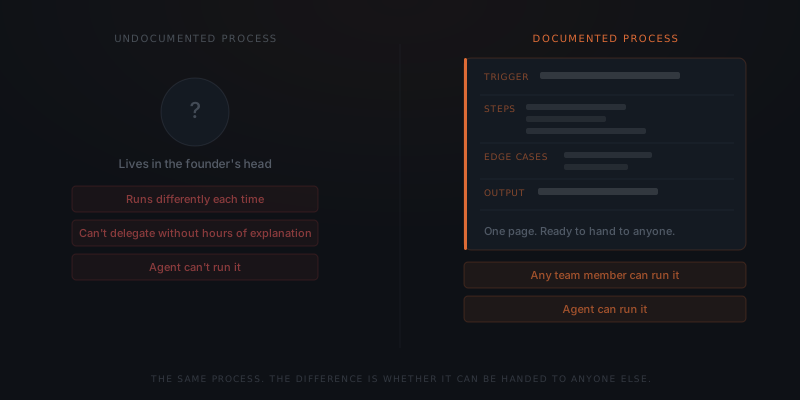
Most business processes that founders call too complex for AI are not complex — they are undocumented. The process exists in the founder's head, runs differently depending on who handles it, and cannot be handed to anyone without hours of explanation. Once written down with a trigger, numbered steps, and edge cases, the same process becomes implementable by an agent, a new hire, or a contractor.
"Too complex" almost always means "undocumented"
The first question in every implementation scoping call: walk me through the process. The answer is usually a 10-minute explanation with branches, exceptions, and "it depends on the client." The process is not in a document anywhere. The process lives in the founder's head and runs differently every time someone else attempts it.
That is not a complexity problem. That is a documentation problem. McKinsey's 2024 State of AI survey found that organizations citing AI implementation as "too complex" were more likely to lack defined process ownership than to face genuine technical barriers — the complexity described was organizational and documentation-related, not algorithmic.[¹]
Any process an employee could follow from a detailed one-page description can be handed to an AI agent. The threshold is the same. A process that exists only as institutional knowledge — carried in one person's memory — cannot be delegated to anyone, human or AI, without documentation first.
The founders who move fastest through implementation are the ones who arrive at the first call with a written version of the process, however rough. The implementation does not slow down because the process is complex. The implementation slows down when the process has to be reconstructed from scratch in every conversation.
What documentation an agent implementation actually requires
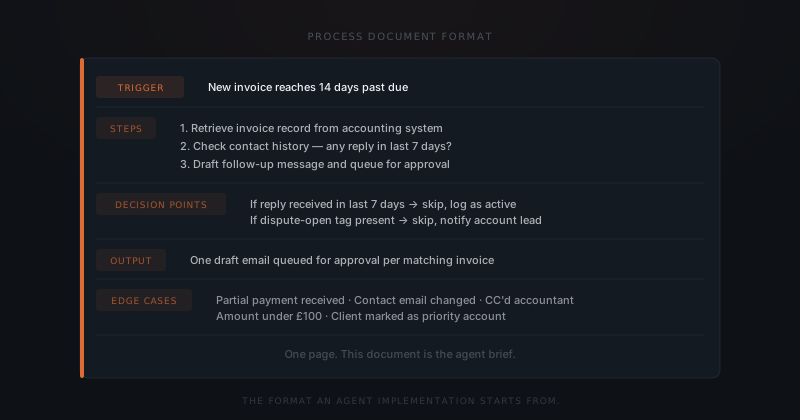
An agent does not need a flowchart or a specification document. An agent needs the process in five components on one page.
Trigger. What starts the process? A new CRM entry, an unpaid invoice reaching 14 days past due, a project milestone marked complete. One sentence.
Steps. Numbered actions in order. Not prose — a numbered list where each line is one action.
Decision points. Where does the process branch? "If the client responded within 48 hours, continue to step 3. If not, go to step 6." These are the conditionals the agent uses to route between paths.
Output. What does a completed run produce? One draft email, one CRM field updated, one Slack message queued. Defined and specific.
Edge cases. Five to ten situations that don't follow the main path. Not exhaustive — the most common exceptions. "If the contact has a 'do not email' flag, skip and log."
The difference between complex and undocumented
The distinction between a complex process and an undocumented process matters because the fix is different. A complex process has many documented components — and each one is implementable. An undocumented process has no components, because it was never written down.
| What it looks like | Undocumented process | Complex but documented process |
|---|---|---|
| Can a new hire run it from a written description? | No — requires explanation or shadowing | Yes — all branching rules are described |
| Is the trigger consistent? | "It depends" is the trigger | One specific, observable event starts the process |
| How are edge cases handled? | Case by case, by whoever handles it | Named and assigned to specific response paths |
| What does implementation require? | Documentation first, then build | Build can start immediately |
| How long does the build take? | Timeline extends until documentation is done | Timeline starts from documentation on hand |
The fastest implementations are not the ones with simple processes. They are the ones with documented processes, regardless of step count or exception volume. A twelve-step process with six documented edge cases builds faster than a three-step process with three undocumented ones.
How to handle a process with many exceptions
Many exceptions do not make a process too complex for an agent. Many undocumented exceptions do. The distinction determines the implementation path.
Map the exceptions before briefing, not during the build. Before the build starts, go through the last forty to fifty instances of the process and flag every one handled differently from the standard path. Sort them by frequency. The five most common exceptions are the ones that belong in the agent brief. The rare ones — five or fewer instances in six months — belong in the exception handler (flagged for manual review) rather than the main flow.
Name each exception precisely. An exception is not a vague category — it is a specific, testable condition. "VIP clients" is not an exception. "Contacts with the CRM field 'Account tier' set to 'Enterprise'" is an exception. The agent can check for a specific field value. The agent cannot check for vibes.
Assign each exception to one of three paths. For each named exception: handle it differently (the agent applies specific logic), skip it and flag for manual review (the agent recognizes the exception and escalates), or exclude it from scope entirely (the agent ignores these inputs and they flow through the manual process unchanged). Every exception should be assigned to one of these paths before the build starts.
Why complex processes often implement faster than simple ones
A recruiting follow-up process with twelve steps and four decision points implements faster than a vague "client check-in that depends on the relationship." The reason: explicit complexity is easier to brief than hidden variation.
Complexity is not what slows implementation. Missing edge-case definitions are. A process with documented exceptions gives the agent clear handling instructions for every scenario. An undocumented "simple" process produces unexpected outputs every time a variant appears.
Processes that founders describe as complex — with branching logic, multiple stakeholders, or time-sensitive decisions — usually have clearer rules than they appear to. The founder knows exactly what to do in each case. The problem is that nobody has written it down.
A 12-step process with documented decision points and five known edge cases is faster to implement than a 3-step process with six undocumented exceptions that only the founder knows how to handle. The agent does not struggle with complexity. The agent struggles with ambiguity.
No process is too complex for an agent. Most processes are too undocumented for one.
How to test whether a process is ready
One test. Write the process on one page in the format above — trigger, steps, decision points, output, edge cases. Then ask: could a new hire run this correctly on their first day, using only this document?
If yes: the process is ready for an agent brief.
If no: the missing piece is the documentation, not the technology. The work is to identify what that new hire would need to learn and write it down. That document is the agent brief.
The businesses that move fastest through implementation are not the ones with the simplest processes. The businesses that move fastest are the ones who documented their process before the first call. That documentation replaces weeks of clarification back-and-forth with a clear starting point.
Frequently asked questions
Why do founders think their process is too complex for AI?
Founders describe a process as too complex when it has many exceptions, requires judgment, or varies by client. In most cases, the same process would also be difficult to hand to a new hire — because it has never been documented. The complexity is not inherent to the process. The complexity reflects that nobody has written down the steps, decision points, and edge cases yet.
What does an AI agent implementation need from a business process?
An agent implementation needs five things on one page: the trigger that starts the process, numbered steps in order, decision points showing if/then branches, the defined output, and a list of known edge cases. This format is comparable to what a new hire would need to run the process independently on day one. A one-page document in this format is usually sufficient to begin implementation.
What makes a process genuinely hard to implement as an agent — if not complexity?
Two things create genuine implementation difficulty: inaccessible data and undefined edge cases. If the process requires data that cannot be reached via integration — information locked in a PDF inbox, a system with no API, or a tool that requires human judgment to parse — the integration work increases. If the process has many undocumented exceptions, those need to be mapped before the agent can handle them. Neither is a permanent barrier.
How long does it take to document a process for agent implementation?
For a well-understood process the founder runs regularly, one focused hour produces a usable first draft. The trigger, steps, and output are usually clear. Decision points take the most time — identifying all the if/then branches the founder navigates intuitively. A 90-minute documentation session before the first implementation call typically replaces two to three weeks of clarification back-and-forth during the build phase.
What should you do with a process that has forty exceptions?
Sort them by frequency and document the top ten. The top ten exceptions almost always account for 90% of the variance. Brief the agent on those ten. The remaining thirty can route to an exception handler — a defined path where the agent recognizes it cannot handle the input and flags it for manual review. After the agent has been running for thirty days, review the exception log and identify which of the remaining thirty are appearing frequently enough to add to the brief.
What is the difference between an agent that cannot handle a process and an agent that needs a better brief?
An agent that mishandles a process is almost always missing documentation in the brief, not capability. If the agent is consistently producing incorrect outputs for a specific input type, that input type was either not included in the brief or the brief's instructions for it are ambiguous. The fix is to document that input type precisely and update the brief — not to replace the agent or assume the process is too complex. An agent built on a clear, complete brief handles nearly any process a documented human procedure can describe.
When does a process genuinely need redesign before it can be automated?
When the process is inconsistent by design — when it is supposed to be decided case by case, with no repeatable rules. Some processes require relationship judgment that changes with each situation: whether to push for a signature this week or wait, which client to prioritize when two deadlines conflict, how to phrase a difficult piece of feedback. These are not processes with hidden rules that need documenting. They are decisions, and decisions require a decision-maker. The right role for an agent is to prepare the input for that decision, not make it.
Notes
- McKinsey & Company. "The State of AI in 2024." McKinsey Global Survey, May 2024. https://www.mckinsey.com/capabilities/quantumblack/our-insights/the-state-of-ai