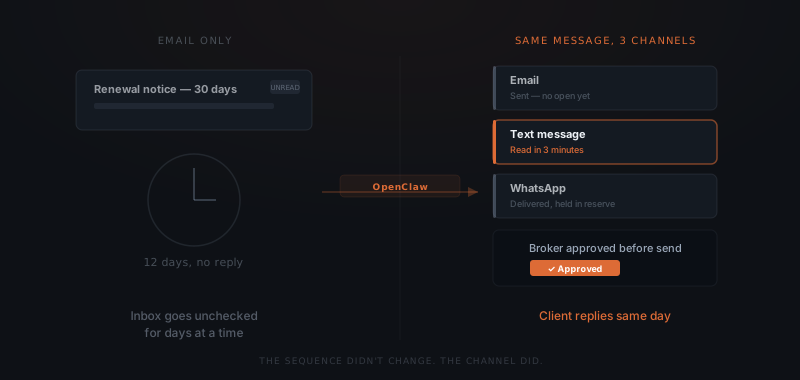
A commercial client's renewal notice goes out by email at the 30-day mark. The client hasn't opened an email from the brokerage in eight months — every renewal, every document request, every account update goes to an inbox that gets checked once a week, if that. OpenClaw runs the same renewal sequence over email, text, or WhatsApp, matched to the channel the client reads. Every message still queues for broker approval before it sends.
A commercial client's general liability policy renews in 90 days. OpenClaw sends the first notice by email — the address on file, the same one the AMS has used for six years. No open. At 60 days, the second notice goes out. Still no open. The client hasn't read an email from the brokerage since a claim two years ago. Every renewal, every document request, every account update has been landing in an inbox nobody checks. OpenClaw reads that pattern and, at day 30, sends the same broker-approved message by text instead. The client replies in four minutes.
Renewal emails don't fail because they're late. They fail because they're email.
Independent brokerage renewal rates average 84–87%, according to McKinsey's insurance research.[2] The lapses that pull that number down are not, in most cases, a pricing problem or a service failure. They are a delivery problem: the renewal sequence assumes the client reads email on a cadence that matches the brokerage's, and for a growing share of clients, that assumption is wrong.
Text messages get opened 98% of the time, usually within three minutes of delivery.[1] Email hovers at a 20–30% open rate, and that figure is inflated — tracking pixels get blocked, previews get pre-fetched, and "opened" doesn't mean read.[1] A brokerage running its entire renewal cadence through one channel is betting the whole sequence on whichever channel that client happens to check.
OpenClaw does not replace the renewal cadence a brokerage already runs — the 90/60/30/14-day sequence, the document requests, the claims status updates. OpenClaw sends that exact sequence over whichever channel the client's contact history shows gets a response, and every message still queues for broker approval before it sends. Nothing in the cadence changes. Where it lands does.
For a five-person brokerage with 300–500 active policies, that channel mismatch compounds across the book. Salesforce's 2024 State of Financial Services report found financial services professionals spend 67% of their time on non-revenue work — admin, tracking, and communication that produces no new business by itself.[3] Resending the same unread notice, calling to confirm a client got the email, chasing a reply that never comes — none of that is advisory work. It's the cost of a channel that isn't reaching the client.
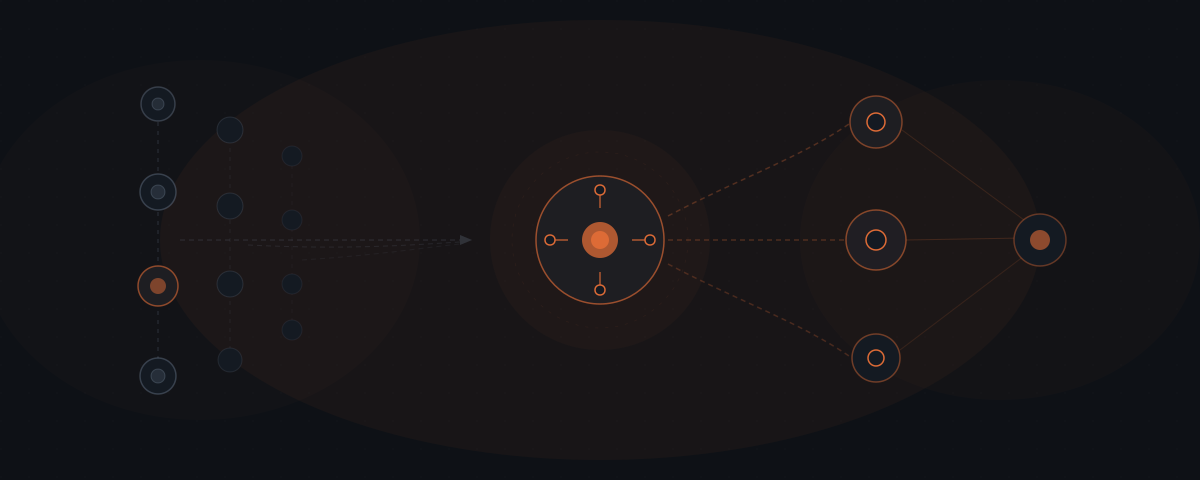
OpenClaw runs the renewal cadence across email, text, and WhatsApp
OpenClaw connects to the AMS for the policy register and expiry dates, and to email, SMS, and WhatsApp Business for outbound communication. When a policy enters the renewal window, OpenClaw drafts the touchpoint message from the brokerage's existing templates and sends it over the channel the client's history shows gets a response — the same address or number already on file, no new client onboarding required.
If a client has replied to text messages in the past but never opened a renewal email, OpenClaw routes future renewal messages to that number. If a client has only ever corresponded by email, OpenClaw keeps using it. The channel decision comes from actual contact history in the AMS, not a guess.
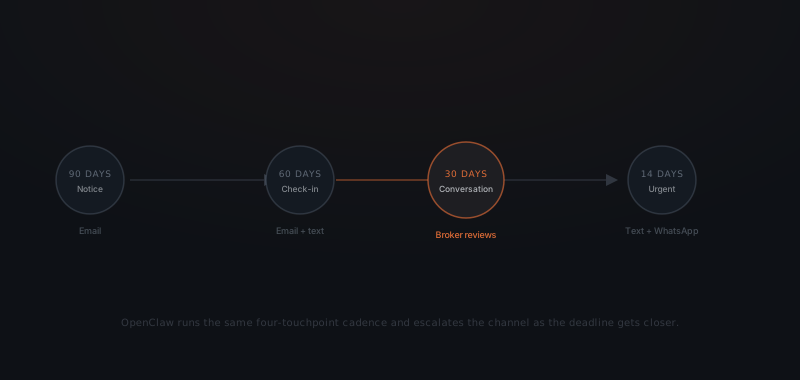
| Days before expiry | Message purpose | Channel OpenClaw uses | Escalation |
|---|---|---|---|
| 90 days | Informational notice | Client's primary channel on file | None |
| 60 days | Check-in, confirm awareness | Primary channel, or email + text if no reply | None |
| 30 days | Conversation request | Escalates to text or WhatsApp if email unread | Flag to broker if no reply within 5 days |
| 14 days | Urgent, time-sensitive | Text and WhatsApp, regardless of prior channel | Escalate to broker immediately |
The escalation logic matters more than the channel itself. A client who hasn't opened the 90-day or 60-day email gets the 30-day message by text automatically — OpenClaw doesn't wait for the broker to notice the pattern and switch channels by hand. By 14 days, every client gets the urgent notice by text or WhatsApp regardless of what channel worked before, because the cost of a missed renewal at that point outweighs the cost of one extra message.
What OpenClaw handles beyond the renewal cadence
Renewals are the highest-stakes sequence, but the same multi-channel approach applies to the rest of a brokerage's recurring client communication.
Document and certificate requests. A client emails asking for a certificate of insurance. OpenClaw reads the request, pulls the document from the AMS, and drafts a reply — over email, since that's the channel the request arrived on. If the client doesn't respond to confirm receipt within a defined window, OpenClaw follows up by text.
Claims status updates. Clients with an open claim want regular updates without having to call and ask. OpenClaw sends status updates at defined intervals. For clients who've shown a pattern of not checking email during an active claim — a common pattern, since claims are stressful and inboxes pile up — OpenClaw defaults to text for the duration of that claim.
Application follow-up. New business applications generate back-and-forth with underwriters and applicants. OpenClaw manages the communication cadence on outstanding items and escalates to the broker when a response is overdue, using the channel the applicant has been most responsive on so far.
Which tools OpenClaw connects to in a brokerage's stack
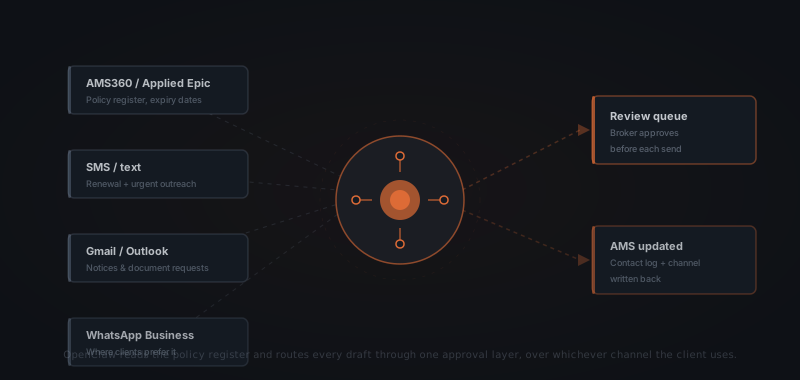
Agency management systems. AMS360, Applied Epic, HawkSoft, EZLynx, and Vertafore connect for policy data, expiry dates, and contact history. After each approved message, OpenClaw writes the channel used and the response status back to the client record, so the next touchpoint reads an accurate history.
Email. Gmail and Outlook connect via OAuth. OpenClaw drafts and sends from the broker's own address for message types where email is the client's established channel.
SMS. A dedicated business number connects through a messaging provider. OpenClaw sends and receives texts from that number, and logs every exchange back to the AMS.
WhatsApp Business. For brokerages with clients who prefer WhatsApp — common in commercial accounts with international contacts — OpenClaw connects through the WhatsApp Business API for renewal and document messages.
Slack or Teams. Internal approval notifications route here. The broker gets a message with the draft, the chosen channel, and a one-click approve.
Platforms outside this list connect with custom integration work, but a well-scoped first implementation covers the AMS the brokerage already runs plus the two or three channels its clients use. Adding channels the client base doesn't use delays go-live without adding response rate.
What the licensed broker retains
It's not that clients ignore renewal emails. They never see them.
OpenClaw picks the channel and drafts the message. The broker makes every decision that requires licensed judgment or a relationship call.
| Task | OpenClaw | Licensed broker |
|---|---|---|
| Renewal sequence drafting and channel selection | ✓ | |
| Document and certificate request handling | ✓ | |
| Claims status update drafts | ✓ | |
| Contact history logging across channels | ✓ | |
| Message review and send approval | ✓ | |
| Coverage advice and recommendations | ✓ | |
| Binding and endorsement decisions | ✓ | |
| Claims advocacy with carriers | ✓ |
Every message OpenClaw drafts — regardless of channel — sits in a queue until a named broker approves it. Text and WhatsApp don't bypass review because they're faster; they go through the same approval step as email. The channel changes where the message lands. It does not change who signs off on it before it goes.
Coverage decisions, binding actions, and disclosure obligations stay with the broker in every case. OpenClaw surfaces the renewal conversation at the right moment on the right channel — it does not have the licensing or the client context to recommend a coverage change or make a binding statement. For the broader breakdown of what an agent handles versus what stays with the broker across the full renewal and admin workload, see AI agents for insurance brokers.
Where multi-channel renewal sequences go wrong
Four mistakes account for most of the failed multi-channel deployments in a brokerage.
Texting a client who never opted in. SMS marketing and transactional texts carry consent requirements — a client who gave an email address at intake did not automatically agree to receive text messages. Before OpenClaw sends the first text to any client, the brokerage needs an opt-in on file, even if that opt-in is as simple as a reply to an initial "can we text you?" message. Skipping this step trades a renewal problem for a compliance problem.
Escalating every client to text by day 14, including the ones who asked for email only. A subset of clients — often larger commercial accounts with a designated risk manager — explicitly prefer email for the audit trail it creates. Applying the same day-14 escalation rule to that segment reads as ignoring a stated preference. The escalation rule needs a client-level override, not just a book-wide default.
Contact history not synced across channels. If the AMS logs the email touchpoint but the SMS platform logs replies separately, a client can receive the same renewal notice twice — once by email, once by text, a day apart. The fix is a single source of truth for contact history: every channel writes back to the same AMS record, so the next touchpoint in the sequence reads one accurate log, not two partial ones.
Treating WhatsApp as a low-stakes channel for regulated content. A message discussing a coverage change, a binding decision, or a disclosure obligation needs the same audit trail regardless of channel. WhatsApp Business messages should log to the client record exactly like email does — a channel chosen for response rate cannot become a channel with a weaker compliance trail.
Setting up OpenClaw for a brokerage's renewal cadence
Export the policy register with contact channel history
OpenClaw needs expiry dates, contact details, and — critically — a record of which channel each client has responded on in the past. Most AMS platforms (AMS360, Applied Epic, HawkSoft) can export this. Without channel history, OpenClaw defaults to email for every client until a response pattern builds.
Connect email, SMS, and WhatsApp Business
Grant OpenClaw access to the brokerage's email inbox, a dedicated SMS number, and a WhatsApp Business account if the client base uses it. Scope access to outbound drafting and inbound reply detection only.
Define the escalation rule for each renewal touchpoint
Set the channel logic for 90, 60, 30, and 14 days: which channel to try first, when to escalate to a second channel, and what "no response" means at each stage. The 14-day touchpoint should default to the fastest channel regardless of prior history.
Set approval rules per message type
Decide which touchpoints require explicit broker review before sending and which can auto-send after a short review window. Renewal notices at 90 and 60 days are lower-risk; the 30-day conversation request and any message following a client reply should route through explicit review.
Run one book segment live for a full renewal cycle
Activate the multi-channel cadence for one segment of the book — personal lines or one commercial vertical — and track response rates by channel for a full 90-day cycle before expanding. The response data from that first cycle should confirm which channel mix moves the needle for that client segment.
A focused implementation covering the renewal cadence, document requests, and multi-channel routing goes from scoping call to first live renewal touchpoint in three to five weeks. For the full timeline from scoping to production, see what a real AI agent implementation involves. For how OpenClaw works as a channel gateway more broadly, see what is OpenClaw.
Frequently asked questions
What does OpenClaw do for an insurance brokerage? OpenClaw runs the renewal communication sequence — 90, 60, 30, and 14 days before policy expiry — plus document requests and claims status updates. OpenClaw sends each message over email, SMS, or WhatsApp, matched to the channel the client responds on, and holds every message in an approval queue before it sends. OpenClaw does not give coverage advice or make binding decisions.
Why would a brokerage add text messaging to its renewal sequence? Text messages get opened 98% of the time, usually within three minutes, compared to a 20–30% open rate for email.[1] A renewal notice sent only by email can sit unread for the full 90-to-30-day window on clients who don't check that inbox regularly. OpenClaw sends the identical, broker-approved message over whichever channel history shows the client reads.
Which agency management systems and channels does OpenClaw connect to? OpenClaw connects to AMS360, Applied Epic, HawkSoft, EZLynx, or Vertafore for the policy register and expiry dates, and to Gmail or Outlook, SMS, and WhatsApp Business for client communication. Slack or Teams handles internal approval notifications.
How long does it take to implement OpenClaw for a brokerage? A focused implementation covering the renewal cadence, document request handling, and multi-channel routing runs three to five weeks. The first two weeks map the AMS data and define channel rules per client segment. The remaining weeks cover channel connections, approval routing, and testing against live policies.
Notes
- SimpleTexting, "SMS Marketing Statistics 2026," SimpleTexting, 2026. https://simpletexting.com/blog/texting-and-sms-marketing-statistics/ — source for: SMS open rates of 90–98%, read within three minutes on average; email open rates of 20–30%.
- McKinsey & Company, "Insurance 2030 — The impact of AI on the future of insurance," McKinsey Global Institute, 2021. https://www.mckinsey.com/industries/financial-services/our-insights/insurance-2030-the-impact-of-ai-on-the-future-of-insurance — source for: independent brokerage renewal rates averaging 84–87%.
- Salesforce, "State of Financial Services 2024," Salesforce Research, 2024. https://www.salesforce.com/resources/articles/financial-services-trends/ — source for: financial services professionals spending 67% of time on non-revenue work.