
AI agents for insurance brokers monitor policy expiry dates, trigger renewal conversations at the right time, and handle the administrative requests that consume 40–50% of a broker's non-selling hours. Brokers using agents run renewal sequences across hundreds of policies simultaneously, respond to client document requests without manual intervention, and concentrate direct contact time on coverage advice and new business — the two activities that require licensed judgment.
A commercial client's general liability policy expires in 45 days. The broker intends to call. New business enquiries arrive. A claims question comes in from another client. Three days later, the 45-day mark passes. The renewal conversation happens at 20 days, under time pressure, with less room to present alternatives. Renewal rates at independent brokerages average 84–87%, according to McKinsey's 2023 insurance research.[¹] Most lapses are not lost to better products. They happen because the renewal conversation started too late — or didn't happen. An AI agent monitors policy expiry dates and initiates outreach at the right time. It keeps the conversation active until the broker is ready to advise — mechanical tracking paired with a handoff at the judgment point, which is what an AI agent is built to do in any structured workflow.
What insurance brokers spend time on that an agent can handle
Salesforce's 2024 State of Financial Services report found that financial services professionals spend 67% of their time on non-revenue work — admin, documentation, compliance tracking, and internal reporting.[²] For insurance brokers, that non-revenue layer includes renewal tracking, document requests, certificate generation, policy status updates, and application follow-up.
An AI agent does not replace the broker's advisory function. The agent handles the structured, repetitive layer: monitoring timelines, sending communications at defined intervals, collecting documents, and routing status updates. The broker focuses on coverage decisions, claims support, and new business — the work that requires licensed judgment.
McKinsey's analysis found that 25–30% of tasks at a typical brokerage are routine: data collection, communication, and status tracking that automation handles well.[¹] For a five-person brokerage with 300–500 active policies, that is a significant time recovery with no reduction in service quality.
An AI agent monitors policy dates and sends renewal communications. Coverage advice, binding decisions, and disclosure obligations remain with the licensed broker. The agent does not recommend coverage changes or make binding statements.
What an AI agent manages in a brokerage workflow
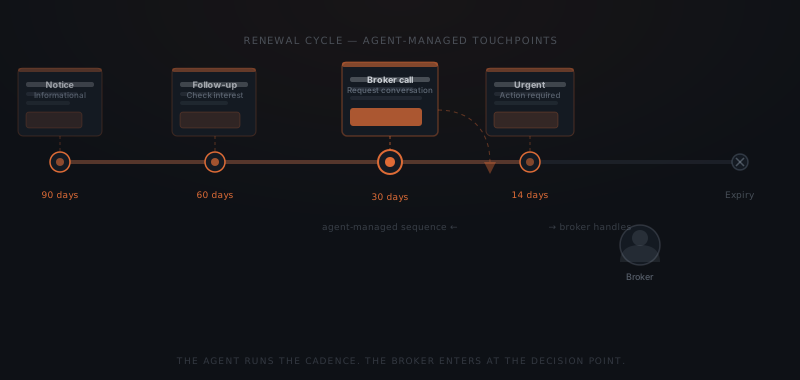
Renewal sequences. The agent monitors policy expiry dates across all active accounts. At defined intervals — 90 days, 60 days, 30 days, 14 days — the agent sends the appropriate communication from the broker's email address. The message at 90 days is informational. The message at 30 days requests a conversation. The agent logs every interaction and flags the accounts that haven't responded to the 30-day outreach.
| Days before expiry | Message purpose | Escalation |
|---|---|---|
| 90 days | Informational notice — upcoming renewal | None |
| 60 days | Check-in — confirm client awareness | None |
| 30 days | Conversation request — schedule broker call | Flag to broker if no reply within 5 days |
| 14 days | Urgent outreach — time-sensitive action | Escalate to broker immediately |
Document and certificate requests. Clients regularly request certificates of insurance, policy documents, and endorsement copies. The agent handles requests arriving by email, routes them to the appropriate record, and sends the document. Requests that require a new endorsement or coverage change get flagged to the broker.
Application follow-up. New business applications involve back-and-forth with underwriters and clients — outstanding information, additional documentation, revised proposals. The agent manages the communication cadence on each open application. It sends reminders at defined intervals and escalates to the broker when a response is overdue.
Claims status updates. Clients in a claims process want regular updates. The agent sends status communications at defined intervals. This reduces inbound calls about claim progress and frees broker time for the conversations that require direct input.
What the licensed broker handles
Coverage advice. A client renewing a commercial policy asks whether their current general liability limits are adequate after a business expansion. An AI agent does not have the context to answer that question — business operations, risk tolerance, industry exposure. The broker answers it.
Binding decisions. Placing coverage, adding endorsements, or making changes to an in-force policy are regulated actions. The agent surfaces the options and routes the request. The broker makes the decision and executes the transaction.
Claims advocacy. When a claim is disputed or underpaid, the broker's role is to advocate with the carrier. That requires reading the policy language, understanding the carrier's reasoning, and making the case on the client's behalf. The agent handles status communication. The broker handles the advocacy.
Relationship decisions. A long-term client considering moving their business elsewhere needs a conversation, not a renewal email. The agent flags the account. The broker decides how to handle it.
| Task | Agent | Licensed broker |
|---|---|---|
| Renewal sequences (90/60/30/14 days) | ✓ | |
| Certificate of insurance requests | ✓ | |
| Application follow-up communication | ✓ | |
| Claims status updates | ✓ | |
| Coverage advice and recommendations | ✓ | |
| Binding and endorsement decisions | ✓ | |
| Claims advocacy with carriers | ✓ | |
| Relationship-sensitive account decisions | ✓ |
Renewals don't go to competitors because their product is better. They go because someone forgot to call.
For how agents handle the broader follow-up layer in a service business, see AI agents for follow-up. For the framework on which workflows to automate first, see which workflows to automate first.
How to configure an insurance agent workflow
Export and structure the policy register
The agent needs a structured view of active policies with expiry dates, client contact details, and policy type. Most agency management systems (AMS360, Applied Epic, HawkSoft) can export this. Without a structured register, the agent cannot monitor renewal timelines reliably.
Define the renewal sequence
Set the touchpoints and message content for each stage: 90-day notice, 60-day follow-up, 30-day conversation request, 14-day urgent. Write the messages in your agency's voice. The agent sends from your email address.
Set escalation rules
Define which events require broker attention: no response after the 30-day message, a client reply indicating they're shopping alternatives, a request that involves a coverage change. These trigger a broker flag, not an automated response.
Connect the document workflow
Map the most common document request types — certificate requests, policy copies, loss runs — to the corresponding records in your management system. The agent handles requests matching a defined template; anything outside the template goes to the broker queue.
Review and refine the first quarter
The first 90 days will surface edge cases: clients who reply in unexpected ways, policy types that need different sequences, communication preferences that weren't captured in setup. Adjust the sequences based on what the first cycle reveals.
Tools and integrations an insurance broker agent workflow connects to
The specific platforms the agent uses depend on which agency management system the brokerage runs. The table below covers the standard connection points for a renewal sequence and document request workflow.
| Platform | Role in the workflow | Notes |
|---|---|---|
| AMS360 | Policy register, expiry dates, client records | Scheduled data export or API sync |
| Applied Epic | Policy data, client communication log, document storage | API integration — most common at larger brokerages |
| HawkSoft | Policy register and contact data | REST API export |
| EZLynx / Vertafore | Policy data sync for expiry monitoring | Integration complexity varies by version |
| Gmail / Outlook | Renewal and follow-up emails from the broker's address | OAuth — agent drafts and sends from the real address |
| Google Calendar / Outlook Calendar | Scheduling broker calls when a client responds | Read availability, write confirmed appointments |
| Slack / Teams | Escalation notifications when the broker flag triggers | Webhook notification — no write access required |
Platforms outside this list can be connected with custom integration work. A well-scoped implementation connects the AMS the brokerage already uses, the email system, and a calendar. Adding more systems in the first implementation delays go-live without proportionate benefit.
What an insurance broker agent workflow costs
The cost breaks into setup, operating costs, and the platform subscriptions the agent connects to.
Setup cost. A full renewal sequence and document request workflow — expiry monitoring, four-touchpoint renewal cadence, certificate handling, escalation rules, and AMS integration — runs $4,000–$8,000. The range is wider than comparable implementations because AMS complexity varies: AMS360 and Applied Epic have well-documented APIs; smaller systems may require custom connectors. Internal builds take 50–100 hours and direct API knowledge.
Operating costs. A brokerage managing 300–500 active policies runs approximately 1,200–2,000 renewal communications per year at the four-touchpoint cadence. At $0.01 per task in API costs, annual operating costs are $12–$20 — essentially zero relative to setup. Document request handling adds a small cost depending on volume. Even at 100 requests per month, annual API costs stay under $150.
Year 1 total (implementation + first year API): $4,012–$8,150.
ROI frame. At $45/hr effective, recovering 8–12 hours per week of renewal and admin time represents $18,720–$28,080 in annual redirected capacity. The agent setup pays back within 3–5 months.
The retention frame is stronger. Independent brokerage renewal rates average 84–87%.[¹] A 300-policy book at 85% retention loses 45 policies per year. Improving retention by 3–4 points through earlier renewal outreach recovers 9–12 policies at $1,200 annual premium — $10,800–$14,400 in retained premium volume. Setup cost recovers in year one from retention alone.
Where insurance broker agent implementations fail
Five failure modes appear consistently across insurance brokerage agent deployments.
Coverage change requests routed through the renewal sequence. A client replies to the 30-day renewal message: "I also want to add a vehicle to the commercial auto policy." The agent treats the reply as a standard renewal engagement and continues the sequence. The endorsement request is logged but not escalated. Coverage gap risk accumulates until the broker catches it. Any reply containing "add," "change," "remove," or "cancel" in relation to coverage should trigger an immediate broker flag. Not a sequence continuation.
Renewal sequences sent to accounts with open claims. A client managing an active claim receives a routine renewal reminder. The message arrives while the broker has not yet returned a call about the claim. The client perceives the sequence as impersonal and out of touch. Accounts with active claims should be filtered from standard renewal sequences. Handle them directly until the claim closes.
AMS data not current. The agent pulls expiry dates from a weekly export. A policy endorsed to a new expiry date on Tuesday triggers incorrect outreach on Friday. Real-time or daily data sync is required for high-volume books. A brokerage relying on monthly exports will have a meaningful error rate in renewal timing within the first quarter.
Agent responds to a regulatory or mandatory coverage question. A client asks whether they are required to carry employer's liability coverage for their industry. The agent draws on general knowledge and provides an answer. Any question involving mandatory coverage, statutory limits, or regulatory requirements must escalate to the broker immediately. The agent should not respond to these — not even with a qualified answer.
Loss runs and claims documents processed without broker review. A client requests a loss run for a policy with a large open claim. Providing the document without broker awareness could affect the claims outcome or the renewal negotiation with the underwriter. Loss runs, claims history, and anything related to an open claim should route to a manual broker approval step. Deliver only after review.
Frequently asked questions
What does an AI agent do for insurance brokers? An AI agent for insurance brokers monitors policy expiry dates and runs renewal outreach at defined intervals. It handles client document requests and manages application follow-up. The agent operates from the broker's email and logs all interactions. Coverage advice, binding decisions, and disclosure obligations remain with the licensed broker.
How does an AI agent handle insurance renewals? An insurance broker AI agent monitors the policy register for upcoming expiry dates. It sends renewal communications at 90, 60, 30, and 14 days before expiry. Each message is specific to the account and policy type. When a client responds or the 30-day mark triggers a conversation request, the agent flags the account for the broker.
What agency management systems work with an insurance agent workflow? Insurance agent workflows connect to AMS360, Applied Epic, HawkSoft, EZLynx, and Vertafore systems that can export structured policy data. The agent reads policy and expiry data from the management system and logs communication activity back to the client record. Configuration depends on the specific AMS the brokerage uses.
Can an AI agent replace a client service representative at a brokerage? An AI agent handles the structured, repeatable layer of client service: renewal sequences, document requests, application follow-up, and status updates. A client service representative handles the variable work: coverage questions, claims support, endorsement requests, and relationships with complex commercial accounts. The two roles are complementary. Brokerages that use agents typically reassign the service rep to the advisory and retention work the agent cannot do.