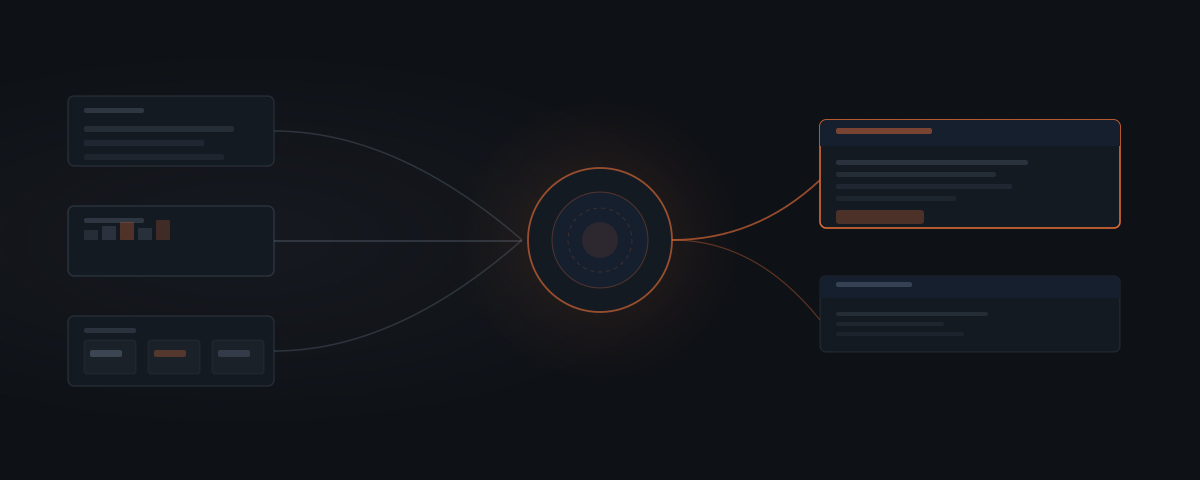
A commercial account renews in six weeks. The submission goes to three carriers — the same loss history, the same schedule of locations, the same narrative, keyed into three different portals with three different field structures. This account has renewed four times before. Nothing about its risk profile is new. Hermes reads the account's renewal history, drafts the submission package for each carrier, and flags where the coverage may be underinsured. The broker reviews the comparison and the narrative — not three separate blank forms.
A commercial account renews in six weeks. The submission goes to three carriers — the same loss history, the same schedule of locations, the same narrative, keyed into three different portals with three different field structures. This account has renewed four times before. Nothing about its risk profile is new, and yet the submission gets built from a blank form each cycle. Hermes reads the account's renewal history, drafts the submission package for each carrier, and flags where coverage may be underinsured. The broker reviews the comparison and the narrative. Hermes assembled both.
The same submission gets rebuilt from scratch, every carrier, every year
Commercial lines quoting is manual, repetitive work spread across multiple portals with no shared format. A submission for a single account with three carrier targets means the loss history, location schedule, and narrative get keyed in three times — once per portal, in that portal's specific field structure.
McKinsey's analysis of brokerage operations found that 25–30% of tasks at a typical brokerage are routine: data collection, communication, and status tracking that automation handles well.[¹] Submission assembly sits squarely in that category. The underwriting judgment — how to frame a marginal loss year, which carrier fits this risk profile best — is not routine. Re-keying the same schedule of locations into a third portal is.
Hermes does not replace the broker's carrier relationships or underwriting judgment. Hermes reads the account's history and drafts the submission package — the narrative, the schedule, the supporting exhibits — for the broker to review before it reaches a carrier. The broker decides which carriers to approach, how to frame a difficult loss year, and which quote to recommend to the client.
An insurance automation vendor's 2026 review of manual quoting workflows found agencies spend 25–40 minutes per commercial quote on carrier portal data entry alone — before any underwriting analysis.[²] At three to four carrier targets per renewal, that is close to two hours of re-keying the same account data, repeated every year the account renews.
Hermes drafts the submission from the account's own renewal history
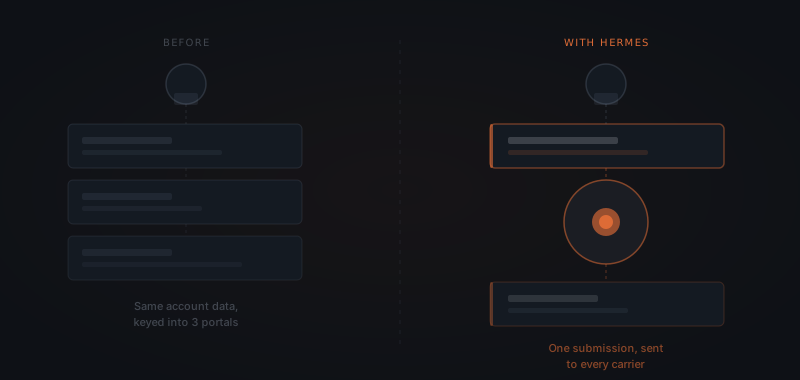
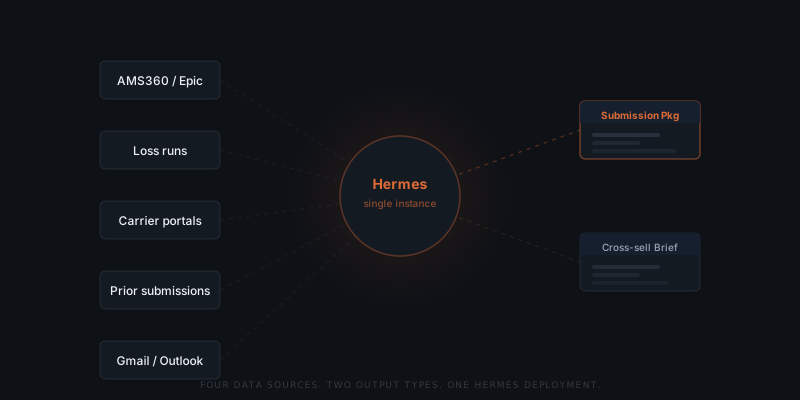
Hermes connects to the AMS for the policy register and loss run history, and to the carrier portals the brokerage submits through. For a renewal, Hermes reads the account's current coverage, its loss history, and — if this is a repeat account — the submission that won the business last cycle and the language that carrier responded well to.
Hermes drafts the submission narrative and schedule for each carrier in that carrier's required format. The broker reviews the draft, adjusts the framing where a loss needs specific context a system doesn't have, and approves. The submission goes out from the broker, through the carrier's normal channel, exactly as if built by hand.
| Renewal task | What Hermes does | Broker's role |
|---|---|---|
| Submission narrative drafting | Drafts from account history and loss runs | Reviews framing, adds context on any unusual loss |
| Schedule of locations or vehicles | Populates from AMS data, formatted per carrier | Confirms accuracy against current AMS |
| Quote comparison across carriers | Reads responses, builds a side-by-side comparison | Decides which quote to recommend to the client |
| Account-rounding flag | Compares current coverage to the account's profile | Evaluates the gap and raises it with the client |
Quote comparison is the second layer Hermes handles
Once carriers respond, someone has to read three separate quote documents, each formatted differently, and build a comparison the client can understand. Hermes reads each carrier's response, extracts the premium, the deductible, the coverage limits, and any material exclusions, and builds a single comparison table.
The broker's task shifts from reading three quote documents cover to cover, to reviewing one structured comparison and deciding which carrier fits the client's price sensitivity and coverage priorities. For an account with three carrier responses, that is a 45-minute reading task compressed to a 10-minute review.
Hermes flags account-rounding gaps the renewal conversation would otherwise miss
The agent doesn't get faster at this. It gets less wrong.
A commercial auto policy with no umbrella above it. A general liability policy on a client that now processes customer payment data, with no cyber endorsement. These are the gaps that get missed when a renewal conversation focuses on the expiring policy's own terms rather than the account's full risk picture.
Hermes compares an account's current coverage against the pattern in similar accounts it has processed — same industry, similar revenue band, similar location count — and flags where a common coverage type is absent. The flag goes to the broker as a note in the renewal prep, not as a recommendation sent to the client. The broker evaluates whether the gap is real for that specific client and decides how to raise it.
Independent brokerage renewal rates average 84–87%.[³] Account rounding — adding a coverage line to an existing client rather than sourcing a new one — is retention-adjacent revenue: it comes from a relationship the brokerage already has, at a fraction of the acquisition cost of a new account. A renewal conversation that surfaces one legitimate gap per cycle compounds across a book of 300-plus accounts in a way that is easy to miss without a systematic flag.
Skills build from every completed renewal cycle
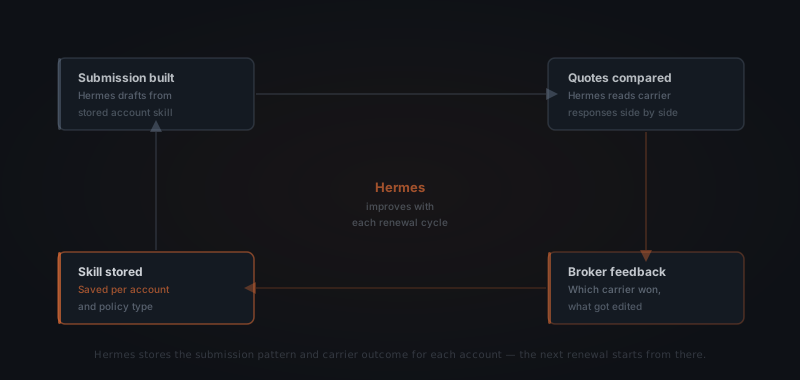
Each completed renewal adds a Skill object to Hermes's library for that account: which carrier responded competitively last cycle, how the loss history should be framed, what schedule format the broker's team prefers, and what the client's actual risk profile looks like beyond the expiring policy's own terms.
By the second or third renewal cycle for the same account, Hermes's submission draft reflects that account's specific history — not a generic commercial lines template. The broker's review shifts from correcting the narrative and re-checking the schedule, to confirming the framing is right and deciding the carrier strategy.
The same pattern applies across policy types. A brokerage that places a high volume of one commercial vertical — contractors, restaurants, professional services firms — builds a skill for that vertical's common risk profile and common coverage gaps after a handful of completed renewals, and applies it to every new account in that vertical from the first submission.
What the licensed broker still owns
Hermes handles the drafting, comparison, and pattern-flagging layer. The broker owns every decision that requires licensed judgment.
| Task | Hermes | Licensed broker |
|---|---|---|
| Submission narrative and schedule drafting | ✓ | |
| Quote comparison across carrier responses | ✓ | |
| Account-rounding gap identification | ✓ | |
| Skill refinement after each renewal cycle | ✓ | |
| Carrier selection and negotiation | ✓ | |
| Coverage recommendations to the client | ✓ | |
| Binding and endorsement decisions | ✓ | |
| Difficult loss year framing and carrier conversations | ✓ |
Salesforce's 2024 State of Financial Services report found financial services professionals spend 67% of their time on non-revenue work.[⁴] Submission assembly and quote comparison sit inside that 67% — necessary, recurring, and not the part of the job that requires a license. The broker's judgment goes into which carrier to approach, how to frame a marginal risk, and what to recommend to the client. Hermes prepares the material that judgment gets applied to.
For the broader breakdown of what an agent handles across the full renewal, document, and communication workload at a brokerage, see AI agents for insurance brokers. For how OpenClaw handles the client-facing renewal messaging that runs alongside this submission work, see OpenClaw for insurance brokers.
Where Hermes-drafted submissions need close review
Three mistakes account for most of the friction brokerages hit when Hermes takes over submission drafting.
Sending the account-rounding flag straight to the client. Hermes surfaces a coverage gap as a note for the broker, not as a client-facing recommendation. A gap that looks obvious in the data — no umbrella above a commercial auto policy — may not fit a client's actual risk tolerance or budget this renewal cycle. The broker decides whether and how to raise it. Automating that decision away turns a useful flag into an unwanted sales pitch.
Applying one account's skill to a dissimilar account in the same vertical. Two restaurant accounts can carry very different risk profiles — one with a liquor license and late-night hours, one without. A skill built from a handful of similar accounts should note what "similar" means for that vertical, and the broker should confirm the comparison baseline fits before trusting an account-rounding flag on a new account.
Working from a stale loss run. A submission drafted from a loss run pulled at the start of the renewal cycle misses a claim filed two weeks later. Carriers see the current loss history when they pull it independently — a mismatch between what Hermes drafted and what the carrier's own systems show raises questions that slow the submission down rather than speeding it up. Refreshing the loss run pull immediately before the submission goes out avoids this.
Setting up Hermes for a brokerage's renewal cycle
Connect the AMS and carrier portals
Grant Hermes read access to the AMS for policy data and loss runs, and to the carrier portals the brokerage submits through most often. Scope the first connection to the two or three carriers that receive the highest submission volume.
Choose one account segment to start
Pick one policy type or vertical with enough renewal volume to build a skill quickly — a commercial auto book or one industry vertical is a strong starting point. Define the submission format and the exhibits that carrier segment requires.
Provide three to five real past submissions per account type
Annotate what made each submission effective: the framing that got a competitive response, the schedule format the carrier preferred, any loss that needed specific context. Example quality drives skill quality more than volume does.
Define the account-rounding comparison baseline
Set the common coverage pattern for the account segment in scope — what a typical account in this vertical carries, so Hermes has a baseline to flag gaps against. Refine the baseline as the first few renewal cycles surface false positives or missed gaps.
Run the first renewal cycle with close review
Review every submission draft and every account-rounding flag closely in the first cycle — not just for accuracy but for what the skill should encode. Corrections from close first-cycle review compress the learning curve for the second and third renewals on the same accounts.
A focused Hermes deployment covering one account segment across two to three carrier connections goes from scoping call to first live submission in three to five weeks. For the full timeline from scoping to production, see what a real AI agent implementation involves. For how Hermes works as a self-improving agent more broadly, see what is Hermes.
Frequently asked questions
What does Hermes do for an insurance brokerage? Hermes reads the policy register, loss runs, and prior submission history for an account, then drafts the carrier submission package for renewal — the narrative, the schedule of locations or vehicles, and the supporting exhibits. Hermes also compares quotes as carriers respond and flags coverage gaps or account-rounding opportunities. The broker reviews every submission and every recommendation before anything goes to a carrier or a client.
How is Hermes different from an agency management system's built-in automation? An AMS stores the policy data and expiry dates. Hermes reads that data plus the account's renewal and submission history, and drafts the actual submission narrative and quote comparison — the writing and analysis layer an AMS doesn't do. Hermes builds a skill per account and per policy type from completed renewal cycles, so draft quality on a repeat account improves each year.
What is an account-rounding opportunity, and how does Hermes flag one? Account rounding means identifying coverage gaps on an existing account — a commercial auto policy with no umbrella, a general liability policy with no cyber endorsement despite the client processing customer data. Hermes compares the account's current coverage against the pattern in similar accounts and flags gaps for the broker to raise in the renewal conversation. Hermes does not recommend specific coverage changes — it surfaces the gap for the licensed broker to evaluate.
How long before Hermes improves on a specific account's submission quality? After two to three completed renewal cycles for the same account, Hermes's submission drafts reflect that account's actual loss history framing, the carrier language that has previously gotten a competitive quote, and the schedule format the broker's team prefers. New accounts and unusual risk profiles continue to improve through the first few cycles.
Notes
- McKinsey & Company, "Insurance 2030 — The impact of AI on the future of insurance," McKinsey Global Institute, 2021. https://www.mckinsey.com/industries/financial-services/our-insights/insurance-2030-the-impact-of-ai-on-the-future-of-insurance — source for: 25–30% of tasks at a typical brokerage are routine data collection, communication, and status tracking.
- US Tech Automations, "Insurance Quoting Automation: 2026 ROI Analysis," US Tech Automations, 2026. https://ustechautomations.com/resources/blog/insurance-quoting-automation-roi-analysis-2026 — source for: agencies spending 25–40 minutes per commercial quote on manual carrier portal data entry.
- McKinsey & Company, "Insurance 2030," McKinsey Global Institute, 2021. https://www.mckinsey.com/industries/financial-services/our-insights/insurance-2030-the-impact-of-ai-on-the-future-of-insurance — source for: independent brokerage renewal rates averaging 84–87%.
- Salesforce, "State of Financial Services 2024," Salesforce Research, 2024. https://www.salesforce.com/resources/articles/financial-services-trends/ — source for: financial services professionals spending 67% of time on non-revenue work.