A mortgage broker has six files moving toward closing this week. Two borrowers are texting the same question: what's my status. A processor is still waiting on a bank statement that was already sent once and buried in an email thread. A listing agent wants an update before the weekend showing. None of this requires a mortgage license. All of it eats the hours that should go to structuring the next deal and protecting the one already in underwriting. The status calls, the document chasing, and the lender follow-ups are coordination work that happens to sit on a loan officer's desk. An AI agent handles that layer. Every pricing decision, condition judgment, and rate lock call still comes from the broker.
A mortgage broker has six files moving toward closing this week. Two borrowers are texting the same question: what's my status. A processor is still waiting on a bank statement that was already sent once and buried in an email thread. A listing agent wants an update before the weekend showing. None of this requires a mortgage license. All of it eats the hours that should go to structuring the next deal and protecting the one already in underwriting. The status calls, the document chasing, and the lender follow-ups are coordination work that happens to sit on a loan officer's desk. An AI agent handles that layer. Every pricing decision, condition judgment, and rate lock call still comes from the broker.
Status updates and document chasing consume a mortgage broker's day
The average mortgage now costs $11,898 to originate, according to the Mortgage Bankers Association's Q1 2026 performance report — up from $11,102 the previous quarter.[¹] Most of that cost is not underwriting risk analysis. It is the labor hours spent coordinating a file from application to closing: pulling status, chasing a missing document, confirming with the lender that a condition has cleared.
A mortgage now closes in an average of 38.2 days — the third-fastest pace on record — according to ICE Mortgage Technology's May 2026 Mortgage Monitor report.[²] Purchase loans moved even faster: 36.8 days in March 2026, the fastest average close time ICE has recorded.[²] Those numbers reflect faster underwriting engines and automated verification. They do not reflect fewer status calls. A broker running 15–25 active files fields the same volume of "where's my loan" questions regardless of how fast the file itself is moving through the pipeline.
A broker with 20 open files answers the same handful of questions dozens of times a week: has the appraisal come back, is the file with underwriting, what is still needed to clear to close. Each answer takes about five minutes to look up in the loan origination system and relay by text or email. At 15 status inquiries a day, that is more than an hour spent relaying information the system already has recorded.
| Loan file touchpoint | Frequency | Requires broker judgment? | Agent-handled? |
|---|---|---|---|
| Status update request (borrower or referral partner) | Very high | No | Yes |
| Document request and follow-up | Very high | No | Yes |
| Lender or processor condition follow-up | High | No | Yes |
| Rate lock timing decision | Medium | Yes | No |
| Condition interpretation requiring judgment | Medium | Yes | No |
| Pricing exception or loan structuring | Low | Yes | No |
| Referral partner relationship management | Medium | Yes | No |
The loan file bottleneck has nothing to do with underwriting judgment
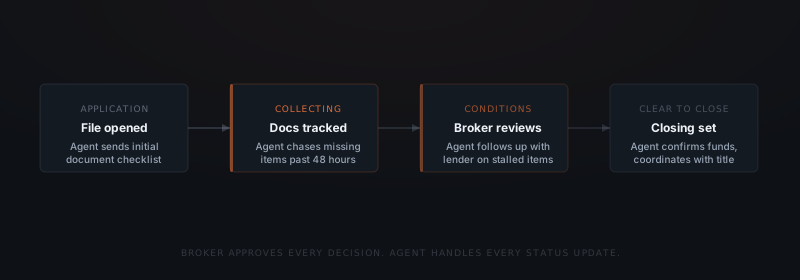
Every loan file moves through the same sequence: application, document collection, submission, conditional approval, condition clearing, clear-to-close, closing. Two distinct kinds of work happen inside that sequence, and most brokerages don't separate them.
One kind requires a licensed loan officer's judgment: how to price the loan, which condition needs a phone call instead of a form, when to lock the rate, how to explain a large deposit to underwriting. The other kind is coordination: confirming the file reached underwriting, requesting the document underwriting flagged, relaying the same status update to three people who are all waiting on the same file.
A broker who personally answers a status text gives it the same attention as pricing a jumbo loan with a compensating factor. Both feel urgent in the moment. Only one requires the license.
A typical purchase file needs 15–25 documents from the borrower across the process. Pay stubs, bank statements, tax returns, a gift letter if funds are gifted, a refreshed bank statement if the first one aged past the lender's 30-day window. Underwriting rarely requests everything at once. Conditions arrive in waves, and each wave restarts the same three-step cycle: request the document, follow up when it hasn't arrived within 48 hours, confirm receipt and log it against the condition.
That cycle is where a broker's coordination hours concentrate — not in the judgment calls the license exists for, but in the repeat requests, the reminder texts, and the status calls that answer a question the loan origination system could answer directly.
Take a large-deposit condition as an example. Underwriting flags a $4,000 deposit on a bank statement and requests a letter of explanation plus a paper trail for the source of funds. The broker's judgment enters once — deciding how to advise the borrower on documenting the deposit and whether it changes the loan structure. Everything after that decision is coordination: requesting the letter, following up when it hasn't arrived, confirming the paper trail matches the deposit amount, and logging the condition as cleared with the processor. A broker handling that condition personally spends 20–30 minutes on follow-up alone, spread across three or four separate touches over a week.
What an AI agent handles across the loan file lifecycle
This is not a chatbot guessing at an answer. The agent reads live file status from the loan origination system — Encompass, Arive, or Lender Price — so every update reflects the file's actual state, not a scripted response.
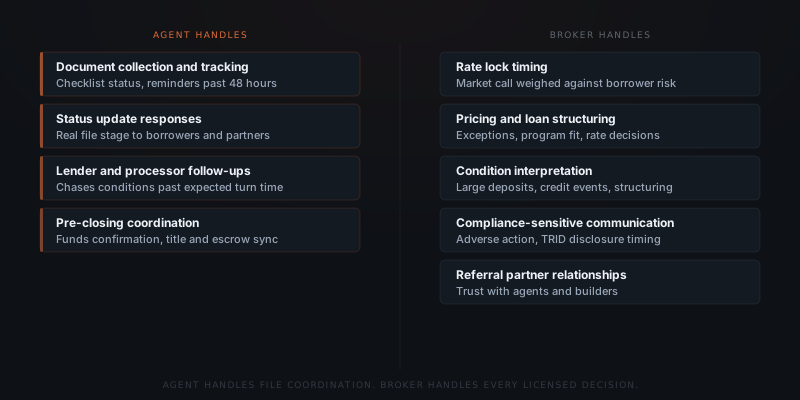
An AI agent for a mortgage broker operates across four workflow categories: document collection, status update responses, lender and processor follow-ups, and pre-closing coordination.
Document collection and checklist tracking covers the initial document request based on loan type and program, tracking what's been received against what's still outstanding, and sending a reminder when an item sits past 48 hours without a response. When a bank statement or pay stub ages past the lender's shelf-life window, the agent flags the broker to request a refreshed copy before it becomes a last-minute scramble at closing.
Status update responses cover the single most frequent interruption in a broker's day. A borrower, co-borrower, or referring agent asks for an update by text or email. The agent pulls the current stage from the loan origination system — submitted, in underwriting, conditional approval, clear to close — and replies with the real status. No borrower gets a placeholder answer. No referral partner waits until the broker has a free minute between calls.
Lender and processor follow-ups track each outstanding condition against the lender's stated turn time and send a follow-up when a condition has sat without movement past the expected window. A condition that should clear in 24 hours and hasn't moved in 72 gets flagged and chased — without the broker having to remember which of 20 files is running behind.
Pre-closing coordination starts once a file hits clear-to-close. The agent confirms funds-to-close details have been received, sends the closing disclosure timeline reminder required before signing, and coordinates document delivery with title and escrow. The broker confirms the closing figures. The agent handles the scheduling and reminder sequence around it.
What stays with the mortgage broker
Nobody's rate lock ever depended on who chased the missing W-2.
An AI agent does not price a loan, lock a rate, or decide how to structure a file around a debt-to-income issue. Those decisions require a licensed loan officer's judgment and stay entirely with the broker.
Rate lock timing is a market call, not a coordination task. The broker weighs the borrower's risk tolerance against where rates are moving and decides when to lock. Condition interpretation that requires judgment — explaining a large deposit, structuring around a credit event — requires a conversation the agent cannot have on the broker's behalf. Pricing exceptions and loan structuring decisions determine what the borrower pays, and stay with the person licensed to make that call.
Compliance-sensitive conversations — adverse action notices, TRID disclosure timing, any communication that touches a regulatory requirement — stay with the broker or a licensed team member. Referral partner relationships, the real estate agents and builders who send repeat business, stay personal. The agent can send the status update a referral partner is waiting on. The agent cannot build the trust that keeps that partner sending deals.
How a mortgage broker AI agent connects to existing tools
A mortgage brokerage typically runs on a loan origination system, a CRM for referral relationships, and email or SMS for borrower communication. An AI agent connects to the tools already in use rather than requiring a new platform.
| Tool category | Common platforms | What the agent reads or writes |
|---|---|---|
| Loan origination system | Encompass, Arive, Lender Price, Calyx Point | Reads file stage, conditions, and document status; updates the checklist |
| CRM | Jungo, Shape, Surefire, BNTouch | Reads borrower and referral partner contact data; logs communication history |
| Email and SMS | Gmail, Outlook, or LOS-native messaging | Sends status updates; reads borrower and agent replies |
| Document and e-sign | DocuSign, borrower upload portals | Tracks signature status and document upload confirmation |
| Scheduling | Google Calendar, Calendly | Books closing appointments and follow-up calls |
The integration scope determines implementation time. A brokerage running Encompass or Arive as the primary loan origination system can go live with status updates and document tracking in two to three weeks. Adding lender follow-up automation and pre-closing coordination typically runs another one to two weeks.
Sync accuracy is the failure mode that matters most. An agent reading a cached or delayed file status tells a borrower the file is still in underwriting when it cleared an hour ago. That gap does more damage to trust than no update at all. A correctly scoped integration reads the loan origination system directly, not a nightly export. The status the agent reports then matches what a processor would see opening the file. Brokerages running an older LOS version or a heavily customized instance should confirm API access before committing to a go-live date — that is where implementation timelines most often shift.
See how to know if a business process is ready to hand to an AI agent for a framework on identifying the right starting workflow for any brokerage.
What it costs and how fast it goes live
Mortgage broker implementations start with the highest-frequency workflow — status updates and document tracking — and expand from there.
Scoping call
Map the highest-volume coordination workflows, typically status updates and document collection. Identify the loan origination system and CRM in use and confirm what data each contains.
Integration
Connect the agent to the loan origination system, CRM, and email or SMS channel. Map the specific fields the agent reads for each workflow — file stage, condition list, borrower contact, referral source.
Template build
Draft the message templates — status update replies by file stage, document request and reminder language, lender follow-up phrasing. The broker reviews and edits each one until the tone matches how the brokerage talks to borrowers and partners.
Approval workflow
Set the review flow for each message type. The broker sees drafts queued for approval before anything reaches a borrower or referral partner. Routine status replies can move to auto-send once the first review period confirms accuracy.
Go-live
The first workflow goes live. The agent begins tracking documents and answering status requests. The broker monitors outputs for the first two weeks and flags any adjustments to phrasing or timing.
A standard implementation covering document tracking, status updates, and lender follow-ups typically runs $2,500–$6,000 for the initial build, depending on the loan origination system and the number of integrations. Monthly API costs at typical brokerage volumes run under $200. A broker running 20 or more active files who recovers 8–10 hours a week in status calls and document chasing sees the setup cost repaid within the first month or two.
J.D. Power's 2025 U.S. Mortgage Origination Satisfaction Study found overall borrower satisfaction with mortgage lenders at 760 out of 1,000 — up 33 points year over year.[³] The gain came largely from better communication and heavier use of technology to keep borrowers informed. A brokerage that answers every status question the same day, every time, is competing directly on that metric.
The implementation timeline for a service business follows the same two-to-three-week pattern for the first workflow across industries. A mortgage brokerage's specifics are the loan origination system integration and the compliance-aware message templates — not the underlying process.
Frequently asked questions
What does an AI agent do for a mortgage broker? An AI agent for a mortgage broker handles document collection and checklist tracking, status update responses to borrowers and referral agents, lender and processor follow-ups on outstanding conditions, and pre-closing coordination. The agent reads the actual file stage from the loan origination system and responds with the real status. Pricing decisions, rate lock timing, condition interpretation, and every borrower-facing lending conversation stay with the licensed broker.
How does an AI agent track loan file status for a mortgage broker? An AI agent tracks loan file status by connecting directly to the loan origination system — Encompass, Arive, Lender Price, or Calyx Point — and reading the current stage of each file. When a borrower or referral agent asks for an update, the agent replies with the file's actual state and flags the broker when a file has stalled past the lender's typical turn time.
What tools does a mortgage broker AI agent connect to? A mortgage broker AI agent typically connects to the loan origination system for file status and conditions, a CRM such as Jungo or Surefire for borrower and referral data, email or SMS for communication, DocuSign for document tracking, and a calendar tool for scheduling closings. The exact integration set depends on which platforms the brokerage already runs.
What does AI agent implementation cost for a mortgage brokerage? A standard implementation covering document tracking, status updates, and lender follow-ups typically runs $2,500–$6,000 for the initial build. Monthly API costs at typical volumes run under $200. A broker running 20+ active files who recovers 8–10 hours per week in status calls and document chasing sees the cost repaid within the first month or two. See what AI agent implementation actually costs for a small business for a full breakdown.
Notes
- Mortgage Bankers Association, Q1 2026 Quarterly Mortgage Bankers Performance Report, as reported by HousingWire, "IMB profit rises to $727 per loan in Q1 2026 even as costs jump." https://www.housingwire.com/articles/mba-imb-profit-costs-q1-2026/
- ICE Mortgage Technology, "May 2026 Mortgage Monitor Report." https://mortgagetech.ice.com/resources/data-reports/may-2026-mortgage-monitor
- J.D. Power, "2025 U.S. Mortgage Origination Satisfaction Study." https://www.jdpower.com/business/press-releases/2025-us-mortgage-origination-satisfaction-study