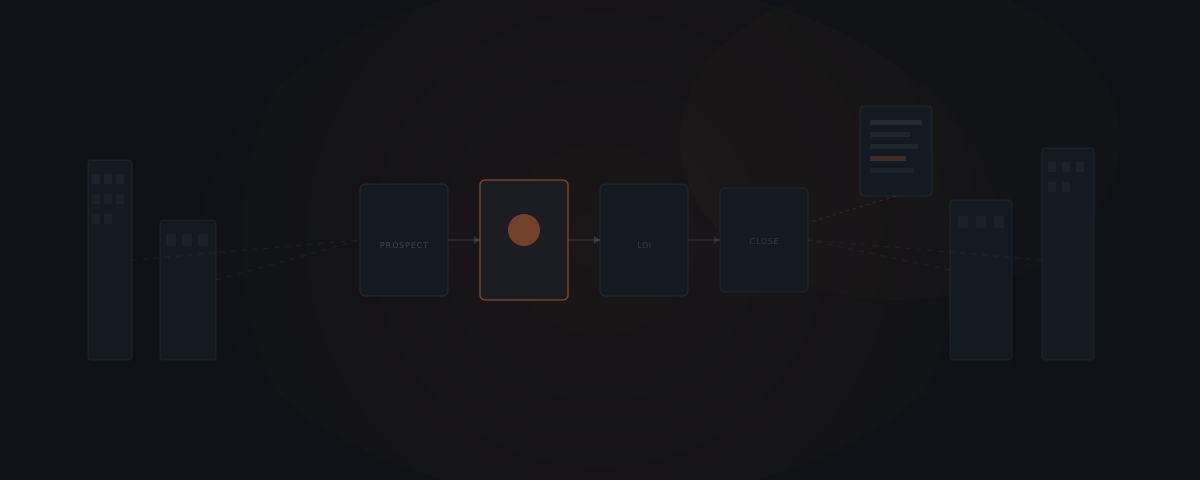
A CRE principal spends hours each week on tasks that have nothing to do with deals: sourcing prospect lists, updating a CRM that's always three months behind, assembling the monthly client report, chasing signatures on leases. An AI agent handles that operational layer — prospecting, pipeline tracking, reporting, document extraction — so the principals spend their hours on the work that requires their judgment. The deals, the relationships, the negotiation. That layer stays with the team.
A CRE principal spends hours each week on tasks that have nothing to do with deals: sourcing prospect lists, updating a CRM that's always three months behind, assembling the monthly client report, chasing signatures on leases. An AI agent handles that operational layer — prospecting, pipeline tracking, reporting, document extraction — so the principals spend their hours on the work that requires their judgment. The deals, the relationships, the negotiation. That layer stays with the team — the same split covered in what an AI agent is, for a fuller picture of where the line between mechanical task and judgment gets drawn.
Where CRE firms lose time outside of deal-making
Commercial real estate is a relationship-driven business built on market judgment. But the principals at most CRE firms spend a significant portion of their week on tasks that require neither relationships nor judgment — sourcing names for a prospect list, logging a call into the CRM, pulling market data for a client report, extracting lease terms from a PDF.
A 2026 study by First American Data & Analytics and DealGround, surveying CRE professionals across brokerage, investment, and property management firms, found that 66% of CRE professionals now use AI weekly or daily.[¹] The adoption is broad. But only 5% of those professionals trust AI enough to let it inform actual deal decisions.[¹]
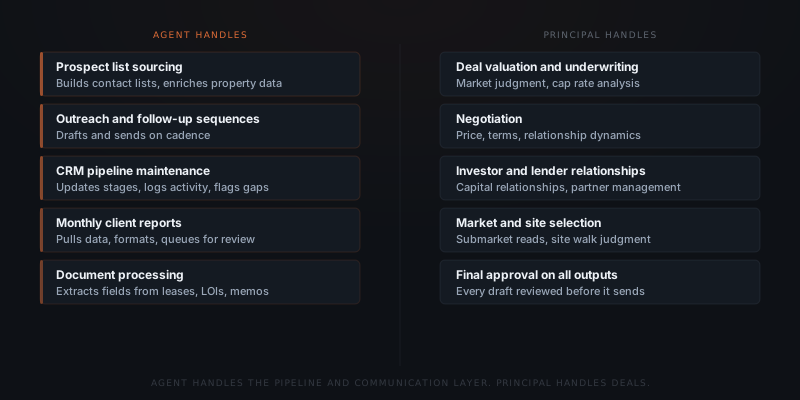
That gap — between widespread adoption and almost no trust at the decision layer — points directly at where AI creates value in CRE firms: the operational layer, not the analysis layer. Prospecting, outreach, pipeline maintenance, reporting, and document processing are all high-volume, low-judgment tasks that agents handle reliably. Valuations, underwriting, market calls, and negotiation require the principals' judgment and remain with the team.
| Operational task | Agent handles | What it does |
|---|---|---|
| Prospect list sourcing | Yes | Builds contact lists from property databases |
| Outreach and follow-up sequences | Yes | Drafts and runs on cadence |
| CRM pipeline updates | Yes | Logs activity, updates stages |
| Monthly client and investor reports | Yes | Pulls data, formats, queues for review |
| Lease and LOI document extraction | Yes | Reads fields, routes to deal tracker |
| Deal valuation and underwriting | No | Requires market judgment |
| Negotiation | No | Requires relationship context |
| Investor relationship management | No | Requires trust and history |
The firms that move from piloting AI to operationalizing it start with the tasks in the first column.
How is AI being used in commercial real estate?
AI use in commercial real estate clusters around two areas: operational automation and analytical support. The distinction matters because they require different levels of trust and produce different business outcomes.
Operational automation covers the tasks that run the business between deals: prospecting new owners or tenants, maintaining the CRM with current deal status, generating the monthly reporting package for investors, and processing the stack of documents that accumulate around every transaction. These tasks are high-volume, follow defined patterns, and produce outputs that a human can review and verify. Agents handle this category well, and firms see near-immediate time savings when they automate it.
Analytical support covers deal underwriting, market analysis, comparable property reviews, and portfolio-level performance assessment. AI tools exist for this layer — Reonomy, CompStak, and ARGUS all embed AI-assisted analysis — but the trust problem identified in the First American/DealGround study sits here. Only 5% of CRE professionals trust AI enough to let it inform deal decisions without heavy verification.[¹]
The practical implication for a CRE firm considering AI agents: start with operations. An agent managing the outreach cadence to a list of industrial property owners in a target submarket produces immediate time savings and builds familiarity with agent-supervised workflows. That is a lower-risk starting point than deploying AI in the underwriting stack before the team has established how to verify its outputs.
JLL's Global Future of Work Survey found that 89% of CRE leaders believe AI can help solve major operational challenges — but the same survey found that companies are three times more likely to succeed with AI programs when leadership actively tracks outputs rather than only reviewing summary results.[²] The agent works. The oversight structure is what separates successful implementations from stalled ones.
What AI agents handle in a CRE firm
An AI agent for a commercial real estate firm operates across four workflows: prospecting, pipeline management, client reporting, and document processing.
Prospecting. The agent reads target parameters — property type, geography, size range, ownership structure — pulls matching records from CoStar, Reonomy, or the firm's existing property database, enriches the list with contact information, deduplicates against the existing CRM, and surfaces the net-new prospects for principal review. A prospecting list that took a junior broker two days to build takes the agent two hours.
Pipeline management. Every call, email, or meeting that advances a deal should update the CRM. Most CRM records at CRE firms are months behind because principals do not have time to log activity between conversations. The agent reads email threads and call notes, extracts the relevant activity, and updates the deal record — stage, last contact, next follow-up, outstanding items. Principals review the updates and correct anything the agent misread.
Client reporting. The monthly investor or client report requires pulling data from the CRM, the property management system, the deal tracker, and the accounting system — formatting it against the firm's report template and drafting the executive summary. The agent handles the data collection and formatting. The principal reviews the numbers, writes the strategic commentary, and approves before it goes out.
Document processing. Leases, letters of intent, purchase and sale agreements, and deal memos all contain specific fields — rent terms, option periods, contingencies, key dates, party names — that need to be extracted and logged. The agent reads the document, extracts the defined fields, and routes them to the deal tracker or the relevant CRM record. A lease abstraction that took an hour per document takes minutes.
The pilot-to-production gap in CRE
Most CRE firms are already using AI — but almost none have moved it into production workflows. The gap is not about technology. It is about starting with the operational layer rather than the decision layer, and building oversight processes that make agent outputs verifiable before the team relies on them.
The 88% pilot / 5% success gap that appears consistently in CRE AI discussions reflects a structural problem in how firms approach implementation. Most pilots start with analytical use cases — can AI underwrite a deal? Can it predict market pricing? — because that is where the headline opportunity looks largest.
But those use cases require trusting outputs that principals cannot easily verify without doing the analysis themselves. The pilot shows promise, the principal cannot confidently act on it without checking, and the agent gets used for low-stakes tasks while the system generates no lasting operational change.
The firms that close the gap start with the operational layer, where outputs are verifiable without expertise: a prospect list from CoStar can be checked against the database. A CRM update after a call can be verified against the email. A report data pull can be checked against the source numbers. The principal is reviewing and approving — not redoing.
Once the team has experience with agent-supervised workflows at the operational layer, extending to more complex analytical assistance becomes far more tractable. The oversight muscle is already built.
The firms that move from piloting to operationalizing start with the tasks a principal can verify in under two minutes.
How agents connect to the existing CRE stack
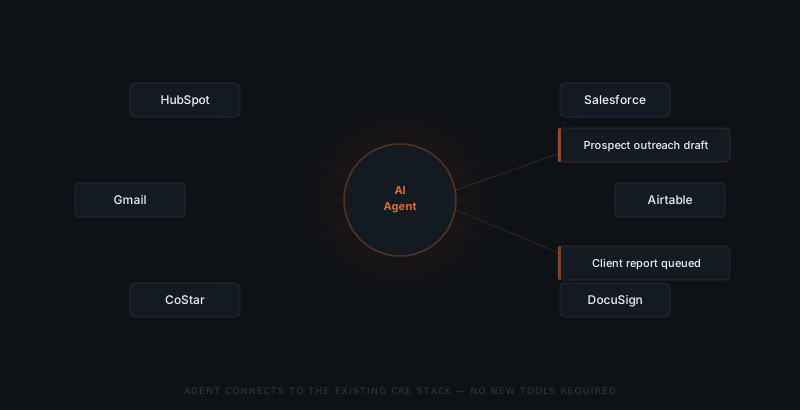
Commercial real estate firms run on a mix of CRM, property data, document management, and financial reporting tools. AI agents connect to this stack through standard APIs — they do not require migrating to new platforms.
CRM. HubSpot, Salesforce, and Pipedrive all provide API access to contact records, deal stages, and activity logs. The agent reads and writes to these records — updating pipeline status, logging outreach, scheduling follow-up tasks — without the principal entering data between conversations.
Property data. CoStar and Reonomy provide API access to property records, ownership history, and comparable transaction data. The agent reads from these databases to build prospect lists and populate deal data fields. Loopnet and Crexi add off-market listing data for brokerage-focused workflows.
Document management. DocuSign and Adobe Sign provide status tracking via API — the agent monitors signature status and logs completion events into the CRM. For lease and document extraction, the agent processes PDFs directly using document intelligence APIs.
Email and calendar. Gmail and Outlook connect via OAuth. Outreach drafts route through a review queue — principals read, edit if needed, and approve before any email sends. Google Calendar and Outlook Calendar handle meeting scheduling and follow-up reminders.
Financial reporting. Yardi, AppFolio, and Buildium expose property performance data via API for property management firms. The agent reads occupancy rates, rent roll data, and maintenance cost summaries for inclusion in investor reports.
What AI agents cannot do for a CRE firm
Agents do not make deal decisions. The operational layer runs well on agent workflows. The judgment layer does not.
Deal valuation and underwriting. A CRE agent can pull comparable sales data from CoStar and format it into a comp sheet. The agent cannot assess whether the pricing implied by those comps fits the specific submarket dynamics, the property's condition, or the sponsor's basis. That assessment requires the principal's market knowledge and judgment.
Negotiation. Lease negotiations, acquisition pricing, and joint venture terms involve reading the counterparty's motivations, constraints, and likely alternatives — context that is not in any database. An agent cannot replace the negotiating principal.
Investor and capital relationships. LP communications during a difficult quarter, requests for capital commitment at an early stage, and investor education in a new product area require the principal's credibility and relationship history. An agent can draft the communication and format the data tables. The conversation is with the principal.
Market and site selection. Deciding which submarket to enter, which asset class to focus on, and which sites fit the firm's strategy requires reading across data, local relationships, and industry signals in a way that current agents cannot replicate.
For a clear framework on which business processes are ready for agent automation versus which require human judgment, see how to know if a business process is ready to hand to an AI agent.
How CRE firms start with AI agents
Choose one operational workflow with clear, verifiable output
Start with the workflow that produces the clearest output the team can verify without expertise: a prospect list checked against CoStar, a CRM update checked against the email thread, or a report data table checked against the source system. The first workflow builds the team's confidence in agent-supervised processes — choose one where the output is easy to check.
Document the process in enough detail to hand it off
Write down exactly what inputs the workflow takes (what data sources, what parameters, what trigger), what the output looks like (the format, the fields, the delivery destination), and who reviews it before it acts. If the principal cannot write this down, the process is not defined enough to implement. Most CRE firms discover undocumented steps in familiar workflows during this exercise.
Connect the agent to the relevant data sources
Map the specific API connections the workflow requires. A prospecting workflow typically connects to one property database and one CRM. A reporting workflow connects to the CRM, the property management system, and the report template. Each connection is configured once. The agent uses those connections for every run of the workflow going forward.
Review every output for four weeks before trusting the cadence
Run the agent workflow for four full weeks with a principal reviewing every output before it is acted on. Check the prospect list for duplicates and quality. Verify the CRM updates against the conversations. Confirm the report numbers against the source data. Note where the agent consistently gets it right and where edge cases appear. Adjust the configuration before removing the manual review step.
Expand after success criteria are defined and met
Before adding a second workflow, define what success looks like for the first: what error rate in prospect lists is acceptable, how often the CRM needs manual correction, how much time report assembly saves per month. Document what good looks like before expanding — or the second workflow inherits the first one's unresolved edge cases.
A standard CRE operational implementation goes from scoping call to first live prospect list or report in two to four weeks. See what a real AI agent implementation involves for the full timeline from first call to production.
Frequently asked questions
How is AI being used in commercial real estate? AI is being used in CRE for prospecting and lead list building, CRM pipeline maintenance, automated client and investor reporting, document processing (lease extraction, LOI review, memo generation), and outreach and follow-up sequence management. A 2026 First American and DealGround study found that 66% of CRE professionals use AI weekly or daily, but only 5% trust it enough to inform deal decisions.[¹] The adoption is concentrated in operational support tasks — not deal-making.
What tasks can an AI agent automate for a CRE firm? An AI agent automates prospect list sourcing and contact enrichment, outreach email sequences, CRM deal stage updates and activity logging, monthly investor and client report generation, and document field extraction from leases, letters of intent, and deal memos. Deal valuation, underwriting, negotiation, and investor relationship management remain with the principals. Every agent output passes through a human review step before reaching any client or counterparty.
What CRM and property tools do AI agents connect to in CRE? AI agents connect to HubSpot, Salesforce, or Pipedrive for pipeline tracking; CoStar, Reonomy, or Crexi for property and market data; Airtable for deal tracking; Gmail or Outlook for outreach; DocuSign for signature status; and Yardi or Procore for property management data. The agent works inside the existing stack — no tool migration required.
How long does it take to implement an AI agent for a CRE firm? A standard implementation covering prospecting, CRM maintenance, and client reporting goes from scoping call to first live output in two to four weeks. The AI configuration takes days. The time is filled by integration work and documenting the firm's specific process for each workflow. See the implementation timeline for a breakdown of what fills each week.
Notes
- First American Data & Analytics and DealGround. (2026). "Surging AI Adoption in Commercial Real Estate, But Trust Lags." First American Press Release, May 2026. https://www.firstam.com/news/2026/fa-dna-dealground-ai-adoption-20260512.html — source for: 66% of CRE professionals use AI weekly or daily; only 5% trust AI enough to inform deal decisions; 53% use AI for support only, excluding it from final decision-making.
- JLL. (2024). "The Future of AI in CRE." JLL Global Future of Work Survey. https://www.jll.com/en-us/insights/the-future-of-ai-in-cre — source for: 89% of CRE leaders believe AI can help solve major challenges; 73% of CRE professionals are early adopters using AI to augment daily work; companies are 3x more likely to achieve successful CRE tech programs when leaders actively track progress.
- Deloitte. (2025). "2025 Commercial Real Estate Outlook." Deloitte Insights. https://www2.deloitte.com/us/en/insights/industry/financial-services/commercial-real-estate-outlook.html — source for: 76% of CRE firms are testing or actively using AI in financial planning, tenant engagement, and marketing.