Off-the-shelf agents cover the most common workflows without modification. When your approval chain, data format, or output destination doesn't match the tool's built-in assumptions, workarounds fill the gap. Those workarounds carry a build cost and an annual maintenance cost. Over two to three years, the total typically reaches $8,000–$15,000 — enough to cover the build cost of a custom agent scoped to the same workflow.
A compliance consultancy buys an off-the-shelf agent to handle client intake emails. The agent works — mostly. Their approval flow requires three stages; the tool supports two. Their client data uses non-standard field names. Outputs go to an internal portal the tool doesn't natively reach. Each gap gets a workaround. Twelve months in, the team spends three hours a week managing workarounds instead of reviewing intake. A custom agent scoped to that workflow would have cost less than the workaround hours accumulated in year one.
Off-the-shelf agents are optimised for fit, not flexibility
Off-the-shelf agents — tools like Hermes or OpenClaw — cover the most common workflows well and reach production faster than any custom build. That speed advantage is real. What they are not built to do is bend to fit every business's specific approval chain, data format, or output destination.
Every off-the-shelf agent bakes in assumptions. The assumptions cover platform (which tools you connect), workflow structure (how decisions are made and by whom), and output format (where results go and in what shape). When your business matches those assumptions, off-the-shelf is the right choice. When your business doesn't match them, the tool doesn't fail — the tool works exactly as designed. The design just doesn't match your process. The distinction matters because the frustration is often misdiagnosed: founders who experience friction with off-the-shelf tools often conclude that "AI agents don't work" when the more accurate conclusion is that this specific tool was not built for this specific workflow configuration.
The gap between what a tool assumes and what your workflow requires is where the cost starts — and where it compounds month by month as the business runs and the workarounds accumulate.
Three signals that predict a poor off-the-shelf fit
Off-the-shelf agents do not have bugs in your workflow — they have assumptions built for a different business. The agent behaves exactly as designed. The design just doesn't match your process.
Three checkpoints determine fit. Each one is a place where a tool's built-in assumptions do not match your workflow.
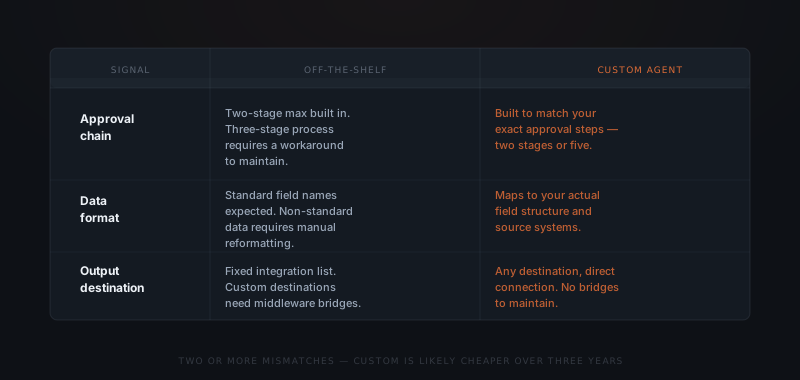
Approval chain — Off-the-shelf tools support a fixed number of approval stages. A two-stage process (draft → approve → send) is standard. A three-stage process (draft → team review → manager sign-off → send) often requires a workaround: a separate Slack thread, a manual step, or a custom Zap. Each workaround adds a process to maintain.
Data format — Off-the-shelf agents expect inputs in a specific shape. When your CRM uses non-standard field names, or your data lives in a system the tool doesn't natively connect to, every run requires reformatting. Reformatting is either done by a human or maintained as a custom transformation — both add ongoing cost.
Output destination — Off-the-shelf agents output to a fixed set of destinations. When your output needs to go to a custom CRM, an internal dashboard, or a client portal not on the tool's integration list, you bridge the gap with middleware — Zapier, Make, or custom webhooks. Each bridge adds a dependency that can break independently.
One mismatch is a manageable workaround. Two or three mismatches are a collection of workarounds that compound.
The three fit signals scored:
| Fit signal | Matched | Mismatched |
|---|---|---|
| Approval chain | ≤2 stages; tool supports your exact flow without modification | 3+ stages; requires a manual step, a separate Slack thread, or a custom Zap to close the loop |
| Data format | Standard field names; CRM natively supported by the tool | Non-standard fields; custom transformation required every run |
| Output destination | Output goes to Gmail, Slack, HubSpot, or another natively supported destination | Output needs to reach a custom CRM, internal portal, or endpoint not on the tool's integration list |
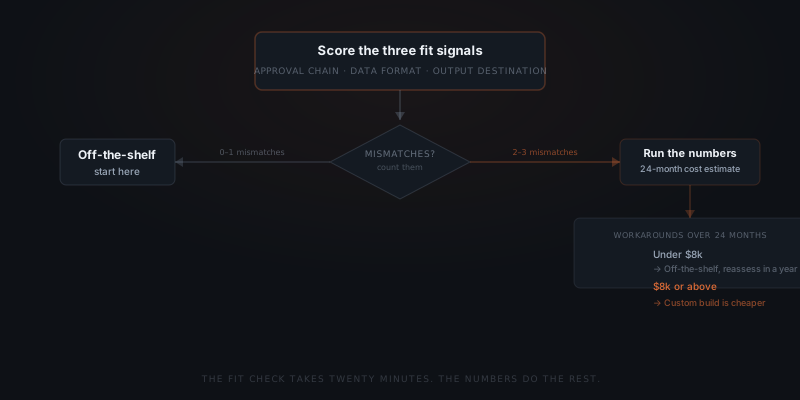
Scoring: 0 mismatches → start with off-the-shelf, no cost comparison needed. 1 mismatch → start with off-the-shelf, reassess at 12 months with real workaround data. 2–3 mismatches → run a 24-month cost comparison before committing to either path.
What workarounds actually cost over time
The upfront price of an off-the-shelf tool is clear: a monthly or annual subscription, often under $500/month. The cost of the workarounds distributes across months of small friction events and is harder to see at purchase time.
Workaround cost has two components. Build cost covers writing the Zap, the custom transformation, the middleware bridge. Three integration bridges typically take a founder three to five days to build. Maintenance cost accumulates when the off-the-shelf tool updates its API, when a connected system changes its data format, or when a new version breaks existing configuration. A realistic assumption is one maintenance event per integration per year at four to eight hours each.
The tool is cheap. The workarounds are where the cost lives.
The 24-month cost comparison by number of fit signal mismatches — using the calculation method above for the workaround estimate:
| Fit signal mismatches | 24-month cost (off-the-shelf + workarounds) | Custom agent 24-month cost | Which wins at 24 months |
|---|---|---|---|
| 0 mismatches | $5,000–$12,000 (subscription + standard maintenance) | $9,200–$32,500 | Off-the-shelf |
| 1 mismatch | $7,000–$16,000 (subscription + 1 workaround) | $9,200–$32,500 | Off-the-shelf — reassess at 12 months |
| 2 mismatches | $10,000–$22,000 (subscription + 2 workarounds) | $9,200–$25,000 | Run detailed comparison |
| 3 mismatches | $14,000–$28,000 (subscription + 3 workarounds) | $9,200–$25,000 | Custom likely wins |
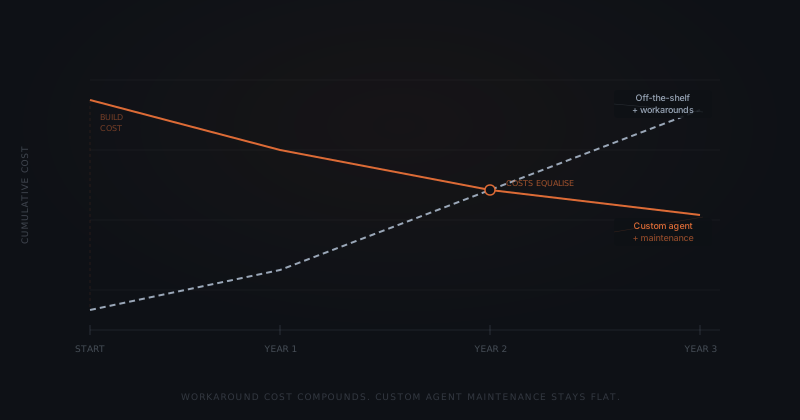
Over two to three years, maintaining three significant workarounds typically reaches $8,000–$15,000 in founder time or contractor fees. A narrow custom agent scoped to the same workflow — one workflow, one to two integrations — builds for $8,000–$25,000. When the 24-month workaround estimate approaches the build cost, the custom agent is the cheaper option at the two-year mark. Custom agent maintenance after launch also runs lower than workaround maintenance, because the agent was built to fit the workflow rather than forced around it.
What off-the-shelf agents do well
Off-the-shelf tools are the right choice when your workflow matches the tool's assumptions. The match is common. Most service businesses using Gmail, Slack, Notion, and a standard CRM will find that Hermes or OpenClaw handles 80–90% of their common workflows without modification.
Off-the-shelf tools also deploy faster. A custom build for a single workflow typically takes four to eight weeks. An off-the-shelf tool can be live in days.
The deployment timeline comparison:
| Timeline point | Off-the-shelf | Custom agent |
|---|---|---|
| Go-live | 3–7 days | 4–8 weeks |
| First output review | Same week | End of week 4 |
| First full production run | Week 1 | Week 5–8 |
| Workaround discovery | Weeks 2–4 | N/A — built to match the workflow |
| Maintenance cycle begins | Month 1–3 (integration drift after first tool updates) | Month 3–6 (after initial calibration period) |
| Typical reassessment point | Month 6–12 | Month 12 (scale or add workflows) |
The businesses best served by off-the-shelf: standard tool stacks, two-stage approval flows, outputs going to natively supported destinations, and workflows common enough to match the tool's design assumptions. Most agencies, consultancies, and service businesses with five to twenty staff in their first year of agent adoption will find that one or two off-the-shelf tools cover 70–80% of their highest-value workflows without modification. The off-the-shelf path is also lower risk as a first implementation: the tool works predictably, the vendor handles maintenance on the tool side, and the business can validate its workflow assumptions before committing to a custom build.
What the two choices look like in practice
A six-person marketing agency. The team uses Gmail, Slack, HubSpot, and Google Calendar — all natively supported by standard off-the-shelf agents. Their approval flow is two stages. All of their output goes to Gmail. Fit signal score: 0 mismatches. Off-the-shelf is the right choice. They are running Hermes within a week at a fraction of what a custom build would cost. At 12 months, they reassess whether any new requirements have appeared.
A compliance consultancy. Their approval flow requires three stages (draft → team review → partner sign-off). Client data uses internal field names not mapped to standard CRM fields. Outputs go to a client portal that no standard integration supports. Fit signal score: 3 mismatches. After running the 24-month cost comparison, the consultancy finds their workaround estimate exceeds $12,000. They commission a custom agent scoped to the intake workflow. At 18 months, the custom agent is cheaper than the off-the-shelf alternative would have been.
A boutique HR consultancy trying off-the-shelf first. They start with an off-the-shelf agent for candidate intake, with full awareness that they have one mismatch in their approval chain and may eventually need a custom build. Three months in, the workaround is manageable but adds 45 minutes of setup per week. At six months, they have enough data from real operation to scope a custom build with precision — no guesswork about edge cases. The custom build takes four weeks and eliminates the workaround entirely.
The third scenario — start with off-the-shelf, move to custom when the friction is well-documented — produces the best custom build. Six months of real operation is the most reliable specification document available. A custom build scoped from a stack of documented workarounds has almost no scope creep; a custom build scoped from assumptions about what might go wrong has much more. Teams that try to go directly to custom without any production experience frequently scope the wrong thing.
How to decide
Score your workflow against the three fit signals above. The scoring takes about twenty minutes and determines whether the decision is straightforward or requires a cost comparison. Zero or one mismatches: start with off-the-shelf. Two or three: run the numbers.
Estimate total workaround cost over 24 months. The calculation has three components:
-
Workaround build time. Count the number of bridges, Zaps, or custom transformations required. Each one typically takes a founder two to four days to build or a contractor $500–$1,500 to deliver.
-
Annual maintenance per integration. Assume one maintenance event per integration per year at four to eight hours each. API updates, format changes, and tool version bumps drive this cost. Three integrations × 6 hours × $75/hour = $1,350/year in maintenance alone.
-
Ongoing friction cost. If managing workarounds takes two hours per week, that is 100 hours per year — at any meaningful hourly rate, a significant cost that does not appear in the subscription fee.
Add all three components over 24 months. Compare that total to a custom build quote for the same workflow.
For a single-workflow custom build with one to two integrations, build cost typically runs $8,000–$25,000, depending on integration complexity. If your 24-month workaround estimate is under $8,000, start with off-the-shelf and reassess after a full year. If the estimate is above $8,000, custom is the cheaper option at the two-year mark even accounting for upfront build cost.
For the full cost breakdown, see what a custom agent actually costs. For the build process, see how to build a custom agent.
Frequently asked questions
When should a business choose off-the-shelf over a custom agent? Off-the-shelf agents fit when your workflow matches the tool's built-in assumptions: approval flows of one to two stages, data in the expected format, and outputs going to natively supported destinations. When all three conditions are met, off-the-shelf is faster to deploy and cheaper to start.
When does a custom agent become the cheaper option? A custom agent becomes the cheaper option when two or three fit signals are mismatched and estimated workaround maintenance over 24 months approaches $8,000–$15,000. At that point, the build cost of a narrow custom agent is comparable, and ongoing maintenance runs lower because the agent was built for the workflow.
Can a business start with off-the-shelf and move to custom later? Yes. Starting with off-the-shelf for three to six months produces real data about exactly where the tool breaks. That data is the most reliable input for scoping a custom build — it replaces pre-build assumptions about edge cases with observed friction points.
What does a custom agent cost compared to off-the-shelf? Off-the-shelf tools typically run under $500/month. A single-workflow custom build with one to two integrations costs $8,000–$25,000 upfront, with ongoing maintenance at 15–30% of build cost per year. The custom build becomes cost-competitive when 24-month workaround maintenance would cost the same. See what a custom agent actually costs for a full breakdown.
Notes
- Anthropic, Building effective agents, 2024. Cited for general agent design-complexity factors, not for the specific cost figures below. anthropic.com/research/building-effective-agents
- Yardwork, What a Custom Agent Actually Costs, May 2026. Planning-estimate cost ranges used for the 24-month comparison above — see that post's Notes for how those ranges are scoped.