Monday morning at a five-person agency: three client reports overdue, two proposals half-written, four status emails to send before the first call. None of it requires strategy. All of it takes the hours the team should spend on client work. AI agents handle that layer — the reporting, the follow-up emails, the CRM entries, the onboarding sequences — drafting each one and queuing it for approval. The account team approves in seconds and moves on.
Monday morning at a five-person agency: three client reports overdue, two proposals half-written, four status emails to send before the first call. None of it requires strategy. All of it takes the hours the team should spend on client work. AI agents handle that layer — the reporting, the follow-up emails, the CRM entries, the onboarding sequences — drafting each one and queuing it for approval. The account team approves in seconds and moves on. That draft-and-approve pattern is the general shape of what an AI agent is — an agency workflow is one application of it.
What marketing agency hours actually go to
Marketing agencies sell strategy, creative direction, and execution. The operational layer that surrounds client delivery — status updates, report assembly, CRM housekeeping, proposal drafts, and new client onboarding — often takes as much time as the billable work itself.
HubSpot's AI Trends for Marketers report, surveying over 1,000 marketing professionals, found that marketers recover 6.1 hours per week on average when AI handles routine workflow tasks.[¹] For a five-person agency where account managers bill at $100–$150 per hour, that is $3,000–$4,500 in recovered capacity weekly — or the equivalent of a part-time hire.
The tasks that consume those hours are consistent across agencies:
| Task | Typical hours per week | Agent handles |
|---|---|---|
| Client status emails | 3–4 hrs | Yes — drafts and queues for approval |
| Report assembly from analytics | 3–5 hrs | Yes — pulls data, formats, queues |
| CRM updates after calls | 2–3 hrs | Yes — reads conversation, updates records |
| Proposal first drafts | 3–4 hrs | Partial — drafts from template, team refines |
| New client onboarding emails | 1–2 hrs | Yes — runs sequence, tracks responses |
| Campaign strategy | 4–6 hrs | No |
| Client calls and strategy sessions | 4–8 hrs | No |
The first five rows are the operational cost of running client relationships. They require accuracy and consistency — not the judgment the agency was hired for.
What AI agents handle in a marketing agency workflow
An AI agent connects to the tools the agency already uses and handles the output layer — drafting, updating, and queuing — without needing direction for each task.
Client reporting. The agent reads from connected analytics platforms (Google Analytics, HubSpot, Databox, or the client's dashboard), formats the data against the agency's report template, and queues the completed report for account manager review. The account manager checks the numbers, adds commentary, and approves. The report goes out under the account manager's name — not as a raw data export.
CRM maintenance. After client calls and email threads, the agent reads the conversation and updates the relevant CRM record — deal stage, last contact date, next follow-up, and any action items. Account managers stop serving as the data-entry layer between client conversations and the CRM.
Proposal generation. When a new brief arrives, the agent pulls from previous proposals in similar verticals or scope, generates a first draft against the agency's proposal structure, and surfaces it for review. Proposals that took three hours to draft take thirty minutes to review and refine.
Client onboarding. New client onboarding involves a predictable sequence of emails, document requests, kickoff scheduling, and brief confirmation. The agent runs the sequence, tracks responses, and flags anything that has not moved in 48 hours — without the account manager tracking it in a spreadsheet.
Follow-up sequences. After proposals go out, after deliverables ship, and at regular check-ins during engagements, the agent maintains the follow-up cadence. Account managers stop setting manual reminders for each client and each outstanding item.
How agents connect to the tools agencies already use
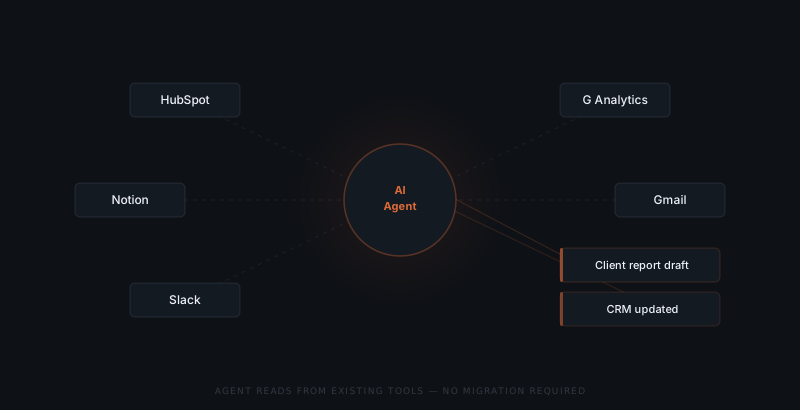
AI agents for marketing agencies work inside the tools the team already uses — not as a replacement layer requiring migration. HubSpot, Notion, Gmail, and Slack connect through standard APIs. The agent reads and writes to each system, queuing every output for a human to approve before it reaches any client.
Marketing agencies are not short on tools. The integration challenge is wiring the existing stack together so the agent can act across systems without manual coordination between them.
CRM. HubSpot, Pipedrive, and Salesforce expose contact records, deal stages, and activity logs through APIs. The agent reads from and writes to CRM records — updating pipeline status, logging calls, and scheduling follow-up tasks — without the account manager entering data between conversations.
Analytics and reporting. Google Analytics 4, HubSpot Marketing Hub, Databox, and individual platform dashboards (Meta Ads Manager, LinkedIn Campaign Manager) expose performance data via API. The agent reads the data, formats it against the agency's report template, and queues the report for review. When the client dashboard changes, the agent regenerates without a manual export step.
Email. Gmail and Outlook connect via OAuth. The agent drafts emails into a review queue — the account manager reads the draft, edits if needed, and sends with one approval action. Nothing goes to a client before a human has reviewed it.
Project management. Notion, Asana, and ClickUp connect through their APIs. The agent reads task statuses, generates project update summaries, and flags overdue items that need the account manager's attention.
Internal communication. Slack routes approvals, flags, and status updates into a dedicated channel. The account manager approves or dismisses from Slack without opening a separate interface.
The setup is a one-time integration project. Once the agent is connected to the agency's stack, it runs the defined workflows against those connections without ongoing manual coordination.
What stays with the agency team
Client churn rarely starts with bad work. It starts with slow reports and unanswered emails.
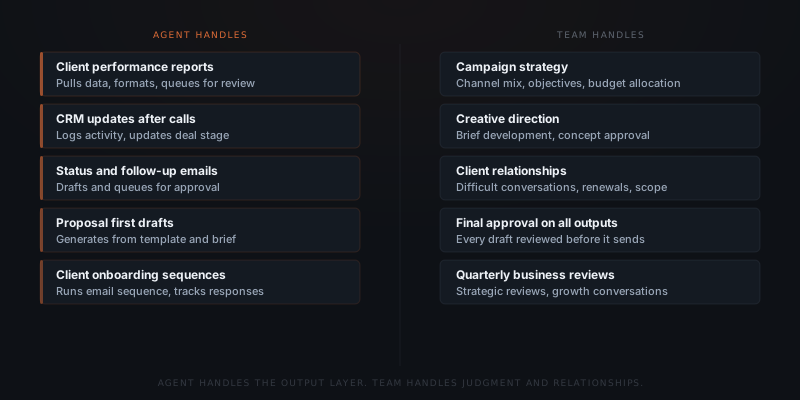
AI agents handle the communication and operational layer. The judgment layer stays with the account team — and that is where agency value concentrates.
Campaign strategy. Channel selection, budget allocation, objective-setting, and media mix decisions require the account team's understanding of the client's business, competitive environment, and risk tolerance. An agent cannot replicate the contextual reasoning behind a media strategy recommendation.
Creative direction. Brief development, concept approval, and quality review require taste and knowledge of the client's brand. An agent formats a creative brief from a template. An agent cannot determine whether a campaign concept fits a specific client's voice.
Client relationships. The conversations that retain clients — difficult performance reviews, scope expansions, strategic resets — require the account team's judgment and relational history. An agent maintains the cadence of regular touchpoints. An agent cannot conduct a quarterly business review.
Final approval on all outputs. Nothing the agent drafts reaches a client without a human reviewing it. The agent is a preparation layer, not a replacement for the account manager's decision about what leaves the agency.
Agencies that implement agent workflows find that account managers shift time from operational tasks to strategic work — not that they reduce headcount. The capacity recovered returns to the work clients are paying for. 60% of marketers who adopt AI automation report higher client engagement as a direct result.[²]
How marketing agencies start with AI agents
Identify the highest-volume repetitive output
Start with one output the account team produces repeatedly with consistent structure: weekly status reports, CRM updates after calls, or new client onboarding email sequences. Avoid starting with proposals — they need the most context and customization. Choose the output the team produces most often with the least variation.
Document the current process for that output
Write down exactly what data goes in, what the output looks like, and what approval step happens before it goes to the client. This documentation becomes the agent's operating brief. Agencies that can describe their process clearly reach production in two weeks. Agencies that cannot spend the first week documenting before implementation can start.
Connect the relevant tools
Map which systems the agent needs to read from (analytics platform, CRM, email) and write back to (email queue, CRM activity log, Slack). A standard marketing agency setup covers three to four integrations. Each connection is a standard API setup — no custom development required for the most common tools.
Run one client's workflow for three weeks
Deploy the agent on one active client's reporting cycle for three full weeks. Review every draft output before it goes out. Note where the agent gets the format and content right consistently and where adjustments are needed. Configure based on what the first three weeks reveal before expanding to more clients.
Define success criteria before scaling
Before rolling out to the full client roster, agree on what good looks like: how long report review should take, what error rate in CRM updates is acceptable, how many proposal drafts need significant revision. Without defined criteria, scaling produces inconsistent quality instead of consistent efficiency.
A standard marketing agency implementation goes from the first scoping call to the first live report output in two to three weeks. See what a real AI agent implementation involves for the full timeline from scoping to production deployment.
For a comparison of whether a custom build or an off-the-shelf solution fits your agency's stack better, see custom vs. off-the-shelf AI agents.
Frequently asked questions
How do AI agents help marketing agencies? AI agents help marketing agencies by handling the client communication and reporting layer — weekly status emails, performance report drafts, CRM updates, proposal generation, and client onboarding sequences. The agent drafts each output and queues it for account manager review. Marketing agencies using agent workflows recover 6+ hours per account manager per week, returning that capacity to billable strategy and creative work.[¹]
What tasks can an AI agent automate for a marketing agency? An AI agent automates report generation from connected analytics platforms, client status email drafts, CRM updates after calls, new client onboarding sequences, proposal first drafts, and post-deliverable follow-up sequences. Campaign direction, creative brief development, and client relationship decisions remain with the account team. Every agent output passes through a human review step before reaching any client.
How does an AI agent connect to a marketing agency's tools? AI agents connect through standard APIs to HubSpot or Pipedrive for CRM, Google Analytics or Databox for reporting, Gmail or Outlook for client email, Slack for internal communication, and Notion or Asana for project tracking. The agent reads data from each connected system and writes approved outputs back. No migration to new tools is required — the agent works inside the existing stack.
What does a marketing agency AI agent implementation cost? A standard implementation covering client reporting, CRM automation, and onboarding sequences typically runs $3,000–$8,000 for the initial build, depending on the number of tool integrations and the reporting layer complexity. Monthly API costs at typical agency client volumes run under $200. See what AI agent implementation actually costs for a small business for a full cost breakdown by scope.
Notes
- HubSpot. (2026). "The HubSpot Blog's AI Trends for Marketers Report." HubSpot Blog. https://blog.hubspot.com/marketing/state-of-ai-report — source for: marketers recover 6.1 hours per week on average with AI automation, based on a survey of 1,000+ marketing professionals.
- Emarsys / SAP Engagement Cloud. (2025). "AI in Retail Global Report 2025." Emarsys. https://emarsys.com/learn/blog/marketing-automation-statistics/ — source for: 60% of marketers report higher client engagement after adopting AI; 58% report higher loyalty.
- DemandSage. (2026). "Marketing Automation Statistics 2026." DemandSage. https://www.demandsage.com/ — source for: 71% of companies have adopted marketing automation; automated workflows save 2.3 hours per campaign on average.