For business owners in the US and Europe who publish or plan to publish content written with AI, this guide explains what Google penalizes, what the ranking data shows, when AI text must be labeled, and how to publish it safely.
What you'll learn
- What Google's guidance says about AI-written content, and what it calls scaled content abuse
- What Google's quality raters treat as low-effort AI content
- Whether Google or AI detectors can tell that a text was written by AI
- How AI-assisted pages rank compared with human-written ones
- When the EU AI Act requires a label on AI-written text, and the checks before publishing
Google does not penalize a page because AI wrote it. Its guidance since February 2023 says that appropriate use of AI is not against its rules, and a July 2025 study of 600,000 top-ranking pages found some AI-generated text in 86.5% of them. What Google does penalize is content produced at scale to rank without helping anyone, a spam policy it named "scaled content abuse" in March 2024. This guide covers what Google's rules and quality raters say, whether AI text can be detected, how it ranks, when it must be labeled in the EU, and how to publish AI-assisted content safely.
Most businesses now use AI somewhere in their writing, and many owners wonder whether Google will hold it against them. Google has answered that question in writing, more than once. The answer is no, with one condition that matters more than the question.
This guide sets out what Google's own documents say, what its quality raters are told to look for, what independent studies show about detection and ranking, and the EU's labeling rule for AI-written text. It ends with the checks that keep AI-assisted content on the right side of all of them.
Does Google penalize AI-written content?
No. Google does not penalize content because AI wrote it. In February 2023, Google's Search team wrote that "appropriate use of AI or automation is not against our guidelines" and that its systems reward quality "however it is produced".[1] The same post put it plainly: "Using AI doesn't give content any special gains. It's just content."[1]
The condition is in the same guidance. Using automation, including AI, "to generate content with the primary purpose of manipulating ranking in search results is a violation of our spam policies".[1] Google's FAQ answers the question "Should I use AI to generate content?" with a test of intent: if AI helps you produce content that is helpful and original, consider it; if you see it as "an inexpensive, easy way to game search engine rankings, then no".[1]
The ranking data fits that position. A July 2025 study by Ahrefs, which sells SEO software, looked at the top 20 results for 100,000 random keywords and found some AI-generated text in 86.5% of the 600,000 pages.[8] If Google demoted pages for containing AI text, that share would be hard to explain.
What does Google penalize instead?
Google penalizes scaled content abuse: publishing many pages mainly to manipulate rankings rather than to help people. As of August 2026, Google's spam policies list "using generative AI tools or other similar tools to generate many pages without adding value for users" as an example.[2] Pages that break the policy "may rank lower in results or not appear in results at all".[2]
The policy does not care who did the writing. Google states that it applies whether content comes from automation, human writers or a combination.[3] A team of freelancers turning out hundreds of thin pages for search traffic breaks it as surely as an AI tool does.
Google finds violations with automated systems and, where needed, human review. A confirmed violation can lead to a manual action, reported in the Manual actions report in Google Search Console; the owner can fix the problem and ask for a review.[2] The other examples on Google's list show what the policy targets: scraping search results or feeds to generate pages, stitching together content from other sites, and creating pages that make little sense to a reader but contain search keywords.[2]
What changed in Google's March 2024 update?
Google turned the old rule against automatically generated content into a broader spam policy. On March 5, 2024, it announced the March 2024 core update and three new spam policies: scaled content abuse, site reputation abuse and expired domain abuse.[3] Google expected the changes to cut low-quality, unoriginal content in search results by 40%; when the rollout finished on April 19, 2024, it reported a 45% reduction.[4]
The reason for the change was that mass-produced content had become harder to spot. Google's announcement said scaled content methods had become "more sophisticated" and that it was not always clear whether content was created purely through automation.[4] So the policy moved from the method to the behavior: "producing content at scale to boost search ranking — whether automation, humans or a combination are involved".[4]
For a business, the practical meaning has not changed since. A page earns its place by answering a question better than the pages already ranking for it. A page that exists only because a keyword tool showed demand, and that repeats what the top results already say, is the kind of page the update was built to remove.
What does Google treat as low-effort AI content?
Google's quality raters give the lowest rating to pages where almost all the main content is "copied, paraphrased, embedded, auto or AI generated, or reposted from other sources with little to no effort, little to no originality, and little to no added value".[5] The rater guidelines dated September 2025 add that "the use of Generative AI tools alone does not determine the level of effort or Page Quality rating".[5]
Raters do not decide rankings. Google uses their ratings to check whether its ranking systems work, and it states that the ratings "don't directly influence ranking".[7] The guidelines still show what Google's systems are built to recognize, and they are specific about the signals.
Google also publishes questions for site owners to ask about their own content. Two of them describe the AI-content risk directly: "Are you using extensive automation to produce content on many topics?" and whether you are writing to a particular word count because you heard Google prefers it.[6]
| Signals of added value | Signals of scaled, low-effort content |
|---|---|
| First-hand experience, your own data, photos or cases | Paraphrase of what the top results already say |
| A named author who knows the subject | Made-up author profiles or AI-generated headshots[6] |
| Facts checked against sources, with dates | Unchecked claims, invented numbers or sources |
| Written for your existing customers' questions | Pages made for every keyword variation a tool suggests |
| Published at the pace someone can review | Hundreds of pages published at once without review[2][5] |
The rater guidelines also name a telltale sign of paraphrased AI content: leftover phrases such as "As an AI language model".[5] A page that still contains one shows that nobody read it before it went live.
Can Google detect AI-written content?
Google has not said whether it can identify AI-written text, and its stated approach makes the question less important than owners think. In its 2023 guidance, Google said its spam systems, including SpamBrain, "analyze patterns and signals to help us identify spam content, however it is produced".[1] Google looks for the behavior, not the tool.
Independent detectors are a poor guide either way. A 2023 study tested 12 publicly available tools and two commercial systems, including Turnitin, and concluded that they "are neither accurate nor reliable", with a bias towards labeling AI text as human-written.[9] Light editing or rephrasing made them worse.[9]
Detectors also flag human writing as AI. In a 2023 study by researchers at Stanford University, seven widely used detectors labeled more than half of a set of essays by non-native English writers as AI-generated, with an average false positive rate of 61%, while classifying essays by US eighth graders almost perfectly.[10] Plain, simple sentences look machine-made to these tools.
Two conclusions follow for a business. A "100% human" score from a detector does not make a page safe, and an "AI-generated" score does not make it unsafe. What protects you is the same thing Google is looking for: a page that adds something real, checked by someone who knows the subject.
Does AI content rank as well as human-written content?
AI-assisted content ranks about as well as human-written content, according to the largest public study. Ahrefs analyzed 600,000 pages ranking in Google's top 20 in July 2025 and found a correlation of 0.011 between the share of AI-generated text on a page and its ranking position, which it called "effectively zero".[8]
| Content type (Ahrefs' detector) | Share of top-20 pages |
|---|---|
| Mix of AI and human writing | 81.9% |
| Human-written only | 13.5% |
| AI-generated only | 4.6% |
The same study found one difference at the very top. Pages in position 1 tended to contain slightly less AI-generated text than the rest, and pages with minimal AI use correlated very slightly with higher rankings.[8] Ahrefs described the effect as very weak.
Read the numbers with their limits. Ahrefs used its own AI detector, which it sells, and it notes that no detector is perfect.[8] The study measures correlation, not cause. It does support one practical reading: most pages that rank combine AI drafting with human work, and pages written entirely by AI are rare in the results.
Google does not ask who wrote a page. It asks whether anyone needed it.
That is also where AI tends to fail in business writing. An AI draft is fluent about the general case and silent about yours: your prices, your projects, your customers' real questions. Those are exactly the parts a reader cannot find on the pages already ranking. Our guide on what AI agents are bad at covers the wider pattern, including confident answers that are wrong.
Do you have to label AI-written content?
Google does not require a label on AI-written content, but the EU AI Act does in one case. Google recommends a disclosure "where someone might think 'How was this created?'".[1] Since August 2, 2026, Article 50(4) of the EU AI Act has required that AI-generated text published to inform the public on matters of public interest is labeled, unless it has been reviewed by a person and someone holds editorial responsibility for it.[11][12]
Google's guidance on authorship is short. Use accurate bylines where readers would ask "Who wrote this?", and do not list AI as the author.[1] Inventing authors is worse: Google calls made-up names, AI-generated headshots and false credentials "a form of deception" that makes a page untrustworthy to readers and to its systems.[6] Online stores have one firm rule: in Google Merchant Center, AI-generated product titles and descriptions must be submitted separately and labeled as AI-generated.[7]
The EU rule applies to text on matters of public interest. The European Commission lists examples such as public health, consumer safety and economic, financial or scientific developments that may be the subject of public debate.[11] A post about your opening hours is outside it. A post explaining a new consumer-safety rule to the public may be inside it.
The exemption is worth more than the label. The Commission defines human review as "deliberate examination of the substance of the content" by people "possessing relevant knowledge", and states that spell-checking or grammar correction does not count.[11] A business that has an expert check every AI draft, and that takes editorial responsibility for what it publishes, can rely on the exemption and follows Google's advice at the same time. Content generated before August 2, 2026 does not need a label retroactively.[11] For the AI Act's other duties, see our EU AI Act guide for small businesses.
How do you publish AI-assisted content safely?
Publish AI-assisted content the way Google's guidance describes: start from what you know, let AI draft, and have a person who knows the subject check every fact before it goes live. As of October 2026, Google's guidance on generative AI content calls it "critical to manually factcheck and review all AI-generated content for accuracy and trustworthiness before publishing".[7] That review includes the page title, meta description, structured data and image descriptions, which appear in search results.[7]
Start from your own material
Pick questions your customers ask
Let the AI draft
Have an expert check the substance
Check what search shows
Put a real name on it
Publish at a reviewable pace
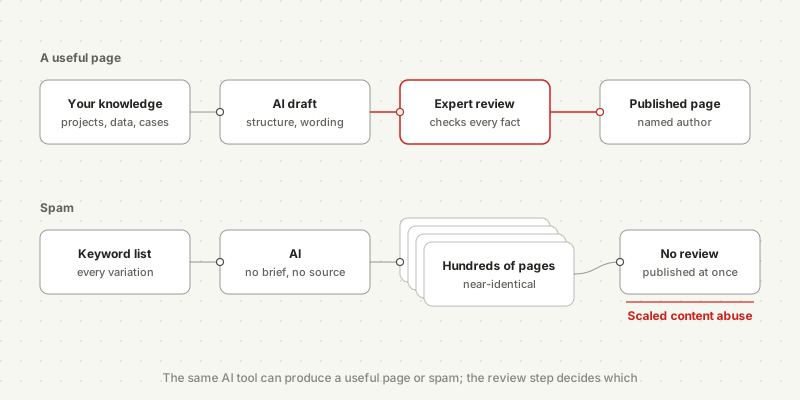
Step 4 is the one that slips first when a team gets busy. A review that only fixes typos meets neither Google's advice nor the EU's definition of human review.[7][11] Our guide on what human-in-the-loop means in practice shows how to set up a review step that stays real after the first month.
When does a content agent make sense?
A content agent makes sense when your business has more expertise than time to write it down. Google's 2023 guidance says AI can help "create great content for the web" when it is used to produce something helpful and original.[1] An agent that drafts from your own projects and data, and holds every piece until an expert approves it, does that.
It does not make sense as a way to publish more pages than anyone can read. The agent's value is turning what your team knows into drafts quickly, not multiplying pages. The work that decides the result happens before and after the draft: what you give the agent, and who checks it.
Briefing is where most of the quality comes from. Our guide on how to brief an AI agent covers what to give it so drafts sound like your business, not like the average of the web. For the choice between a ready-made writing tool and an agent built around your own material, see what a custom agent is and when to build one.
Frequently asked questions
Does Google penalize AI-generated content? No, not for being AI-generated. Google's guidance since February 2023 says appropriate use of AI is not against its guidelines and that it rewards quality however content is produced. Google does penalize content produced at scale mainly to manipulate rankings, which its spam policies call scaled content abuse. Pages that break the policy may rank lower or disappear from results, whether AI or people wrote them.
Can Google detect AI-written content? Google does not say whether it can identify AI-written text, and it says it looks for spam however it is produced. Third-party AI detectors are unreliable: a 2023 study of 14 detection tools found them neither accurate nor reliable, and another found an average false positive rate of 61% across seven detectors for essays by non-native English writers. Whether a page is useful matters more than whether a detector flags it.
Do I have to disclose that content was written with AI? Google recommends a disclosure where readers would reasonably ask how a piece was made, and it advises against listing AI as the author. In the EU, the AI Act has required since August 2, 2026 that AI-written text published to inform the public on matters of public interest is labeled, unless a person with relevant knowledge has reviewed it and someone holds editorial responsibility. Spell-checking alone does not count as review.
Is it safe to publish AI-written blog posts on a business website? Yes, when each post adds something a reader cannot find elsewhere and a person who knows the subject checks it before it goes live. Google's guidance calls it critical to fact-check AI content, including titles, descriptions and image text. The risk comes from publishing many pages that repeat what already exists, which Google treats as spam whoever wrote them.
Notes
- Google Search Central Blog, Google Search's guidance about AI-generated content, Danny Sullivan and Chris Nelson, February 8, 2023, accessed October 16, 2026.
- Google Search Central, Spam policies for Google web search, section "Scaled content abuse", last updated August 28, 2026, accessed October 16, 2026.
- Google Search Central Blog, What web creators should know about our March 2024 core update and new spam policies, Chris Nelson, March 5, 2024, accessed October 16, 2026.
- Elizabeth Tucker, Google Search: New updates to address spam and low-quality results, Google, March 5, 2024, updated April 26, 2024, accessed October 16, 2026.
- Google, Search Quality Rater Guidelines (General Guidelines), version of September 11, 2025, sections 4.6.5 and 4.6.6, accessed October 16, 2026.
- Google Search Central, Creating helpful, reliable, people-first content, accessed October 16, 2026.
- Google Search Central, Google Search's guidance on using generative AI content on your website, accessed October 16, 2026.
- Si Quan Ong, AI-Generated Content Does Not Hurt Your Google Rankings (600,000 Pages Analyzed), Ahrefs, July 7, 2025, accessed October 16, 2026. Vendor research; Ahrefs used its own AI detector.
- Weber-Wulff et al., Testing of detection tools for AI-generated text, International Journal for Educational Integrity 19, article 26, December 25, 2023, accessed October 16, 2026.
- Liang et al., GPT detectors are biased against non-native English writers, arXiv:2304.02819, revised July 10, 2023, published in Patterns, accessed October 16, 2026.
- European Commission, Transparency obligations under Article 50 of the AI Act, accessed October 16, 2026.
- AI Act Service Desk, Article 50: Transparency obligations for providers and deployers of certain AI systems, consolidated text as at July 27, 2026, accessed October 16, 2026.