For trade businesses and small service firms in the US and Europe thinking about letting AI write quotes, this guide explains what AI quoting tools can do, when a quote binds you, where AI gets quotes wrong, and what to check before sending.
What you'll learn
- How AI quoting tools turn voice notes, photos and text into a draft quote
- When a quote binds you in the US and the UK, and why Germany is stricter
- How a quote differs from an estimate
- What a quote to a consumer must show, including cancellation rights for sales at home
- Where AI gets quantities, prices and totals wrong, and seven checks before sending
- When a custom quoting agent is worth building
AI can turn a voice note from a job site into a draft quote in minutes: in October 2026, field-service software for trades advertised creating quotes "using just your voice" in the field. But a quote the customer can accept is your price once they accept it, and in Germany a quote binds you from the moment you send it. AI language models are also weak at arithmetic: in a study published in 2024, their maths performance dropped when only the numbers in a task changed. This guide sets out what AI quoting tools do, when a quote binds you in the US and in Europe, how it differs from an estimate, what a quote to a consumer must show, where AI gets quotes wrong, and the checks before one goes out.
A quote takes time. Someone measures, notes the work, looks up prices, writes the line items, adds them up and turns it into a document the customer understands. AI can take over much of that. It can also commit you to a price you never meant to offer.
This guide covers what AI quoting tools do today and when a quote binds you, in the US and in Europe, with Germany as the strictest case. It also covers where AI gets quotes wrong and the checks that catch it before the customer does.
Can AI write a quote for a trade business?
Yes, as a draft from your own price list. In October 2026, Jobber, field-service software for trades, advertised creating quotes "using just your voice" while in the field and automatically drafting quotes from new requests.[10] A German quoting tool for trades described the same idea: services, quantities and materials recognised from a spoken site measurement against your catalogue.[11] General chatbots such as ChatGPT can write the text, but they do not know your prices.
The difference between those two matters more than the AI behind them. A quoting tool that works from your catalogue picks line items and prices you have already set. A general chatbot fills gaps with plausible guesses, including prices that look reasonable but are not yours.
What AI does well in a quote is the writing: turning "bathroom, tile the walls, remove old tiles, new shower tray" into clear line items with sensible descriptions, and producing a cover note that sounds like your business. What it does badly is arithmetic and judgement about your margins, both covered below.
How do AI quoting tools work?
AI quoting tools match what you say, write or photograph against your own catalogue of services and prices, and assemble a draft quote. Jobber listed plans from $29 a month on annual billing in October 2026, with a 14-day free trial.[10] The German tool listed a Starter plan at €12.90 a month and a Pro plan at €29.90, and presents its quotes as ready to send.[11]
The workflow usually has four steps:
- Capture. You speak the measurements on site, type a short description or upload a photo.
- Match. The AI maps what it heard or saw to line items in your catalogue: services, materials, quantities.
- Assemble. The tool builds the quote document with your letterhead, line items and terms.
- Send. The quote goes to the customer, often as a link they can accept online.
The fourth step is the one to slow down. "Ready to send" describes the format, not whether the quantities and prices are right. The next sections explain why that check has legal weight.
What should the AI capture on site?
The AI can only quote what it is told, so the site visit decides the quality of the draft. The tools described above build their drafts from what you say on site or from the customer's request, matched against your catalogue.[10][11] Anything you do not say or show does not appear in the quote.
A complete capture covers five things:
- Measurements with units. "Eighteen square metres of wall tiles", not "eighteen of tiles". Units are where spoken input most often goes wrong, and square feet and square metres are easy to mix up.
- The existing condition. What has to come out first: old tiles, a damaged subfloor, a cabinet that must be moved.
- Materials and choices. The customer's preferred product, colour or quality level, or a note that they still have to choose.
- Access and logistics. Floor, elevator, parking, a dumpster or skip permit, working hours in the building.
- Unknowns. Anything you cannot see yet, such as what is behind a wall. These are the reasons to send an estimate instead of a fixed quote.
Say a tiler measures a bathroom, for example, and records: "Wall tiles, eighteen square metres, remove old tiles, new shower tray." If the AI hears "eighty" instead of "eighteen", the draft is wrong by a factor of four. Reading quantities back before leaving the site catches that in seconds.
A photo helps the AI suggest line items you may have forgotten. It does not replace the measurement: a photo shows that there are tiles, not how many.
Is a quote written by AI binding?
An accepted quote is your price, whoever drafted it. In the US and the UK, a quote becomes a binding offer when it reads like one: an offer "must be stated and delivered in a way that would lead a reasonable person to expect a binding contract".[1] Germany is stricter. Under §145 of its Civil Code (BGB), whoever offers to make a contract is bound by the offer from the moment it is made, unless the binding effect was excluded.[3]
An itemised quote with a scope, prices and a line to accept reads like an offer. The law does not care who or what wrote it. If the AI picked the wrong line item, misheard "eighteen" as "eighty" or left out a material, the customer can accept the quote as written. Whether you can later get out of a mistake depends on the circumstances, and a dispute costs more than the time a check would have taken.
In the US, a further rule applies when a business sells goods to another business. Under section 2-205 of the Uniform Commercial Code, a merchant's signed written offer that gives assurance it will be held open cannot be withdrawn for the time stated, up to three months.[2] A supplier's signed quote for materials that promises to hold its prices for 60 days is the kind of offer the rule covers.
Many businesses add a validity period or mark quotes as "subject to change" to limit the commitment. That can help, but it makes the quote less useful to a customer comparing offers, and it does not fix a wrong price the customer has relied on. The reliable fix is the check before sending.
What is the difference between a quote and an estimate?
A quote fixes the price; an estimate gives an expected price without guaranteeing it. The line matters most when costs rise. Germany writes it into law: under §632(3) BGB a cost estimate is, in case of doubt, not paid for, and if the work will substantially exceed it, §649 BGB requires the business to tell the customer without delay, after which the customer may terminate.[4][5]
| Quote (fixed price) | Estimate | |
|---|---|---|
| Price | Binding once accepted; in Germany, once sent[1][3] | Expected, not guaranteed |
| If the cost rises | You carry the difference, unless agreed otherwise | Tell the customer before you go far over it; in Germany this is a legal duty (§649 BGB)[5] |
| Paid for? | Part of the offer | In Germany, in case of doubt, no (§632(3) BGB)[4] |
| Best for | Work you can measure and price fully | Work with unknowns, such as hidden damage |
AI tools usually produce a document called a quote. Decide before you send whether it should be a fixed quote or an estimate, and make sure the document says which. An AI-drafted estimate also needs a habit: when the job heads past the estimate, someone tells the customer straight away.
What must a quote to a consumer show?
A quote to a private customer has to show the full price, and a contract signed at the customer's home comes with a right to cancel. In the EU, the Consumer Rights Directive requires the total price inclusive of taxes and gives consumers 14 days to withdraw from a contract concluded away from the business's premises; if they were not told about that right, the period runs for up to 12 more months.[6] The UK applies the same 12-month extension.[7] In the US, the FTC's Cooling-Off Rule gives buyers until midnight of the third business day to cancel most sales of $25 or more made at their home.[8]
Both points matter for AI-written quotes. A quote assembled from net catalogue prices needs a correct total including tax for a private customer in Europe.[6] A tool that lets the customer sign on a tablet at their kitchen table creates a contract concluded at their home.[6][8] In Europe that contract needs a proper withdrawal notice, or the customer may withdraw long after the work has started.[6][7] In the US, the seller must tell the buyer about the right to cancel at the time of the sale and hand over a copy of the contract and two cancellation forms.[8]
The US rule has exceptions a trade business should know: it does not cover work needed to meet an emergency, or repairs on personal property that the buyer asked the seller to come and do.[8] Business customers are outside all of these consumer rules. Make sure the quoting tool knows which kind of customer each quote is for and uses the right template.
The cancellation notice and the price display are standard text. They should come from a template you have had checked once, not be written fresh by the AI for each quote.
Where does AI get quotes wrong?
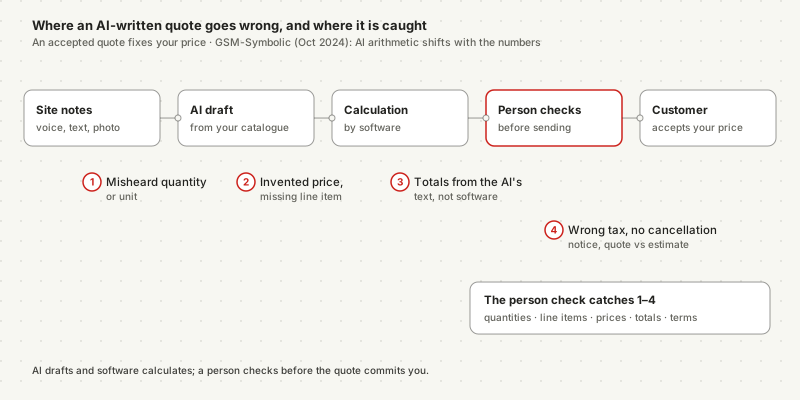
AI gets quotes wrong in four places: the numbers, the line items, the prices and the conditions. A study submitted in October 2024 found that AI models' maths performance declined "when only the numerical values in the question are altered", and that adding one irrelevant-sounding clause caused drops of up to 65%.[9]
The study tested grade-school maths problems, not quotes, and models have changed since. Its lesson still applies to quoting: a language model calculating a total is guessing at arithmetic, and small changes in wording can change the answer.[9] Totals should come from software that calculates, not from the AI's text.
An AI that writes a quote in two minutes can also commit you to a wrong price in two minutes.
| Where it goes wrong | What happens | Fix |
|---|---|---|
| Numbers | A misheard quantity, a wrong unit (square feet instead of square metres), a total added up wrongly | Read quantities back; let software calculate totals[9] |
| Line items | A needed item is missing, or one is included twice | Compare against a checklist for the job type |
| Prices | A price invented or taken from the wrong catalogue entry | Only catalogue prices; flag any line item without one |
| Conditions | Wrong tax treatment, missing cancellation notice, a fixed quote that should have been an estimate | Fixed templates per customer type and place |
Errors of this kind are not unique to quotes. Our guide on where answers from your files go wrong covers the same failure modes for AI that answers from documents. If a wrong quote has already gone out, our guide on what to do when an AI agent makes a mistake covers the response.
What should you check before a quote goes out?
Check the quantities, the line items, the prices, the totals and the legal text, every time, before an AI-written quote reaches a customer. Once the customer accepts, and in Germany once you send it, the quote binds you, so the check belongs before the send button.[1][3] These seven checks take a few minutes for a typical quote.
Quantities against your notes
Line items against the job
Every price from your catalogue
Totals from software
Fixed quote or estimate
Consumer rules
Your name on it
The one-page checklist holds these seven checks and the legal points for the US and Europe: Download the AI quote checklist (PDF).
Do customers have to be told a quote was drafted by AI?
No general duty applies to a quote you send in your own name. In the EU, Article 50(4) of the AI Act requires disclosure for AI-generated text only where it is published "with the purpose of informing the public on matters of public interest", and even then not where a person has reviewed it and holds editorial responsibility.[12] A quote to one customer is neither.
The quote is your offer, whoever drafted it, and the customer deals with you. What matters to them is that the prices and line items are right and that someone answers their questions about it.
The picture changes when the AI talks to the customer directly. In the EU, an AI that answers questions about the quote by chat or phone, in its own name, must be designed so the customer knows it is an AI, under Article 50(1).[12] In California, a bot that chats with customers online to sell to them must not mislead them about being a bot, and disclosing it avoids liability.[13]
When does a custom quoting agent make sense?
A custom quoting agent makes sense when your quotes depend on more than a catalogue: past jobs, supplier prices that change, your own calculation rules, or several people who must approve. Off-the-shelf tools from €12.90 or $29 a month in October 2026 fit a business with a stable price list and simple jobs.[10][11] Complex or high-value quotes need the AI to work inside your own systems.
A custom agent can draft from your site notes, look up current supplier prices, reuse line items from similar past jobs, calculate in your own system and then hold the quote for approval. Our guide to approval workflows in an AI agent system shows how the approval step works: the agent prepares, a person decides, and nothing reaches the customer before that.
The quote is also where sales follow-up starts. If your agent will chase open quotes by email, our guide to cold email and calling rules for sales AI covers the rules. For the general build-or-buy question, see what a custom agent is and when to build one.
Frequently asked questions
Can ChatGPT write a quote for a trade business? ChatGPT can write the text of a quote, but it does not know your prices, and AI language models are unreliable at arithmetic: a study published in 2024 found their maths performance fell when only the numbers in a task changed. Use AI to draft the descriptions and structure, take every price from your own price list, and let software calculate the totals before a person checks and sends the quote.
Is a quote legally binding? It depends on where you work and how the quote is worded. In the US and the UK, a quote binds you once it reads as an offer that a reasonable customer would expect to accept, with definite scope and prices, and the customer accepts it. In Germany, a quote is binding from the moment it is sent unless you exclude that (§145 BGB). An accepted quote is your price, whoever drafted it.
Is an AI-written quote legally different from one I write myself? No. The law does not distinguish who drafted the quote. Once you send it, it is your offer, with your prices and your conditions. That is why a person should check every AI-written quote before it goes out, especially quantities, unit prices and totals.
What must a quote to a private customer include? In the EU, the total price including taxes, and for contracts concluded at the customer's home, information on the 14-day right of withdrawal; without it, the period runs for up to 12 more months. The UK has the same rule. In the US, the FTC's Cooling-Off Rule gives buyers until midnight of the third business day to cancel most sales of $25 or more made at their home, and the seller must say so and hand over two cancellation forms.
Notes
- Legal Information Institute, Wex: Offer, last reviewed August 2023, accessed October 15, 2026.
- Uniform Commercial Code, § 2-205 Firm Offers, Legal Information Institute, accessed October 15, 2026.
- Bürgerliches Gesetzbuch (BGB), § 145 Bindung an den Antrag, accessed October 15, 2026.
- BGB, § 632 Vergütung, accessed October 15, 2026.
- BGB, § 649 Kostenanschlag, accessed October 15, 2026.
- Directive 2011/83/EU (Consumer Rights Directive), Articles 2(8), 5, 6, 9 and 10, accessed October 15, 2026.
- The Consumer Contracts (Information, Cancellation and Additional Charges) Regulations 2013, regulation 31, accessed October 15, 2026.
- Federal Trade Commission, Buyer's Remorse: The FTC's Cooling-Off Rule May Help, September 2025, accessed October 15, 2026. The rule is at 16 CFR Part 429.
- Mirzadeh et al., GSM-Symbolic: Understanding the Limitations of Mathematical Reasoning in Large Language Models, arXiv:2410.05229, submitted October 7, 2024, revised August 27, 2025, accessed October 15, 2026.
- Jobber, pricing page, accessed October 15, 2026. Used as one example of an AI quoting tool for trades: quotes created by voice, auto-drafted quotes, plan prices and trial.
- AngebotFIX, product and pricing page, accessed October 15, 2026. Used as a European example: voice measurement against the user's catalogue, plan prices.
- AI Act Service Desk, Article 50: Transparency obligations, accessed October 15, 2026.
- California Business and Professions Code, sections 17940–17943 (Bots), operative July 1, 2019, accessed October 15, 2026.