
For law firms, accountants and medical practices in the US and Europe, this guide explains when client or patient data may reach an AI tool, what the contract with the provider must cover, and what a firm should set up before staff use AI.
What you'll learn
- Why entering client data into an AI tool can count as disclosure
- What ABA Formal Opinion 512 asks of US lawyers, and HIPAA of medical practices
- What the UK's SRA and the EU's GDPR require, and Germany's stricter secrecy rules
- When the client's consent is needed, and why removing names is often not enough
- How free accounts, business accounts and custom AI differ for confidential work
- A firm policy in five steps
Client confidentiality applies to AI tools the same way it applies to any outside service. In the US, the American Bar Association's Formal Opinion 512 of July 2024 recommends getting a client's informed consent before confidential information goes into a generative AI tool, and says boilerplate in an engagement letter is not enough; a medical practice needs a business associate agreement before a provider handles patient data. In the UK, the Solicitors Regulation Authority warned in August 2026 that client data belongs only in AI systems with contractual, technical and organisational safeguards. In the EU, the GDPR requires a processing agreement, and Germany adds a criminal-law secrecy duty with its own contract rules. This guide sets out what each place requires, what the provider contract must cover, when to ask the client, how to anonymise and what to set up before staff use AI.
AI tools can draft letters, summarise files and check documents in minutes. For law firms, accountants and medical practices, the question is not what the tool can do. It is who may see what is typed into it.
The answer depends on where the firm practises. This guide covers the US and the UK, the EU rule every European firm shares, and Germany, where professional secrecy is written into criminal law and the contract rules are the most explicit. It ends with what a firm should set up before staff open an AI tool with a client file.
Does client confidentiality apply to AI tools?
Yes. Every confidentiality rule that covers outside services also covers AI tools. In July 2024 the American Bar Association applied its Model Rule 1.6 to generative AI in Formal Opinion 512: a lawyer using such a tool must keep confidential "all information relating to the representation of a client, regardless of its source, unless the client gives informed consent".[1] In Germany, §203 of the Criminal Code makes it an offence for lawyers, tax advisers, doctors and other professionals to disclose a client's or patient's secret without authorisation.[6]
The risk is not that someone at the provider reads prompts. It is that the data sits on the provider's systems, where the provider could access it, keep it or use it. Germany's Federal Bar said in December 2024 that for access to client secrets it is enough that a provider has the possibility to read them.[9]
The provider does not have to read your client's file. Having it on its systems can already count as disclosure.
For lawyers there is a second risk. The UK's Solicitors Regulation Authority (SRA) warned in August 2026 that putting client material into an open AI tool will likely breach client confidentiality, and that legal professional privilege "may be permanently waived and unable to be recovered".[4] Once privilege is gone, the client cannot get it back.
What does ABA Formal Opinion 512 require of US lawyers?
ABA Formal Opinion 512, issued on 29 July 2024, applies four duties to generative AI: competence, confidentiality, communication with clients and fees.[1] On confidentiality, it recommends that lawyers secure clients' informed consent before using client confidences in generative AI tools, and says boilerplate consent in an engagement letter will not be adequate.[2] The opinion is guidance rather than binding law, and state and local bars issue their own.[1][2]
Competence comes first. Lawyers must understand what a tool can and cannot do and keep that understanding up to date, and they are responsible for knowing how the tool uses data and for putting safeguards in place.[2] In practice that means reading the provider's terms before the first client file goes in: whether input is stored, for how long, who can see it and whether it trains the model.
The opinion also flags a risk inside the firm. When several lawyers use the same tool, client information from one matter can be used or disclosed in another without anyone intending it.[2] A firm-wide AI assistant needs the same walls between matters that the document system has.
Fees follow the work, not the tool. A lawyer who spends 15 minutes entering information into an AI tool to draft a pleading may charge for that time and for reviewing the draft, but should not charge a client for learning the tool.[1]
US accountants and tax preparers have their own criminal rule. Under 26 U.S.C. §7216, a tax return preparer who knowingly or recklessly discloses information furnished for a return commits a misdemeanor, punishable by a fine and up to one year in prison, unless the regulations permit the disclosure.[11] The regulations require the taxpayer's consent before return information goes to a preparer outside the United States, or to another preparer for substantive advice.[12] They do not name AI tools, so the safe course is the taxpayer's consent before return information goes into an outside AI service.
What do medical practices need before AI sees patient data?
In the US, a business associate agreement. HIPAA lets a covered entity, such as a medical practice, allow a provider to "create, receive, maintain, or transmit protected health information on its behalf" only after obtaining satisfactory assurance that the provider will safeguard it, documented "through a written contract or other written agreement or arrangement".[3] An AI tool that handles patient data without that agreement puts the practice in breach.
In the EU, patient data is health data, one of the special categories under Article 9 of the GDPR, with stricter conditions for processing, and any provider that handles it for the practice needs a processing agreement under Article 28.[5] In Germany, doctors, dentists and pharmacists are also bound by §203 of the Criminal Code, so the provider must be bound to secrecy as well.[6]
The practical rules are the same everywhere. Clinical details do not go into a general AI tool on a consumer account. A provider that processes patient data signs the agreement your place requires before the first record reaches it. Anything that answers patients directly, such as a chatbot on the practice website, stays on appointments and practice information.
What does the UK require of solicitors using AI?
The SRA's warning notice of 17 August 2026 says that "both free to use and paid for AI systems may pose risks to client confidentiality", and that client information should only be entered into AI systems where appropriate contractual, technical and organisational safeguards are in place.[4] Firms should be satisfied that client data is not used to train AI models "except where explicitly authorised and appropriate to do so".[4]
The notice also settles who answers for the result: "The use of AI does not diminish or transfer your professional responsibilities."[4] A solicitor who files an AI-drafted document is responsible for it as if they had written it.
For a UK firm, the notice translates into three questions before any tool is approved. Does the contract keep client data confidential and out of training? Where is the data held, and for how long? Can the firm show a regulator which tools staff use, and for what? A paid account answers the first question only if its terms say so.
What must the contract with an AI provider say?
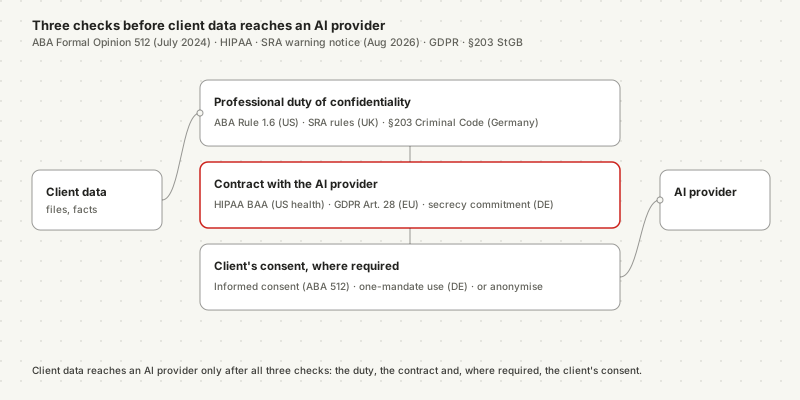
The contract has to give the protection your rules require, and the requirement differs by place. US lawyers have no set contract form, but Formal Opinion 512 makes them responsible for knowing how a tool uses data.[2] A US medical practice needs a business associate agreement.[3] Any firm in the EU needs a processing agreement under Article 28 of the GDPR.[5] In Germany, lawyers and tax advisers also need a secrecy commitment in text form.[7][8]
| Where | What the AI provider must agree to | Source |
|---|---|---|
| US law firm | Terms that keep input confidential and out of training; no set form | ABA Formal Opinion 512[2] |
| US medical practice | A business associate agreement before it handles patient data | HIPAA, 45 CFR 164.502(e)[3] |
| UK law firm | Contractual, technical and organisational safeguards; no training without authorisation | SRA warning notice[4] |
| EU firm | A processing agreement under Article 28 of the GDPR | GDPR[5] |
| Germany: lawyers, tax advisers, doctors | The processing agreement plus a secrecy commitment in text form | §203 StGB, §43e BRAO, §62a StBerG[6][7][8] |
Germany's rules are the most specific. Section 43e of the Federal Lawyers' Act (BRAO) and §62a of the Tax Advisers Act (StBerG) allow a provider access to client secrets only with a contract in text form that binds it to secrecy, warns it of the criminal consequences of a breach, limits its access to what the service needs, and says whether it may use subcontractors, who must be bound in the same way.[7][8] The work must stop at once if the conditions are no longer met.[7][8]
Large AI providers rarely negotiate individual contracts with small firms. Ask in writing whether the provider offers the terms your rules require, such as a business associate agreement or a secrecy commitment, and keep the answer with your records. Germany's Federal Chamber of Tax Advisers notes that concluding such a contract with a provider, where it is possible at all, can be complicated and time-consuming.[10]
What about AI providers in another country?
Where the provider processes data abroad, many rules add a test. Germany's §43e(4) BRAO and §62a(4) StBerG require that the protection of secrets abroad be comparable to the protection in Germany.[7][8] The German Federal Bar noted in December 2024 that most AI providers are based in the United States, and recommends preferring providers with servers in Germany or Europe where possible.[9] US tax preparers need the taxpayer's consent before return information goes to a preparer outside the country.[12]
For EU firms, the GDPR's rules on transfers outside the EU apply on top, in its Chapter V.[5] For US firms, the question is mostly contractual: where the provider stores data, and whether its terms let it move data elsewhere.
Before signing up, ask the provider three questions:
- Where is the data processed and stored, and can that be limited to a region you choose?
- Who at the provider, and which subcontractors, can access it?
- Is input used to train models, and can that be excluded in the contract?
Our guides on Microsoft Copilot and the GDPR and which AI providers train on your data answer these questions for the most common tools.
When do you need the client's consent?
In the US, the ABA recommends a client's informed consent before client confidences go into a generative AI tool, and says a line in the engagement letter is not enough.[2] In Germany, consent is needed when the AI service serves one specific mandate directly rather than the firm's general working tools, under §43e(5) BRAO and §62a(5) StBerG.[7][8] Germany's Federal Chamber of Tax Advisers said in January 2026 that it is unclear whether using ChatGPT on a single mandate falls under that rule, and advises consent or anonymisation.[10]
The German distinction is between infrastructure and a case-specific helper. Email hosting, document management and a firm-wide AI assistant are part of the general set-up; an outside expert, a translator or a tool used for one client's matter serves that mandate directly.[10] The US recommendation draws no such line: what matters is that client confidences go into the tool.
Consent works only if it is real. The client should know which provider will see which data, for what purpose and where it is processed. A sentence buried in standard terms is weaker than a specific agreement for a specific use, and under Formal Opinion 512 it is not enough.[2]
Is removing names enough?
Often not. The GDPR treats data as personal as long as a person can be identified by "all the means reasonably likely to be used", so stripping names does not make a file anonymous if the context still points to someone.[5] Germany's Federal Bar said in December 2024 that removing names and addresses is regularly not enough when the mandate can be worked out from the context.[9] Its tax-adviser counterpart adds that every page of an uploaded document must be checked.[10]
Context identifies people more often than firms expect. A dispute about a specific property in a named small town, a company's unusual turnover figure, a rare medical history, a court date: each can point to one person even without a name.
A workable anonymisation routine has three steps:
- Strip the obvious. Names, addresses, dates of birth, tax, case and account numbers.
- Generalise the specific. "A mid-sized retailer in the Midwest" instead of the company; "a property worth around $1 million" instead of the address and price.
- Read it as an outsider. Could someone who knows the local market or the case work out who this is? If yes, generalise further, or do not use the tool.
Where a task cannot be done without identifying data, such as reviewing the client's actual contract, anonymising does not help. That task needs a provider under the right contract, or the client's consent.
Free account, business account or custom AI?
For confidential work, the account type decides most of the risk. Germany's Federal Chamber of Tax Advisers said in January 2026 that free versions often use input for training, while business accounts can exclude training by agreement.[10] The SRA's notice of August 2026 says both free and paid tools may pose risks, so a paid plan is a starting point, not an answer.[4]
| Option | Training on input | Contract terms | Fit for client data |
|---|---|---|---|
| Free consumer account | Often used for training[10] | Consumer terms only | No: abstract, anonymised prompts only |
| Business or team account | Can be excluded by agreement[10] | Business terms; a business associate agreement or secrecy commitment only if the provider signs one | Only with the right contract or the client's consent |
| Custom AI on infrastructure you choose | Under your control | Part of the build contract | Yes, if the contract and hosting meet the rules where you practise |
Business accounts are the usual starting point. Our page on ChatGPT and the GDPR shows which ChatGPT plans come with a processing agreement and what they do with your data.
A custom agent is the route when the AI must work with real client files every day. It can run in the region you choose, read only the folders a task needs, and have the confidentiality terms written into the build contract from the start.
Do you have to tell clients you use AI?
Whether you must tell clients depends on the place and the use. Formal Opinion 512 gives US lawyers guidance on when, and how far, they must tell clients about generative AI, and its informed-consent recommendation applies whenever client confidences go into a tool.[2] Germany's Federal Bar said in December 2024 that neither its lawyers' act nor the professional rules impose a general duty to inform clients about AI use.[9]
The responsibility for the result does not move to the tool anywhere. The SRA says the use of AI "does not diminish or transfer" professional responsibilities.[4] The German Federal Bar requires the lawyer's own review and final check of AI output, and the Federal Chamber of Tax Advisers warns that AI tools can invent sources and rules that do not exist.[9][10]
Many firms choose to be open anyway. A short paragraph in the engagement letter on which tools are used, for what and under which safeguards answers the question before a client asks it. In the US, it does not replace informed consent where client confidences go into the tool.[2]
What should a firm set up before staff use AI?
A firm needs a written AI policy before anyone uses AI on client work: which tools are approved, what may be entered and who checks the output. The SRA's August 2026 notice expects safeguards to be in place before any tool sees client data, and Germany's Federal Chamber of Tax Advisers recommends defining which data and which applications are allowed.[4][10] These five steps turn the rules above into a routine.
Approve the tools
Put the contracts in place
Set the data rule
Decide on consent
Check and train
The one-page checklist holds the contract terms by place, the consent rule, the anonymisation check and these five steps: Download the client confidentiality and AI checklist (PDF).
Frequently asked questions
Can lawyers use ChatGPT with client data? Only with safeguards and, in the US, usually the client's informed consent. ABA Formal Opinion 512 of July 2024 recommends informed consent before client confidences go into a generative AI tool and says boilerplate consent in an engagement letter is not adequate. In the UK, the Solicitors Regulation Authority warned in August 2026 that client data belongs only in AI systems with appropriate contractual, technical and organisational safeguards.
Can a medical practice use AI with patient data? In the US, only once the provider has signed a business associate agreement: HIPAA lets a covered entity share protected health information with a provider that handles it on its behalf only after written assurances that the provider will safeguard it. In the EU, patient data is health data under Article 9 of the GDPR and the provider needs a processing agreement; in Germany it must also be bound to professional secrecy.
Is a GDPR processing agreement enough for professional secrecy? Not in Germany. A processing agreement under Article 28 of the GDPR covers data protection. Professional secrecy under §203 of the German Criminal Code is a separate duty: the provider must also be bound to secrecy in text form, with a warning about the criminal consequences, as the codes for lawyers (§43e BRAO) and tax advisers (§62a StBerG) require.
Do I have to tell clients that I use AI? It depends on the place and the use. ABA Formal Opinion 512 gives US lawyers guidance on when they must tell clients about generative AI, and its consent recommendation applies whenever client confidences go into a tool. Germany's Federal Bar says lawyers have no general duty to inform clients about AI use, but using a provider for one specific mandate can require the client's consent.
Notes
- American Bar Association, ABA issues first guidance on a lawyer's use of AI tools, July 29, 2024, accessed October 15, 2026. Announces ABA Formal Opinion 512, "Generative Artificial Intelligence Tools".
- American Bar Association, Business Law Today, ABA Ethics Opinion on Generative AI Offers Useful Framework, October 2024, accessed October 15, 2026. Used for the opinion's confidentiality recommendation, the boilerplate-consent point, the risk from shared tools, competence and communication, and its non-binding status.
- 45 CFR § 164.502, Uses and disclosures of protected health information, paragraph (e), Legal Information Institute, accessed October 15, 2026.
- Solicitors Regulation Authority, Misuse of AI: warning notice, August 17, 2026, accessed October 15, 2026.
- Regulation (EU) 2016/679 (GDPR), Recital 26, Articles 9 and 28, and Chapter V, accessed October 15, 2026.
- Strafgesetzbuch (StGB), § 203 Verletzung von Privatgeheimnissen, accessed October 15, 2026.
- Bundesrechtsanwaltsordnung (BRAO), § 43e Inanspruchnahme von Dienstleistungen, accessed October 15, 2026.
- Steuerberatungsgesetz (StBerG), § 62a Inanspruchnahme von Dienstleistungen, accessed October 15, 2026.
- Bundesrechtsanwaltskammer, Hinweise zum Einsatz von künstlicher Intelligenz (KI), December 2024, accessed October 15, 2026. Used for the possibility-of-access test, anonymisation, providers abroad, transparency towards clients and the final check of output.
- Bundessteuerberaterkammer, FAQ: KI im steuerberatenden Berufsstand, January 27, 2026 (legal position July 2025), accessed October 15, 2026. Used for training on free and business accounts, the contract route, the open consent question, anonymisation, invented sources and firm policies.
- 26 U.S.C. § 7216, Disclosure or use of information by preparers of returns, Legal Information Institute, accessed October 15, 2026.
- 26 CFR § 301.7216-2, Permissible disclosures or uses without consent of the taxpayer, paragraphs (c) and (d), Legal Information Institute, accessed October 15, 2026.