For small businesses in the US and Europe thinking about letting an AI answer the phone, this guide sets out what it costs, which calls it handles badly, what the greeting has to say, and how practices, trades and property managers should set it up.
What you'll learn
- What subscription services in the US and Europe and build-it-yourself platforms charge, per minute and per call
- How to work out the monthly cost from your own call numbers
- Which calls AI phone assistants get wrong, and how a call should reach a person
- What medical practices, trades and property managers need to set up first
- What the AI Act and US and German recording laws require in the first sentence of a call
- Whether to buy a service, build one yourself or have one built, and how to test it
An AI phone assistant answers your calls in a natural voice, and the minutes are cheap: in October 2026, build-it-yourself platforms charged from about $0.07 a minute, European subscriptions about €0.08 to €0.15, and a US AI receptionist service about $2 a call. The price list is not where the decision is made. McDonald's switched off AI order-taking in more than 100 US restaurants in 2024 with accuracy reported in the low-to-mid 80% range. In the EU, the AI Act now requires callers to be told they are talking to an AI, and recording a call can need every caller's consent, in California as in Germany. This guide sets out the prices, a way to work out your own monthly cost, the calls these assistants get wrong, what medical practices, trades and property managers need to set up, what the first sentence of the call must say, and a test to run before customers call.
An AI phone assistant answers your business line in a natural voice. It listens to the caller, works out what they want, and then answers a question, takes a message, books an appointment or puts the call through to a person. Vendors also call it an AI receptionist or a voice agent.
The minutes are cheap. The calls it gets wrong are not. This guide covers the prices providers in the US and Europe publish, how to work out your own monthly bill, where these assistants fail, how practices, trades and property managers should set one up, what the law requires of the greeting, and a test to run before a customer hears it.
What does an AI phone assistant cost?
As of October 2026, an AI phone assistant costs from about $0.07 a minute on a build-it-yourself platform, before anyone has built it, and roughly €0.08 to €0.15 a minute on a European subscription. Smith.ai's US AI receptionist charged per call: $150 a month for 75 calls, about $2 a call.[20] In Germany, fonio charged €99 a month, before VAT and billed annually, for 1,000 minutes, and IONOS €39 a month including VAT for 30 calls, or €99 for all calls.[1][2]
Prices fall into four models. A subscription service sells a finished assistant with a monthly bundle of minutes. Some providers bundle calls rather than minutes. A build-it-yourself platform charges per minute for each part of the call, and someone has to build the assistant on it. Microsoft bills voice in its own currency, Copilot Credits.
| Model | Example | Published price | Per minute or call |
|---|---|---|---|
| Subscription, minutes | fonio Solo (Germany) | €99/month for 1,000 minutes, annual billing, before VAT; €15 per 100 extra minutes[1] | about €0.10 a minute; extra minutes €0.15 |
| Subscription, minutes | fonio Team (Germany) | €299/month for 3,600 minutes, annual billing, before VAT[1] | about €0.08 a minute |
| Subscription, minutes | Placetel AI Grow (Germany) | from €69/month for 750 minutes; AI phone number €9/month[3] | about €0.09 a minute |
| Subscription, calls | Smith.ai AI Receptionist Pro (US) | $150/month for 75 calls, then $2.50 a call; month-to-month[20] | about $2 a call |
| Subscription, calls | IONOS Flex / Flex Pro (Germany) | €39/month for 30 calls, then €0.49 a call; €69/month for 100 calls, then €0.39 a call; including VAT[2] | €0.39–1.30 a call |
| Subscription, all calls | IONOS All-Flat Advanced (Germany) | €99/month including VAT, all calls included, cancellable monthly[2] | falls with every call |
| Build-it-yourself platform | Vapi | $0.05/min hosting plus speech, AI model and voice at cost; calculator: $82–129 for 1,000 minutes[4] | about $0.08–0.13 a minute |
| Build-it-yourself platform | Retell AI | $0.055/min voice infrastructure, $0.015/min telephony, AI model from $0.0016 to $0.32/min[5] | from about $0.07 a minute |
| Build-it-yourself platform | ElevenLabs Agents | $0.08/min for the agent speech pipeline[6] | from $0.08 a minute |
| Microsoft | Copilot Studio, GenAI Voice | 35 Copilot Credits per minute; credits $200 per 25,000 or $0.01 each pay-as-you-go[8][9] | $0.28–0.35 a minute |
The per-minute figures for the build platforms add up their published parts. The AI model moves the price most: Retell's list ran from a fraction of a cent to $0.32 a minute, depending on which model answers.[5] A cheaper model answers faster and costs less, but it handles unusual requests worse.
Watch the tax line when you compare European prices. fonio quotes prices before VAT and IONOS includes it, so fonio's €99 is €117.81 with 19% German VAT.[1][2] Placetel's price page does not say either way, so ask before you sign.[3]
Smaller items add up too. Retell charges $2 a month per phone number and includes 20 simultaneous calls, then charges $8 a month for each extra one.[5] Placetel adds €0.025 a minute when the assistant forwards a call to an internal extension and €0.05 a minute to an outside number.[3]
How do you work out the monthly cost for your calls?
Multiply your monthly calls by their average length, then by the price per minute or per call, and add set-up and the time someone spends checking calls. Say a business takes 400 calls a month averaging two and a half minutes. That is 1,000 minutes, which fits fonio's €99 Solo bundle exactly, or IONOS's €99 all-calls plan, while on Smith.ai's per-call pricing it is 400 calls.[1][2][20]
The same 400 calls cost different amounts on each model:
| 400 calls of 2.5 minutes a month | Monthly cost (October 2026 prices) |
|---|---|
| fonio Solo, 1,000 minutes included | €99 before VAT[1] |
| IONOS All-Flat Advanced, all calls | €99 including VAT[2] |
| IONOS Flex Pro, 100 calls + 300 at €0.39 | €186 including VAT[2] |
| IONOS Flex, 30 calls + 370 at €0.49 | €220.30 including VAT[2] |
| Smith.ai Enterprise, 300 calls + 100 at $2.17 | $717[20] |
| Placetel AI Professional, 1,500 minutes | from €129[3] |
| Vapi, calculator range for 1,000 minutes | $82–129[4] |
| Retell AI, cheapest model | about $72[5] |
| Copilot Studio GenAI Voice, pay-as-you-go | $350[8][9] |
Per-call and per-minute pricing reward different businesses. A practice whose calls last a minute pays less on per-minute pricing. A builder whose callers describe a leak for five minutes pays less per call. Work out your average call length before you choose a pricing model, not after.
Two numbers you already have decide most of the bill: calls per month and average minutes per call. Your phone provider's call log shows both. Count only the calls the assistant would take. Calls that go straight to a named person stay with that person.
Four costs sit outside the minutes:
- Set-up. Writing what the assistant may say, connecting the calendar, and recording a greeting. On a subscription this is hours. On a build platform it is a project. Our guide to what an AI agent implementation costs in Europe covers that side.
- Checking. Someone listens to a sample of calls each week, at least in the first months.
- Overflow. Minutes or calls above the bundle cost more. fonio charges €0.15 for each extra minute against about €0.10 inside the bundle.[1]
- Wrong calls. A missed booking or a wrong answer costs more than the minute it took. The next sections are about those.
What can an AI phone assistant handle on a call?
An AI phone assistant handles calls that follow a known pattern: answering a question your documents answer, taking a message, booking or moving an appointment, and putting the caller through to the right person. fonio, for example, lists calendar booking, live forwarding to staff, and call recording with automatic deletion.[1] IONOS sends an email summary of each call with the caller's name, callback number and reason.[2]
Each of those jobs needs something from you before it works:
- Answering questions needs a written list of what the assistant may say: opening hours, prices you publish, directions, what you do and do not offer. It answers from that list, not from what it guesses about your business.
- Taking messages needs a place for the message to land and a person who reads it the same day.
- Booking needs access to the calendar and rules for which slots it may offer. IONOS's top plan connects to Google Calendar, Outlook, Cal.com and Calendly.[2] A booking is the first thing the assistant does in your systems rather than in conversation.
- Forwarding needs a person to forward to, at the hours callers ring.
The written list does not need to be long, but it needs to be specific. For a hairdresser, it might read:
- Opening hours: Tuesday to Saturday, 9 a.m. to 6 p.m.; closed Sunday and Monday.
- Services and published prices: the price list from the website, word for word.
- Booking rules: colouring needs a 2-hour slot; new customers only on weekdays.
- Never: discounts, complaints, anything about an allergic reaction. These go to a person.
The "never" line matters most. It tells the assistant where its job ends.
Calls outside a pattern are where the next section starts: complaints, emergencies, a caller who wants to negotiate, a supplier with a question nobody wrote down.
Where does an AI phone assistant fail?
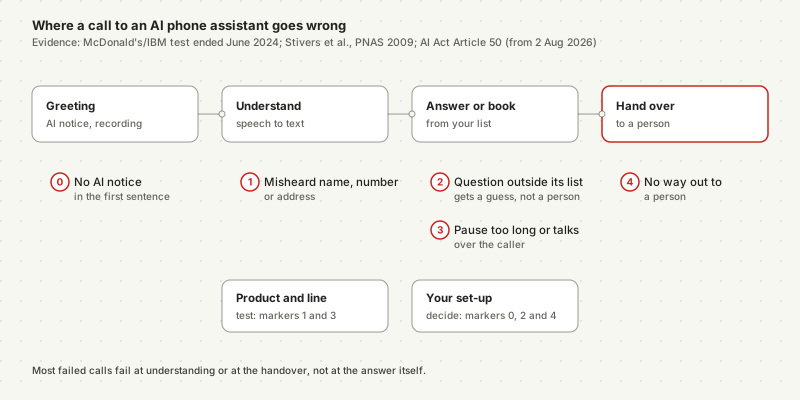
AI voice systems fail on accuracy, timing and calls nobody planned for. McDonald's ended its test of AI order-taking with IBM in more than 100 US restaurants by 26 July 2024, after an analyst reported accuracy "in the low-to-mid 80% range" and high operating costs.[10] A drive-through is not a phone line, but it is the largest public test of AI taking spoken requests.
Roughly one order in six going wrong was enough for McDonald's to switch the system off. The same analyst said the technology "will have to be at least 95% accurate".[10] McDonald's still said voice ordering "will be part of our restaurants' future".[10] The lesson is not that voice AI does not work. The lesson is that a public business noticed every wrong order.
McDonald's tested AI order-taking in more than 100 restaurants and switched it off in 2024. Cheap minutes do not help when roughly one order in six is wrong.
On a phone call, four failure points matter:
| Failure point | What happens on the call | Why |
|---|---|---|
| Names, numbers and addresses | A misheard digit or spelling becomes a wrong callback number or a booking under the wrong name | Speech is turned into text before the AI understands it, and errors at that step carry through |
| Timing | The assistant pauses too long or talks over the caller, and the caller hangs up or repeats themselves | Across 10 languages, people avoid overlapping talk and keep silence between turns short (PNAS, 2009)[11] |
| Calls outside its list | A complaint, an emergency or an unusual request gets a confident wrong answer instead of a person | The assistant answers from what it was given; anything else is a guess |
| No way out | The caller asks for a person and gets the assistant again | The handover has to be built and staffed |
The first two depend on the product and the line quality. Test them with your own callers' names and your own street names. The last two depend on you. Write down what the assistant may handle, and make "I'll put you through" the answer to everything else.
Speed is a vendor claim until you hear it. Retell advertises a response time of about 600 milliseconds.[5] Whether that holds on a mobile line with a busy kitchen in the background is something only a test call shows.
How should an AI phone assistant hand a call to a person?
A good handover gets the caller to a person, or gets a person back to the caller the same day, without making them repeat themselves. IONOS's assistant passes the caller's original number through when it forwards a call, and its plans include one, five or unlimited forwarding destinations depending on the tier.[2] The handover is the part of the set-up you design yourself.
Three routes cover most calls:
- Live transfer when someone is free. The person picking up should see who is calling and why. A transfer that arrives as an unknown number with no context is a cold call to your own staff.
- Callback list when nobody is free or the office is closed. The assistant takes the name, number and reason, and promises a callback window it can keep. Someone owns that list every morning.
- Emergency route for anything that cannot wait: a burst pipe, a gas smell, a patient in distress. The assistant does not try to solve it. It forwards to whoever is on call, or tells the caller which emergency number to ring.
Forwarding is not always free. Placetel adds €0.025 a minute for transfers to internal extensions and €0.05 a minute to outside numbers.[3] Check how many forwarding destinations your plan includes before you set up the on-call rota.
The summary decides whether the callback works. IONOS's email summary carries the caller's name, callback number and reason.[2] Add two things to whatever your service sends: how urgent the caller said it was, and anything the assistant promised, such as "someone will call you back today". A colleague who calls back without knowing what was promised starts on the wrong foot.
The words matter as much as the wiring. "I'll put you through to the team" works. "I can't help with that" ends the call. Every request the assistant cannot handle should end in a transfer, a callback promise or an emergency number, never in a dead end.
What should a medical practice check before an AI answers the phone?
A practice can let an AI take calls, but the provider must sign the contract the law requires before it hears a single patient. In the US, HIPAA lets a practice allow a provider to handle protected health information on its behalf only after written assurances that the provider will safeguard it, in a business associate agreement.[23] In the EU, health data is a special category under Article 9 of the GDPR, and the provider needs a processor contract under Article 28.[15]
Germany adds a criminal-law layer. Section 203 of the German Criminal Code lets doctors share patients' secrets with service providers only as far as the service requires, and makes the doctor liable if the provider was not obliged to secrecy, with a penalty of up to one year in prison or a fine.[14] The same section covers dentists, pharmacists, lawyers, notaries, auditors and tax advisers.[14] Our guide to client confidentiality and AI sets out those rules for each profession and place.
Keep the assistant's job narrow:
- Hand it: booking, moving and cancelling appointments; opening hours; directions; which documents to bring.
- Keep from it: symptoms, test results, medication questions. "I'll ask the practice team to call you back" is the right answer.
- Emergencies: for life-threatening cases, the caller must hear to ring 911 in the US or 112, the emergency number that works everywhere in the EU.[24] In Germany, the out-of-hours medical service is 116117, for illnesses that cannot wait until the next day.[16]
Before signing, ask the provider for four things in writing: the business associate agreement in the US, or the processor contract in the EU, plus the secrecy obligation in Germany; where calls are processed; whether recordings or transcripts are kept; and for how long. A lawyer or your professional body can check the wording against your situation.
How can a trade business use an AI phone assistant?
A trade business uses an AI phone assistant to catch calls while the team is on site. It takes the job details, books a visit, and puts urgent jobs straight through to whoever is on call. Calendar booking is a standard feature: IONOS's top plan connects to Google Calendar, Outlook, Cal.com and Calendly.[2]
Say a plumber is fitting a bathroom when a customer calls about a dripping tap. Without an assistant, the call goes to voicemail or interrupts the job. With one, the caller hears a clear greeting, describes the problem, gives their address, and is offered two visit slots next week. The plumber reads the summary at lunch.
The assistant should collect what a person needs to quote or plan the visit:
- the caller's name, number and address;
- the problem in the caller's own words;
- whether it is urgent, such as water running now or no heating in winter;
- access details, such as a key holder or parking.
Two things should stay with a person. Prices beyond the ones you publish: a quote commits your business, so the assistant takes the request and a person replies. And emergencies: a burst pipe goes straight to the on-call number, not into next week's calendar.
Per-call pricing suits trades with long calls. A caller describing a leak for five minutes costs the same per call as a one-minute booking on IONOS's call-based plans.[2] Check your average call length against both pricing models before choosing.
What should a property manager set up for an AI phone assistant?
A property manager needs the assistant to tell a routine repair from an emergency. It logs the routine report with the tenant's name, address and unit, and puts the emergency straight through to the on-call caretaker or tells the caller which emergency service to ring. If tenants ring in the evenings and at weekends, those are the hours an assistant covers, and IONOS's all-calls plan costs a flat €99 a month.[2]
Write the categories down before launch:
| Report | What the assistant does |
|---|---|
| Dripping tap, broken light, door that sticks | Logs it with name, address, unit and a callback number; confirms when someone will be in touch |
| Water coming through the ceiling, no heating in winter, locked out | Forwards to the on-call caretaker or emergency contractor |
| Smell of gas, fire, someone hurt | Tells the caller to leave the building if needed and ring the emergency number (911 in the US, 112 in the EU) or the gas supplier's emergency line; does not troubleshoot[24] |
| Rent, contracts, complaints about neighbours | Takes a message for the office |
The assistant's notes are tenant data. In the EU, tenants must be told who processes their data and why when they call, under Article 13 of the GDPR.[15] Keep the notes in the system your team already uses for repairs rather than in a separate inbox nobody checks.
Damage reports are where a phone assistant meets your other systems. When the assistant should open a ticket in your property software, assign a caretaker or send the tenant a confirmation, it is acting in your systems. That is the point where a custom agent fits better than a phone subscription, as the section on buying versus building sets out.
Can you build an AI phone assistant yourself?
Yes, with a voice platform and an automation tool, but you take on the building and the upkeep. As of October 2026, Vapi charged $0.05 a minute for hosting plus the speech, AI model and voice providers at cost, ElevenLabs listed its agent speech pipeline at $0.08 a minute, and n8n's cloud plans for connecting calendars and other systems started at €20 a month on annual billing.[4][6][7]
A self-built assistant has six parts:
| Part | What it does | Example |
|---|---|---|
| Phone number | Receives the call | A number from a carrier or the platform; Retell charges $2 a month[5] |
| Speech to text | Turns the caller's words into text | Deepgram on Vapi, $0.0095–0.0099 a minute[4] |
| AI model | Decides what to say and do | OpenAI models on Vapi, $0.0077–0.0452 a minute[4] |
| Voice | Speaks the answer | ElevenLabs on Vapi, $0.0146–0.0238 a minute[4] |
| Connections | Books the calendar, writes the CRM, sends the summary | n8n, from €20 a month in the cloud, or the self-hosted version on GitHub[7] |
| Monitoring | Records what happened and alerts someone when it fails | Built from the platform's logs |
The parts are cheap. The work is not. Someone writes the instructions, connects each system, tests the edge cases from this guide, and changes the set-up when a provider updates its models or prices. Our guide to what building AI agents in-house takes sets out that ownership.
Building it yourself makes sense when someone in the business enjoys this work and has the hours for it. If the assistant must not break during the week, budget for the person who keeps it running, not only for the minutes.
Is there a free AI phone assistant?
Mostly not. Smith.ai's US AI receptionist had a free plan in October 2026 with 25 calls a month, then $3 a call, which suits a business that takes about a call a day.[20] European providers offer trials instead: IONOS offered the first month free, fonio a 14-day trial, and Placetel AI a 10-day trial with 50 test minutes.[2][1][3] Build platforms give starter credit: Retell's is $10.[5]
A trial is the right time to run the test at the end of this guide. Thirty days at IONOS is enough to see a month of real call reasons. Ten days and 50 minutes at Placetel is enough for a structured test, not for live customer calls.
Check what happens when the trial ends. Smith.ai runs month to month with 30 days' notice, and IONOS's plans are cancellable monthly.[20][2] Placetel offers a monthly term and a 24-month term at different prices.[3] fonio's published prices assume annual billing.[1] Diary the end date before you start.
Can the AI on an iPhone or Samsung phone answer business calls?
Not in the way a business needs. Apple's Call Screening, announced for iOS 26 on 9 June 2025, gathers information from callers so the phone's owner can decide whether to pick up.[17] Samsung's Bixby Text Call lets the owner type a reply, which Bixby speaks to the caller.[18] Both help one person screen their own calls. Neither answers customer questions, books appointments or covers a team's shared number.
These features are worth switching on for a sole trader whose mobile is the business line. They filter unknown callers and let you reply while you are on a ladder. They stop there.
A business phone assistant does four things a phone feature does not:
- It answers for the business, not for one person. Callers reach a shared number, and the assistant works the same way whoever is on shift.
- It books and records. It writes appointments into the business calendar and sends a summary of each call to whoever needs it.
- It hands over. It forwards to colleagues or an on-call number, not only back to the phone in your pocket.
- It comes with a contract. A business service signs a data processing contract for the callers' data, or a business associate agreement for patient calls in the US, which a feature on your personal phone does not.
If your calls are mostly unknown numbers you want to filter, start with the feature on your phone. If customers need answers or appointments when you cannot pick up, you need a business assistant.
Must an AI phone assistant say it is an AI, and may it record?
In the EU it must say so, and everywhere a recording needs the consent the caller's location requires. Article 50 of the EU AI Act, which applies from 2 August 2026, requires AI systems that talk directly with people to be designed so that people are informed "from the start of the first interaction", in a "clear and distinguishable manner".[12] On recording, US federal law allows it when one party consents, but California requires the consent of all parties to a confidential call, and Germany's Criminal Code punishes recording without authorisation.[21][22][13]
Article 50 places the duty on the provider, which must design the system so people are informed. The European Commission's FAQ allows an exception only where it is obvious to a reasonably well-informed person that they are talking to an AI, and it reads that exception narrowly.[12] A voice that sounds human is the opposite of obvious. In practice, the business answering the phone makes sure the greeting does it, whoever built the system.
US federal law has no general rule requiring an AI that answers inbound calls to say so. The FCC's February 2024 ruling that AI-generated voices are "artificial" concerns calls a business makes, not calls it answers.[25] Saying it anyway costs one sentence and spares the moment a caller realises they were not talking to a person.
Recording is where the rules differ most. Under US federal law, one party's consent is enough, and the business is a party to the call.[21] California makes it an offence to record a confidential communication "without the consent of all parties", with fines of up to $2,500 per violation.[22] Germany's §201 punishes recording someone's non-public spoken words with up to three years in prison or a fine.[13] Callers ring from anywhere, so follow the strictest rule: if your assistant records, or keeps audio for quality checks, the greeting says so before the recording starts, and the caller can decline by pressing a key or asking for a person.
In the EU, the GDPR adds three duties. The caller must be told who processes their data and why, at the time it is collected (Article 13). The phone service is a processor and needs a written contract with you (Article 28). If callers talk about their health, that data is a special category under Article 9, with stricter conditions.[15]
The full privacy notice does not have to be read out. The transparency guidelines of the EU's data protection authorities, last revised on 11 April 2018, say that where the first contact is by telephone, the most important points can be given during the call and the rest sent afterwards by email or as a link to the online privacy notice.[19] The most important points are who you are, why you use the data, the caller's rights, and anything that would surprise them.[19]
For an AI phone assistant, that means a short notice in the greeting and a link afterwards. The greeting names your business, says that an AI is answering, what the caller's details are used for and where to find their rights. The confirmation by text message or email links to your full privacy notice.
A greeting that covers the rules can still be short: "Good morning, this is the digital assistant of [business name]. I am an AI. This call is not recorded, and we use your details only to handle your request; your rights are at [website]/privacy. How can I help you, or would you like me to put you through?" Our guide to what the EU AI Act asks of deployers covers the rest of the Act, and GDPR for AI agents covers data protection more broadly. For your own wording, a lawyer can confirm the details.
Should you buy a phone service or have one built?
A subscription service fits when the assistant answers, takes messages and books into a standard calendar. A build is worth it when the call has to act inside your own systems. As of October 2026, IONOS's €99 plan included calendar booking and unlimited forwarding, and fonio listed calendar booking and live forwarding among its features.[2][1]
| Your situation | What fits | Why |
|---|---|---|
| Missed calls, simple questions, bookings in a standard calendar | Subscription service | Ready in days; minutes or calls bundled; the vendor maintains it |
| Someone in-house wants to build and run it | Build-it-yourself platform | Lowest price per minute; you own the building and the upkeep |
| Calls that must check or update your own systems: an order, a ticket, a job sheet, a CRM record | Custom agent | The call becomes an action in your systems, with access designed per system |
| Anything that commits you: a price, a refund, a delivery date | Custom agent with approval | A person approves before the promise goes out |
| Your whole company runs on Microsoft 365 and staff already build agents there | Copilot Studio voice | Same tools, but billed per minute at a higher rate |
The line between them is whether the call ends in conversation or in an action. A subscription service talks and books. When the assistant should create a ticket in your system, look up an order or promise a delivery date, it is acting on your behalf. That needs access to each system scoped to the job, and a person approving the actions that commit you.
That is the job of a custom agent: built around your systems, with the phone as one way in. Businesses already on Microsoft 365 can also build voice agents in Copilot Studio. Our page on Copilot Studio pricing and limits sets out what that costs beyond the voice minutes.
How do you test an AI phone assistant before customers call?
Call it yourself with real requests, including ones it should refuse, before it answers a single customer. The free trial is the time to do it. These seven steps cover the failure points in this guide.
List your real call reasons
Spell names and numbers
Call from a noisy place
Ask what it must not answer
Ask for a person
Check the greeting
Listen to a weekly sample
The one-page checklist holds the cost line, the greeting, the handover routes and these seven steps: Download the AI phone assistant checklist (PDF).
Frequently asked questions
How much does an AI phone assistant cost per month? In October 2026, build-it-yourself platforms such as Vapi estimated $82 to $129 for 1,000 minutes, and Smith.ai's US AI receptionist charged $150 a month for 75 calls. In Germany, IONOS charged €39 a month for 30 calls or €99 for all calls including VAT, and fonio €99 a month for 1,000 minutes before VAT. Your cost is your monthly calls times their average length times the price, plus set-up and the time someone spends checking calls.
Does an AI phone assistant have to say it is an AI? In the EU, yes in most cases. Article 50 of the AI Act, which applies from 2 August 2026, requires AI systems that talk directly with people to be designed so people are informed from the start of the first interaction, and the European Commission reads the exception for obvious cases narrowly. US federal law has no general rule for an AI that answers inbound calls. The safe practice everywhere is to say it in the first sentence of the call.
Can an AI phone assistant record calls? Only with the consent the law requires where the caller is. US federal law allows recording when one party to the call consents, but California makes recording a confidential call without the consent of all parties an offence, and Germany's Criminal Code punishes recording without authorisation with up to three years in prison or a fine. If the service records or keeps audio, the greeting should say so and give the caller a way to decline.
Is an AI phone assistant allowed in a medical practice? Yes, with conditions. In the US, the provider must sign a business associate agreement under HIPAA before it handles patient information. In the EU, health data is a special category under Article 9 of the GDPR, and in Germany §203 of the Criminal Code also requires the provider to be bound to secrecy. Keep the assistant to appointments and practice information, send anything about symptoms to a person, and point life-threatening cases to 911 in the US or 112 in the EU.
Notes
- fonio.ai, Preise (KI-Telefonassistent) and free trial page, accessed October 15, 2026. Used for the Solo, Team and Scale prices, included minutes, extra-minute price, VAT and billing terms, listed features, and the 14-day trial.
- IONOS, KI Telefonassistent, accessed October 15, 2026. Used for the Flex, Flex Pro and All-Flat Advanced prices including VAT, included calls, per-call prices, forwarding destinations, calendar connections, email summaries, caller-number pass-through, monthly cancellation and the free first month.
- Placetel, Placetel AI Preise, accessed October 15, 2026. Used for the Grow, Professional and Enterprise prices and minutes, contract terms, the AI phone number fee, forwarding surcharges and the 10-day trial.
- Vapi, Pricing, accessed October 15, 2026. Used for the hosting fee, pass-through component rates, carrier rates and the 1,000-minute calculator estimate.
- Retell AI, Pricing and home page, accessed October 15, 2026. Used for voice infrastructure, telephony, model and phone-number prices, concurrency, starter credit and the advertised response time.
- ElevenLabs, API pricing, accessed October 15, 2026. Used for the per-minute price of the agent speech pipeline.
- n8n, Pricing, accessed October 15, 2026. Used for the Starter plan price on annual billing and the self-hosted version.
- Microsoft Learn, Billing rates and management (Copilot Studio), updated October 1, 2026, accessed October 15, 2026. Used for the voice rates in Copilot Credits per minute.
- Microsoft, Copilot Studio pricing and Microsoft Learn, Pay-as-you-go meters, October 14, 2026, accessed October 15, 2026. Used for the credit pack price and the pay-as-you-go rate.
- NBC News (CNBC), McDonald's to end AI drive-thru test with IBM, Kate Rogers, June 17, 2024, accessed October 15, 2026.
- Stivers et al., Universals and cultural variation in turn-taking in conversation, Proceedings of the National Academy of Sciences 106(26), June 2009, accessed October 15, 2026.
- European Commission, Transparency obligations under Article 50 AI Act (FAQ), last updated July 24, 2026, accessed October 15, 2026.
- Strafgesetzbuch, § 201 Verletzung der Vertraulichkeit des Wortes, accessed October 15, 2026.
- Strafgesetzbuch, § 203 Verletzung von Privatgeheimnissen, accessed October 15, 2026. Used for the professions covered, disclosure to service providers (paragraph 3), the duty to oblige them to secrecy (paragraph 4) and the penalty.
- Regulation (EU) 2016/679 (GDPR), Articles 9, 13 and 28, accessed October 15, 2026.
- 116117, Ärztlicher Bereitschaftsdienst, accessed October 15, 2026. Used for the out-of-hours medical service and the instruction to call 112 in life-threatening cases.
- Apple Newsroom, Apple elevates the iPhone experience with iOS 26, June 9, 2025, accessed October 15, 2026. Used for Call Screening.
- Samsung Mobile Press, Samsung Announces Enhancement of Bixby, February 22, 2023, accessed October 15, 2026. Used for Bixby Text Call.
- Article 29 Working Party, Guidelines on transparency under Regulation 2016/679 (WP260 rev.01), adopted November 29, 2017, last revised April 11, 2018, paragraph 38, accessed October 15, 2026.
- Smith.ai, AI Receptionist pricing, accessed October 15, 2026. Used for the Free, Pro and Enterprise plans, included calls, per-call and overage prices, and the month-to-month terms.
- 18 U.S.C. § 2511, Interception and disclosure of wire, oral, or electronic communications prohibited, subsection (2)(d), Legal Information Institute, accessed October 15, 2026.
- California Penal Code, § 632, accessed October 15, 2026.
- 45 CFR § 164.502, Uses and disclosures of protected health information, paragraph (e), Legal Information Institute, accessed October 15, 2026.
- European Commission, 112: the European emergency number, last updated June 23, 2026, accessed October 15, 2026.
- Federal Communications Commission, FCC Makes AI-Generated Voices in Robocalls Illegal, news release, February 8, 2024, accessed October 15, 2026.